
Daily insights for city builders, delivered every morning at 6 AM ET. I’m Brandon Donnelly — a Toronto-based real estate developer and founder of Globizen. I’ve been writing here since 2013.

Homes per acre

I spent three years living in Philadelphia for grad school and one of the things that I appreciated the most was its walkability. I walked and took transit everywhere. Much of this has to do with the grid system that was laid out for the city in the 17th century. But there are also lots of more recent developments that help to reinforce this fabric.

CityLab, for example, just published this article on Penn’s Landing Square, which is a housing complex in Philadelphia’s Society Hill neighborhood. Built in 1970 and designed by Canadian-American architect Louis Sauer, the modernist complex occupies an entire 2.37-acre block and contains an assortment of 118 low-rise homes, many of which are connected through small interior laneways.
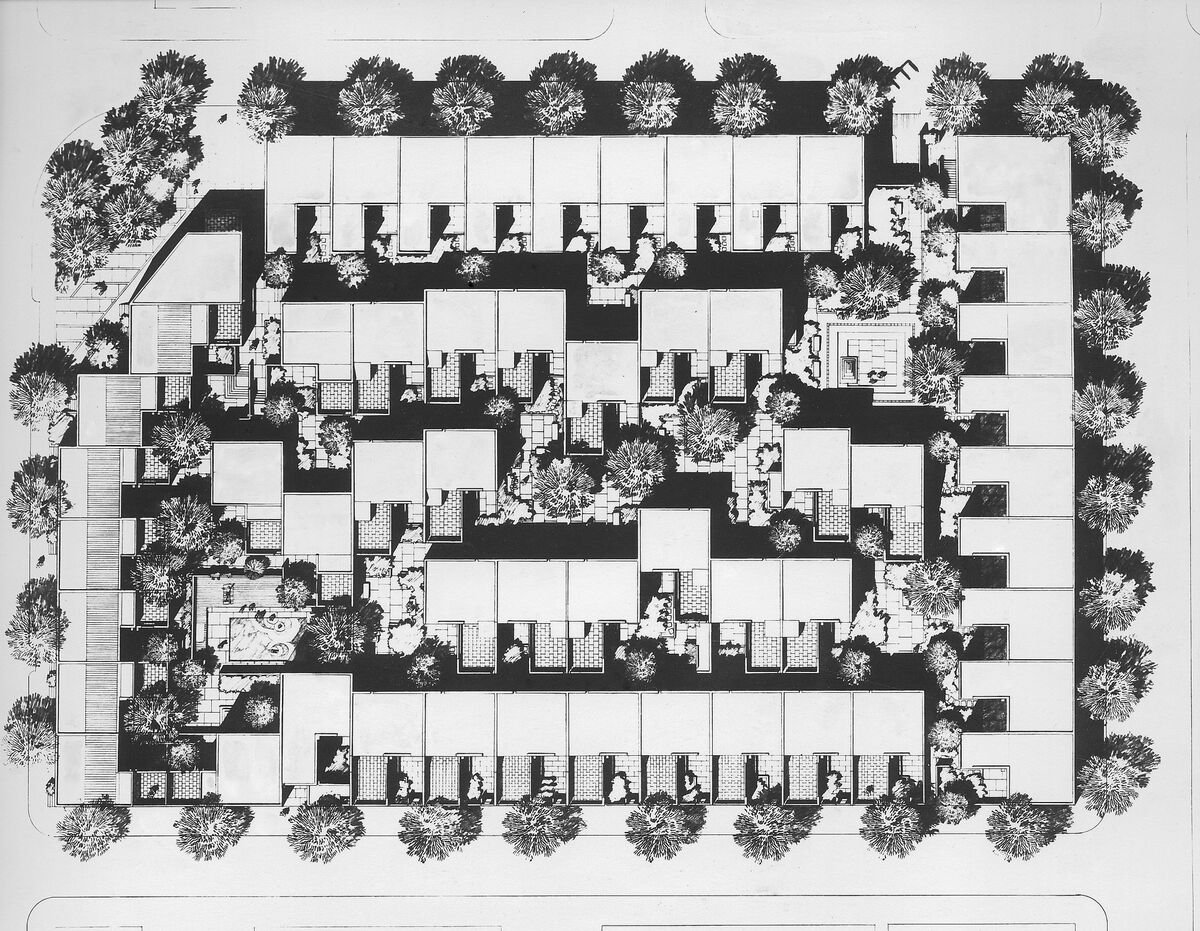
Here’s the site plan:

In addition to its handsome architecture, what is noteworthy about Penn’s Landing Square is that its site plan makes it quite a dense low-rise development. At 118 homes, this translates into just under 50 units per acre. CityLab estimates that this means the development holds about 174 people per acre (~412 people total), which would make it more dense than Stuyvesant Town in New York (~158 persons per acre).

However, this is based on the assumption that there are almost 3.5 people living in each of these homes. While generally large, I don’t know if this is the case. It would be higher than the average US household size. But regardless, from a unit per acre standpoint, it remains a great example of dense, family-oriented, and grade-related housing.

For fun, let’s compare this to a more intense form of infill development. Our Junction House project, for instance, contains 151 homes and sits on a 0.48-acre piece of land. This translates into about 315 units per acre. I don’t know off hand the average number of occupants per household, but I reckon that, given our larger average suite size, we should be on the higher end compared to most mid-rise condominiums. So I would say that we are probably 400+ people per acre.

It’s unfair to compare a single development to an entire neighborhood, such as Stuyvesant Town. Circulation and other open spaces will necessarily pull down your average density. But these individual development examples do speak for themselves. There are many parts of North America where you might find 1 home or a handful of homes per acre of land. At Penn’s Landing Square, this number is 50 units per acre. And at Junction House, it’s 315 units per acre.

One response to “Homes per acre”

  1. Scott Baker Avatar
    Scott Baker

    NYC is the most dense city in the United States, in addition to being, by far, the largest.

    Yet, there are always ways to squeeze even more people into a given space – we tend to think in terms of square feet instead of acres, because even a tenth of an acre is more than many tall skinny buildings sit upon.

    I tried to develop on a 19 acre site, split between two sites, on the opposite sides of the East River. It would have had 7,630 units and at 2.5 person per unit – the average of the two zip codes the building would occupy – that comes to 19,100 people, in the world’s largest building, by floor area, nearly 25m sf, including 300k of outdoor spaces. Unlike the glut of high end super-talls, many of which remain unoccupied by their multi-apartment owning multi-millionaires, and a lot that remain unsold for months or even years, the RiverArch would have had 30% affordable Condos at 60% Area Median Income (AMI). The average 2BR would have been 1,602sf. The building would have been for working class to wealthy class – because it HAD to be, to sell all the units. However, the NYC Housing, Preservation and Development department (HPD) told my partner and me that was too large to qualify for the usual housing subsidies for affordable units. It was hard to split the building into more units because of the long lease-spans – up to 100′ for some units on some floors, and the lack of light and air for all major rooms required here (the units had dens in place of bedrooms in most units, to get around that requirement for bedrooms). Large apartments are discouraged in space-challenged New York City, even where possible!

    I think, even more than density challenges, are demographic challenges. I was told, or strongly hinted by, many developers with decades of experience in NYC, that you can’t mix all kinds of people in one building. Way back in 2018, one of the earliest developers I met said “Don’t try to build something for everyone.” The political fractionalization and division has only intensified and proven him right since then. Any developer in a major urban area who doesn’t worry about politics and demographics is bound to fail.

    After years of asking, we finally heard back from the utility on the Brooklyn side in 2023, that they had decided to replace their decommissioned steam plant with a clean energy hub and were retaining the pier we would have needed for the Brooklyn half of the location, so that was the end of the quest.

    You can search for The RiverArch on Youtube (>10,000 views so far), with links to the investor’s summary & media coverage, etc.

Leave a Reply

Your email address will not be published. Required fields are marked *