Daily insights for city builders, delivered every morning at 6 AM ET. I’m Brandon Donnelly — a Toronto-based real estate developer and founder of Globizen. I’ve been writing here since 2013.

Tag: land

  • Homes per acre

    I spent three years living in Philadelphia for grad school and one of the things that I appreciated the most was its walkability. I walked and took transit everywhere. Much of this has to do with the grid system that was laid out for the city in the 17th century. But there are also lots of more recent developments that help to reinforce this fabric.

    CityLab, for example, just published this article on Penn’s Landing Square, which is a housing complex in Philadelphia’s Society Hill neighborhood. Built in 1970 and designed by Canadian-American architect Louis Sauer, the modernist complex occupies an entire 2.37-acre block and contains an assortment of 118 low-rise homes, many of which are connected through small interior laneways.
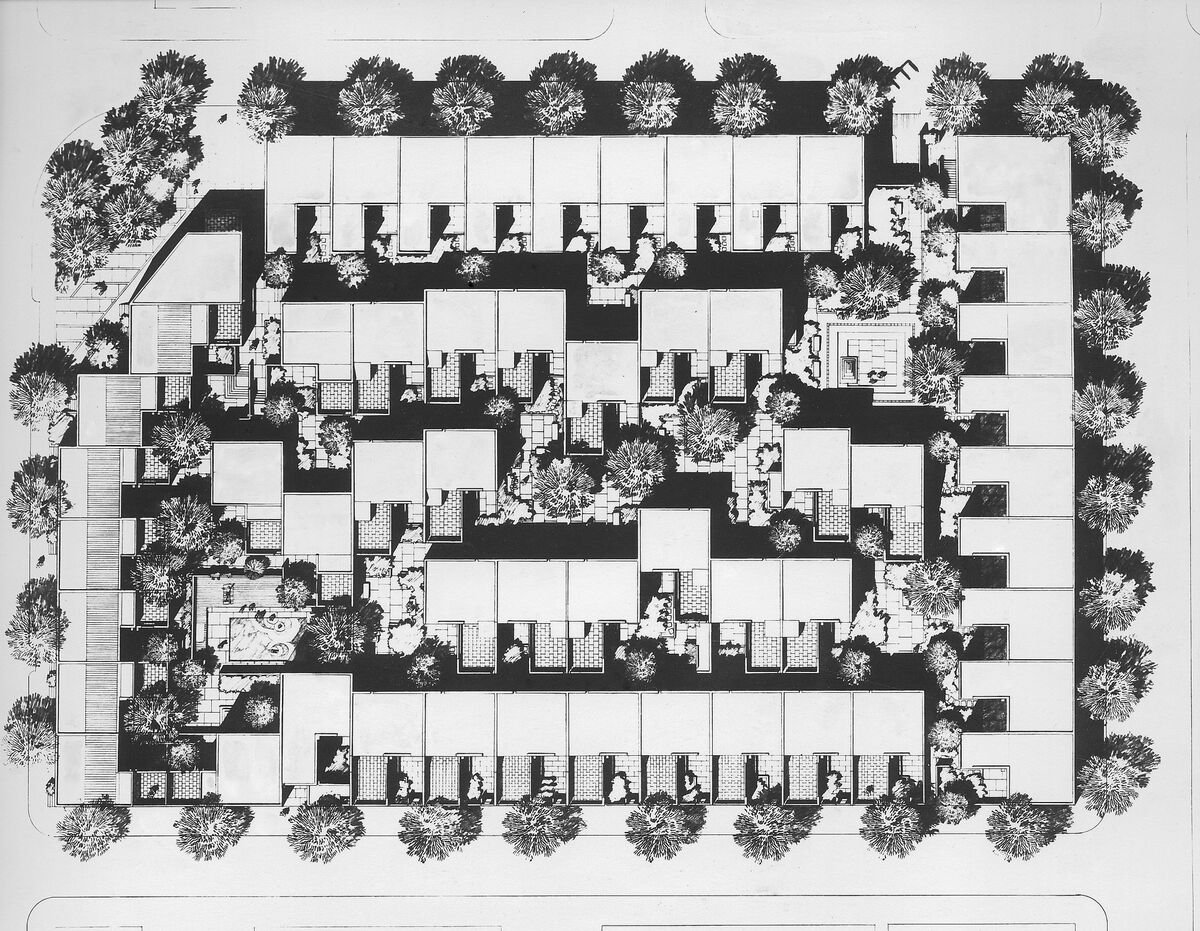
    Here’s the site plan:

    In addition to its handsome architecture, what is noteworthy about Penn’s Landing Square is that its site plan makes it quite a dense low-rise development. At 118 homes, this translates into just under 50 units per acre. CityLab estimates that this means the development holds about 174 people per acre (~412 people total), which would make it more dense than Stuyvesant Town in New York (~158 persons per acre).

    However, this is based on the assumption that there are almost 3.5 people living in each of these homes. While generally large, I don’t know if this is the case. It would be higher than the average US household size. But regardless, from a unit per acre standpoint, it remains a great example of dense, family-oriented, and grade-related housing.

    For fun, let’s compare this to a more intense form of infill development. Our Junction House project, for instance, contains 151 homes and sits on a 0.48-acre piece of land. This translates into about 315 units per acre. I don’t know off hand the average number of occupants per household, but I reckon that, given our larger average suite size, we should be on the higher end compared to most mid-rise condominiums. So I would say that we are probably 400+ people per acre.

    It’s unfair to compare a single development to an entire neighborhood, such as Stuyvesant Town. Circulation and other open spaces will necessarily pull down your average density. But these individual development examples do speak for themselves. There are many parts of North America where you might find 1 home or a handful of homes per acre of land. At Penn’s Landing Square, this number is 50 units per acre. And at Junction House, it’s 315 units per acre.

  • Land and improvements

    At a high level there are two components to the value of a house. There’s the value of the land and there’s the value of all the improvements. That is, the bricks, wood, and other stuff that form the actual house. When a media outlet runs a sensational headline about some shack in Toronto selling for, oh I don’t know, a million dollars, what it actually means is that the land in this particular area was just valued by somebody at this number. In fact, if the property is very clearly a “knock down” the improvements sitting on the land become a liability/cost rather than anything of value. Because whoever buys the land will almost certainly need to remove the improvements before they can build whatever it is they want to build.

    This distinction between land and improvements is a valuable one for many reasons. Here’s one example. In cases where the improvements aren’t some shack, you may be faced with a scenario where a property can be valued in two different ways. You can value it based on the development potential of the underlying land or you can value it based on the income (either in-place or potential) that the improvements are generating, or could be generating with some hard work on your part. If the development value is greater than the value of the improvements, then there will be pressure to redevelop. Conversely, if the opposite is true, it is likely that not much will happen other than maybe capital expenditures applied to the existing building(s).

    Of course, you could also run into a scenario where there’s little development potential and there’s zero ability to invest in the existing improvements, either because the market rents are too low in the area or because they’re capped and/or controlled in some way. In this scenario, it’s likely that not much will happen other than the normal and expected depreciation of the improvements. Maybe one day the development/investment math will work. But in the interim, you probably won’t be seeing any of those sensational media headlines.

    Photo by Andre Gaulin on Unsplash

  • How America uses its land

    Last summer Bloomberg ran a visual essay on how America uses its land. In case some of you missed it, I thought I would share it here today.

    They started by breaking the country down into 6 main land uses. Each square represents about 250,000 acres.

    What likely won’t surprise any of you is that urban areas punch well above their weight:

    Even though urban areas make up just 3.6 percent of the total size of the 48 contiguous states, four in five Americans live, work and play there. With so much of the U.S. population in urban areas, it’s little surprise that these areas contribute an outsize amount to the economy. The 10 most productive metropolitan areas alone contributed to about 40 percent of U.S. GDP in 2016.

    Here’s a further breakdown of the map:

    There is a lot that is interesting here. Note that golf courses made the cut.

  • The Hess triangle

    A friend of mine recently shared this Twitter thread with me. It is by Chaz Hutton. I didn’t know who Chaz was before I read the thread. But I now know that he draws things, sometimes for the New Yorker.

    Chaz’s Twitter thread covers the history behind what was once believed to be the smallest plot of land in New York City. He also positions the story as the “perfect embodiment of New York’s attitude.” Guess what the means.

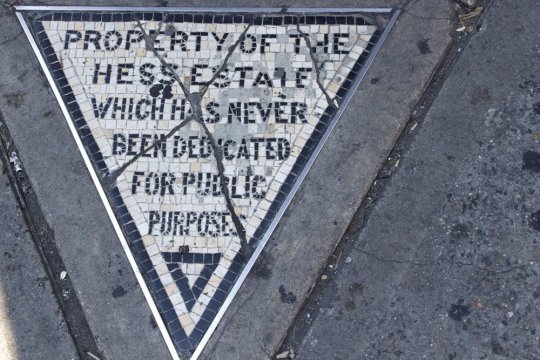
    The story is about the isosceles triangle pictured above, measuring 25-1/2″ at its base and 27-1/2″ along its sides. It is known as the Hess triangle and it reads: “Property of the Hess Estate which has never been dedicated for public purposes.“

    Click here for the full story.

    Image: Chaz Hutton

  • What’s Manhattan worth?

    I like looking at real estate values over longer periods of time because it helps to put things into perspective. 

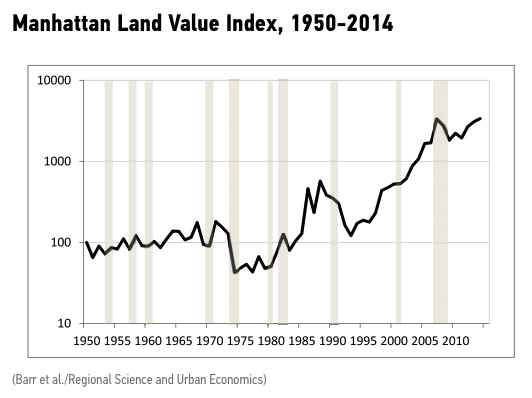
    Below is a land value index for Manhattan running from 1950 to 2014 that was recently created by economists out of Rutgers University.

    image

    The study was also cited in this recent article by Richard Florida.

    Here are some of the highlights from their study:

    We find three major cycles with land values reaching their nadir in 1977, just after the city’s fiscal crisis.

    Since 1993, land prices have risen much faster than population or employment, at an average annual rate of 15.8%.

    We estimate the entire amount of developable land on Manhattan in 2014 was worth approximately $1.74 trillion.

    We estimate the long run return to Manhattan land values [since the island was first inhabited by Dutch settlers in 1626] to be about 6.4%.

    What’s fascinating to me is the accelerated appreciation. The index starts at 100 in 1950, ends up slightly above that by 1993, and then simply takes off.

  • “I hate golf”

    I am a big fan of Malcolm Gladwell, and not just because he’s Canadian and went to the University of Toronto (my alma mater), although those facts certainly don’t hurt.

    I’m late to his podcast, Revisionist History, so in case some of you are as well, I would encourage you to check it out. Every episode reexamines something from the past and questions: Did we get it right the first time? It’s very Gladwell. It’s a must listen.

    The episodes span a secret research project setup by the Pentagon in downtown Saigon during the Vietnam War to why rich people are obsessed with the game of golf. Spoiler: He hates golf.

    The golf episode will be of particular interest to many of you because it deals with real estate. Malcolm wades into something known as California Proposition 13, which is a constitutional exemption that keeps property taxes artificially low.

    It is what has allowed these “vast, gorgeous, and private” golf courses to continue to exist in expensive cities like Los Angeles. Otherwise they would have long ago drowned under the property taxes following reassessment.

    This also leads to a philosophical debate about what constitutes a change in ownership, since many clubs are member owned and Proposition 13 requires that there not be a change in more than 50% of the ownership. 

    But I’ll stop there. Give it a listen. Malcolm is just excellent.

    Photo by Rémi Müller on Unsplash

  • Operating at the margins

    image

    I’ve been thinking about land markets as of late and so today I thought I would share a post by Toby Lloyd that I recently discovered called: Understanding and adapting the land market is key to solving our housing crisis (2014). It’s from the London School of Economics’ British Politics and Policy blog.

    His argument, as the title suggests, is that we need to dig deeper and look at how our land markets are functioning if we want to address some of the challenges facing our cities today.

    The post is obviously written from a UK perspective, but many of his points will probably ring true for a lot of you in the industry. One remark that stood out for me was his point about developers always operating at the margins:

    “The result of the land auction process is that the worst scheme, the one that offers the least to the community, the poorest quality homes, and charges the most for them, is generally the one that will happen, because this is the one that offers the most cash up front to the landowner. As a result, development is always already at the margins of viability. Even a relatively small shock can see construction grind to a halt rapidly, because there is simply not enough margin left after the landowner’s cut has come out for the developer to want to build.”

    When it comes to building, most people tend to think about the developer, the architect, and so on. But what I think many people overlook is that this entire process starts with a land input and a landowner. And the cost, availability and usability of that land input has a significant impact on everything that happens downstream.

  • Honduras is building a decentralized land registry system using the bitcoin blockchain

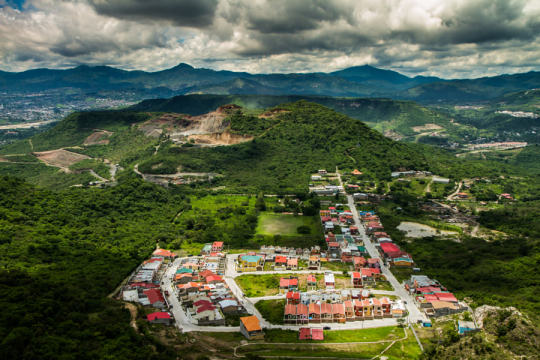
    Tegucigalpa by José López on 500px.com

    https://500px.com/embed.js

    I am very interested in bitcoin because of the underlying technology behind it – namely the blockchain. And that’s because it has the potential to be applied to and to disrupt many different industries and sectors, including real estate.

    That’s why I was fascinated to learn over the weekend that Honduras, with the help of a Texas-based company called Epigraph, is in the midst of building a permanent land title registry system based on the blockchain architecture.

    This is particularly important for Honduras because the country currently suffers from a significant amount of land fraud. And according to Reuters, 60% of land is actually undocumented. So the impact of a secure blockchain-based registry system could be transformational.

    Obviously the impetus for Honduras doing this is to fix the broken system that they currently have in place. But there’s no reason that it couldn’t also be done in the developed world to reduce transaction costs and improve overall transparency in the marketplace.

    Hopefully Honduras will show us how it is done.

    If you’re curious and would like to learn more about the blockchain, here’s a short primer. Once you’ve read that, you can then check out this post I wrote talking about how the blockchain could be applied to real estate.

  • When everyone thinks you’re wrong

    Sunset by Paolo Mastrogiacomo on 500px.com

    https://500px.com/embed.js

    I was recently talking to my good friend Jeremiah Shamess about the current state of development land sales in Toronto (he does this for a living) and he said something to me that I found really interesting.

    He said that because the market is so competitive, you can really only win development sites in one of two ways. Either you’re willing to spend the most money or you see something and have a vision that nobody else sees.

    And it was this second piece that really stood out to me because it reminds me of one of my favorite investing frameworks.

    Warren Buffet is famous for saying that you should be fearful when others are greedy and you should be greedy when others are fearful. And what I’m about to talk about is really that same core philosophy.

    Here’s how venture capitalist Fred Wilson put it (reiterating something that Bill Gurley said):

    I saw Bill Gurley say that you can only make money by being right about something that most people think is wrong. His logic was that you can’t make money by being wrong. And you can’t make money by being right about something everyone else knows. So you have to be right about something that most people think is wrong. I really like that framework.

    But this doesn’t just apply to technology companies or stocks. It applies to city building, most industries, and probably most things in life if you think about it.

    If all you’re doing are things that everyone else is doing, then how can you expect to outperform? You’re going to revert to the mean.

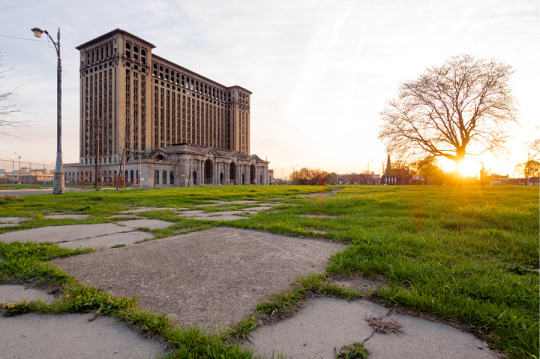
    Take, for example, billionaire Dan Gilbert and Detroit. Not everyone believes that Detroit will come back. In fact, I suspect there are probably more people who think it won’t come back, than people who think it will. Otherwise, it would already be back.

    But Gilbert is unquestionably long on Detroit (via Forbes):

    As you’ve likely heard, over the past four years Gilbert has become one of Detroit’s single-largest commercial landowners, renovating the city with the energy and impact of a modern-day Robert Moses, albeit bankrolled with his own money. He’s purchased and updated more than 60 properties downtown, at a total cost of $1.3 billion. He moved his own employees into many of them–12,000 in all, including 6,500 new hires–and cajoled other companies such as Chrysler, Microsoft and Twitter to follow.

    If/when Gilbert proves to be right about Detroit, then he will have been right about something that most people thought was wrong. And because of that, he will no doubt make a lot of money.

  • 3 risks that real estate developers face

    Photograph 'Jailhouse Rock' by Michael Hill on 500px

    ‘Jailhouse Rock’ by Michael Hill on 500px

    Real estate development is a risky game. So much so that some people in the business like to say that their primary function is to mitigate risk. 

    Today I’m going to focus on 3 risks that developers face. There are, of course, others risks, but these are some of the biggest. Some people might also categorize them differently, but this is my simplified way of thinking about it.

    The first risk is approvals. Oftentimes in development you need some sort of special permissions to build what you hope to build. These permissions come in many different forms, but whatever the case may be, there is risk associated with this part of the process. 

    What happens if you’re not able to build what you were hoping to build? Is the project still feasible? Do you have a viable plan B? Did you budget for a redesign? Have you now overpaid for the land? There’s a lot of uncertainty in this phase and uncertainty generally means risk.

    Assuming you’re able to obtain your entitlements (this is more of an American term), the next big risk factor is the market. Can you sell or lease out the space that you’re about to build and can you do it at the rates you were assuming when you acquired the site? 

    In a bull market this isn’t usually a problem. In fact, prices and rents may actually exceed your early assumptions. But what if you bought the site in 2006 and now it’s 2008 and you’re hoping to go to market. Now you might be in trouble. In business school I learned to do sensitivity analyses and stress tests. How far does the market need to drop before I lose my shirt? Those are good exercises to do in development.

    Assuming though that the market holds up and you’re able to pre-sell and/or pre-lease your new project and obtain financing, you would then be ready for construction – another big risk. This is why many developers bring construction in-house. It’s them trying to exercise more control over the process and mitigate risk.

    Construction is messy both literally and figuratively. There’s a lot to consider. 

    Are the drawings that you’re using to buy construction properly coordinated? Because if they’re not, you’re going to pay for it later. Is that Chinese curtain wall a great bargain or are you going to end up on a flight to China when it never shows up on your construction site? Are the trades hungry for work or are they busy? If it’s the latter, you’re going to get higher prices. And oftentimes there’s nothing you can do about it. You’re just buying construction at the wrong time.

    But we all know that with risk there’s reward. So if weren’t for all these risks, real estate development just wouldn’t be the same. 

    If you’re in the business, what keeps you up at night? Did I miss something? Let us all know in the comment section below.