Daily insights for city builders, delivered every morning at 6 AM ET. I’m Brandon Donnelly — a Toronto-based real estate developer and founder of Globizen. I’ve been writing here since 2013.

Tag: politics

  • Do you trust your government?

    This, it turns out, is an important question, because there’s a strong correlation between trust in government and overall prosperity (the above chart is via NZZ). The extreme examples of distrust are somewhat intuitive. If, for example, you don’t believe that your government will uphold property rights, why would you ever want to risk investing in property?

    But it can be even more subtle and insidious:

    Trust is central to both stability and development. If citizens have trust in their system, they will be more likely to push for growth-promoting reforms. Moreover, they will be more confident that politicians will actually implement such reforms, and that sacrifices made today will pay off in the future. If this trust is lost, democracies become unstable, and autocratic tendencies are more likely to prevail. However, trust is also important for the transition from an autocracy geared solely toward the extraction of resources and wealth into a progressive democracy. A politically dominant class that governs autocratically will make concessions voluntarily and refrain from repression only if it trusts that it too will benefit from the institutional changes over the long term, and that it will not later be deprived of all opportunities.

    All of this forms part of the work of economists Daron Acemoglu, Simon Johnson and James A. Robinson, who were awarded the Nobel Prize in Economics earlier this year. Their research explains why wealth is so unevenly distributed across the world. It’s a problem of institutions. But it’s also highly relevant to countries that are already rich.

    Distrust is on the rise in countries like the UK (57%), France, (51%), Germany (49%), and Italy (47%). The outliers among OECD countries are places like Luxembourg and Switzerland. Only 25% of Swiss people express distrust in the government. That’s a good thing for overall prosperity and it shows in their GDP. So how can we be more like the Swiss?

    Radical transparency when it comes to decision making and more of a direct democracy (versus a representative democracy) are two places to start, according to the research. People, it seems, trust their government more when they themselves make more of the decisions.

    Here’s the full NZZ article. It’s an illuminating read.
  • London’s clean air zone

    In 2019, London implemented something known as an Ultra-Low Emission Zone (or ULEZ). The intent was to reduce the number of older and higher-polluting vehicles entering and driving around the city.

    It works like this: If you have a vehicle that does not meet the ULEZ emission standards, you need to pay a daily charge of £12.50. This applies all day every day (except Christmas) and it is in addition to London’s congestion charge.

    It’s also done entirely through license plate cameras. If you enter the zone, don’t have an approved plate, and don’t pay the charge within a few days, you get sent a fine. The result is that London’s ULEZ is now the largest clean air zone in the world (at least according to London).

    It also achieved its intended purpose. In 2017, only 39% of cars entering London would have met the ULEZ emission standards. Today the number is over 95%. Meaning, most people don’t actually pay the charge.

    At the same time, nitrogen dioxide levels in the zone have more than halved, improving overall health outcomes. It’s a perfect example of taxing the things you want less of. What’s also interesting is that there were positive second-order consequences.

    Vehicle traffic as a whole declined by about 9% in the first year, with no evidence of displacement to other areas. And according to this research study, it actually encouraged more kids to walk and take other forms of “active transport” to and from school.

    Seems like a no brainer to me.

  • Rent control and road pricing — economics is the study of choice

    Yesterday’s post tried to pit politics against the realities of how we know cities and economics work. So today, I thought I would share a set of memos from Howard Marks (of Oaktree Capital) titled Economic Reality, Political Reality (which he refers to as an oxymoron), and Shall We Repeal the Laws of Economics?

    In this last one, he specifically talks about things like price gouging (starting with the grocery industry) and apartment rent controls. Each is worth a full read when you have the time, but here I’ll leave you all with a few city building-related thoughts.

    Marks describes economics as the study of choice. And within these choices, there are many complicated moving pieces and second-order consequences. Take, for example, rent control in New York City. What rent control does is stop the free market from being able to freely set rents. The result:

    A person in favor of this arrangement would argue that it maintains affordability and diversity. What it means in purely economic terms is that some people who couldn’t afford to live in New York City if rents were set by free-market forces are able to live there if they’re lucky enough to secure an apartment with regulated rent. But other people who would like to live in New York City and can afford higher rents can’t do so because there are no apartments for them. And lastly, landlords that have apartments that are somehow unregulated can command higher rents than would be the case if additions to the supply of apartments weren’t being discouraged. It’s a matter of personal philosophy whether this is good or bad. But clearly, the laws of economics and the actions of free markets aren’t at work in New York City. Someone in government is making the decisions.

    Much like inclusionary zoning in the case of new housing, the tradeoffs with regulated rents are that you get (1) less overall housing supply and (2) more expensive prices for the people that can pay market rents.

    You could argue, as Marks suggests, that these are acceptable outcomes; but regardless of your opinion, there are real consequences to this policy decision. There’s no such thing as a “free lunch” in economics, and consequently there’s no such thing as no-cost affordable housing. The question is: Who pays?

    Going back to the topic of traffic congestion from yesterday’s post, Toronto’s general reluctance to implement any form of road or congestion pricing is also an economic choice. We have priced our roads so cheaply that demand is always going to outstrip supply. And this is expected. What we are experiencing today is a natural market outcome.

    Targeting bike lanes as part of the problem is meant to counter this by increasing road supply. Less bike lanes means more space for cars, right? But the second-order consequence of this choice is that you push people off their bikes (which take up less road space) and into cars (which take up more road space). So demand is also likely to increase.

    The stark reality of solving traffic congestion is that it will require greater change. It will mean fewer people driving, more people taking transit and biking, and the people who do continue to drive will have to pay more for it.

    Of course, this is not what any politician wants to talk about. As Marks says: “In the world of politics, there can be limitless benefits and something for everyone. But in economics, there are only tradeoffs.” The tradeoff we have decided to make is cheap roads in exchange for crippling traffic congestion.

  • Homes per acre

    I spent three years living in Philadelphia for grad school and one of the things that I appreciated the most was its walkability. I walked and took transit everywhere. Much of this has to do with the grid system that was laid out for the city in the 17th century. But there are also lots of more recent developments that help to reinforce this fabric.

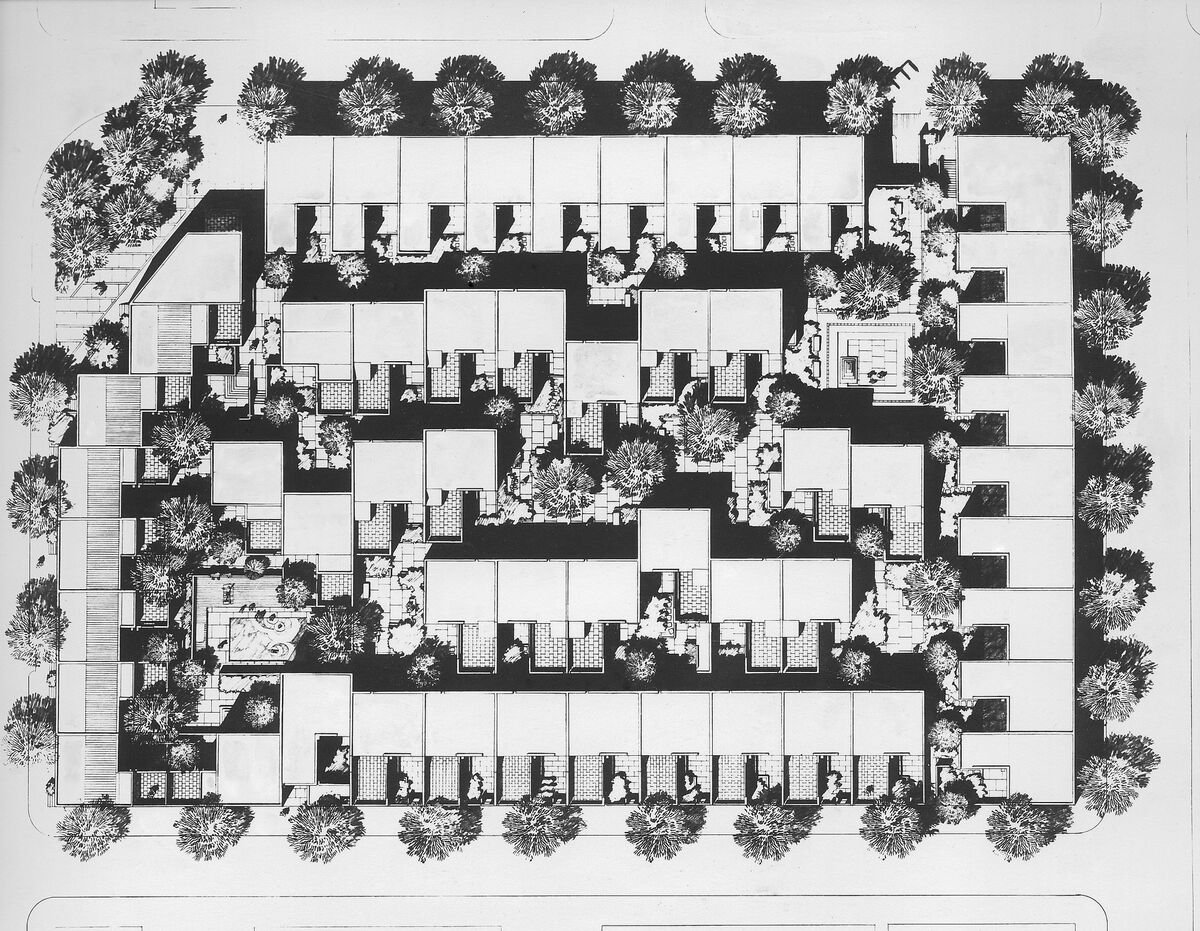
    CityLab, for example, just published this article on Penn’s Landing Square, which is a housing complex in Philadelphia’s Society Hill neighborhood. Built in 1970 and designed by Canadian-American architect Louis Sauer, the modernist complex occupies an entire 2.37-acre block and contains an assortment of 118 low-rise homes, many of which are connected through small interior laneways.

    Here’s the site plan:

    In addition to its handsome architecture, what is noteworthy about Penn’s Landing Square is that its site plan makes it quite a dense low-rise development. At 118 homes, this translates into just under 50 units per acre. CityLab estimates that this means the development holds about 174 people per acre (~412 people total), which would make it more dense than Stuyvesant Town in New York (~158 persons per acre).

    However, this is based on the assumption that there are almost 3.5 people living in each of these homes. While generally large, I don’t know if this is the case. It would be higher than the average US household size. But regardless, from a unit per acre standpoint, it remains a great example of dense, family-oriented, and grade-related housing.

    For fun, let’s compare this to a more intense form of infill development. Our Junction House project, for instance, contains 151 homes and sits on a 0.48-acre piece of land. This translates into about 315 units per acre. I don’t know off hand the average number of occupants per household, but I reckon that, given our larger average suite size, we should be on the higher end compared to most mid-rise condominiums. So I would say that we are probably 400+ people per acre.

    It’s unfair to compare a single development to an entire neighborhood, such as Stuyvesant Town. Circulation and other open spaces will necessarily pull down your average density. But these individual development examples do speak for themselves. There are many parts of North America where you might find 1 home or a handful of homes per acre of land. At Penn’s Landing Square, this number is 50 units per acre. And at Junction House, it’s 315 units per acre.

  • Population-weighted densities, compared

    Boy, population densities can be so misleading. The typical approach is to just take the number of people and divide it by a given area. This then gives you something like X number of “people per square kilometer.” The problem with this approach is that there are countless factors that can skew your result.

    Hong Kong, for instance, is really dense. But as a city, it also has a lot of green space, mountains, and other undeveloped areas. Only about a quarter of Hong Kong’s land is developed. So when you divide total people by its administrative boundary area, it is going to appear less dense than it really is.

    One alternative approach is to use a method known as population-weighted density. The way this works is that you take the average densities of smaller more granular subareas and then weight them by the population of each subarea. It is a little more complicated to calculate, but the overall intent is to try and capture a density figure that more accurately reflects what the average person experiences on the ground.

    And this is exactly the method that Jonathan Nolan decided to use in his new website CityDensity.com. What his site allows you to do is compare population-weighted densities across various cities, and then see how it tapers off as you move outward from their city centers.

    Once again, it is hard to beat Paris’ supremely dense mid-rise built form:

    Well, that is, until you check out Hong Kong:

    Charts: CityDensity.com

  • Does every real estate developer really do this?

    I am not a lawyer. Nothing I write on this blog should be construed as legal advice. In fact, it is highly questionable whether anything I write here should be construed as any sort of advice. Still, Trump’s fraud trial is an interesting one for us to discuss. The case, as I crudely understand it, accuses him of “inflating his net worth to dupe banks” and “issuing false financial statements every year between 2011 and 2021.” And possibly some other things, too.

    Now there are some people who are saying that there’s nothing actually wrong with the way Trump conducts his real estate practice. Kevin O’Leary, for instance, was just on CNN saying, “every real estate developer everywhere does this.” His position was that if you’re going to fault Trump, then you need to go after every developer out there. Here’s the video interview where he says this:

    Let’s break this down. Kevin is right in that people who own real estate ordinarily want it to be worth as much as possible. This is true for individual homeowners and it’s true for large real estate companies. And there are various reasons for this. One reason is that it maximizes your debt proceeds. For example, if you buy a building for $100 and the banks are willing to give you a loan based on a LTV (loan-to-value) of 70%, then you will get $70 in debt proceeds and you will need to put in $30 of your own cash equity.

    However, if you buy a building for $100 and it ends up being worth ~$143, then this same 70% LTV will result in $100 of debt proceeds. This means that you won’t need to put in any of your own cash and that, for all intents and purposes, you just got a building for “free.” By most metrics, this would be considered a good real estate deal. (Of course, you could also buy a building for $100 and have it be worth only $50. And this would be much less fun than getting free real estate.)

    One important question, though, is how does the building end up “being worth $143?” Well, one scenario could be that you just bought really well. It was an off-market transaction (i.e. it wasn’t formally listed), the seller was highly motivated, and so you negotiated a below-market purchase price. You then went out and hired a reputable third-party appraiser who did a bunch of rigorous research and issued you a report that said, “your building is worth $143.” And this would be perfectly fine.

    But one can also imagine ways in which someone could lie and do nefarious things to try and convince people that their building is worth $143, even if it clearly isn’t. Now, at the end of the day, I don’t know the facts of this case. So I can’t comment directly. But I did want to use this as an opportunity to add some nuance to Kevin’s claim that “every real estate developer everywhere does this.” Ultimately, that depends on what “this” is. Are we talking about doing customary things to maximize value creation? Or are we talking about fraud?

  • The politics of flooding

    Do you believe that human action has caused and is causing negative outcomes with respect to the environment?

    The New York Times published a feature piece this week on the flooding of the US east coast. 

    Associated with the article is a fantastic infographic that shows all of the NOAA (National Oceanic and Atmospheric Administration) tide gauges up and down the eastern seaboard. It then zooms in to a few locations and shows mean sea level rise (in inches) since 1950 and the number of days of “nuisance flooding.”

    Here’s a sample screenshot:

    If you don’t feel like reading the full article, at least check out the infographic. The increase in nuisance flooding for some cities – such as Wilmington, N.C. (shown above) and Annapolis, MD – is astounding.

    What’s frustrating about the whole climate change debate is that it remains not only a debate, but an ideological debate. Here’s a quote from the article that stood out for me:

    “I’m a Republican, but I also realize, by any objective analysis, the sea level is rising,” said Jason Buelterman, the mayor of tiny Tybee Island, one of the first Georgia communities to adopt a detailed climate plan.

    In other words: I’m not supposed to think this way, but I do.

    Politics.

  • The Scarborough Subway Extension is a mistake

    Last weekend over dinner, a friend of mine asked me what I thought about the Scarborough Subway Extension debate going on in Toronto right now. Costs are coming in higher than initially projected and the usual back and forth is taking place. Transit blogger Steve Munro has a good post on this called Spinning a Tale in Scarborough.

    I haven’t written much about the Scarborough Subway, but I do have a strong opinion. I believe it’s a mistake. I am not saying that we shouldn’t be building higher order transit in Scarborough – we absolutely should – but it does not need to be an expensive subway line. There are more sensible solutions.

    Here are a few things to consider:

    Light rail transit (LRT) does not equal streetcar. As an avid user of the King streetcar, I’ll be the first to admit that something needs to be done to address the city’s busiest streetcar routes. They are broken. But this is not what was being previously contemplated for Scarborough. True LRT – which Toronto does not yet have – is far more effective at moving people.

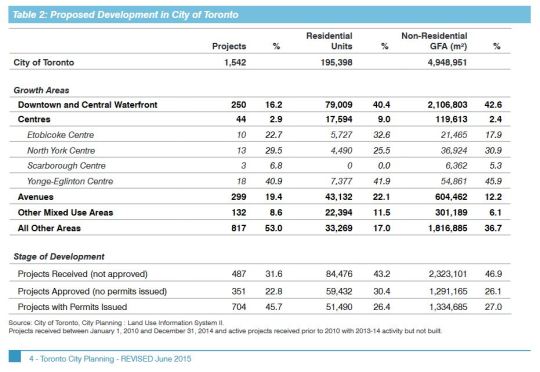
    Scarborough Centre is seeing almost no new residential and commercial development. In fact, the “Centres” in general are not seeing much development. The largest share is happening downtown, along the central waterfront, and along the “Avenues.” We shouldn’t ignore this when making our investment decisions. Transit and built form go hand in hand. 

    I also do not buy the argument that we are building this subway in anticipation of demand 50 or 100 years from now. We are not in a position to be proactive about our infrastructure. We are desperately playing catch up and there are already lots of high growth and high density areas in the city which today are completely underserved by higher order transit. 

    Finally, a new subway line with low ridership will mean higher operating cost subsidies to keep it afloat. And at the rate that Scarborough Centre is growing today, this would likely continue for many years into the future. Not only is this debate about spending money today, it is about spending money well in the future, month after month.

    So let’s be clear: the Scarborough Subway Extension debate is about politics. It is not about transportation planning.

  • Politics and bike lanes

    image

    Recently a good friend of mine told me that I had conflicting views in the world of politics.

    She more or less said to me: I know you’re a real estate developer and obviously a capitalist (read: right of center), but you also support what are often considered to be left of center issues. Issues like tearing down the Gardiner Expressway and building more bike lanes.

    I thought this was an interesting comment because, regardless of whether or not you agree with the categorization she was making, the unfortunate reality is that sometimes (oftentimes?) city building issues do become about left vs. right. Bike vs. cars. Urban vs. suburban. And the list goes on.

    My response to her was that I don’t care about what side of the political spectrum an issue supposedly falls on. That’s a distraction. When I think about something, I try and apply rationale thought and facts to the best that I can. 

    For instance, in the case of bike lanes, I have asked myself: would cities be better off if we had more, or less, people cycling? Simple question. And when I think about this and look at some of the numbers, I see a lot of benefits (this is a non-exhaustive list):

    – More people cycling means we’re moving people more efficiently, which you could argue improves urban productivity and overall quality of life. 

    – More people cycling means we will naturally start prioritizing more compact types of urban form, which in itself has a myriad of socioeconomic benefits. 

    – More people cycling means we’re actually taking action to try and fight climate change.

    – And more people cycling means we’re improving health outcomes. Given that public spending on health care is one of the largest government expenditures in OECD countries, I bet you could find measurable financial savings.

    With all of this, I am not naively suggesting that all cars should disappear from our cities and that everyone should only cycle. I think electric vehicles and self-driving vehicles are going to be an important part of the mobility equation in the future. But I am saying that more, not less, cycling strikes me as an obviously positive thing for our cities. 

    On that note…

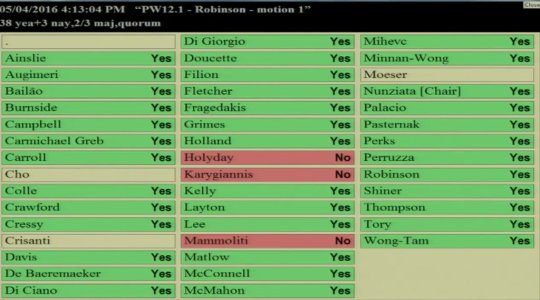
    Toronto City Council voted today in favor (38-3) of a pilot project that will bring separated bike lanes to Bloor Street. The image at the top of this post is how each Councillor voted. So today, we appear to have not fallen into the divide that my friend was talking about. And that makes me, as well as many others, quite happy.

    //platform.twitter.com/widgets.js

    I would be curious how all of you feel about this particular issue. And I would also be curious if you find yourself being more issued based rather than aligned across the political spectrum. That’s certainly how I feel these days.

    I bet we could have a great discussion on this topic in the comment section below 🙂

  • Those troublemakers

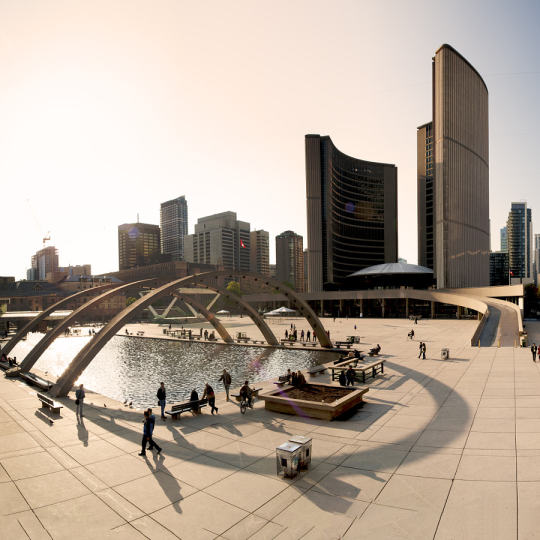
    Toronto City Hall by Sébastien Pacaud on 500px.com

    https://500px.com/embed.js

    Jennifer Keesmaat is the Chief Planner of Toronto. She was hired for this job in 2012.

    She has a Masters in Environmental Studies (Politics and Planning). She is a Registered Professional Planner with the Canadian Institute of Planners. And she was also the founder of 2 (city) planning firms prior to taking the position of Chief Planner for Toronto.

    So presumably, she was hired for this job because she possesses some sort of expertise in the realm of planning. I also presume that she is expected to make her opinions known to other people so that informed planning discussions can occur and decisions can be made.

    So I find it curious that in some circles, and in the media, Jennifer Keesmaat is being branded as a “troublemaker.”

    A lot of the recent chatter stems from the fact that Keesmaat was at odds with Mayor Tory during the Gardiner Expressway East debate (quote via Toronto Life):

    Eventually Tory had enough and pulled Keesmaat into a meeting where he basically told her to zip it. “The mayor has said it is perfectly appropriate for staff to make their opinions public, as Ms. Keesmaat has done,” wrote his communications chief, Amanda Galbraith, in a statement. “It is not appropriate for city staff to campaign against councillors or the mayor on social media or through other public platforms.” Keesmaat counters that she never campaigned. “I stated an opinion,” she says simply.

    But the “troublemaking” didn’t just start with the Gardiner East. Pretty much since the moment she took the position of Chief Planner and launched her own blog (ownyourcity.ca), she was dubbed a shit disturber. (Those bloggers!)

    But if you ask me, these criticisms stem from an old and outdated way of thinking.

    The last thing we need from government is less transparency and more politicking. We should be working towards more, not less, information. Even if that information doesn’t butter our metaphorical bread.

    What do you think?

    I think this will make for a great discussion in the comment section below.