Daily insights for city builders, delivered every morning at 6 AM ET. I’m Brandon Donnelly — a Toronto-based real estate developer and founder of Globizen. I’ve been writing here since 2013.

Tag: politics

  • Gardiner East vote shows that Toronto is not yet ready to be an urban leader

    image

    Today is very sad day for Toronto. 

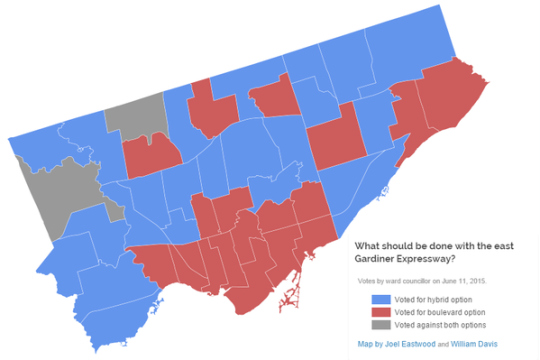
    After 2 days of debate, City Council voted this afternoon, 24-21, in favor of rebuilding the elevated Gardiner Expressway East (”hybrid” option) that runs along the city’s eastern waterfront.

    And once again, Toronto is largely divided. See above image prepared by Joel Eastwood and William Davis.

    It’s the old city of Toronto (who uniformly wanted the elevated highway replaced with a boulevard) versus the rest of the city (who for the most part voted for the hybrid).

    I can’t begin to tell you how deeply disappointed I am by not only the outcome, but also by how it happened and why it may have happened. For all of our talk about being a progressive global city, today we are clearly not that. 

    Because more than a vote on what to do with the Gardiner East, today was a vote on how we believe we should be building this city for the future. 

    When the Gardiner East was first built, the vision was one of fluid private mobility, where it would be possible to quickly circle around and across the city on an endless sea of highways. Detroit was doing it. Baltimore was doing it. Everybody was doing it.

    In other words, we were building our environment around the car. And our primary – some would say singular – focus was to ensure that the car could move unencumbered around the city. That’s why Toronto is now home to the busiest and one of the widest highways in the world.

    But despite all this, Toronto remains crippled by gridlock. And so does every other big city city in the world that has bet on cars as the solution. Why is that?

    Because that model doesn’t work.

    The I-10 Katy Freeway in Houston is 26 lanes at its widest point. It is the largest highway in the world by number of lanes. But from 2011 to 2014, commute times in some sections increased by as much as 51%. Is that because they haven’t built enough highway? How much is enough?

    By comparison let’s look at a city that has bet on transit as the solution: Tokyo. 

    The metropolitan area of Tokyo is approximately 37.8 million people. That’s more than the entire population of Canada and by most accounts is the largest urban region in the world. But despite its size, Tokyo is consistently ranked as one of the most livable cities in the world and also one of the most efficiently run.

    Interesting.

    So when I heard Councillors going on today about how a vote for the “hybrid” is a vote not to increase congestion and gridlock, it became abundantly clear that many – apparently most – people in this city still do not appreciate what it is going to take to get us efficiently moving as this region approaches 10 million people by 2041.

    This should not have been a debate about 3 minutes. That, as I’ve said before, is a red herring.

    Of course, there was lots of lip service to transit. Many seemed to agree that transit is the future. And some even went so far as to say that removing the Gardiner East and replacing it with a boulevard is the right thing to do, but that we simply can’t do it now because we haven’t made the requisite investments in transit. 

    If transit is truly what we want, then we why don’t we take the boulevard savings and put it directly into transit?

    To me it’s like saying: I really want to be homeowner, but I can’t afford it right now. So instead, I’m going spend more on rent so that I can burn through more money and make it even more difficult for myself to eventually become a homeowner.

    Because that is what happened today. 

    We voted to overspend on a stretch of elevated highway that is used by a small sliver of downtown commuters (~3%), instead of replacing it with a cost-effective surface boulevard (with similar road capacities) and then prioritizing the proven solution to urban congestion: transit.

    At the same time, we also made a number of other things clear in today’s vote. 

    We made it clear that cars matter more than our city’s public realm; that cars matter more than our waterfront revitalization plans; that cars matter more than our environment and our “efforts” to reduce GHG emissions; and, frankly, that cars matter more than our overall quality of urban life.

    I believe that cars will always be a part of our cities, but I don’t believe in putting them ahead of you and I. I guess old habits die hard. That my friends, really sucks.
  • I would make a terrible politician

    Ever since I was a little kid, I have thought that I would one day get into politics. 

    A lot of it has to do with me wanting to affect positive change, which is also one of the reasons I love real estate development (and one of the reasons I write this blog). Developers might have a bad rap in some circles, but I view it as a mechanism for positive change in the built environment.

    However, I have also felt that politics is something that’s better to do when you have grey hair and you don’t actually need the money to live. That way people take you more seriously and you can, hopefully, just do what you feel is right as opposed to playing the political game.

    But more and more I find myself thinking: Brandon, you would make a terrible politician.

    I don’t want to play games. I don’t want to have to think about which stance will win me the most votes. And I don’t want to have to dance around questions so I can avoid upsetting certain constituents. I’d rather be clear and decisive about what I think is the right thing to do.

    But that doesn’t always work so well in politics. So I think I’ll just stick to building things and writing this daily blog.

  • It’s voting day in Toronto

    Today is municipal election day in Toronto.

    About 8 months ago I publicly announced here on ATC who I would be supporting, and my position hasn’t changed. I was disappointed by the fact that he ended up backing away from his initial promise of a true downtown relief subway line (see blog post), but I nonetheless continue to support his candidacy.

    In the words of Mike “Pinball” Clemons, he’s “the right man at the right time.” Click here if you can’t see the video below.

    [youtube https://www.youtube.com/watch?v=ouqv782giyw]

    But I’m not here to try and sway your vote. That is ultimately your decision. However, I am here to encourage you to get out and vote. Regardless of who you might be supporting, I think it’s important that you get out and take a position. So I hope you do that today.

    Happy Monday!

  • What use could driverless cars serve beyond just transport?

    image

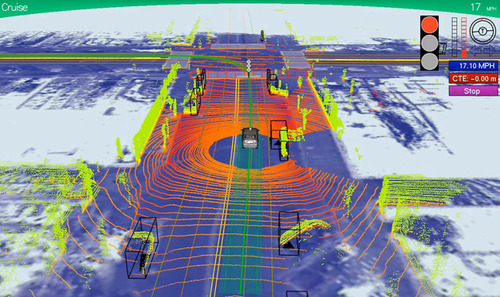
    Here’s further evidence that technology is starting to infiltrate into many other industries, including architecture. London-based architect and designer Pernilla Ohrstedt is currently working on an exhibition for Dezeen and MINI Frontiers that will architecturally visualize the 3D data that driverless cars collect in order to navigate around.

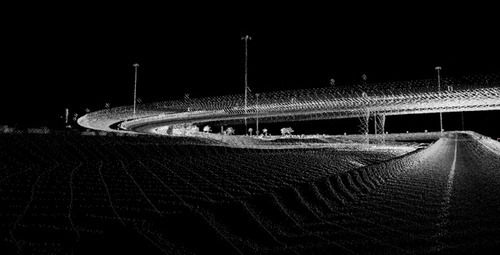
    I had never thought of this before, but as a byproduct of driverless cars, we’re about to start collecting detailed replicas of all of our cities – well beyond the static images we currently have with Google Streetview. In order to navigate by themselves, driverless cars are constantly scanning their surroundings to create a “point cloud” replica of the built environment. This point cloud basically tells the car where they are, where they should drive, and what obstacles might be around.

    It could look something like this:

    image

    Already there are firms like ScanLAB emerging to provide 3D scanning, publishing, and visualization services. But this is obviously just the tip of the iceberg. I can only imagine what innovation will emerge from the passive collection of all this data once driverless cars become commonplace in our cities.

    As one example, it could be a way for us to systematically measure the correlation between the qualities of a street and the vibrancy of its street life. Is there a perfect width? An ideal traffic volume? A right scale? All of this data could make city building more of a science (and perhaps less political).

    My hope though is that this data would be open and accessible to all, so that clever entrepreneurs could build on top of it.

    What are some of your ideas?

    Images: Dezeen

  • $12,000 pink umbrellas

    image

    Sometimes I like to start my mornings off by grabbing a coffee and walking down Jarvis Street to Sugar Beach and the lake. 

    I’ll find a Muskoka chair (Adirondack chair for you Americans) and position it underneath one of the iconic pink umbrellas. I mostly like to look out at the lake, but I also like the shade so that I can see the screen on my phone in case my Type A tendencies kick in and I want to check emails or mess around on Twitter.

    Oftentimes when I’m there–even early in the morning–there will already be other people at the beach. One time I came at 730am and a lady was there tanning in a bikini. I admired her dedication.

    Sometimes I need these moments. I like that sobering feeling you get when you take a time out from the everyday to just sit and think. It helps put things into perspective. And you could argue that great cities provide those kinds of spaces.

    But how valuable are those spaces? Can you put a price tag on it? Is it worth $1M? How about $14.1M, including $12,000 for each pink umbrella?

    Image: blogTO

  • Those evil bikes

    image

    I just stumbled upon an interesting piece in the Boston Globe (from last December) talking about how the bicycle is “emerging as a new conservative front in the culture wars.

    It starts by talking about Toronto mayor Rob Ford and asks: Who elected this guy? Their response comes down to mode of transport.

    The answer, in large part, comes down to transit. Ford is famously pro-car, and his strongest support came from suburbs outside downtown Toronto, where voters drive into the city during the day and return by car in the evening. One political scientist found that the strongest predictor of whether someone voted for Ford in the 2010 mayoral election was the person’s method of commuting: Car commuters were Ford voters; everyone else wasn’t. Ford repaid their loyalty by declaring on his first day as mayor that the “war on cars” was over; he abolished the vehicle registration tax and announced a plan to kill light rail in the city simply because, he said, streetcars “are just a pain in the rear end.”

    The article then goes on to argue that Ford is at the forefront of a growing conservative movement using bikes as a new political lightning rod. Conservative politicians view cyclists as urbanites (statistically this is true) and therefore not part of their core voter base (statistically this is also true). And so hating on bikes has become a convenient way for them to galvanize their support base.

    But beyond bikes, we’re really talking about a bigger city building issue: How do you unify a city with such divergent priorities? How do we stop this downtown versus the suburbs mentality? These are important questions and I don’t think the answer is to de-amalgamate Toronto. That’s the easy way out.

    Whether we like it or not, the Toronto region functions as one contiguous economic unit and, if we want to be able to effectively compete on the global stage, we’re going to need cohesion. We need to get our house in order. It’s still early days for Toronto’s 2014 mayoral election, but I really hope the next 4 years turn out to be better than the last. I think they will.

  • There’s no light rail in Toronto

    Next City published an interesting article this morning on the politics behind Rob Ford’s subway obsession. I encourage you to have a read if you’re interested in politics, transit and/or the increasing polarization of North American cities (core vs. suburbs). It’s called Canada’s Strangest Straphanger.

    There are a number of great take-aways from the article, but I’d like to highlight one that I’m not sure many Torontonians realize: There’s currently no light rail (LRT) in the city. We have streetcars, of course. But no light rail. There’s a difference.

    Here’s an exert from Next City:

    “It is true that most people in Scarborough don’t want a light rail. They want a subway, and the reason they want it is that there is no light rail in Toronto,” says Jay Young, SSHRC postdoctoral fellow in the Department of History at McMaster University in Hamilton, Ontario. “We just have streetcars and subways and they think light rail is a streetcar, when actually it’s very close to a subway in terms of having its own right of way.”

    This may seem like semantics, but it’s not. Again, one difference is that light rail has its own right of way and streetcars compete with vehicular traffic. The other significant difference is station spacing. Streetcars stops are spaced similar to bus stops, which let’s say averages around 250m. LRT stations on the other hand are often in the range of 400-600m. This makes them similar to subways.

    It’s for this reason that even though the St Clair streetcar has its own right of way, I would not personally consider it a true LRT. As someone who lived in midtown for over 3 years, I can tell you that the stations are way too close together and that it’s highly inefficient during peak times – much like the rest of our streetcar network.

    Given the constant debates going on this city about light rail vs. subways, I think it’s important that we’re clear on definitions. Light rail has the potential to be an effective (read: cheaper and faster) way of delivering rapid transit to a greater number of people in the city. Before we dismiss that proposition, let’s please understand what it is.