Daily insights for city builders, delivered every morning at 6 AM ET. I’m Brandon Donnelly — a Toronto-based real estate developer and founder of Globizen. I’ve been writing here since 2013.

Tag: news

  • Louis Vuitton’s Big Duck

    When I first saw this picture of Louis Vuitton’s flagship store in Manhattan I thought it was AI. That is where we are right now. When something looks wild, I just automatically assume it’s fake. But alas, it’s not fake. Louis Vuitton is renovating their flagship store at the corner of 57th Street and 5th Avenue and so, naturally, they decided to completely cover it with luggage facade wraps.

    These wraps make the entire building look like six grey trunks stacked on top of each other and are a nod to a 19th century luggage design from the company. They even used real metal details throughout. Apparently the heaviest luggage handle weighs something like 5,000 pounds.

    This is wild and remarkable in so many ways. The scale of it is remarkable. This is a 15 storey building concealed entirely by luggage trunks. It also speaks to the scale and dominance of New York as a city. Not every city can absorb a pile of giant luggage trunks and not bat an eye. But in New York, it’s just another noteworthy thing within its relentless urban grid.

    I also can’t help but think of the work of architects Robert Venturi and Denise Scott Brown. In 1972, they published a book called Learning from Las Vegas. And in it, they defined two types of contrasting buildings: decorated sheds and ducks. Decorated sheds are, as the name suggests, nondescript buildings. Think big box stores. These buildings get their specificity from signage and other ornament because, without this, they’d just be nondescript sheds.

    Duck buildings are, on the other hand, buildings that take on a symbolic form. In other words, their shape and construction tell you what they’re all about. The term duck comes from an actual building that looks like a duck, namely The Big Duck on Long Island. This is a building that was built in the 1930s to help promote the owner’s duck farming business and is now on the US National Register of Historic Places.

    The Big Duck is and was an actual building, whereas Louis Vuitton’s trunks are just temporary construction wrap. So they’re not exactly the same thing. Still, the similarities are there. Both were erected to promote their respectiveness businesses. And both tell you, through their form, what’s meant to happen inside. So in this sense, Louis Vuitton has just created its own Big Duck.

    Photo by Brad Dickson via Dezeen

  • Manhattan’s congestion charge is back, maybe

    I first wrote about Manhattan’s proposed congestion charge back in 2018. Naturally, some people supported it and some people opposed it. Four years later, it was reported that the charge was still being considered for the area of the island south of 60th Street, and that it could generate an additional $1 billion in revenue for the city’s transportation authority. But then in June of this year, right before the charge was set to come into effect on June 30, 2024, New York Governor Kathy Hochul said “nah, let’s pause this indefinitely.” And at that point, it felt mostly dead.

    Nope: A revised tolling plan has just been announced — the charge has been reduced from $15 to $9 — and Hochul is now trying to jam it through before Trump takes office in January. Trump opposes the charge and has branded it the “most regressive tax known to womankind”, so there’s a real deadline here. This could get interesting. Do you think it will actually happen, some 6 years later? (In reality, the timeline is far longer. Congestion pricing also looked promising during the Bloomberg era, but then similarly died. And I’m sure there were even earlier proposals.)

  • Do you trust your government?

    This, it turns out, is an important question, because there’s a strong correlation between trust in government and overall prosperity (the above chart is via NZZ). The extreme examples of distrust are somewhat intuitive. If, for example, you don’t believe that your government will uphold property rights, why would you ever want to risk investing in property?

    But it can be even more subtle and insidious:

    Trust is central to both stability and development. If citizens have trust in their system, they will be more likely to push for growth-promoting reforms. Moreover, they will be more confident that politicians will actually implement such reforms, and that sacrifices made today will pay off in the future. If this trust is lost, democracies become unstable, and autocratic tendencies are more likely to prevail. However, trust is also important for the transition from an autocracy geared solely toward the extraction of resources and wealth into a progressive democracy. A politically dominant class that governs autocratically will make concessions voluntarily and refrain from repression only if it trusts that it too will benefit from the institutional changes over the long term, and that it will not later be deprived of all opportunities.

    All of this forms part of the work of economists Daron Acemoglu, Simon Johnson and James A. Robinson, who were awarded the Nobel Prize in Economics earlier this year. Their research explains why wealth is so unevenly distributed across the world. It’s a problem of institutions. But it’s also highly relevant to countries that are already rich.

    Distrust is on the rise in countries like the UK (57%), France, (51%), Germany (49%), and Italy (47%). The outliers among OECD countries are places like Luxembourg and Switzerland. Only 25% of Swiss people express distrust in the government. That’s a good thing for overall prosperity and it shows in their GDP. So how can we be more like the Swiss?

    Radical transparency when it comes to decision making and more of a direct democracy (versus a representative democracy) are two places to start, according to the research. People, it seems, trust their government more when they themselves make more of the decisions.

    Here’s the full NZZ article. It’s an illuminating read.

  • Mass transit with on-demand service

    Here’s what we know:

    In the mid-20th century, the US made a pivotal choice that shaped its cities, economy and lifestyle. It chose highways and cars over public transit. At the time, this seemed like the future: the freedom of the open road, the allure of suburban living, and the booming post-second world war economy all converged to push America towards a car-centric culture.

    The Federal-Aid Highway Act of 1956 cemented this vision, unleashing a highway system that encouraged suburban sprawl, fuelled the automotive industry and sidelined public transit. Rail systems were seen as relics of a slow, industrial-era technology ill-suited to America’s postwar aspirations. The car was king. 

    But this congested system is breaking. In 1950 about 30 per cent of the world’s population lived in cities. By 2030 this is expected to reach 60 per cent. Infrastructure cannot keep up with this growth. An increase in cars further reduces street capacity.

    What we don’t have a clear consensus on, though, is the path forward. Is it more highways? More public transit? More bike lanes? Or will autonomous vehicles finally arrive and bail us out? The answer will depend on who you ask.

    In this recent opinion piece, venture capitalist Vinod Khosla makes the case for something else: personal rapid transit systems (or PRT). Conveniently, he also happens to be an investor in one — a company called Glydways.

    The promise is an on-demand mass transit system that offers the convenience of a personal car, but with the capacities and price points of public transit. And it is based on small autonomous vehicles riding in their own dedicated lanes.

    Each lane only needs to be 1.5 meters wide, which is less than the 2.3 meters that the Dutch see as the ideal width of a one-way bike lane. And with this, the company claims that it can reach capacities of up to 10,800 people per hour.

    To further put this into perspective, the standard width of a two-way parking drive aisle here in Toronto is 6 meters. So this would mean that each drive aisle could, in theory, have 4 lanes dedicated to these “Glydcars.” That’s how narrow they are.

    Here’s a video of them in operation:

    This, of course, isn’t an entirely new idea. You might remember that Masdar City in Abu Dhabi claims to have opened the world’s first PRT system in 2010 — a 1.4 km line with only two stations. That said, Glydways has already been awarded three projects in the US. So for fun, I think I’ll keep an eye on them.

  • We need far better urban data

    The divisive debate over bikes lanes in Toronto continues to remind me that we need far better urban data. People and politicians keep touting “evidence-based decisions,” but what exactly is that evidence? The high-level figure being thrown around by the anti-cycling side is that only something like 1% of residents use bike lanes. So obviously it only makes sense to focus on the 99% and not give up any space to this small minority group.

    But this is highly aggregated data. It also doesn’t speak to any of the externalities associated with introducing new bike infrastructure. Looking at 2021 Census data, the number of cyclists was actually around 5% for the old City of Toronto and in some areas it was between 15-20%. However, it’s absolutely critical to note that this is only the people who selected cycling as their “primary mode of commuting” when submitting their responses to the last census.

    Meaning, it excludes people who maybe only cycle 1-2 days a week, or who ride for leisure and/or for exercise, or who ride to their French class in the evenings (like me). I would also assume that these numbers have generally grown since 2021 given the overall investments that have been made in biking infrastructure. So overall, this is weak data. It’s a few years old. And it excludes many types of users. We need to get more granular.

    Like, it’s great to see local business owners speaking out about the benefits that they have seen as a result of the Bloor bike lanes, but in the end, this is also anecdotal. We need real-time data, precise modal splits, the throughput of every major street, and much more. Then maybe we’ll be able to better optimize around the fact that we are a city divided by built form and by politics. That’s the thing about evidence-based decisions, they tend to get stronger with accurate evidence.

  • Crypto is really hard to explain, but things are happening

    I was at a dinner recently where the topic of crypto came up. Only two of us at the table were full-on believers, and the rest were generally sceptics. So naturally, the two of us started talking about why we think crypto is important. But in moments like this, it always becomes immediately clear that crypto is really hard to explain in a succinct and compelling way. Like, I don’t know how to do it. Thankfully, venture firm a16z just released their latest State of Crypto report, and so here are a handful of interesting takeaways.

    The number of crypto addresses continues to grow. Currently it’s at an all-time high of approximately 220 million, which roughly mirrors the adoption curve of the internet back in the 90s (log scale). It is, however, important to note that one crypto address does not necessarily correspond to one human being. For example, I have many different crypto addresses. So if you dig a little deeper, you’ll see that their net estimate is somewhere between 30-60 million real human beings transacting using crypto every month. This is the estimated active user base and it continues to grow.

    The number of mobile crypto wallet users is also growing rapidly outside of the US, namely in countries like Nigeria, India, and Argentina. This is the result of a number of factors: population growth, mobile phone adoption, government support, inflation, and many others. I mean, since 2010, the Argentine Peso has lost basically 99% of its value against the USD. So of course you’d rather put your money somewhere else, such as in stablecoins.

    Stablecoins are cryptocurrencies that have their value pegged to something else, such as a fiat currency. Today, they are one of the most popular crypto products and virtually all of them (more than 99%) are pegged to the USD dollar. This is viewed by some as an opportunity to strengthen the dominance of the US dollar at a time when it’s waning (see above). But more importantly, stablecoins already serve two important functions in the market: one, it’s as stable as the US dollar; and two, the cost of sending a stablecoin anywhere in the world is now basically free. Say goodbye to bank wire transfers.

    It’s worth reiterating that a16z is a venture capital firm that is heavily invested in the crypto space. And so reports like this are naturally a form of marketing and a form of lobbying. Still, there’s a lot of great information in here that you can use to form your own opinions about the sector. It may not be succinct, but if you take the time, I think you’ll find it compelling.

  • I’d actually like a Tesla bicycle

    I watched Tesla’s We, Robot event last night. As many of you know, Elon and his team showcased a Cybercab, Robovan, and a humanoid robot that dances funny, all of which will be available in the market for purchase at some unknowable date in the future. What was obvious is that Elon himself has no clear idea of when this will be.

    What I will say, though, is that the designs look cool. The Cybercab looks like a Porsche and a Cybertruck had a love child, and the Robovan looks like an Art Deco rendition of what the future is supposed to be like. I first wondered why they’d create a robotaxi with only two seats. But thinking about it now, most Uber rides probably only have 1-2 passengers.

    Despite these pretty designs, the overwhelming reaction to the event seems to be one of disappointment. We’ve heard what was said before. Public transportation is bad (I disagree). Autonomy will free up your time and remove unnecessary parking spaces from our cities (allowing for more public space). And soon you’ll be able to put your under-utilized car to work and earn extra cash.

    Cool, but when?

    Waymo and Uber are not, as far as I know, hosting similarly flashy events. But as far as I can tell, they’re making meaningful progress in advancing toward full autonomy. As of June of this year, Waymo had already logged over 22 million rider-only miles. And in September, they announced a partnership that would bring AVs to Austin and Atlanta by way of the Uber app.

    At this point in the hype cycle, I don’t think anyone is interested in hearing promises about what the future of autonomy will be like, especially without any firm dates. They want to know: Are we there yet? So I think it’s no surprise that people, including investors, weren’t all that pumped up by the event.

    On a more important note, Tesla had bicycles with brightly illuminated wheels circulating around their event set (at Warner Bros.) to presumably demonstrate that their Cybercabs can successfully navigate around moving objects (when brightly illuminated). If you missed them, look at the 29 second mark in the below video:

    I can’t be the only one who thought: “What are those? Now, that’s what I want!” So I’ve asked Elon when they’ll be available and when I can buy one. I’ll keep you all posted on his response.

  • Density is good

    Here is an interesting chart (source) showing housing starts in Canada, by type, between 2000 and 2023:

    As recent as 2000, single-family houses accounted for 61% of total starts and multi-family housing accounted for 39%. This flipped somewhere around the financial crisis and, last year in 2023, the percentages were 23% and 77%, respectively. This is a meaningful inversion which has helped our cities become more vibrant and more conducive to non-car modes of transport.

    But in this recent article about Canadian housing, Donald Wright more or less argues: so what? We’ve been densifying our cities for all these years, but it hasn’t helped our affordability problem. Supply must not be the answer to our housing crisis.

    I’m not exactly sure what he believes to be the solution, but I don’t think this problem is as simple as “we’ve built some housing, we made our cities denser, and yet housing is still expensive — more supply must not be the answer. Let’s move on.”

    Among many other things, it’s important to understand what kind of density we’ve been building. Because up until very recently, we’ve basically taken the position that single-family neighborhoods should never be touched, and that density should only go in very specific areas — and only after a lengthy and expensive rezoning process has been completed.

    We’ve designed new housing to be expensive.

    But attitudes are changing all across North America. We are now starting to do two very important things: (1) we are opening up more of our cities to intensification and (2) we are now allowing more multi-family housing on an as-of-right basis. Meaning, no lengthy rezoning exercises and no risk of community opposition.

    These are two fundamental changes that should alter the kind of density that gets built. And in my view, it’s going to be a positive thing for Canadian cities.

  • Toronto’s highway 407 is doing what it is supposed to do

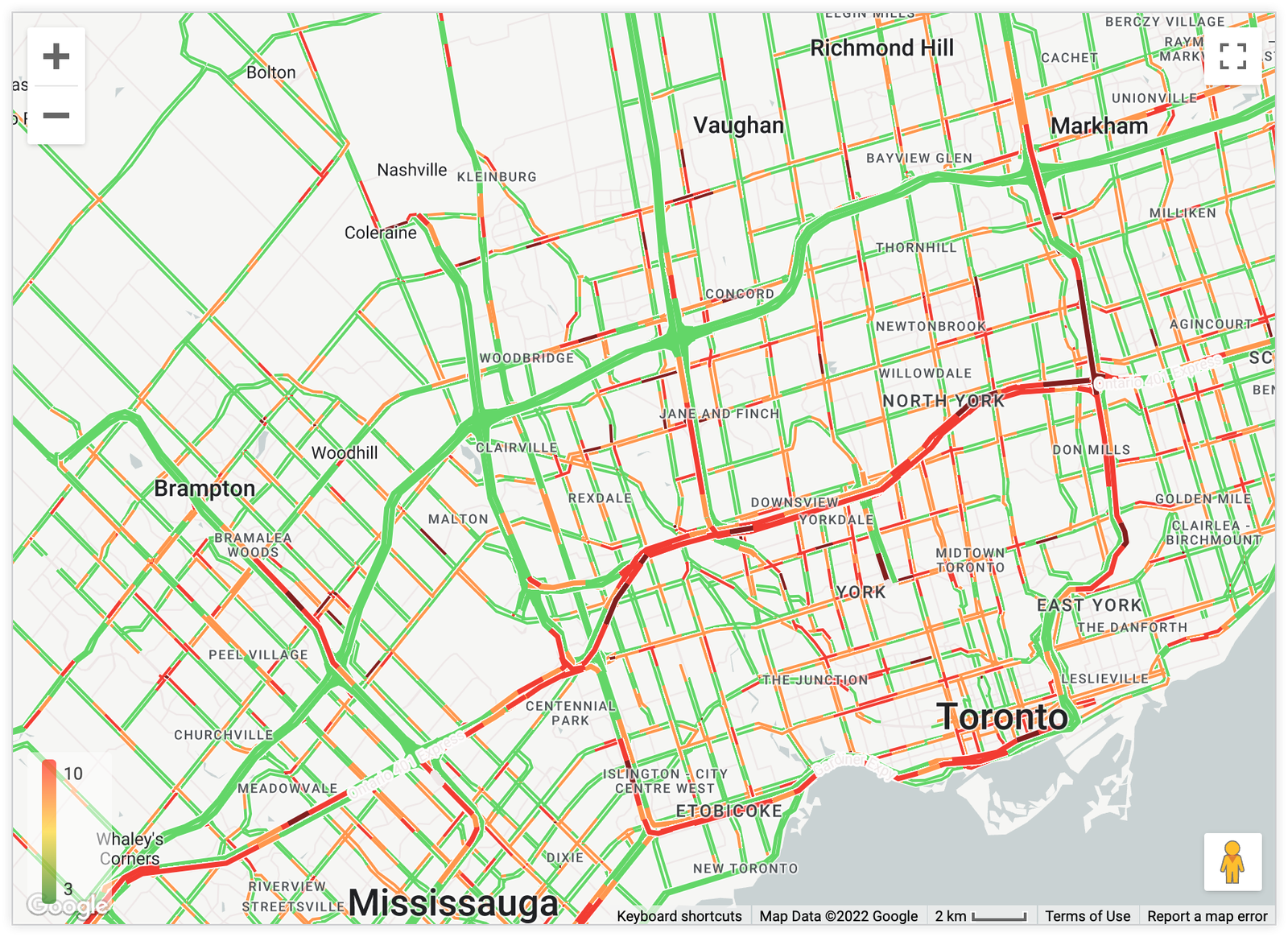
    In Google’s guide to its maps, there is a section on live traffic congestion, and in it, this image is used:

    It is a map of the Toronto region, and not surprisingly, it is showing traffic congestion on the 401 highway. But what’s interesting about this image is that there’s no traffic at all on the 407 express toll route. (This is the green highway running generally parallel and north of the 401, for those of you who aren’t familiar with Toronto.)

    This is, of course, accurate. A 2019 study by the Canadian Centre for Economic Analysis called the Economic Impacts of Highway 407 found that, at the time, an average of 413,000 drivers were using the 407 highway each weekday. And of these trips, more than 85% of vehicles were travelling at or above 100 km/h. This translates into a traffic congestion index of almost zero.

    During this same time, the highway 401 through Toronto showed that about 85% of vehicles were travelling below 50 km/h. Meaning, lots of congestion. This also had a significant impact on collision and fatality rates. On the 407, both were about half of what they were on the 401. (I couldn’t find any more decent data, but if you have it, please share it in the comments.)

    The reason for these differences is simple: the 407 charges for congestion. Here are the current per kilometer weekday rates for light vehicles travelling westbound:

    Naturally, there are people who think the 407 is too expensive and that it shouldn’t have been privatized. But the reality is that it works; really well in fact. And this is the only method that has been proven to reliably combat congestion. We can go ahead and spend a gazillion dollars building a new tunnel under the 401, and double the number of lanes (it’s already 18 lanes at its widest point), but we already know that it won’t solve our congestion problem.

    Either we price roads and congestion, or we don’t. But if we don’t, then we need to be brutally honest with ourselves about the economic trade off that we are making: free/underpriced roads = traffic congestion, and accurately priced roads and congestion = less traffic. The choice is ours. But know, there’s no such thing as a free lunch.

  • EV charging stations > gas stations

    If you do a search for the number of electric vehicle charging stations in the US, you’ll likely get a number somewhere around 160,000. But to better understand what this means, you’ll probably want to ask a few follow-up questions:

    • Are these individual charging ports (for a single vehicle) or are these stations (locations with multiple charging ports)?
    • How many of these chargers are private versus publicly-accessible?
    • And how many of these are DC fast, versus just level 2? Level 2 is what most people have at home (I think), whereas DC charging is what you need if you’re stopping on the side of the road and need to supercharge your car in 20-30 minutes.

    Usually the biggest fear with EVs is range anxiety. We have come to expect that we’ll be able to find a gas station when we need it, but, for the most part, we don’t yet feel that way about EV charging stations.

    So for this concern, the more precise question would be: How many publicly-accessible DC-fast charging stations are there in the US? This is the filter that gives you stations that would be most comparable to how gas stations function today.

    The answer, according to the US Department of Energy, is about 10,597 stations and 44,160 charging ports. And according to Bloomberg Green, this puts the US on track to have public fast-charging sites outnumber gas stations in about 8 years.

    Of course, it’s probably safe to assume that the pace of EV adoption will only increase. And that means that this flip could happen well before 8 years. In my mind, that’s soon.