Daily insights for city builders, delivered every morning at 6 AM ET. I’m Brandon Donnelly — a Toronto-based real estate developer and founder of Globizen. I’ve been writing here since 2013.

Tag: Montréal

  • Paris may have the busiest bike route in the world

    In my opinion, we need far better urban data if we’re actually going to make evidence-based decisions. Thankfully, there are lots of great companies that are focused on this space. One of them is Eco-Counter, which makes devices to count pedestrians and cyclists, among other things. This is an important job, because as Peter Drucker used to say, “you can’t manage what you don’t measure.”

    Let’s look at their bike counters. According to their global map, they have 464 of them installed around the world. Montreal has 58 of them, which we’ve spoken about before, and is an impressive install base. And Toronto looks to have only one, which is located on Bloor Street on the north side of High Park.

    The busiest route/counter in Montreal is at St-Denis Street and Rue des Carriéres. So far this year — up to November 17, 2024 — this counter has seen an average of just under 5,000 trips per day and a year-to-date total of 1,600,468 trips. Both of these metrics are notably up compared to 2023 when I last looked at the data.

    The busiest route in Eco-Counter’s entire network is on Boulevard de Sébastopol in Paris (an important main roadway, not a side street). It has seen an average of 13,667 trips per day and a year-to-date total of 4,386,996 trips. Not surprisingly, the Paris counter exhibits less seasonality. People still cycle in the winter in Montreal, but it’s less than in the warmer months.

    Finally, our lone Toronto counter adjacent to High Park has seen an average of 1,186 trips per day and a year-to-date total of 380,813 trips. Not quite Paris or Montreal (the latter of which has a colder climate), but I would argue that this really isn’t an indicative location for Toronto given how underdeveloped the area is. Plus, you need to see each route as part of a network.

    If you look at Montreal’s top 5 bike counters, all of them have a year-to-date total that exceeds 1 million trips. This is important information if you’re trying to make mobility decisions and these are significant figures. Imagine if these millions of people got off their bikes and instead decided to take transit or drive a car. That would change things.

    Photo by Celine Ylmz on Unsplash

  • Montréal is making yet another case for pedestrian-only streets

    There are parts of Toronto that are pedestrian only. There’s the Distillery District, some small laneways in Yorkville, the Toronto Islands (though this is a bit of a unique situation), and various other pockets around the city.

    There are also streets that we temporarily open up to only pedestrians, such as Market Street and King Street, and areas, such as Kensington Market, that we have been rigorously considering pedestrianizing for as long as I can remember.

    What is clear is that pedestrian-only streets are controversial. Motorists fear that it will make driving in the city even more inconvenient. And businesses fear that it will limit their customer base.

    While it is true that not all streets can and should be pedestrianized, there are countless examples of streets and areas that appear to be thriving because of it.

    Take, for example, Montréal.

    Since 2021, the city has been pedestrianizing a stretch of 30 blocks along Mont-Royal Avenue during the summer months. And according to Mayor Valérie Plante, the commercial vacancy rate for the street has dropped from 14.5% in 2018 to 5.6% in 2023:

    Maybe you don’t want to infer causality here, but at the very least, it seems to suggest that the street isn’t dying and bereft of human activity. This year, pedestrianization is also planned to be extended further into the fall.

    This won’t necessarily be the outcome for all streets, but I do agree with this recent Globe and Mail article that, oftentimes, the reasons for not pedestrianizing are “a question of philosophy, not geography.” Because there’s lots of research and data to support doing this.

    If any of you are business owners along Mont-Royal, I’d love to hear about your experiences and how you think, for better or for worse, it has changed the area. Leave a comment below or drop me a line.

  • Angles and atria

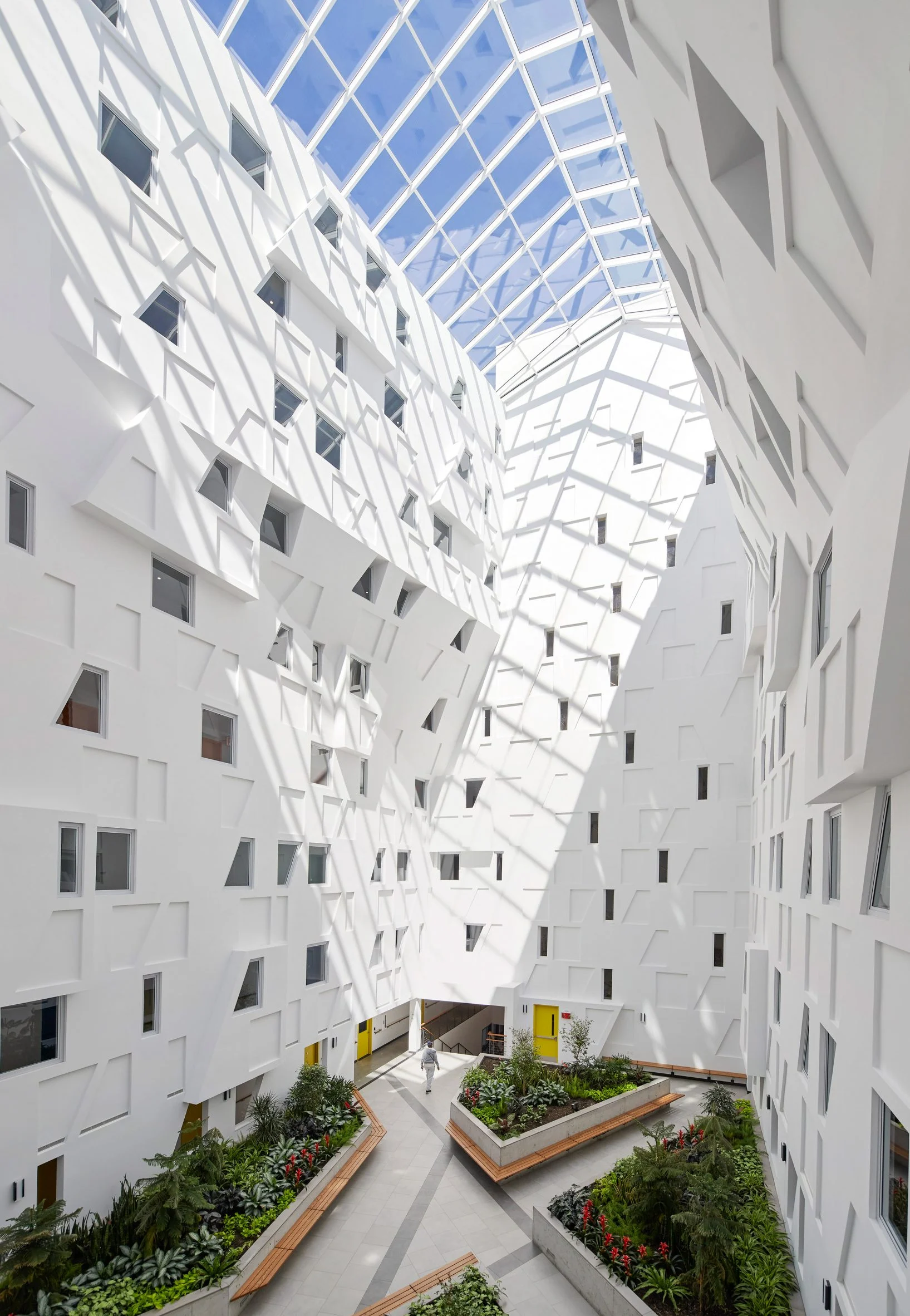
    Studio Libeskind has a recently completed project in Brooklyn that looks like it was designed by Studio Libeskind. It has angled facades and, judging by the comments on Dezeen, its design is polarizing. But it is an affordable housing project for seniors, and it does have a large atrium in the middle of it.

    Atria are a bit of a unique feature in multi-family housing (at least in this part of the world). For better or for worse, the gold standard has become the double-loaded corridor. And that’s because it’s “efficient.” It helps you maximize the amount of rentable or saleable area to gross construction area.

    Here in Toronto, a typical efficiency — calculated as the net saleable/rentable area divided by the gross construction area — would be somewhere between 75-80%. Though many factors can affect this percentage, such as the amount of amenity space in the building.

    There is certainly the option of just building a less efficient building, but then it means you’ll likely need to increase the price of the homes to compensate for this loss in efficiency.

    This is the trade-off that is often made with smaller suites. More and smaller suites usually translate into more corridor space (i.e. a lower overall efficiency). But it may make sense to do this if you think your smaller suites will generate more revenue on a per square foot basis.

    Off the top of my head, I can only think of two residential building in Toronto with an atrium. And that’s 71 Front Street East in the St. Lawrence and “The Atrium” at 650 Queens Quay West. The latter is pretty neat inside. The last time I checked, it even had fake palms.

    In the case of both The Atrium and Libeskind’s Brooklyn project, the atria result in single-loaded corridors. (I’m not sure how 71 Front was designed.) Here’s what Libeskind’s project looks like:

    The obvious advantage of this condition is that you get natural light into the corridors, whereas with a typical double-loaded corridor you don’t. But again, the disadvantage of this design is that you only have apartments on one side, instead of both sides.

    In this case, the thermal envelope of the building is the outside face of each corridor (atrium side). This means the corridors are interior or conditioned spaces.

    Another option would be to create open-air corridors, like in this example from Montreal. This creates corridors exposed to the elements, but now you’ve reduced your overall energy consumption (less space to heat/cool) and you’ve created the possibility of double-aspect units.

    Personally, I’m a fan of atria and courtyards in residential buildings. But for the reasons we just talked about, they’re not that common. My sense is that they’re far more common in commercial buildings. John Portman, for instance, made a name for himself designing and developing hotels around them.

    What are your thoughts, though? Would you pay a premium to live in a residential building with a nice atrium? I bet some of you would if it meant an improved suite design, such as more windows and more natural light.

    Photos: Hufton + Crow

  • Open-air corridors and exterior exit stairs

    Montreal is, in many ways, a city of winding exterior stairs. If you’ve been there, then you know. The city is overwhelmingly a city of low-rise apartments (less than five storeys). And with these, comes lots of exterior circulation. But this tradition doesn’t just apply to older buildings. Here is a contemporary tall-building example which follows a similar approach.

    Designed by MSDL Architects, the project, called The Laurent & Clark, consists of two tower volumes. They read as two separate towers, but they’re connected and share egress paths. On the east side is a conventional “scissor stair” tucked behind two elevators. And on the other end, connected by an open-air corridor, is an exterior exit stair that runs all the way up the tower.

    Here is a circulation diagram via Azure:

    This is novel (at least in this part of the world). The suites in the west tower are all dual aspect; meaning, they have windows on both ends.

    They also have direct elevator access (see cores above), which means a lot less non-revenue generating circulation space. I mean, if you think about it, the open-air corridor on the north side of the west tower is akin to building a simple balcony. Extend the slab and add a guard rail. And so you could argue that this portion of the building has a near 100% efficiency factor.

    However, the downside is that you need more elevators. Here, it looks like they have 6 for their 356 suites. That’s an overall ratio of just under 60 suites per elevator, which is lower (i.e. better) than what you’d typically find in a conventional tower. The crude rule of thumb is 1 elevator for every 100 suites. That said, these direct-access suites would be premium.

    But perhaps the most important takeaway is this: If cold and snowy Montreal is cool with open-air corridors and exterior exit stairs, then maybe your city should be as well.

  • More people are cycling in Chicago

    One of the common criticisms of bike lanes is that most people don’t want to cycle in the winter. I mean, just look at Montreal’s winter cycling retention ratio.

    But that doesn’t mean that you shouldn’t invest in cycling infrastructure. Chicago, for instance, has been building out cycling infrastructure over the last few years (2020-2023) at an average rate of approximately 30 miles per year. This is double its rate from 2011-2019. And the results show.

    According to recent data from Replica and the Chicago Department of Transportation (CDOT), Chicago saw the highest growth in cycling among the 10 largest cities in the US between fall 2019 and spring 2023.

    Biking overall was up 119%. Crosstown trips were up 180% (bike trips that spanned across four or more neighborhoods). Trips related to shopping were up 117%. And notably, zero-car households were up 207%.

    Remember, this is a city that basically has the same weather as Toronto. It gets cold in the winter. And sometimes it snows. But clearly if you build good cycling infrastructure, people will use it.

  • Touchdown in Lyon

    We landed in Lyon around 12:30 PM local time today. And it was about 15 degrees and sunny. This doesn’t bode well for fresh snow in the mountains. But it does bode well for getting a nice raccoon tan.

    Our flights and connections were heavily delayed, and so I had started mentally preparing for the possibility of an overnight layover in Montreal. Thankfully, we managed to make our connection. Unfortunately, some of our skis didn’t. Hopefully they come tomorrow.

    It’s for this reason that I usually throw an AirTag in my bag(s). It probably won’t help you get your delayed luggage any faster, but at least it gives you some peace of mind knowing where it is.

    For whatever reason, I also slept really well on last night’s flight. I don’t generally sleep well on planes. So I’ve been up all day, and we’ve been eating our way through Lyon.

    The general rule of thumb with these overnight European flights seems to be that you want to stay up as best you can once you arrive. If you nap, it’ll only prolong the adjustment period.

    Our first meal was during that awkward time in between lunch and dinner when most restaurants are closed. But we went to Bistro Bondy (our hotel recommended it) and it was exactly what we needed. For dinner, we ended up at La Tête de Lard and it looked something like this:

    There was a bit of cream and cheese involved in this meal and so, at this point, I am ready for bed. See you all tomorrow.

  • Montréal’s winter cycling retention ratio

    Montréal had its first snowstorm of the season this week, and if you look on X, you’ll find images and videos like these:

    What’s remarkable is the number of people who, at least from these tweets, continue to cycle in the winter. In fact, in the above video, there looks to be more bikes on the road than cars. Plowed lanes certainly help!

    According to the city of Montréal, about 80% of the network is maintained for year-round use (717 km of its 900 km network). But I’m sure that there are a lot of people who still can’t imagine anyone wanting to cycle in these conditions. So what is the actual winter usage?

    Thankfully, Montréal has bike counters. 55 of them to be exact. And all of the data can be viewed, here. The busiest location is Saint Denis and Rue des Carrières. This falls within their Réseau Express Vélo (REV) network, which is a series of protected lanes intended to do what the name suggests.

    The daily average for this counter is currently 4,403 riders, but the summer peak looks to be closer to 10,000. And this year, it has seen close to 1.5 million rides in total. This is a significant number. I mean, imagine 1.5 million more car trips on the road.

    Looking at yesterday’s data, the daily count was 1,292. If you very crudely divide this by my 10,000 summer peak estimate, you get to around 13%. And this happens to line up with what seems to be the city’s generally accepted winter cycling retention ratio.

    Not surprisingly, fewer people want to cycle in the winter. But the number is not nothing. If you multiple 1,292 cycling trips by 120 days (roughly December to March), that’s still over 150,000 trips (I know, I didn’t account for weekends). On top of this, the city’s winter cycling retention rate appears to be increasing.

    So just because you may not want to cycle to work in the winter, it doesn’t necessarily mean that others feel the same way.

  • Claude Cormier (1960-2023)

    Today, one of the top landscape architects in Canada — Claude Cormier — died from complications associated with something known as Li-Fraumeni Syndrome. He was only 63.

    Claude, and the firm he founded CCxA, have been responsible for some of the most beautiful, whimsical, and critically acclaimed public spaces in Canada.

    Those of you familiar with Toronto will know Berczy Park, Sugar Beach (pictured above), the new Love Park, and others. These are easily some of the most successful public spaces in the city, and for good reason.

    CCxA is also the landscape firm behind our 100 Lombard project, where we have been similarly working to create a new and whimsical public space in downtown Toronto.

    We’re all sorry to see you go, Claude. Canada is a better — and more fun place — because of your work.

    Photo by Filip Mroz on Unsplash

  • Montreal’s Diverse Metropolis policy has delivered exactly zero affordable homes

    Montreal has a bylaw that came into effect on April 1, 2021 and that requires developers to contribute to the city’s supply of social, affordable, and family housing. (All three of these have their own definition.)

    Developers can meet this requirement in a number of different ways:

    • They can build the social, affordable, and/or family housing
    • They can contribute land or a building
    • Or they can pay cash-in-lieu

    Usually, I think of inclusionary zoning as being the first of these three bullet points: a hard requirement to build a certain amount of non-market housing. That is not an absolute requirement here, and so I see this policy as being IZ lite.

    Since the bylaw came into force, there have been approximately 150 new projects by private developers in Montreal, according to this CBC article. That has resulted in about 7,100 new market-rate homes. At the same time, it has resulted in exactly zero non-market homes.

    From what I can tell from the article, every single developer has opted for option three: pay the cash-in-lieu instead of actually building the housing. Supposedly this has produced about $24.5 million in new fees, which sounds like a lot. But if you divide it by 7,100 homes, it isn’t all that much: just under $3,500 for each new home.

    So what is clear is that this is the least expensive option. That’s why everybody is choosing it. If the fee was significantly higher and it was cheaper to just build the social/affordable/family housing, then every developer would just do that. This is how development pro formas work.

    But at the end of the day, we are still taxing new housing and new home consumers for the purpose of trying to create a smidgen of more affordable housing. And this has never sat well with me, especially considering that there are plenty of other things that we could be doing to make new housing more affordable for everyone.

  • Phase one of Montreal’s REM is now open

    The first phase of Montreal’s new Réseau express métropolitain (or REM) just opened it up. It is a 17 km light-rail line that includes five stations running from Brossard in the south (A1 above) to Gare Centrale in downtown Montreal. Eventually this network — which is distinct from but connected to the city’s existing metro network operated by STM — will span 67 kilometers and have a total of 26 stations. To put this into perspective, Montreal’s current metro totals 69.2 kms. So this is a near doubling.

    As with most big city building projects, Montreal’s REM is being and will continue to be criticized. Back in 2016, the project had an estimated total project cost of $5.9 billion. By 2021, this number had increased to $6.9 billion. Today, who knows what the number will be. But it will be more. The reality is that everything went up, by a lot, over the last five years. During the pandemic, we were seeing 30-40% cost increases on some of our construction line items.

    What’s perhaps most noteworthy about this project is its delivery model. It is being delivered through a partnership with the the Caisse de dépôt et placement du Québec (CDPQ):

    Under the pact, the Caisse’s infrastructure arm is assuming $3.5-billion of the project’s $6.9-billion construction cost while Quebec is committing $1.28-billion and the Canada Infrastructure Bank is providing a $1.28-billion loan. The balance consists of a $295-million payment from Hydro-Québec for the line’s electrification, while the Autorité régionale de transport métropolitain, the transit authority for the Montreal region, is pledging $512-million.

    Provincial and local governments will provide continuing operating subsidies for the REM to make sure the Caisse earns its required return on the project, currently pegged at 8 to 9 per cent. The pension fund manager will get 72 cents for each passenger-kilometre travelled on the light rail system. Without such a subsidy, fares would climb to a level few passengers could afford.

    It’ll be interesting to see how this approach stands the test of time. As I understand it, CDPQ wants to continue building and operating transit in other cities around the world. I don’t know any of the specifics other than what I have read online. But from the outside, things seem to be working. The first phase of the REM broke ground in April 2018, and the opening ceremony was held this month (July 2023). That’s basically warp speed in transit timelines.

    Map: Montreal REM