
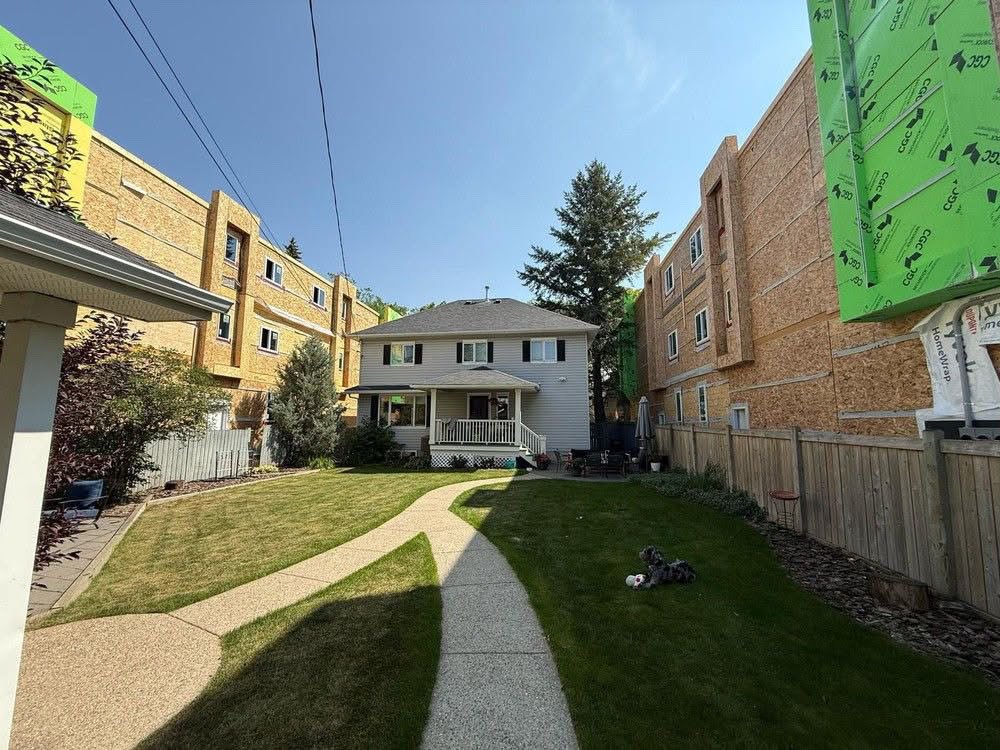
Here’s a polarizing photo of the backyard of a house in Edmonton flanked by two multiplexes under construction. For additional drama, it was also taken with an ultra-wide lens, which is evident from the stretched-out walkway in the foreground. But even still, it is indeed a photo of a single-family house between two larger multi-unit buildings.
When I first saw the photo, via this tweet, I actually read it all wrong. What I thought was the concern — underutilized residential land — was not the concern. The concern was too much housing. More specifically, too much infill rental housing.
So much so that one of the next tweets I saw was the premier of Alberta, Danielle Smith, using this exact photo to say that the province would be coming over top of Edmonton to overturn its multiplex permissions and return the city to the “density and height rules that were in place before 2024” along with “common-sense minimum parking requirements.”
This, in my opinion, is provincial overreach (which sadly happens here in Toronto too) and a shortsighted approach to city-building. Now, I don’t know the address of this house (I tried to find it), nor would I be familiar with the area, but I do know that cities all across North America are taking an important and critical look at their low-rise neighbourhoods.
We know that many of them are unaffordable, car-oriented, and actively losing population. To turn back the clock and return to parking minimums is to restrict housing supply and signal that Edmonton is not yet prepared to be an urban leader in the 21st century. Alberta likes to tout its “free-market” brand, but of course this move is anything but.
One response to “The viral housing photo that triggered provincial overreach in Alberta”
Hi Brandon,
This drama is playing out where I live. Here is some more context; the so-called affordable infill is anything but. Most of the infill builders hail from warm weather countries (mostly Southeast Asia). The vast majority do not build to a delta T of 70 degrees. The vast majority do not understand basic cold climate building principles. Speaking with an infill developer client who hails from that part of the world, he had this to say one evening: “I wish that I could take back the first dozen or so infills that I built; they are truly awful from a thermal performance point of view”. This guy subsequently made a concerted effort to learn building envelope best practices. He now works with architects like me on larger scale projects. He is however the exception. I regularly see infill projects that are missing layers and are actively directing water INTO the building envelope. You and I will remember the Vancouver leaky condo problem and will realize that this is a slo-mo human health disaster in the making. Within 20-30 years, we will see increases in respiratory illnesses and other knock-on health effects of moldy infill homes. That leads to one question: how is affordable housing affordable if it needs to be knocked down and rebuilt every thirty years?
Unfortunately, there is no one on City council with an architecture or engineering background. Instead we have activists whose education consists of weekend courses and retreats. Amateurs, in the truest sense.
I appreciate the Province stepping in. Civic infill policy in Edmonton is being shaped by councillors who are better suited to legislating safe spaces for queer people and engaging in blood libel against Jewish residents (in the case of councillor Michael Janz). They have no business thinking through and deciding on a thoughtful and effective set of policies to guide infill development in Edmonton.