Daily insights for city builders, delivered every morning at 6 AM ET. I’m Brandon Donnelly — a Toronto-based real estate developer and founder of Globizen. I’ve been writing here since 2013.

Tag: housing supply

  • Let’s get serious about building more homes in Canada

    I live in a condominium. I find it extremely desirable. I don’t yearn to live anywhere else. And I think of it as my home. But there is of course truth to this Globe and Mail article:

    Canadians, by and large, continue to think of condos and apartments as housing, not homes. That’s hardly surprising given the way Canada builds them: small units in tall towers clustered in downtown cores or near busy transit hubs. They’re the one- and two-bedrooms young people rent in their 20s (and, increasingly, their 30s). The starter homes. The initial landing spot for newcomers. But they are not desirable homes for two large swaths of the population. Young families need multiple bedrooms and proximity to parks and schools. Retirees looking to downsize often say they want to remain in the same neighbourhood. A dearth of higher-density homes for these two groups has dire consequences for cities.

    The problem is twofold.

    Our land use policies are too restrictive, though that is slowing starting to change for the better. And it is simply not economically feasible to build larger, family-sized apartments at any sort of meaningful scale. This is not a developer unwillingness problem, it is a math problem.

    Toronto, for instance, would be far better off if we had European-scaled apartment buildings all across the city and a lot more family-friendly housing. I believe this to be true at least. But in order to achieve this, we need to get serious. This is not serious.

    We need to dramatically reduce development charges and other government fees. We need to get rid of the site plan control process for smaller buildings. We need to remove required amenity areas (the city is the amenity for small-scale neighborhood apartments). And the list goes on.

    So if anyone in government is reading this and is truly serious about building more affordable housing in this country, please give me a call. I will gladly come into your office and run you through a development pro forma so that you can see what it’s going to take. We can fix housing.

  • Attainable housing is in short supply

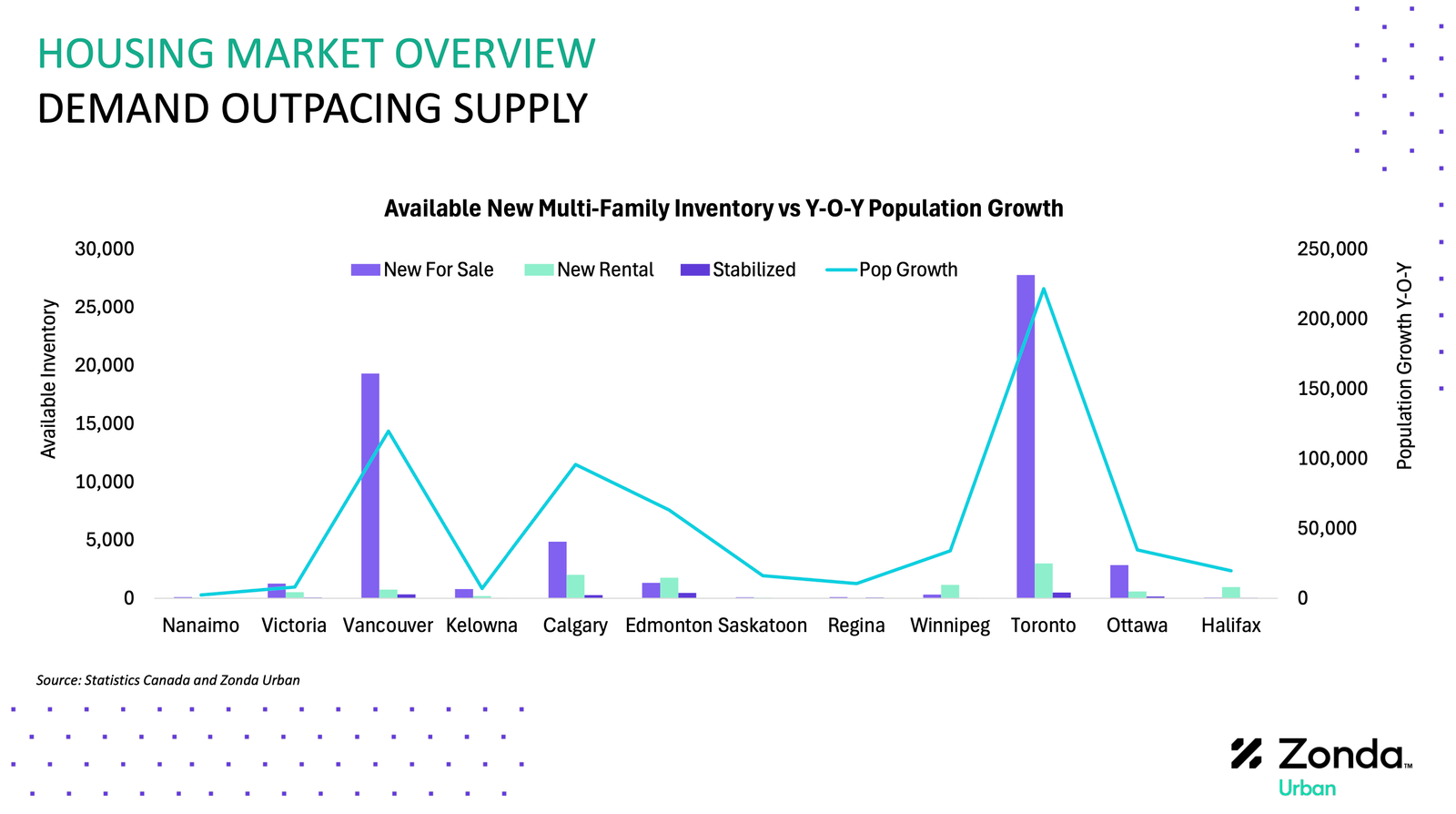
    Approximately 41% of the YTD population growth in Canada this year has been in Ontario. Here’s a slide from a recent presentation by Zonda Urban:

    So there’s an argument to be made that demand is still outpacing new housing supply in most of our major markets:

    Why then are new home sales continuing to slide? A reasonable answer would be that — by design — this new housing isn’t attainable to most:

    The result seems to be a long-term structural shift toward more rental housing:

  • Density is good

    Here is an interesting chart (source) showing housing starts in Canada, by type, between 2000 and 2023:

    As recent as 2000, single-family houses accounted for 61% of total starts and multi-family housing accounted for 39%. This flipped somewhere around the financial crisis and, last year in 2023, the percentages were 23% and 77%, respectively. This is a meaningful inversion which has helped our cities become more vibrant and more conducive to non-car modes of transport.

    But in this recent article about Canadian housing, Donald Wright more or less argues: so what? We’ve been densifying our cities for all these years, but it hasn’t helped our affordability problem. Supply must not be the answer to our housing crisis.

    I’m not exactly sure what he believes to be the solution, but I don’t think this problem is as simple as “we’ve built some housing, we made our cities denser, and yet housing is still expensive — more supply must not be the answer. Let’s move on.”

    Among many other things, it’s important to understand what kind of density we’ve been building. Because up until very recently, we’ve basically taken the position that single-family neighborhoods should never be touched, and that density should only go in very specific areas — and only after a lengthy and expensive rezoning process has been completed.

    We’ve designed new housing to be expensive.

    But attitudes are changing all across North America. We are now starting to do two very important things: (1) we are opening up more of our cities to intensification and (2) we are now allowing more multi-family housing on an as-of-right basis. Meaning, no lengthy rezoning exercises and no risk of community opposition.

    These are two fundamental changes that should alter the kind of density that gets built. And in my view, it’s going to be a positive thing for Canadian cities.

  • Remember unfunded inclusionary zoning?

    Over the weekend, we spoke about how the “GTA condo market is in a state of economic lockdown.” What this generally means is that the math isn’t making sense to build new condominiums. And so the market is necessarily pausing.

    We spoke about what this will likely mean for supply in the coming years, but I think it’s also interesting to talk about this in the context of something else: unfunded inclusionary zoning.

    As a reminder, inclusionary zoning is, in its most basic form, a requirement to build a certain amount of affordable housing as part of new housing developments. And what I mean by “unfunded” is that there are no subsidies or other incentives being provided to the project.

    This means that the cost of providing this housing — and there is an additional cost — needs to be shouldered by the project, which ultimately means the market-rate units need to pay for it.

    Which is why if you look at most policy studies, you’ll often find recognition that, because of this economic reality, IZ tends to work better in areas where home prices/rents are higher. And again, that’s because the market-rate homes need to shoulder the cost.

    We have questioned, many times, on this blog, whether this is the right approach to delivering affordable housing, but I think this question becomes even more critical in our current market environment.

    If the entire market is, for the most part, in a state of economic lockdown, should we really be layering on additional costs and making it broadly more difficult to build any sort of new housing? It seems counterintuitive.

    For more on this topic, check out this recent Sightline article by Dan Bertolet.

  • Over-building and then under-building: Is Toronto headed for a severe shortage of new rental housing?

    As we know — because here’s the data — this is the current state of affairs:

    The GTA condo market is in a state of economic lockdown. The math doesn’t make economic sense from both the demand side (investors) and the supply side (developers), leaving the market at a standstill.

    The above excerpt is from a recent CIBC Capital Markets article by Benjamin Tal (CIBC) and Shawn Hildebrant (Urbanation). And what it ultimately means is that the supply of new condominiums in the GTA is falling and will continue to fall for the foreseeable future. Below are two charts, from the same article, that show that.

    Because of this, I actually think that, if you need or want a place to live, right now is a near ideal time to buy a condominium, especially if it’s from developer inventory (in an already completed project) or it’s a resale. Of course, most people won’t want to do this because they’d rather buy when most other people in the market want to buy. This is how markets tend to go.

    It has been a while since the GTA has gone through one of these real estate cycles, but it is typical: developers are prone to both over-building and under-building. It simply takes too long to build a building, and so it is natural for there to be moments when supply and demand don’t exactly line up.

    Pre-selling condominiums is — in theory only — supposed to protect against too much overbuilding. But as we have spoken about many times before, it can be challenging for end users to buy a new home so far in advance. And so the new condominium market has come to rely on investors who want to buy early and then either sell later or rent later.

    According to the above article (and MLS data), the share of newly completed condominiums used as rentals reached a peak of 34% in 2023. So a third of new condos. My gut tells me that the actual number is much higher. Many rentals never reach MLS. Overall, I think it’s very safe to assume that the majority of new condominiums are owned by investors.

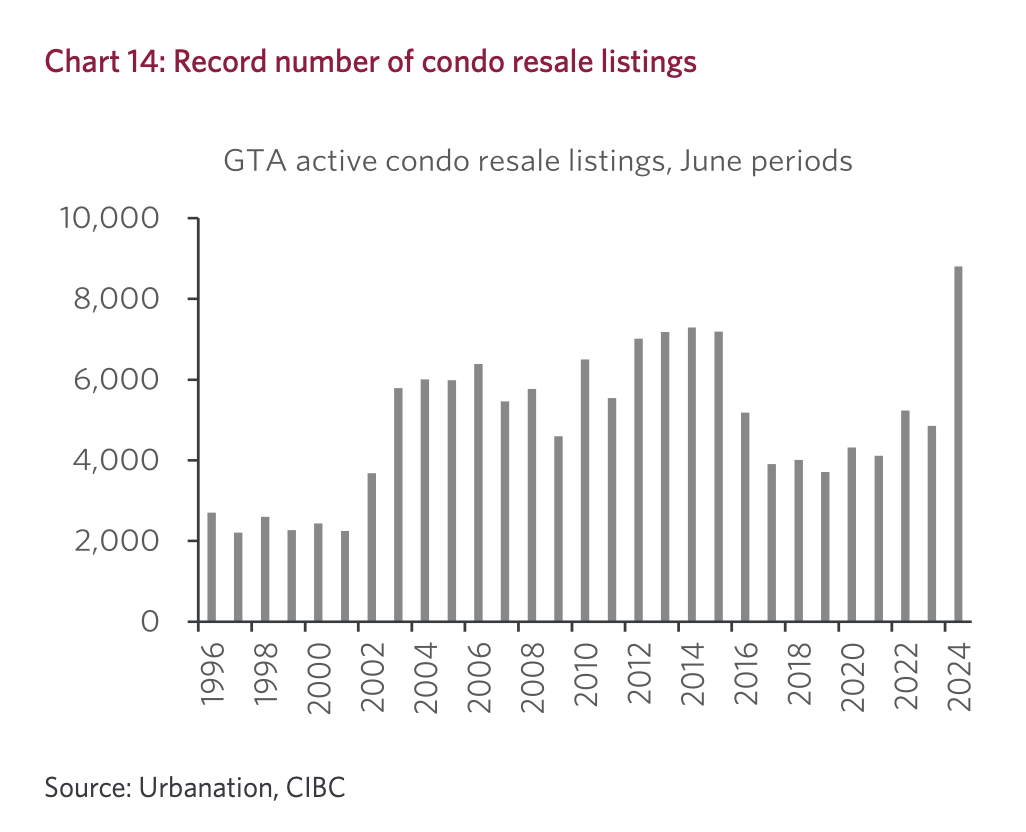
    But right now, fewer investors want to own condominiums, which is why the number of resale listings has spiked this year:

    This is, again, why I think right now is an excellent time to buy a condo. You know, be greedy when others… Regardless, this inventory will need to get absorbed and that will ultimately happen. Some of it will go to end users and some of it will go to investors who can make sense of the rental math and/or want to take a long view on Toronto. But if more goes to the former, we will be losing a lot of new rental housing.

    At the same time, while all of this is going on, construction starts are likely going to remain depressed (chart 3 above). It’s impossible to know how long this lasts, but at some point we will reach a moment in the cycle where we are under-building new housing. Maybe we’re already there. Development simply can’t turn on fast enough when demand spikes. There will almost always be a lag.

    So, since the majority of new condominiums have been serving as new rental housing, there’s a strong case to be made that at some point we will run into a potentially severe shortage of rentals. Condo investors are sometimes vilified in the media, but we will soon find out what happens when you take a big chunk of them out of the housing market.

  • Where 3+ bedroom homes are getting built in Ontario (Hint: It’s not Toronto)

    Here’s an interesting, though not shocking, chart from a recent Globe and Mail article talking about “Canada’s dysfunctional housing market.” What is noteworthy is that Toronto is dead last when it comes to the number of new 3+ bedroom homes built between 2016 and 2011.

    Peterborough, for example, is a census metropolitan area with somewhere around 130,000 people. And yet, based on this data, it is building more family-sized homes than Toronto.

    Why this is not surprising is that the vast majority of new homes now built in Toronto are high-density and built out of reinforced concrete. This means that they are relatively expensive on a per square foot basis.

    In fact, you could argue that mid-rise housing — the exact high-density type that is supposed to be most attractive to families — is the most expensive to build. What this means is that if you’re building a 3+ bedroom home in this way, it’s not going to be affordable to most.

    It also means that people are going to go shopping elsewhere: Ottawa, York, Simcoe, Durham, and so on. The expected market outcome is decentralization. But in my mind, this raises an important question: Is this what people really want?

    This is a great debate. And many will argue that grade-related suburban housing is exactly what people want. What we are seeing is a result of raw consumer preference.

    However, the costs are so skewed in favor of low-rise housing, that I think it’s hard to say with absolute certainty the degree in which this is true. What if higher-density 3+ bedroom homes were the cheaper option? My bet is that we would see a lot more centralization.

    The development charge rate for a 2+ bedroom apartment in the City of Toronto is currently $80,690 per unit (effective June 6, 2024). As development charges work, this is supposed to pay for the growth-related impacts of adding a 2+ bedroom apartment in the city.

    However, the above chart suggests that there are also impacts to not building that 2 or 3 bedroom apartment in an already developed area next to existing infrastructure. It means the home goes somewhere else (further away) or doesn’t get built at all.

    Both of these outcomes also have costs.

  • Britain is missing 4.3 million homes

    According to this report (2023) from the Centre for Cities, the UK has a backlog of about 4.3 million homes. This is in comparison to other Western European countries for the period from 1955 to 2015.

    Said differently, these 4.3 million homes are effectively missing from the UK’s national housing market because it failed to build and deliver at the same rate as some other rich countries.

    The report also argues that this housing shortage started not at the end of the post-war period, but at the beginning of it in the 1940s.

    So what do they propose? The following:

    Increase housing supply where new homes are needed. More homes are built in Wakefield than Oxford. Building in places with fewer jobs won’t fix prosperous cities’ housing crises.

    Planning reform to introduce a new flexible zoning system that would allow builders to build if they follow the rules, while maintaining special protections for National Parks, Conservation Areas etc.

    Zoning of land in walkable distances around train stations in the green belt for suburban living and with protected green space, which would provide 1.8 to 2.1 million homes.

    Increase the use of permitted development rights to cut the red tape that makes it hard to build upward extensions or infill developments.

    Stop subsidising home ownership. Despite Right to Buy, home ownership as a share of private housing has fallen in every city since 1981. The Government should stop subsidising ownership, tax housing wealth increases by abolishing the Capital Gains Tax exemption for primary residences and treat owning and renting equally.

    None of these proposed solutions should come as a surprise. We know that housing follows money/jobs. And we know that if we want more of it, we need to remove the barriers to building it, especially around higher-order transit.

    Image: Bloomberg

  • Approved but unbuilt

    Recent data from the City of Toronto indicates that there were approximately 106,000 new residential units completed between 2019 and 2023. That averages to about 26,500 homes per year.

    At the same time, Toronto is reporting that 258,397 units are currently approved for development and that 436,421 units are currently under review. The former means that the projects have been approved and that a building permit has been applied for or has been issued. And the latter means that the units are still under review or under appeal.

    These feel like staggering numbers. If we were to use the same completion rate as 2019-2023, it would take over 26 years to build these 694,818 new units (homes approved + under review).

    However, I think it’s safe to assume that not all of these homes will be built; at least not in the short term. Many (perhaps most) of these projects are simply going to evaporate in the current market environment. They’re unfinanceable.

    Because that’s the thing, zoning approved does not necessarily equal built and occupied. And right now, in this market, these two things feel like they’re diverging. Toronto grew by about 207,000 people between 2019 and 2023. And it built about half of this number in new homes.

    When we look back at the next four years, I suspect that this housing supply number will be noticeably lower. This is despite the staggering headline numbers.

  • More people, fewer new homes

    This is an interesting chart from the Centre for Urban Research and Land Development at Toronto Metropolitan University (TMU).

    It is based on recent population estimates from Statistics Canada, and what it is saying is that the Greater Toronto Area grew by 233,000 people during the 12 months ending July 1, 2023. If you include Hamilton, this number increases to 246,000. And if you include the entire Greater Golden Horseshoe, it increases to 340,000.

    This is significantly more population growth compared to any of the six preceding years. And assuming this 2021 population estimate of about 9.8 million people is more or less correct, it represents an almost 3.5% growth rate. That’s remarkable. It’s also happening at a time when housing starts are declining.

  • The US is building a lot of apartments right now

    As of November 2023, it was estimated that there were 988,000 homes under construction in multi-family buildings containing 5 or more units. This is in comparison to 680,000 single-family homes, according to US Census data. (Looking at the below graph, it’s also interesting to see how the supply of single-family homes dropped off after the global financial crisis and multi-family apartments took off.)

    All of this means that in 2024, the US is on track to complete more apartments than it has in many many decades. In fact, exactly similar to what we experienced here in Toronto, if you want to find a comparable multi-family supply number, you need to go as far back as the 1970s (see below). Of course, the US had fewer people back then, and so on a per capita basis, it was building more housing.

    Still, all of this new supply is having an impact. Apartment List recently published its national rent report, over here. And overall, it found that:

    Rent increases are currently being moderated by a robust construction pipeline expected to deliver a decades-high number of new apartment units in 2024.

    More specifically, they found that the cities with the most supply are now seeing the largest rent declines:

    Many of the steepest year-over-year declines remain concentrated in Sun Belt cities that are rapidly expanding their multifamily inventory, such as Austin (-7.4 percent year-over-year), Raleigh (-4.4 percent), and Orlando (-3.9 percent).

    If you’re an apartment developer, this is not what you want to see. It means that increased competition is creating downward pressure on rents and that vacancy rates are probably rising. But if you’re someone looking to rent an apartment, this is exactly what you want to see. You want more affordable housing. And so, as a consequence, you want more homes to be built. Because when supply outstrips demand, this is what you get.

    Charts: Apartment List