Daily insights for city builders, delivered every morning at 6 AM ET. I’m Brandon Donnelly — a Toronto-based real estate developer and founder of Globizen. I’ve been writing here since 2013.

Tag: infill housing

  • Toronto is looking to remove garden suite zoning permissions from this street

    Toronto has been making great progress when it comes to allowing more housing in its low-rise neighborhoods. We now allow laneway suites, garden suites, multiplexes, and soon we’ll allow 6-storey apartments. But interestingly enough, there is one small part of the city that is looking to regress. This past summer, council asked planning staff to bring forward a zoning by-law amendment to remove garden suite permissions for some of the properties backing onto Craven Road, near Danforth and Coxwell.

    Here’s a community consultation flyer that went out to residents and that shows the affected properties:

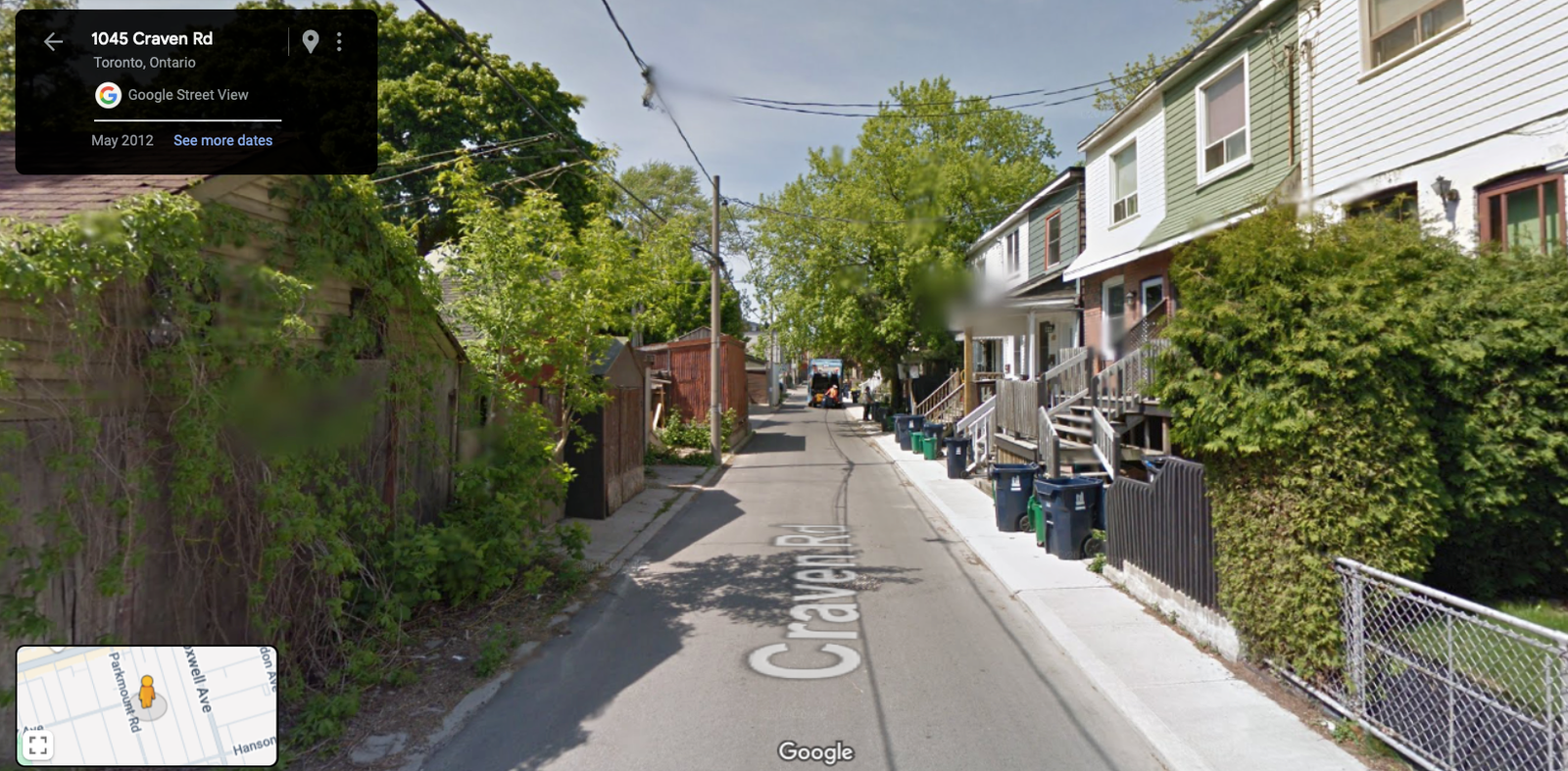
    We’ve spoken about Craven Road before. It’s a relatively odd street with a unique history. Its most obvious characteristic is that it’s a kind of single-sided street. For the most part, there are homes on the east side of the street, but no homes on the west side. On the non-home side there is typically a garage, or the longest municipally-owned fence in the city. Here’s some of the backstory on Craven Road’s infamous fence (which occurs on a stretch further south), and below is what the study area in question looks like today:

    So why remove the garden suite permissions here? The answer is to block housing. The people who live on Craven Road like it the way it is and don’t want anyone to build new housing on the other side of the street. What’s interesting about this is that it roughly mirrors what happened over a century ago. We couldn’t figure out how to broker a deal between two adjacent streets and so we just said “screw it, let’s build a really really long fence and call it a day.”

    Today we’re saying, “yeah, we really need more housing in the city, but I dunno, somebody might get upset here.” There is nothing sacrosanct about the old garages, or the fence, that line the west side of Craven. It is a street, proximate to a major subway station, that is missing homes on one entire side. It’s low hanging fruit for infill housing. In fact, there’s an easy argument to be made that garden suites aren’t nearly enough density for a location like this. We should be encouraging a lot more.

    But this is just my opinion. If you’d like to share yours, the City of Toronto is hosting a community meeting this week on September 19, 2024 from 7 – 830 PM. To participate, register here.

  • Paseo Mallorca 15

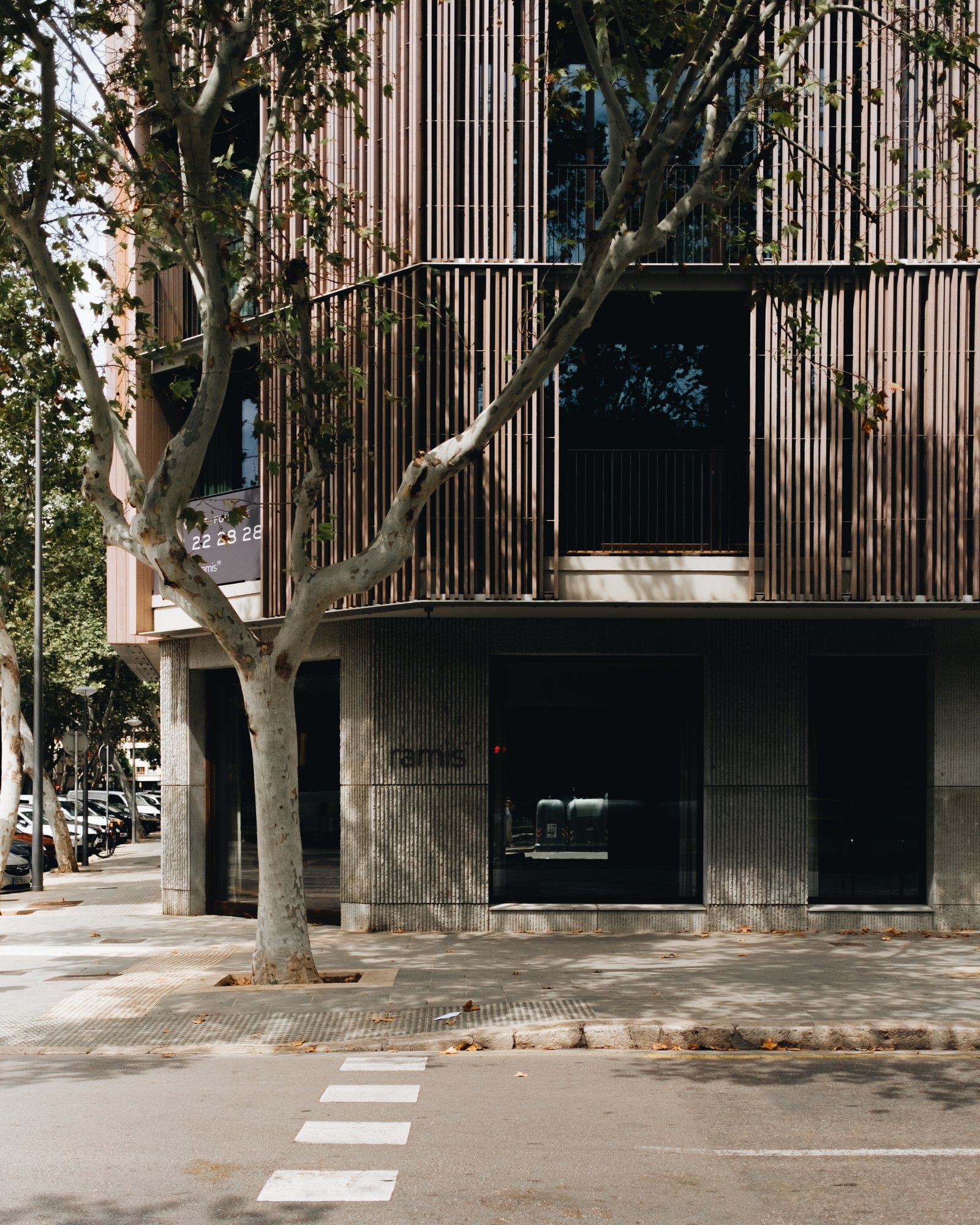
    This is a beautiful apartment building in the center of Palma. Brutalist ground floor. Operable wooden slats up the rest of the facade. It feels right at home in this climate. It’s also a passive-energy building that uses 90% less energy compared to a “conventional” apartment building. The technical classification is nZEB (or a nearly zero energy building). It’s pretty amazing that with only 9 apartments, these kinds of projects pencil here. Perhaps it’s no surprise that it’s also a single-stair building.

    The architect is OHLAB. For more information, here’s their website.

  • XS in Philadelphia, not Tokyo

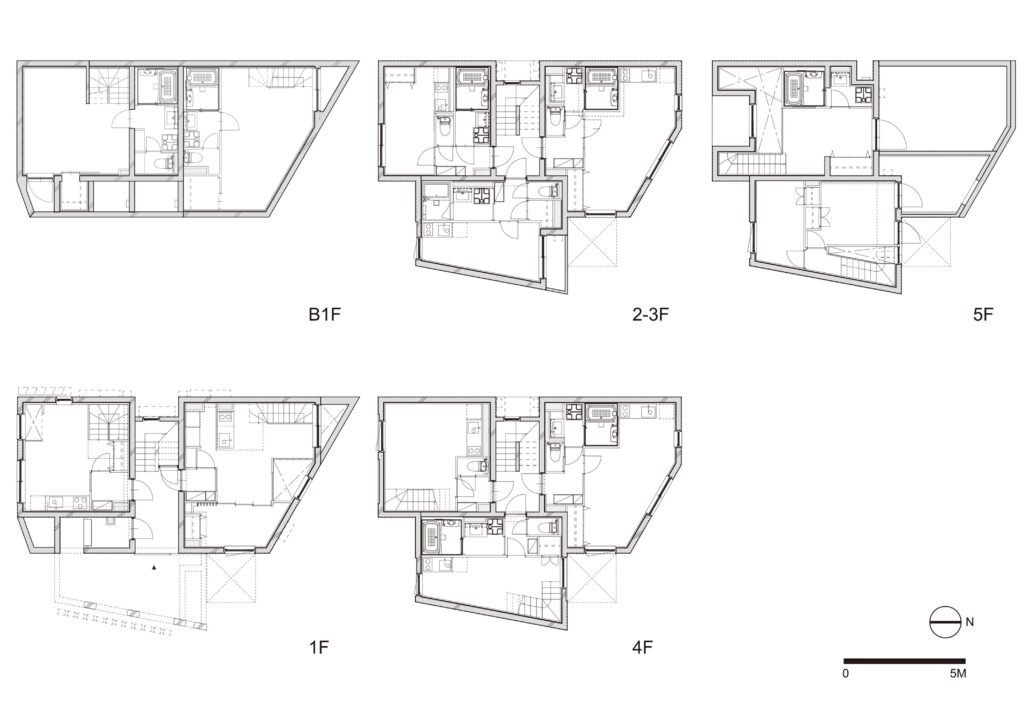
    This is the sort of housing project that you’d fully expect to find in Tokyo. Seven homes built on a small urban lot measuring only 11 feet wide by 93 feet deep. But in this case, it’s not Tokyo; it’s Chinatown, Philadelphia, where a residual lot that was created when the sunken Vine Street Expressway was carved through the middle of the city in the 1950s.

    Designed by Philadelphia-based Interface Studio Architects (ISA), the project contains 7 levels of livable space. What’s interesting, though, is that from a building code perspective this is still a 4-story building. There are two mezzanine levels that don’t get counted (and that create some great double-height spaces). This also seems to be what allowed them to get away with a single egress stair in the middle of the building.

    The other technique that was used to maximum density is facade projections. Philadelphia’s zoning code allows for projections up to 3 feet in the horizontal dimension. And if you look at the above plans, you’ll see that these were used to “top up” or extend the site’s 11 foot width to 14 feet, when it made sense to do so from a programming standpoint. The result is some very livable spaces.

    I am endlessly fascinated by these sorts of projects because they demand creativity and because you ultimately end up unlocking something that the market had been overlooking. Here is an example of a small leftover urban parcel that was previously used as surface parking for two cars. Now it’s seven beautiful homes.

    Photos/drawings: ISA

  • Project Profile: Iconik Apartments, Prague

    Today, let’s take a look at the Iconik Apartments in Prague.

    Completed in 2023 and designed by edit!, this mid-rise project is split into two distinct volumes — a 9-story one and an 8-story one. This was done to respond to both the surrounding context and the way that the parcels were divided on the site prior to redevelopment. In total, the building is 5,433 m2 and has 48 apartments.

    There are 3 levels of below-grade parking, which are accessed via a single parking elevator (pictured above). Based on the one example parking plan provided (which has 13 spaces), I’m guessing the project has somewhere around ~39 total parking spaces (13 x 3). This is a higher parking ratio (39/48 = 0.81) than I would have expected for what looks to be a central and urban location.

    The color of the traffic coating in the garage is nice, though.

    The lobby is simple. It contains one elevator and one staircase running up the building. I like how prominent and accessible they made the latter. It encourages you to take the stairs if you live on one of the lower floors.

    Above is what one of these lower floors might look like. There are two dual-aspect apartments on either end of the plate, meaning they have windows facing both the street and the rear courtyard. There are also a handful of studio apartments facing this same courtyard.

    Finally, above is what the outdoor spaces look like for the penthouses at the top. The clear heights appear a little low, but presumably they were working to an overall building height.

    I like studying this scale of project because it is a housing type that we should be building more of in our cities. So it is helpful to see how others are doing it. In the case, there are a number of obvious takeaways: no onerous loading/servicing requirements on the ground floor, a single parking elevator in lieu of a space-consumptive ramp (though less parking would would be even more ideal), and a single means of egress throughout the building.

    If you’re looking to build at this scale, these are good places to start.

    Drawings/Photos: edit! and BoysPlayNice

  • Building a home on a constrained site

    I’m so predictable. This is the kind of house that tends to grab my attention: modern design, relatively small footprint (~7.8m x 12.3m), narrow street (~4m), and panoramic views (of Seoul). But what does it take to actually build a house like this in an urban fabric as dense as Seoul’s?

    If you read TIUM Architect’s description (using Google Translate for those of us who don’t speak Korean), you’ll see that the house was built out of concrete and steel, but that concrete trucks couldn’t stage on the narrow and dead-end street.

    So what they ended up having to do was build a 100-meter concrete conveying pipe (~328 feet) and staging somewhere else. It was such a pain in the ass that they only wanted to do this for the foundations. The rest of the house was built out of steel. (I think because of the clear spans that they wanted.)

    Sometimes small infill projects aren’t as simple as they may seem. In this case, the lot size is 92 m2. The building footprint is 51.53 m2 (56% lot coverage). And the total floor area is 136.52 m2.

    Photo: Lee Hanul via ArchDaily

  • This is how many more people Toronto could house if it increased its population density

    As a follow-up to yesterday’s post about infill housing and overall urban densities, let’s look at some basic math.

    The City of Toronto has an estimated population of 3,025,647 (as of June 2023) and a land area of 630 square meters. That means that its average population density is about 4,803 people per km2. Obviously this number will be higher in some locations, and lower in others. But overall, this is the average.

    Now let’s consider how many people we could actually fit within the existing boundaries of the city (city proper not the metro area) if we were to simply match the average population densities of some other global cities around the world.

    Again, what this chart is saying is that if we took the same physical area (Toronto’s 630 square meters) and just increased the population density to that of, say, Paris, we would then have a total population of over 13 million people and we’d be housing an additional 10,011,573 humans on the same footprint.

    I am not suggesting that this is exactly what should be done. (Though, you all know how much I love Paris.) What I’m suggesting is that calling a place “full” isn’t exactly accurate. How would you even measure that? What someone is really saying is that they are content with the status quo in terms of built form and density.

    Note: The above population densities were all taken from Wikipedia, except for Toronto’s figures, which were taken from here.

  • We’re far from full

    I tweeted this out yesterday:

    What I was getting at is that there’s lots of available room within our existing boundaries for infill housing. We are nowhere near full, despite what some people will tell you. In fact, most areas are not dense enough to properly support modes of transport that aren’t the car.

    Of course, there are a number of ways that one could be offended by a statement like this.

    One, you could argue that more density would make the city unlivable. Two, you could get into the chicken-and-egg game of whether a more expansive transit system is needed before allowing more density. Three, you could say that we already have enough zoned and unbuilt housing supply — so why do we need more? And I’m sure that there are many others that I’m not mentioning here.

    Density can be a counterintuitive feature for cities. It can actually make a place more livable by encouraging more amenities adjacent to where people live and work, and it can also reduce traffic congestion by empowering alternative forms of mobility. If the only reasonable way to get around is by car, then of course most people will drive.

    We also need to avoid the chicken-and-egg mental trap when it comes to mobility infrastructure. Land use and transportation always work hand in hand and need to be thought of and executed on simultaneously.

    Finally, the objection of already having lots of sites zoned for new housing is an enticing one. But zoned and delivered are two vastly different things. And the unfortunate reality is that there are a lot of zoned sites that won’t be able to develop in the short and medium terms because the market isn’t there. But that doesn’t mean that other housing typologies couldn’t be built.

    At the same time, we need move away from “cruise ships of urbanity.” Broadly speaking, Paris — to cite just one of many examples– is at least and on average about 4x denser than Toronto. And somehow, people still like living and visiting there.

  • Exactly how gentle does gentle density need to be?

    This proposal by Dubbeldam Architecture + Design, called Incremental Density, is both an obvious step in the right direction and a problem. It is directionally right because it is exactly the kind of “gentle density” that we need and that many of us hope to see in our cities.

    Four to six storeys, prototypically built on an as-of-right basis all across city, possibly by small-scale owner/developers. In fact, this approach is one of the things that Toronto’s new mayor, Olivia Chow, has been speaking about on her first day in the office:

    Further, Chow said she wants to make it “easy and fast” for those who want to “build up” their single-family, often detached, homes to address what is known as the “missing middle” due to a history of “red tape” around zoning.

    “What I’m saying is ‘build, build, build, build,’ up to four storeys if you want to have four units,” she said. “You can rent out three of them and some money right. Then you are creating more housing, and you’re earning some extra dollars,” she continued.

    “So I want to unleash the power of the homeowner and say to them, ‘go build it,’ because we need housing right here now.”

    Here’s the problem, though. I’m going to go out on a limb and assume that at least a few people will not want 6 storeys beside them and their backyard. I mean, I struggled with a 2.5 storey laneway house for many years. (11 to be exact.)

    So how do we get from where we are today to what you see above? It’s going to take some finessing. Maybe it’s only in specific areas and on certain sites to start, or maybe we need to gradually increase the massing over time. Either way, I too am ready to “build, build, build, build.”

    What do you all think of this proposal?

    Images: Dubbeldam

  • Project Profile: Montréal is really good at missing middle housing

    We often talk about the challenges associated with smaller scale developments on this blog. They are difficult to underwrite, there are diseconomies of scale and, after a certain point, developers typically start to require a certain minimum size. In other words, if you have a big development machine with a lot of fixed costs, you probably don’t want to build even 100-150 homes at a time. You want something like 250-300 homes as a starting point.

    But there is something so great about small infill projects, which is another topic that we like to talk about on this blog. Take, for example, the above 10,940 square foot project at 6001-6009 Rue St-Hubert in Montréal. Designed by L. McComber, the project includes 2 commercial spaces and 8 homes (specifically, 2 studios and 4 multi-level “townhouses”).

    Using rough measurement approximations from Google Maps, the lot looks to be about 15m wide x 26m deep. So the lot itself is somewhere around 4,200 sf, which is effectively a double lot based on the prevailing frontages in the area. According to this rough math, I’m guessing the FSI (floor space index) of this development is somewhere around 2.5x.

    It is certainly a beautiful project, but in my mind the two most noteworthy aspects of this development — at least for this audience — are the following:

    1. The architect essentially acted as the developer. They wanted to build and then own their own office space, and so they now occupy the ground floor of this project. As a partial end-user of the development, this likely means that they underwrote it slightly differently compared to if they were a pure developer.
    2. The project’s circulation space is outside and is largely housed in a central open-air courtyard.

    Here’s what #2 looks like:

    This second point about circulation is an important one because it’s an effective way to reduce hard costs, improve overall efficiency (rentable/saleable divided by gross construction area), and lower long-term operating costs. Of course, exterior stairs/circulation are quite common across Montréal’s walkups. So maybe this isn’t all that novel for them.

    But I still think it’s a perfect reminder that we shouldn’t use climate as an excuse. Montréal is both colder and snowier than Toronto. And just look how they’re building. I would happily live here. Would you?

    Photos: Raphaël Thibodeau via L. McComber

  • California has a plan for 2 million new homes

    On July 1 of this year, a new California bill, called the “Affordable Housing and High Road Jobs Act of 2022”, will go into effect. And the goal of this legislation is to significantly increase the supply of new homes in the state by allowing multi-family construction on lands that are currently zoned for commercial uses.

    On some level, it is of course curious that there even needs to be this bill. Because what we are effectively saying is, “hey, we should allow people to build a mix of uses on our main streets and with high enough densities that we might actually be able to support transit.” Why was this not always the case? (Rhetorical question.)

    In the words of architect and planner Peter Calthorpe, who was recently interviewed here in ArchDaily, this is a “landmark piece of legislation” that has “received very little attention.” So that’s why we’re talking about it today.

    Calthorpe was actively involved in crafting this legislation, and his work apparently started with different scenario land-use models. The first experiment looked at a 43-mile stretch of El Camino running from San Francisco to San Jose (pictured below). And what they found was that this one strip alone could accommodate somewhere around 250,000 new infill homes.

    To put this into context, the state of California is currently building about 140,000 new homes each year, through a roughly equal (1:1) split of multi-family and low-rise single-family. Already this represents a shift, as supply used to be slanted (3:1) toward low-rise. (I don’t know when exactly this was the case, but Calthorpe mentions the figure in his interview.)

    Moving on from El Camino, Calthorpe and his team then ran a similar exercise for the five-county inner Bay area. And here they found that some 700 miles of commercial land could produce up to 1.3 million multi-family homes at “reasonable densities.” This was then expanded to the entire state of California and the number increased to 10 million new homes.

    Of course, as we have talked about before on this blog, not all of this land might actually be feasible for development. Sometimes the math doesn’t work even at a zero land cost; you might need a negative land cost in order to pencil a new development. Meaning, you might need to be paid, perhaps through some sort of subsidy.

    So what Calthorpe and the team did was use MapCraft to quickly run development feasibilities on the above sites. They had it run 6 different pro formas using local rents, construction costs, city fees, and so on. And what they determined was that this 10 million number drops down to 2 million when you apply the economic realities of the world.

    As a disclaimer, I’m not at all familiar with MapCraft. But I’m going to take this number at face value and say that this is still a lot of new homes. And this is what people are hoping for come July 1 of this year.

    Image: HDR / Peter Calthorpe