Daily insights for city builders, delivered every morning at 6 AM ET. I’m Brandon Donnelly — a Toronto-based real estate developer and founder of Globizen. I’ve been writing here since 2013.

Tag: edmonton

  • The 2026 Governor General Medals in Architecture

    I was in Montréal at the start of this year for work and I stayed at the Moxy Downtown. (I will, by the way, use any excuse to find my way to Montréal.) As I walked over to the hotel from the train station, I remember thinking to myself, “Wow, this is a beautiful tower.” It has a nice slenderness ratio and the entire precast facade has been designed to look like an intricate woven pattern.

    Well, it turns out, I’m not alone in my appreciation of 900 Saint-Jacques. The Royal Architectural Institute of Canada and the Canada Council for the Arts have just revealed the winners of the 2026 Governor General’s Medals in Architecture (which are given to exceptional projects recently completed by Canadian architects) and it’s on the list.

    Designed by Chevalier Morales architectes and Brian Elsden Burrows Architecte – Le Groupe Architex, the project is worth checking out if you aren’t familiar. Not just because of its beautiful facade, but because of its urban contributions to the Quartier des Gares. The jury called the site “prominent but hostile.”
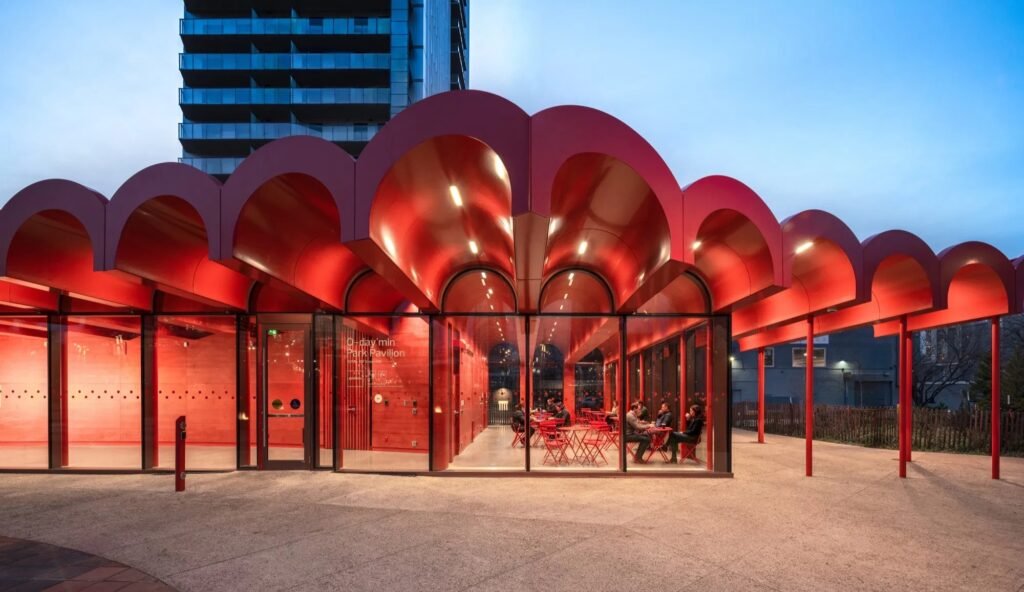
    Also on the list are two projects by Toronto-based gh3*, who some of you might recall are the architects behind our Project Bench. One is Windermere Fire Station and the other is O’Day-Min Pavilion, both of which are in Edmonton and are exceptional.

    I could keep talking about more of the projects, but I’ll end by saying that this is the first time I’m learning about Kìwekì Point in Ottawa (designed by Patkau Architects and Janet Rosenberg & Studio — the landscape firm behind One Delisle). This is reason enough to book a trip to Ottawa.

    Congratulations to all of the winners. For the full list of projects, click here.


    Photography: 900 Saint-Jacques by Maxime Brouillet; O’Day-Min Pavilion by Raymond Chow

  • Housing starts up 63% in Calgary

    The Canada Mortgage and Housing Corporation (CMHC) just published its latest housing supply report for Canada’s 6 largest city regions (downloadable over here).

    One figure that stands out is the increase in housing starts in the Calgary CMA — it was up almost 63% last year compared to 2020. This is a positive indicator for that market.

    It’s also worth mentioning that Calgary’s supply is more evenly split between low-rise and apartment housing. This is in contrast to markets like Toronto, where 3/4 of all new housing is now “apartment”, and in Montreal, where the percentage is even higher.

    My view is that it’s time to get more granular with our reporting of higher density housing. In the above example, we are showing 3 categories for grade-related housing and only 1 for anything outside of that.

    This is our national bias toward low-rise housing coming through.

  • Statistics Canada publishes its wastewater-based estimates of drug use

    In March 2018, Statistics Canada launched the largest “wastewater-based epidemiology pilot test” ever conducted in North America. Over a 12 month period, it collected wastewater samples across the country in order to test for traces of cannabis and other drugs. The pilot captured 8.4 million people in Vancouver, Edmonton, Toronto, Montréal, and Halifax. And it was allegedly timed to coincide with the legalization of cannabis in Canada on October 17, 2018.

    This week Statistics Canada published its findings. While the study does cover over 8 million people, it was not intended to be representative of the entire Canadian population. Some sites, such as Vancouver, had nearly complete coverage of the metro area population. While others, such as the Halifax site, only covered about half of the metropolitan area. In any event, the findings are interesting.

    Above is one example: methamphetamine load per capita for the five study cities. The y-axis is grams per million people per week. And the time period is, again, March 2018 to February 2019. Average levels for Edmonton and Vancouver were found to be about 3.7x higher than those in Montréal and Toronto. There was also no apparent seasonal/monthly variation, which is something else they looked at.

    Here I learned that a large portion of this drug passes through the body unchanged. And so the concentrations they discovered in wastewater is likely a fairly direct indicator of consumption within the population. Stats Canada is still reviewing its findings and evaluating this approach to collecting large scale urban data. But I am certain we’ll be seeing more of these kinds of urban studies.

    Chart: Statistics Canada

  • Do Canadians embrace winter?

    Curbed published an article this week called, Why U.S. cities should stop whining and embrace winter. It is about Canada and how we allegedly embrace winter, which is arguably true, except I think there’s still a healthy dose of whining combined with trips to the south.

    I went ice skating a few weeks ago along the waterfront here in Toronto. It was a cold night and we debated whether we should skate or do something indoors involving Niagara’s finest red wines. We opted for skating and weren’t cold at all. It was great.

    I was reminded of this when I read the line: “The purpose is to get you skating. If you are skating, you are warm.” It is a good reminder that one of the keys to a successful winter space is physical activity. That and hot tubs.

    Photo by Joseph Barrientos on Unsplash

  • 10 city building predictions for 2016

    Dawn by Adrian Popan on 500px.com

    https://500px.com/embed.js

    Few things are better than waking up in the mountains and seeing a notification on your phone that 9″ of fresh snow have fallen overnight, bringing the 48 hour snowfall total to 16″.

    This is what people in mountain towns live for. They ski in the morning and then head to work in the afternoon. I heard a number of people on the mountain today saying that they, “want to be in the office after lunch.” It’s a lifestyle thing.

    On that note, today I’d like to focus on 10 city building predictions for 2016. I’ve been assembling this list over the past few weeks and now that I have had my fill of Utah powder for the day, I’m dedicating the rest of the afternoon to writing.

    These are never easy to put together. But here are my thoughts:

    1. We will see increased migration to secondary cities – outside of the alpha global cities – which offer a higher quality of life, more affordable housing, and the ability to live a particular lifestyle. This includes cities like Austin (creative startup hub) and Denver (outdoor recreation).
    2. As more and more cities wake up to the importance of lifestyle in attracting top talent, I think we will see a lot of cities follow the lead of Amsterdam and create “night mayors” or some other equivalent. These cities will begin to see nightlife as a competitive urban advantage.
    3. Global cities will start experimenting with different land use and property tax reform strategies to try and deal with rising income inequality and eroding housing affordability.
    4. We will see a barbell of residential unit sizes. We’ll see more well-designed small units as a way to try and promote housing affordability and we’ll see larger urban infill units for families and baby boomers who want to live/remain in walkable urban communities.
    5. In line with above, I think we will see a further rethinking of urban spaces. Flexible spaces, unique program mixes, and a continued blurring of public/private spaces. One example of this is the trend towards small private spaces surrounded by generous public/communal spaces.
    6. The Toronto and Vancouver real estate markets will continue to chug along because of low interest rates, a weak Canadian dollar, and increased foreign investment. That said, I think we will see more restraint when it comes to over-the-top luxury product.
    7. We will finally see a disruptive technology product that starts to get people in the real estate industry thinking that change is on the way. This will not be a product that ports an offline experience online; it will a new way of thinking about the industry.
    8. This will be the year that cities stop fighting Uber (and other similar marketplaces). Cities (and lobbyists) will finally accept that this is a new reality and then work to figure out the best way to create policy around it. Edmonton, Alberta has already become the first Canadian city to regulate Uber.
    9. Road pricing will get the attention it deserves in North America. Things will start out slow, but we will finally get ourselves on a path which recognizes that we can’t build our way out of traffic congestion in most major cities.
    10. I will publish a book on becoming a real estate developer.

    Many city building trends and shifts seem to happen in a global way. But I think it’s worth noting that a lot of these predictions were likely written with my North American lens on, and in some cases my Toronto lens on.

    It’s not easy sitting down and thinking about what will happen in the future. But it’s a worthwhile exercise. It forces you to take a stance and then, when the future does come, you can see how well you did. I saw Fred Wilson do this on his blog and I thought it was a great idea.

    Now I would love to hear what you think about my predictions and what yours are for this year. Please let us know in the comment section below.

  • Natural resources drive employment growth in Canadian cities

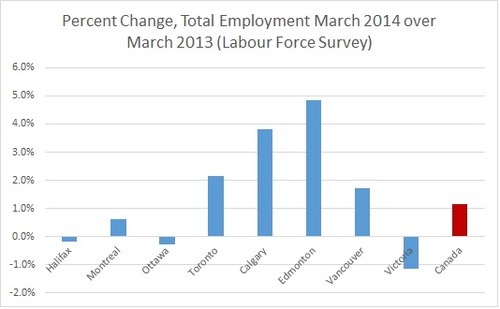
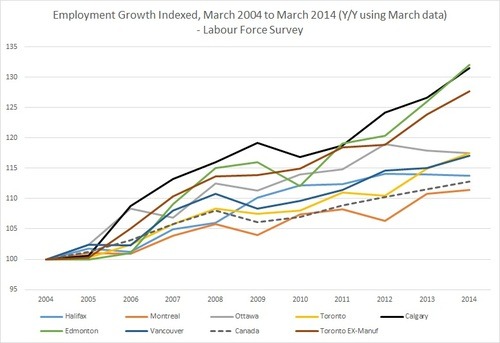
    I was reading Wendy Waters’ All About Cities blog this morning and I came across the following charts showing employment growth across Canadian cities. The first chart shows total employment growth over the last year and the second chart shows employment growth over the past 10 years.

    What is immediately obvious from these charts is that Calgary and Edmonton–both resource driven economies–have and are leading Canada in terms of employment growth.

    Toronto isn’t that far behind though, particularly if you exclude manufacturing from the equation (see second chart). The decline of manufacturing in the Greater Toronto Area really represents a structural change in the economy.

    I wanted to post these charts because, for all the talk about the rise of the information and digital age, Canada’s economy is still very much based on natural resources. We extract and sell. And we have one of the largest proven oil reserves in the world.

    Now, I’m not opposed to this business model, but there’s lots of evidence out there to suggest that resource dependency ultimately hurts innovation and productivity–which makes sense. If we didn’t have resources, we’d be forced to figure out other ways to make money.

    So while it’s great to see our cities growing, let’s not take it for granted.