
I recently started following Adam Nathan’s posts about airlines, airports, and travel in general. This week he posted a comparison between taking the train and flying for 8 city pairs. The comparison looks at door-to-door time, factoring in the time it takes to travel to and from each station or airport; how long check-in, security and boarding take; and then how long you’re actually on board.
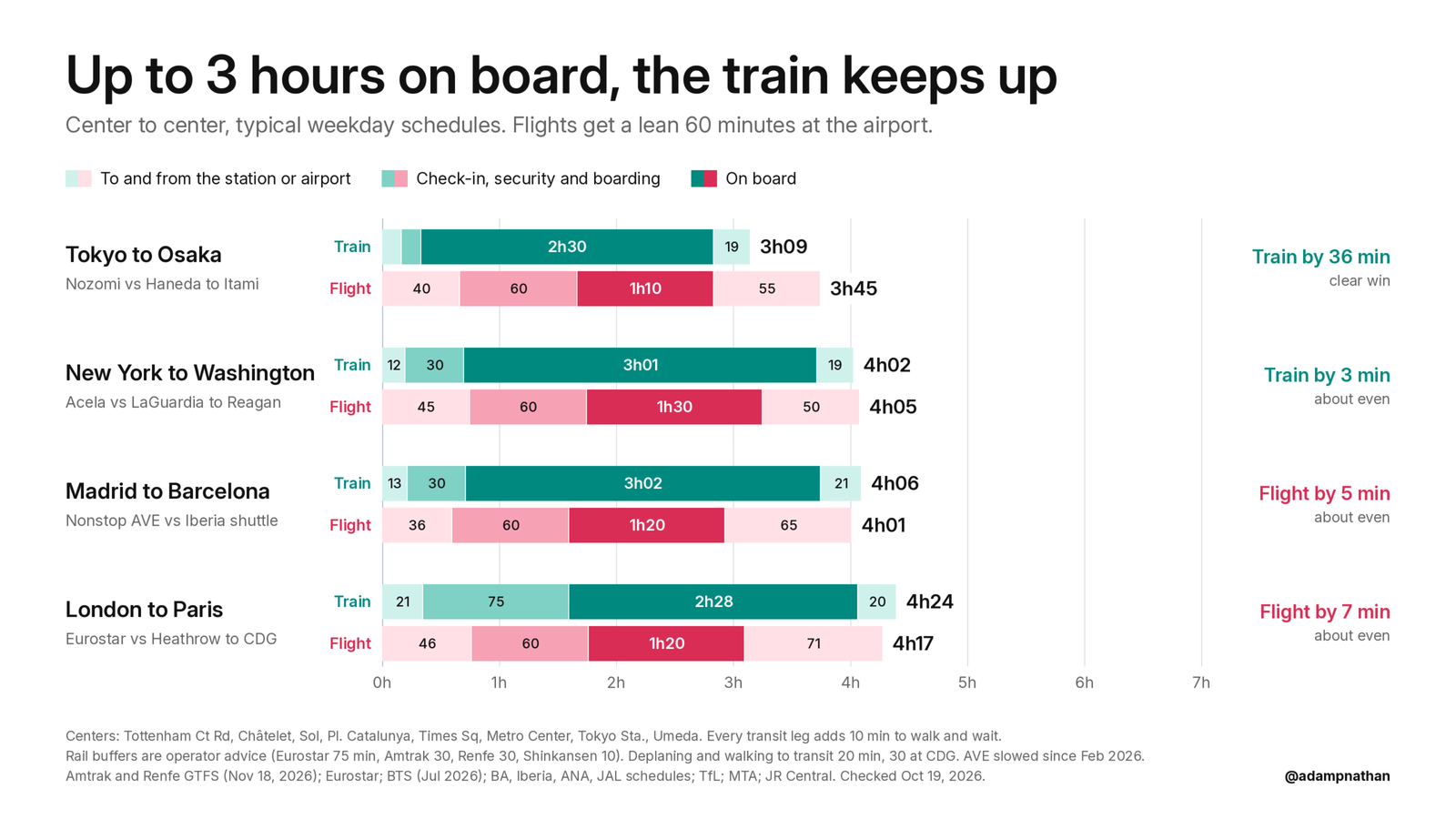
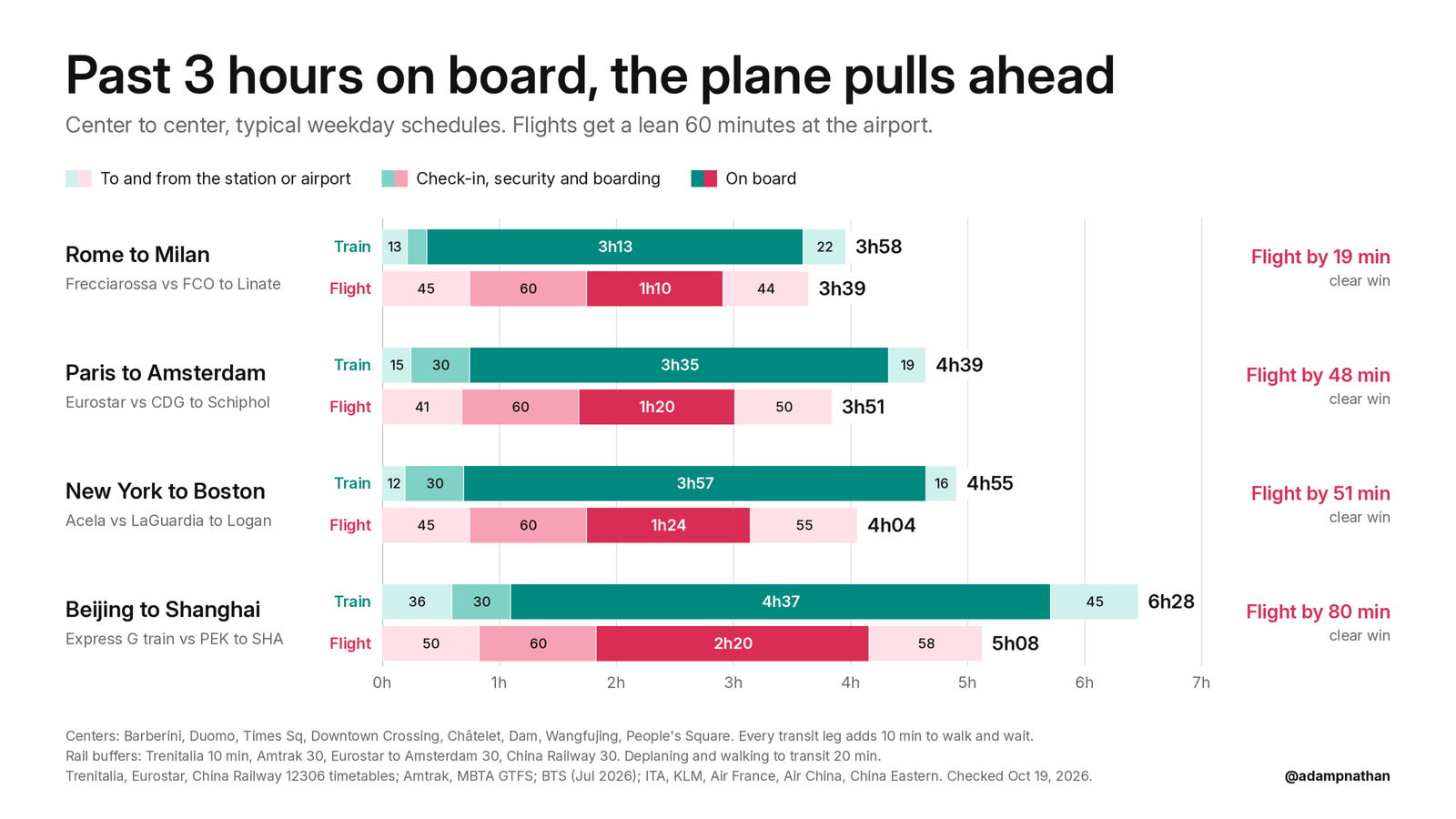
What he found was that 3 hours on board a train tends to be the magic number. Once you pass this duration, travel times tend to flip in favor of flying. The one exception seems to be London-Paris, which is only a 2.5-hour train ride, but has a longer check-in time, presumably because you’re crossing a border in and out of the EU’s Schengen Area.
I’m going to assume that the people planning Canada’s high-speed Alto train are similarly doing rigorous analyses such as these. Good case studies for us are Rome-Milan and Madrid-Barcelona. Both routes have on-board train times of about 3 hours and have a similar distance to Toronto-Montreal.
If you want to ensure that high-speed rail is a success in Canada, make it faster, cheaper, and generally better than flying. This seems to include keeping the on-board time at or below 3 hours.
Leave a Reply