Daily insights for city builders, delivered every morning at 6 AM ET. I’m Brandon Donnelly — a Toronto-based real estate developer and founder of Globizen. I’ve been writing here since 2013.

Tag: train

  • The 50 coolest neighborhoods in the world

    There’s a stretch of restaurants and bars on the south side of King Street, west of John Street, here in Toronto, that I generally try and avoid. I won’t name names, but if you’re from Toronto, you know what I’m talking about. With all due respect to the business owners, I think of this stretch as tourist row. All cities have them. Usually the identifying marker is a human on the street with a menu trying to entice you to come inside and eat. And there’s nothing wrong with that. I can appreciate good street hustle.

    But whenever I’m traveling and trying to find a place to eat, I’ll often think to myself, “Oh man, is this the (insert city name here) equivalent of tourist row? I see people on the street with menus in their hands. Could be.” This is one of the reasons why I like Time Out’s recent “definitive list of the planet’s cultural and culinary hotspots.” They surveyed over 27,000 city dwellers in order to figure out where locals actually want to hang out. The result is the 50 coolest neighborhoods in the world.

    I am somewhat embarrassed to say that, I think, I’ve only been to 6 of them. I have work to do. But Toronto does make the list — once — and it is none other than the Junction. Their recommendations, here. However, one thing they did miss was the Union Pearson Express. That is the way to get to the Junction from Union Station and it is, clearly, still under the radar for most. The number one spot on their list goes to Arroios in Lisbon, which is actually beside where I stayed when I was there this summer. Damn that city is cool.

    For the full list of neighborhoods, click here.

    Full disclosure: I am not a neutral observer. We are developing in the Junction. And I am moving to the Junction (and trying to pretend to be cool).

  • Pritzker Prize-winning architect Kazuyo Sejima designs Japanese commuter train

    In commemoration of the company’s 100th anniversary, Japanese rail operator, Seibu, recently unveiled a new commuter train designed by Pritzker Prize-winning architect Kazuyo Sejima. Sejima is a founding partner in the Tokyo-based firm SANAA, which has started branching out beyond buildings. She recently designed a neat and multi-functional bag for Prada.

    One of the key features of the “Laview” commuter train is its unusually large 1.35m x 1.58m windows. They’re designed to maximize views, as this particular route travels from the city and into the mountains. It’s a simple design move, but it’s one I have never seen before. The overall result is quite beautiful and it goes to show you just how much the Japanese value train travel.

    Images: Dezeen

  • Let’s fix the UPX train, together

    I am a big fan of the UP Express train that runs from downtown Toronto to Pearson Airport. 

    I love the station architecture, the branding and identity, the trains themselves (with wifi), and the local retailers they house at Union. I also happen to live a stone’s throw away from the downtown station. So I can go from door to bum in seat within 10 minutes.

    But despite all this, it has become clear that something needs to be done to fix the UPX train. Just last weekend a friend of mine and fellow urbanist, who was visiting Toronto from Vancouver, sent me a text message saying: “This UPX train is really nice, but why is it so expensive?”

    Indeed, that seems to be the general consensus. Here is the opening paragraph from a recent Globe Editorial article:

    Toronto’s high-end airport express train is a failure. A city that urgently needs better transit has been saddled with a deluxe boutique rail service that cost $456-million to build and runs nearly empty, 19 ½ hours a day.

    So today I thought we could collectively brainstorm some ideas for how Metrolinx – the public agency that operates the train – should address this issue.

    I’ll start by sharing my thoughts as a rider and then, hopefully, you all will share yours in the comment section below. I know that there are people from Metrolinx who subscribe to this blog, so I am sure your feedback will get through to them.

    My thoughts are twofold. Like many others, I think the pricing is off. But at the same time, I think there should be a focus on enhancing the value proposition of the service.

    Bur first, let’s talk about price.

    At the time of writing this, a one-way trip from Union Station to Pearson Airport on the UPX is $27.50. If you happen to have a PRESTO card, it’s $19.

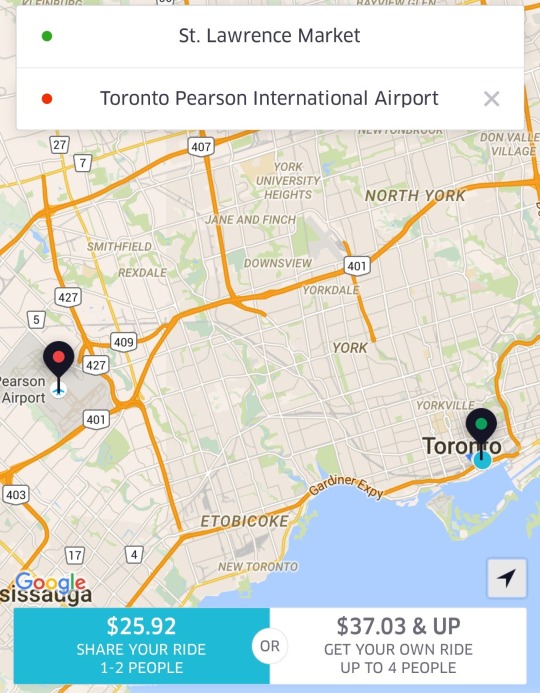
    The alternative for many is probably a taxi. So let’s also look at some Uber fare estimates. For someone like me leaving the St. Lawrence Market area, I’m looking at $25.92 with UberPOOL (meaning I’m sharing the car with 1-2 other people) or $37.03 if I insist on riding solo.
    image

    Against the non-PRESTO fare, UberPOOL is a cheaper option and it’s door-to-door service. Against the PRESTO fare, UPX is potentially $6.92 cheaper. But if you’re someone who has to take the subway to the UPX station, then it’s only $3.67 cheaper (add $3.25 for the subway) and it’s not door-to-door service. So for the vast majority of people, I suspect that UberPOOL would win out in this particular scenario.

    If you happen to be traveling with someone, then UberPOOL and UberX are probably going to be cheaper no matter how you slice it. And again, you’re getting door-to-door service. So I think the consensus is right: fares need to come down.

    But I don’t think Metrolinx should be solely focused on price. They should also be thinking about ways to create additional values for riders. 

    One of my favorite travel experiences is that of Hong Kong’s airport train. There, they have airline check-in counters in the city so you can collect your boarding pass and check your baggage up to a day before your actual flight. This is a huge value add because it means you can check out of your hotel, liberate yourself of your luggage, and spend the day in the city before leaving on the train to catch your flight. You can’t do that with an Uber. And lugging bags around a busy city, sucks.

    My point with all of this is simply that you can’t expect people to pay more or roughly the same, if they are not getting additional value. And right now, the train isn’t door-to-door and taxis are. (Though, the train has a travel time advantage during peak times.) So you either make it cheaper or you create additional value. Or, you do some combination of the two, which is where my head is at.

    What are your thoughts? Please respond in the comments below so all the feedback is public. Thanks.

  • Why Toronto-Waterloo needs all-day two-way urban rail service

    image

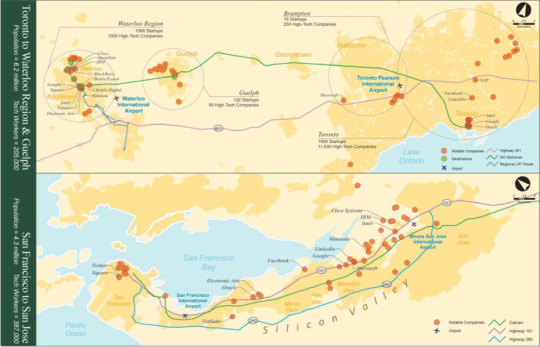
    This morning I stumbled upon an interesting Medium article talking about the need for an all-day two-way urban rail service between Toronto and Waterloo. 

    The argument is that along this corridor sits a technology ecosystem that is second in size only to San Francisco-Silicon Valley and that current connectivity levels represent a missed opportunity of epic proportions. Presently this rail service will feed you into Toronto during the morning rush hour and take you back out in the evening rush hour. But that’s it.

    According to this report prepared by the City of Kitchener (which is beside Waterloo), efficient train service would stitch together an ecosystem of approximately 12,800 technology companies, 2,800 startups, and 205,000 technology employees. It would also connect 6 universities and 4 colleges, many of which are ranked top in the world.

    There’s an argument here that this is exactly the sort of thing that governments should be doing to encourage innovation and entrepreneurship. Rather than trying to be heavily involved in actual startups, they should be creating an environment that maximizes output and then getting out of the way. 

    I think this makes a lot of sense. Don’t you?

    Image: The Innovation Express

  • How much should a ride on the Union Pearson Express cost?

    When I was in Chicago a few weekends ago, one of the things we did was take the train from Midway Airport to downtown. We were a large group, but since it was only $2.25 and we figured it would be easier and faster than contending with traffic, we decided to take it.

    Since it was their local transit service (as opposed to a dedicated airport rail line), the train came within a few minutes and it took us about 25 minutes to get to the Loop. It was a great experience. And I would take it again the next time I go to Chicago.

    I mention this because there’s been a lot of debate in Toronto recently about the potential ticket price for the new Union Pearson Express train to the airport. Some are suggesting that it could cost upwards of $30 for a one way ride, which would also take 25 minutes and would leave every 15 minutes.

    The concern is that at this price, the train will only serve the business community and the rich. And indeed, it’s a lot more than the $2.25 I paid when I landed in Chicago earlier this month. But at the same time the Union Pearson Express promises to offer a more refined travel experience than your regular old subway train. So how should it be priced?

    Pricing exercises are really interesting because, as David Fitzpatrick pointed out in a recent tweet, increasing the price of the ticket will lower ridership. And at a certain point, this will cause overall revenues to also decline (the loss in ridership stops being made up by the higher ticket price). So, in theory at least, there exists a magic, profit maximizing number.  

    Of course, profit may not be the only goal. One might also be interested in reducing the number of vehicles on the road, promoting sustainability, and generally providing people with a convenient way to get to and from the city’s biggest airport. And should this be case, then those factors also need to be worked into the pricing model.

    Now, I don’t know what that magic number should be off hand, but I do think we need to be clear on our goals as that decision is made.

    I personally believe that we underprice roads in this city, which is why we have such a supply and demand imbalance (i.e. gridlock). And so if we decide that rail travel should be a premium service, then I don’t think it’ll do much to correct that imbalance.

  • Balancing progress

    Some buildings should be torn down. And others should not be. The challenge, sometimes, is figuring out which is which. But when a great building is torn down, I get upset. 

    I get upset because good architecture should represent the place and era in which it was built. This means that, in a lot of cases, it’ll never be replicated. When it’s gone, it’s gone.

    Take for example the old Penn Station in New York City. Designed by renowned architectural firm McKim, Mead, and White, the station opened in 1910 and was an iconic Beaux-Arts structure. Here’s an historic photo:

    In 1963 the building was demolished. It was eventually replaced with a building that, I think most people today would agree, is quite awful. And while it did teach New York City a lesson about historic preservation, the loss still sucks.

    Ultimately I think that preservation is about balance. I’m obviously pro-development but, at the same time, I don’t believe in erasing our history.