Daily insights for city builders, delivered every morning at 6 AM ET. I’m Brandon Donnelly — a Toronto-based real estate developer and founder of Globizen. I’ve been writing here since 2013.

Tag: milan

  • Roncesvalles is a great, single-sided, street

    Roncesvalles Avenue is a successful north-south main street in the west end of Toronto. I say successful, because it is truly a great street. It has transit, bike lanes, a fine-grained built form, and lots of interesting retail:

    But it is somewhat unique in that a large section of it is a one-sided retail street. Meaning, it looks like this:

    This obviously isn’t a fatal flaw. It remains a wonderful street. And there are lots of examples of thriving one-sided retail streets. Ocean Drive in Miami Beach immediately comes to mind (notwithstanding the fact that locals tend not to go to it).

    But conventional retail wisdom does dictate that two sides are better than one. Consider this 2023 report by Cushman & Wakefield ranking the top global main streets across the world. All of the streets that I have been to before are two-sided:

    • 5th Avenue in New York between 49th and 60th (above 60th is, incidentally, when the street converts to single-sided because of Central Park)
    • Montenapoleone in Milan
    • The main street of Tsim Sha Tsui in Hong Kong
    • New Bond Street in London
    • Avenues des Champs-Élysées in Paris
    • Grafton Street in in Dublin
    • Passeig de Gracia in Barcelona
    • Bloor Street in Toronto

    These are all two-sided retail streets.

    None of this is to say that the west side of Roncesvalles has nothing going on. It has a diverse mixture of uses, including churches, libraries, apartments, and many other things. But I think there is still an argument to be made that it has been hamstrung by restrictive zoning.

    That said, Roncevalles is defined as a “major street” in Toronto’s Official Plan and so it does fall under the city’s new Major Street Study. Maybe that changes things.

  • Population-weighted densities, compared

    Boy, population densities can be so misleading. The typical approach is to just take the number of people and divide it by a given area. This then gives you something like X number of “people per square kilometer.” The problem with this approach is that there are countless factors that can skew your result.

    Hong Kong, for instance, is really dense. But as a city, it also has a lot of green space, mountains, and other undeveloped areas. Only about a quarter of Hong Kong’s land is developed. So when you divide total people by its administrative boundary area, it is going to appear less dense than it really is.

    One alternative approach is to use a method known as population-weighted density. The way this works is that you take the average densities of smaller more granular subareas and then weight them by the population of each subarea. It is a little more complicated to calculate, but the overall intent is to try and capture a density figure that more accurately reflects what the average person experiences on the ground.

    And this is exactly the method that Jonathan Nolan decided to use in his new website CityDensity.com. What his site allows you to do is compare population-weighted densities across various cities, and then see how it tapers off as you move outward from their city centers.

    Once again, it is hard to beat Paris’ supremely dense mid-rise built form:

    Well, that is, until you check out Hong Kong:

    Charts: CityDensity.com

  • Will Apple Vision make our cities more lonely?

    Okay, so I haven’t tried it yet. But Apple Vision looks pretty awesome and the people who have tried it seem to be very impressed by it. The best article that I have read, so far, is this one here by Ben Thompson (of Stratechery). He gets into some of the tech details and explains why Apple is probably the only company in the world that could have created a device like this.

    For those of you who are interested, Apple Vision is still technically a VR device, even though it is being marketed as an augmented reality (AR) device that allows you to stay engaged with the world around you. This last part is true, but it is all done digitally through 12 cameras that capture the world around you and then display it back to you.

    So experientially, yes, it is an AR device; however, the tech behind it is actually just exceptional VR.

    But this is not the point of today’s post. The point I would like to make is one that Ben raises at the end of his article. After praising Apple Vision’s achievements, he goes on to argue that the arc of technology is one that is leading toward “ever more personal experiences.” In other words, it is increasingly about individual, rather than group, use cases.

    And this is one of the first things that I thought of when I watched the Vision Pro keynote. “Wow, this looks like a really cool way to watch and experience a movie. But how do I do that with my partner? I guess we both now need Vision Pros. And what about families with a bunch of kids? That is a lot of Vision Pros.”

    But maybe this doesn’t matter. Ben’s point is that it’s probably not an accident that this technology arc is happening at the same time as a larger societal shift away from family formation and toward more feelings of loneliness. Indeed, the number of single-person households has been steadily increasing in the US since the 1960s. The current figure sits at more than 1 in 4 households.

    So there is an obviously dystopian narrative that we could all tell ourselves here. It is one where everyone works from home, plugs into virtual workplaces, and then flips over to other, more exciting, virtual worlds when it’s time to unwind from the stresses of the former. And if you think about it, this isn’t that much of a stretch compared to what many of us do today.

    Whatever the case, in my mind, none of this is any reason to become bearish on cities. Humans will still be humans. And none of this tech is going to replace the feeling of enjoying a perfect pesto gnocchi in an impossibly narrow laneway in Milan, or drinking a caipirinha on the beaches of Rio de Janeiro while being surrounded by shockingly beautiful people.

    Or at least let’s hope so.

  • Density is good, but let me explain

    I tweeted this out last week:

    Not surprisingly, the responses were divided. Some responded saying that beauty is more important than density, and a lot of people were quick to point out that there’s good density and there’s bad density. And because I can appreciate both of these comments, it made me think that I should probably elaborate on my glib tweet.

    The points I was trying to vaguely imply are the following.

    More often than not (at least for North American cities), I think our problem is not too much density, it’s too little. This translates into cities that aren’t walkable, aren’t conducive to transit, and that are overall less sustainable. Right now, every mayoral candidate in Toronto is promising to fix our crippling traffic congestion. I don’t know how they’re going to do it, but they’re promising it because they know it’s something people are pissed off about.

    But here’s my take: counterintuitively, the problem is not enough density. The problem is that too many people in our region have no reasonable way to get around without a car. So they’re forced to drive. The way you fix this not as simple as more traffic enforcement or better signal timing. Good luck! You fix it through density, because density is what makes other forms of mobility suddenly possible.

    All of this is not to say that density alone will render you a great city. Obviously things like beauty also matter a great deal. But in my opinion, density is a fundamental component. Because what good is beauty if you don’t have any urban vibrancy? The answer is that you probably don’t have a real city.

    The other point I was trying to make is that space and density are both relative and oftentimes difficult to understand. We think building height and density are correlated, but that’s not always the case. Look at Paris or Barcelona. We also like to make a lot of spatial rules that we think are right and make our cities better: streets should be at least this wide, buildings should be no taller than the width of the street, and so on.

    But here (pictured above) is a street that narrows to around 6 meters and has buildings that are probably 2.5-3x the width of the right-of-way. Sure, it also happens to be beautiful, historic, and Italian. But what would happen if you maintained this same beauty and made the street 5x as wide and lined up parking in front of the stores?

    Somehow it wouldn’t be as enjoyable as what you see here.

  • I love narrow streets

    If you’re a regular reader of this blog, you’ll know that I’m a fan of narrow streets. It’s one of the reasons I have been such a supporter of laneway housing here in Toronto, and why I think they should ultimately allow for some non-residential uses.

    If you have narrow streets and reasonably decent buildings that frame them, you have a base condition that has worked remarkably well since the creation of cities. Almost by default, and even if you don’t have proper sidewalks, it is going to feel pedestrian-oriented.

    The challenge, however, is that it’s usually difficult to create these after the fact. Street networks are powerfully sticky; they generally don’t change unless you have someone like Haussmann rebuilding your city. So if you have these in your city, try and take advantage of them. You’re fortunate to have them.

    The above two photos/measurements are from Milan. Both streets are around 20 feet wide (or 6 meters), which happens to be the required width of a standard two-way drive aisle here in Toronto. It’s a good example of how differently cities can view and allocate space.

    You can do a lot with 6 meters.

  • Which is more “sustainable”?

    These two residential buildings:

    Or this one here?

    Both are located in the Porto Nuova district of Milan.

    And from what I could tell when I walked by them yesterday, they’re pretty comparable. They have similarly deep balconies. And they even appear to have the exact same exterior cladding.

    Of course, the big difference is that the former — the celebrated Bosco Verticale — has about 800 trees, 4,500 shrubs, and 15,000 plants sitting on its 3.3m cantilevered balcony slabs. It also has an elaborate irrigation system that services said greenery.

    Okay, so which is more “sustainable”?

    First impressions would suggest that it’s the former. Trees and green things are good for the environment. So putting trees on a tall residential building must also be good, right? Maybe.

    The main counterargument is that it requires a lot of additional work to get trees, shrubs, and plants onto a tall building. You need more concrete, more structural reinforcing, an irrigation system (maybe not always?), and a way to maintain everything going forward.

    In this case, all of the greenery is a common element, and so it’s maintained by the building and not by any of the individual residents. Among other things, this preserves a uniform aesthetic.

    But all of these additional materials increase the building’s embodied carbon. And so there’s an important question to consider: Do the benefits of putting trees up in the sky outweigh the impacts of actually doing it?

    This is one of the great debates surrounding this project, and it’s a good reminder that being more sustainable isn’t so simple. There’s a lot to balance, and there are countless details to figure out.

    However, innovation does require iteration. And already there are new iterations of the Bosco Verticale, such as this one in Paris, that plan to swap concrete for mass timber construction.

    So even more trees in the sky. That’s probably a good thing.

  • Fashion and design capital of the world!

    The first and only other time that I have visited Milan was over 20 years ago. I was 19 or so, and a close friend and I decided to take the train into Centrale without a place to stay and without a plan, other than to get into some trouble.

    We ultimately succeeded at this ambitious plan. But I clearly didn’t see enough of the city, and I left thinking that it was a bit of a grimy and sleepy place. I was disappointed. I thought it would be fashion everywhere, and it wasn’t for me. And this impression has lingered with me ever since.

    Boy have I been missing out.

    I have fallen in love with Milan on this very short trip. It really is a capital of fashion and design. This is not a city of meandering tourists looking for the Pantheon (okay, there’s still some of that); it is a big city of business and culture. And if I had to compare and contrast it to other cities, I would say this.

    Its built form is not nearly as manicured and as fussy as Paris’. In fact, in some ways, it’s a bit like Toronto. Its overall urbanism is messier, and you have to scratch beneath the surface and sneak into some courtyards before you really uncover its true beauty. But once you do, it’s magical.

    At the same time, its street fashion strikes me as being slightly fussier. There is an effortlessness in Paris that doesn’t seem as pronounced in Milan (though it is still there). Here, there’s a little more flash and a little more, “I’m sexy and stylish, and I would like you to be aware of that.”

    But this is not to say that you won’t see men and women in suits and stilettos riding a bicycle. It still feels effortless. It still feels natural. And when you’re here, you can’t help but feel like you’re probably not stylish enough for this capital of fashion and design.

  • Shutdown and restart

    Very few of us have a mental model for the macro conditions that we are living through right now. We have been through economic downturns, but most of us haven’t lived through a pandemic. I am an optimist and I know that we will get through this and normalcy will return. But one of the questions that we’re all asking ourselves right now is: What will “normalcy” look like on the backend?

    Here is an interesting piece of evidence for the current shutdown:

    When I see pictures of our cities, like these from Italy, I can’t help but think of the life that normally plays out in the streets. The conversations. The chance encounters. And even the smells. Some of that activity has moved to every single balcony in Italy and that is a beautiful thing. But it’s no substitute for true street life. Thankfully, we know that public life will both return and prevail.

    Along the way there will be changes. There are going to be winners and losers. Some companies are going to go bankrupt. And there will be adjustments that we have made that will invariably stick. Are we all going to video conference more? (The obvious one.) Will we all travel less? Will this macro event accelerate our transition to a knowledge-based digital economy? I’m sure it will. Also consider all of the new companies that are being started right at this very moment.

    But as I said on Twitter today, we are social beings. That is one of the reasons why we choose to live in cities. And I am certain that isn’t going away.

    Photo by Kristijan Arsov on Unsplash

  • Multi-storey retail

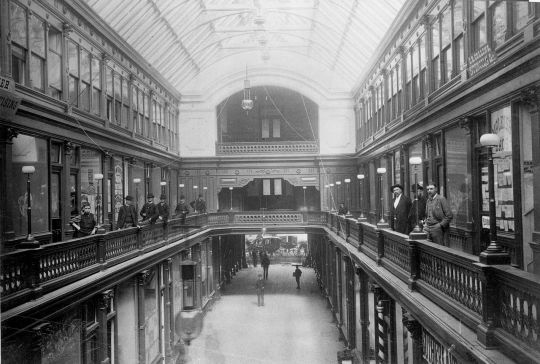
    I was at the St. Lawrence Market over the weekend and I saw a poster up for the original Yonge Street Arcade building, which was located at Yonge Street and Temperance Street here in Toronto. Initially constructed in 1884, the building was ultimately demolished in 1952 and replaced with today’s building by 1960.

    Here is a photo of the original arcade dated 1885:

    image

    The Yonge Street Arcade has been fairly well documented online (check out here and here). But what interested me when I saw the poster was the building’s retail characteristics.

    Modeled after the glass-roofed malls being constructed in Europe at the time – the Galleria Vittorio Emanuele II opened in Milan in 1867 – the Yonge Street Arcade is said to be Canada’s first enclosed shopping mall.

    The galleria was 267 feet in depth and 3 storeys high (pictured above). The ground floor contained 32 retail units, each 12 feet wide by 29 feet deep. 24 of the units were in the galleria and the other 8 faced outward toward each street frontage.

    On the 2nd floor were 20 more units. Some sources say they were intended to be offices, while others say they were retail units. The above photo makes me think they were retail. The 3rd floor then had offices and maybe some artist studios.

    Either way, the mix of uses is interesting (and maybe a first for Toronto). And if you know anything about retail, you’ll know how difficult it can be to successfully pull it off across multiple levels. The Yonge Street Arcade shows that we’ve been (possibly) trying it for well over a hundred years in this city.

  • Sidewalk Labs, Amazon HQ2, and the Milanese Leonardo

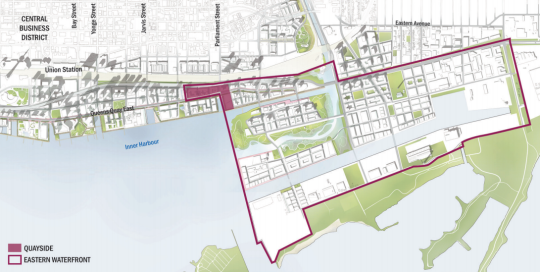
    Earlier this week the WSJ announced that Sidewalk Labs (Alphabet Inc.’s urban innovation organization) is close to a deal with Waterfront Toronto to develop a new 12-acre section of the eastern waterfront. Sidewalk Labs would be their innovation and funding partner. It’s not final yet and it’s still subject to board approval, but the sentiment is that it should go.

    There aren’t a lot of details about the project – other than the fact that it will be fairly big, up to 3 million square feet – but the overall intent is digital city building. It’s about imagining what a city could be if you built it today “from the internet up.” More info about Sidewalk Labs, here.

    I thought of this project as I read Seth Godin’s daily blog post this morning in bed. Here are two snippets from that post:

    When a new technology arrives, it’s often the nerds and the neophiliacs who embrace it. People who see themselves as busy and important often dismiss the new medium or tool as a bit of a gimmick and then “go back to work.”

    There’s never a guarantee that the next technology is going to be the one that moves to the center of the conversation. But it’s certain that a new technology will. It always has.

    Openness matters.

    I’m anxious to learn more details about the project, but this is obviously very exciting. It also creates momentum and strengthens the case for Amazon HQ2 in Toronto. The above 12-acre Quayside area is only the tip of the iceberg. There’s the rest of the eastern waterfront and also East Harbour.
    image

    Some people have been critical of this city’s push for Amazon HQ2. Anthony Lacavera, chairman of Globalive Capital, called this “the biggest Trojan Horse of all time.” His view is that Amazon would simply use HQ2 Toronto as a mechanism for cheaper labor (USD > CAD) and to siphon the best and brightest down to the US.

    Now, I agree that it would be more impactful to create the next Amazon then to simply lure in its second headquarters. Big entrepreneurial successes are what fuel the darwinian evolution of startup hubs. The founders, early employees and investors make boatloads of money and then they start reinvesting that back into the ecosystem by, among other things, backing the next generation of entrepreneurs.

    But does this necessarily mean that an Amazon HQ2 would be detrimental to Toronto by acting as a conduit to the US? Will it discourage entrepreneurship? Should we eschew all US firms out of fear that this may in fact happen? I don’t think so.

    There’s tremendous value in concentrating smart people in one place – ideas build on ideas. And I don’t think technology has been able to disrupt that, at least not yet. One example of this is a theory that Paul Graham calls the Milanese Leonardo:

    You can see how powerful cities are from something I wrote about earlier: the case of the Milanese Leonardo. Practically every fifteenth century Italian painter you’ve heard of was from Florence, even though Milan was just as big. People in Florence weren’t genetically different, so you have to assume there was someone born in Milan with as much natural ability as Leonardo. What happened to him?

    And his reasoning is as follows:

    Nothing is more powerful than a community of talented people working on related problems. Genes count for little by comparison: being a genetic Leonardo was not enough to compensate for having been born near Milan instead of Florence. Today we move around more, but great work still comes disproportionately from a few hotspots: the Bauhaus, the Manhattan Project, the New Yorker, Lockheed’s Skunk Works, Xerox Parc.

    Xerox Parc (Palo Alto Research Company) is a great example of the kind of positive externalities that can happen as a result of smart people being in close proximity to each other while they wrestle with similar problems. It has been well documented that it was Steve Jobs’ visit to Xerox Parc that inspired many of Apple’s early innovations.

    So my view: let’s increase Toronto’s urban metabolism and make it the Florence of 1450.

    Ed Clark – who is leading the charge for HQ2 in Toronto – has been clear that large taxpayer subsidies are not on the table for Amazon. That would not be fair to the existing companies in this city. If that is what it is going to take, then we are not going to win. We will win based on our city, our human capital, and our openness to the rest of the world. That feels right.

    Welcome Sidewalk Labs. Welcome Amazon. This city is open for business and to new ideas. 

    Image: Waterfront Toronto