Daily insights for city builders, delivered every morning at 6 AM ET. I’m Brandon Donnelly — a Toronto-based real estate developer and founder of Globizen. I’ve been writing here since 2013.

Tag: milan

  • Ingressi di Milano

    A new architecture book, called Entryways of Milan, will be released next month that profiles some of the city’s most beautiful residential entryways. There are 144 of them and they are housed in buildings dating from 1920 to 1970. For a sneak peek of the architecture, click here.

    What makes a book like this interesting is that these are private entryways, which means they are spaces that are largely overlooked within a city. They are the spaces that mediate between public (street) and private (residences). The book also dives into things like materials and the art-historical and social significance of each lobby.

    I am now wondering if similar books or photography projects exist for other cities. I think it would be fascinating to compare residential entrance halls across different cities during the same time period. Although the above Milanese lobbies have set the bar pretty high. 

  • Un bosco verticale

    At the end of 2015, the Council on Tall Buildings and Urban Habitat awarded Bosco Verticale in Milan the “2015 Best Tall Building Europe” and the “2015 Best Tall Building Worldwide.” It was the 14th Annual of these awards.

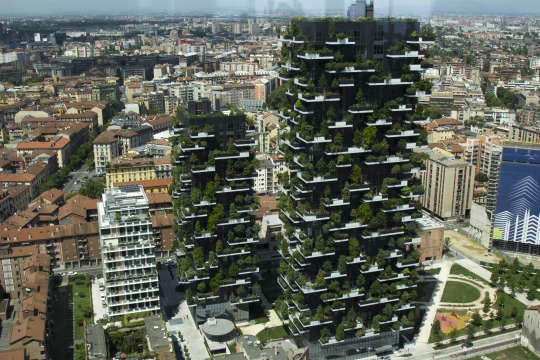
    What makes Bosco Verticale (or Vertical Forest) special is its integration of landscape into the tower building typology. In fact, the architect, Stefano Boeri, describes the project as a “skyscraper for trees that also takes humans.”

    Here is a photo of the two towers via Wikipedia:

    And here is description of the plantings via Houzz:

    “The more than 17,000 plantings include 780 full-size trees of 60 species on all sides of both towers for a suspended-garden visual effect. Among the plantings are holly oak, ornamental apple and beech trees, as well as a great mass of smaller plants, such as lavender, azaleas and camellias, positioned among the trees with taller crowns. The plantings provide shade in summer and help filter the air. The number of trees in each building is the equivalent of 1.7 acres of forestland and 18.5 acres of an urban area with single-family dwellings. The vegetation is watered with a greywater filtration system.”

    This idea is something that has appeared a lot in theoretical projects. But it is still in its infancy in terms of realized projects. So the architect has also published a book explaining – using drawings and photos – how the project works and how it could be reproduced in other cities. It’s in both Italian and English.

    With so many cities trying to build up, as opposed to out, it makes a lot of sense for us to figure out how to make up as livable, enjoyable, and sustainable as possible.

    Photo by Luca Nebuloni from Milan, Italy – Milan_7899, CC BY 2.0, Wikipedia

  • How much does it matter what message a city sends you?

    In keeping with the recent theme about cities, their brands, and the messages they send, I thought I would revisit an old essay (2008) written by Paul Graham (of Y-Combinator) called “Cities and Ambition.” In it, he talks about the various messages that cities send us, such as:

    • You should make more money (New York)
    • You should be better looking (Miami?)
    • You should be smarter (Cambridge)
    • You should be more powerful (Silicon Valley)

    But the most interesting part of his argument is the belief that we are largely products of our environment. No matter how strong or formidable our personalities might be, the message a city sends us is hugely important. In fact, it might be impossible to escape it. Here’s how Paul puts it:

    How much does it matter what message a city sends? Empirically, the answer seems to be: a lot. You might think that if you had enough strength of mind to do great things, you’d be able to transcend your environment. Where you live should make at most a couple percent difference.

    But if you look at the historical evidence, it seems to matter more than that. Most people who did great things were clumped together in a few places where that sort of thing was done at the time.

    You can see how powerful cities are from something I wrote about earlier: the case of the Milanese Leonardo. Practically every fifteenth century Italian painter you’ve heard of was from Florence, even though Milan was just as big. People in Florence weren’t genetically different, so you have to assume there was someone born in Milan with as much natural ability as Leonardo. What happened to him?

    If even someone with the same natural ability as Leonardo couldn’t beat the force of environment, do you suppose you can?

    I don’t. I’m fairly stubborn, but I wouldn’t try to fight this force. I’d rather use it. So I’ve thought a lot about where to live.

    To some, this thought may depress you. I mean, if you happen to live in a city or place with the “wrong” message, you might feel as if you’re missing out. I know that thought certainly crossed my mind when I read his essay. But different messages resonate with different people, and so maybe the message your city is telling you is exactly the one you need to accomplish great things.

    In Toronto, I’d say that the message is similar to that of New York: You should make more money. Oh, and also that you should buy more condos 😉

    What message does your city tell you?

  • In your place

    image

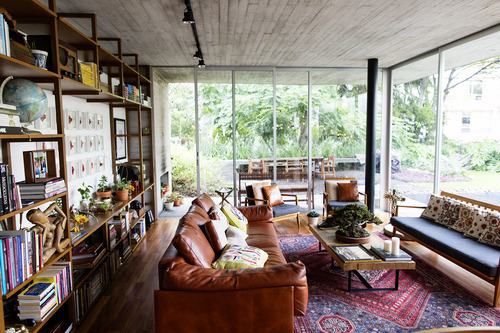
    Ever since I was a kid, I’ve always enjoyed seeing people’s places. I like seeing different homes and I like seeing how people decorate them. Which is why I’m a big fan of photographer Todd Selby’s project, The Selby Is In Your Place

    Starting in June 2008, Selby has gone around and photographed the personal spaces of creative people all around the world–everyone from fashion designers to artists to entrepreneurs. The most recent is the home of Carolina Castiglioni, who is Director of Special Projects at Marni in Milan.

    image

    The project has been a huge success for Todd and his website now receives over 100,000 unique visitors a day. He’s also gone on to publish 3 books. The first was simply called ‘The Selby is In Your Place’. If you’d like to pickup a copy for your coffee table, you can do so here.