
If you’ve ever been to Rome, then you’ve probably been to the Trevi Fountain. It is, arguably, the most famous fountain in the world. And if you’ve ever been to the Trevi Fountain, then you’ve probably thrown change into it, over your left shoulder, and hoped for good things. Lots of people do this. I did it when I was there in 2007 as a grad student. And in 2016, the fountain collected nearly US$1.5 million in change, all of which was (and still is) donated to a Catholic charity. But I can’t help but wonder if this number is declining at all. I mean, I couldn’t tell you the last time I handled physical money, especially coins. Though maybe this is such an entrenched tradition that people seek out change for this very purpose. The desire to want to believe things that aren’t true can be a strong one.
Tag: rome
-
How to create narrow European-style streets
If you’re a regular reader of this blog, you’ll know that I have a thing for narrow streets. Which is why when I travel I sometimes (okay, oftentimes) bring a laser distance measuring device with me. I like measuring things so that I have dimensions that I can feed back into our own development projects. But perhaps most importantly, it allows me to appear as nerdy as humanly possible while traveling. Walking around with just a camera in hand isn’t enough. You need to try harder than that. And so far the narrowest street that I have come across was in Noto, Sicily at just over 1.3m wide.
If you also like to fawn over narrow European streets, you may enjoy this recent video by City Beautiful. In it, Dave Amos compares European cities, like Rome, to US cities, like Salt Lake City and Philadelphia, and then asks: Can the US build European-style street networks? His immediate answer is, “probably not.” And this is something that we have talked about before on the blog. Street networks tend to be really sticky. They’re hard to change. However, there is another possible solution: create new smaller mid-block streets. And that’s the focus of Dave’s video:
But if you think about it, this condition already exists in a number of cities. Here in Toronto, we have somewhere around 300 kilometers of laneways, which tend to range in width from 4 to 6m. These are European-scaled streets and amazingly they’re already in place! The only difference is that, today, they mostly serve a back-of-house function. They provide access to garages. However, that is quickly changing with the introduction of laneway suites. And so over a long enough time horizon, our laneways are going to inevitably flip from back-of-house to primarily residential.
Though maybe there’s even more we could do with this asset. European cities manage to fit retail, restaurants, patios, and more within 6m. Why not do the same with some of our narrowest streets?
-
From unfashionable, dirty, and full of prostitutes, to too many tourists
Cities are complicated. And we have spoken before about how it can sometimes feel like they never really reach homeostasis. In extreme cases, it might seem like they’re either decaying and losing people, or they’re too successful.
I was reminded of this again this morning while reading an article about how Rome’s historic city center is being overrun with Airbnbs and tourists, and how it is pushing out the locals. It has, arguably, become too successful as a tourist destination.

Of course, this problem isn’t unique to Rome. Venice has the same thing going on, though probably to a greater extent. And Amsterdam is currently working to attract more highbrow tourists and to move their red light district out of the city center.
But the question I have is: What’s the right amount of tourism? If 25,000 listings is too many for Rome, what’s the right number? And do cities ever really achieve homeostasis, where, you know, things feel just right? Here’s an excerpt from the above article that describes what parts of Rome were like before the tourism boom:
Ms. Rapaccini remembers when Monti was a quiet, authentic haven for arty types and locals. She and her late partner, the film director Mario Monicelli, who received six Oscar nominations, moved to Monti in 1988. The area was unfashionable, dirty and full of prostitutes, but beautiful in its gritty way, “like a little village” even though it was in the heart of a big, bustling city, she recalls. The apartments were cheap and the area began to attract film types, journalists and artisans – none of them rich – who mixed easily with local workers and shop owners.
It’s a romantic description of what sounds like a pretty gritty area. Unfashionable, dirty, and full of prostitutes is apparently better than full of annoying American tourists. And perhaps it is. But then what was the area like before it was unfashionable, dirty, and full of prostitutes? Was that also better?
I have no idea. But cities are constantly changing and evolving, and they were doing it long before any of us arrived, especially in the case of an ancient city like Rome. Maybe that’s what makes it so difficult to hang onto that exact moment in time when everything was just right.
Chart: Globe and Mail
-
Do the best cities have a lot of immigrants?
I tweeted this out last night while watching old reruns of Anthony Bourdain’s Parts Unknown series. This was a great show. If I were to give everything up and become a YouTuber, this is the kind of travel and food channel I would want to make, except that I would naturally have to add in some equal parts around architecture, planning, and real estate.
The responses to my tweet were of course mixed. Some people agreed and some people didn’t. And a few people provided examples of great cities that aren’t particularly known for their openness to new entrants — places like Tokyo. This kind of response is not at all surprising given how divisive this topic has always been throughout history.
But here’s what I was thinking:
1/ There are some obvious current case studies. Consider places like Toronto and Miami, where foreign born residents now make up the majority of the population. These are two fast growing and dynamic cities that wouldn’t be anywhere near as interesting without their immigrant populations. Certainly the food wouldn’t be as good.
2/ Many of the most beautiful cultures in the world are the result of different cultures coming together. Brazil is one example that comes to mind. Throughout history they have been one of the largest recipients of immigrants in the western hemisphere. Sadly, Brazil was also the last country in the western world to abolish slavery.
3/ Rome and Tokyo were cited (in the comments) as two great cities that frankly aren’t all that diverse. According to Wikipedia, less than 10% of Rome’s population is non-Italian. But Rome, while nice, is provincial these days. And Tokyo, while awesome, has a bit of a demographic problem.
4/ Even if you think a place doesn’t have a lot of immigrants and maybe isn’t all that diverse, it is still probably the result of diverse cultures coming together at multiple points throughout history. Maybe because of immigration. Or maybe because of something bad like war. Think of the Moors from northern Africa who crossed the Strait of Gibraltar and conquered the Iberian Peninsula.
5/ An openness to new people could signal and probably does signal an openness to other things. And since we are living in a world that thrives on innovation and new ideas, being open strikes me as being a fairly good and useful characteristic to have.
6/ Lastly, I come from a family of immigrants. I self-identify as being entirely Canadian. But I had to come from somewhere (multiple places, in fact). And so it strikes me as being odd and entirely selfish to want to block the flow of people now that I’m here and established.
What are your thoughts?
-
Largest cities in the world from 100 to 2015 CE
I just discovered this set of maps (via Brian Potter) looking at the largest cities in the world from 100 CE all the way through to today (well 2015 CE). Here are what the two bookends of this map series look like:


It is an interesting reminder of just how centralized the world was around the Mediterranean and parts of Asia, and also how nothing is guaranteed. As recent as 1900, cities like Manchester and Philadelphia were among the top 10 largest cities. Today they aren’t even close.
For the full map collection, click here.
UPDATE: The data behind these maps has been called into question. Look out for a follow-up post.
-
Airbnb’s S-1 is now public
Airbnb’s IPO documents recently went public.
Not surprisingly, their business as a travel company has been heavily impacted by COVID-19. Last year, the platform saw 326.9 million nights and experiences booked, with 251.1 million being booked in the first nine months of 2019. This year, nights and experiences are down to 146.9 million for this same nine month period. Revenue is correspondingly down from $3.7 billion for the first nine months of 2019, to $2.5 billion for the first nine months of this year.

But what is also clear from their data is that people still really want to travel and have new experiences. As soon as April passed and the Northern Hemisphere entered the normally busy Q3 travel season, domestic travel began to quickly ramp back up. For many, this likely took the place of international travel. See above chart.
Of greater concern might be all of the regulation that now surrounds short-term rentals. As of October 2019, about 70% of the platform’s top 200 cities (by revenue) had some form of regulation impacting short-term rentals. But at the same time, no one city accounts for more than 2.5% of the platform’s revenue. So there’s strong geographic diversification.
If you’d like to take a look at the company’s S-1, you can do that over here. And for those of you who might be curious, these are Airbnb’s top 10 cities based on revenue:
- London
- New York City
- Paris
- Los Angeles
- Rome
- Barcelona
- Tokyo
- Toronto
- San Diego
- Lisbon
-
City guides in the pre-smartphone era

I came across this stack of old Wallpaper city guides while reorganizing a few things over the weekend (because that’s what happens on the weekends now). They are pretty beat up and color faded from travel. It looks like these guides are still being published by Phaidon (along with an app), but it’s been well over a decade since I bought one.
I know the exact time period of the above books because I used to do really nerdy things like date and location stamp them when I got them. The Rome book was July 2007 and I picked it up in Dublin, while I was there working for a real estate developer before the global financial crisis. I also discovered old phone numbers and email addresses written inside of them. Usually it was a Hotmail address.
What I liked about these guides is that they were fairly condensed — good for a long weekend — and they were generally design-focused — perfect for architecture nerds like me. Their restaurant, bar, and club selections were also just fine as a jumping off point. After that it was up to you to make your own adventure.
I sent this photo to my friend Alex Feldman over the weekend — he also went without any sleep in Berlin — and he reminded me what it was like at this time. This was 2007. The first iPhone was just being released. Its map functionality was nowhere near what it is today (or didn’t exist). And I certainly didn’t have one. I had a Blackberry with a plastic wheel on the side. It was basically a giant pager.
To navigate a city at this time meant using a physical map. It also meant getting repeatedly lost and having to ask real people where to go. Alex also reminded me that I made him wander all around Berlin so that I could buy a new pair of glasses. What can I say, this was pre-laser Brandon and I needed cool architect glasses. They ended up being red.
As frustrating as this must have been at times, there’s something nice about traveling without knowing each and every step and without being able to summon an Uber at any point in time to take you exactly where you want to go. In fact, this is probably the central ingredient of all good travel: you need to allow yourself to be open to new experiences.
One of the great lessons of Anthony Bourdain was that you have to get out of your comfort zone. Cities have both highs and lows, but there’s real value and authenticity in the lows if you’re willing to engage beneath the surface. Perhaps that is the irony of old fashioned guide books in the pre-smartphone era. They were supposed to tell you exactly where to go, but they actually helped you find the opposite.
The only city that I never actually got around to visiting from the above stack is São Paulo. As you can tell, Brazil has been on my list for many years. I did make it to Rio de Janeiro a few years ago and São Paulo was supposed to be October 2020. But I’m pretty sure that trip will need to wait. Maybe I should leave my phone at home.
-
Kickstarter: Modern map art
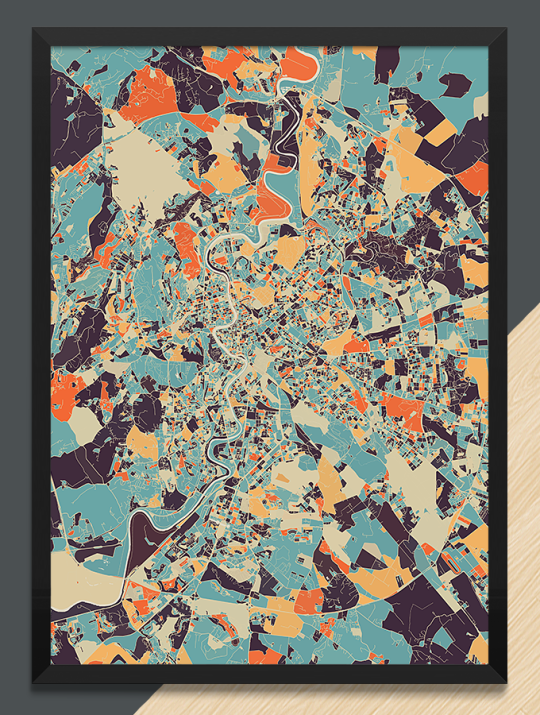
It has been a while since I shared a Kickstarter campaign on the blog and this one caught my attention:
https://www.kickstarter.com/projects/1505932940/map-art-prints/widget/card.html?v=2
If you can’t see the project embedded above, click here.
The project is colorful abstract art maps of anywhere in the world. You can also choose whatever color theme you want.
I think these are beautiful. The print at the top of this post is Rome.
-
Enemies of the High Line
Despite not being the first example of infrastructural adaptive reuse, the High Line in New York has certainly kickstarted an urban trend. Cities all around the world now want their own “version of the High Line.”
Philly is working on a new “rail park.” I toured the space last summer and it’s very similar to the High Line in terms of existing infrastructure. Rome and Toronto are both working on “under” spaces, which are beneath an old viaduct and elevated expressway, respectively. And the list goes on.
But I think it’s worth remembering just how contentious the High Line was before it was built. For some people it was just an eyesore and a public safety hazard. Here’s a excerpt from a New York Times article dated 2002:
“This is a terrific win for us,” said Michael Lefkowitz, a lawyer for Edison Properties, one of 19 businesses that own land beneath the High Line.
Janel Patterson, a spokeswoman for the city’s Economic Development Corporation, said an agreement to share the $11 million cost of dismantling the High Line was being circulated among the property owners and the rail bed’s owner, CSX, of Richmond, Va. “It’s about eliminating a public safety hazard,” Ms. Patterson said, “but it’s also about enabling the city to move forward and better develop the area.”
It’s also worth mentioning that former Mayor Giuliani supposedly favored demolition of the High Line. Former Mayor Bloomberg, however, did not:
…Mr. Bloomberg said: "Today, on the West Side of Manhattan, we have an opportunity to create a great new public promenade on top of an out-of-use elevated rail viaduct called the High Line. This would provide much-needed green space for residents and visitors, and it would attract new businesses and residents, strengthening our economy. We know it can work … . I look forward to working with Friends of the High Line and other interested parties to develop a feasible reuse scenario.”
The challenge with these sorts of things – that is, new ideas – is that we live in a world of proof and precedents. We want to see that it has been successfully done before, because, otherwise, we might be wrong. So now that New York has shown what is possible, it has cleared the way for other cities.
Rethinking old infrastructure is a sound urban strategy. But we also shouldn’t forget that it’s less valuable to be right about something that every other city already believes to be true. The real value is created when you’re right about something that most other cities don’t yet believe.


