
Daily insights for city builders, delivered every morning at 6 AM ET. I’m Brandon Donnelly — a Toronto-based real estate developer and founder of Globizen. I’ve been writing here since 2013.

Category: Uncategorized

  • Standing inventory is clearing out, but a major condo supply crunch is coming

    Urbanation just released its Q2 2026 new condominium sales report for the GTHA (Greater Toronto and Hamilton Area). New condominium apartment sales posted their first year-over-year gain since 2023, with 702 home sales, representing a 52% annual increase. Anecdotally, I will also say that those of us in the industry can feel these winds changing.
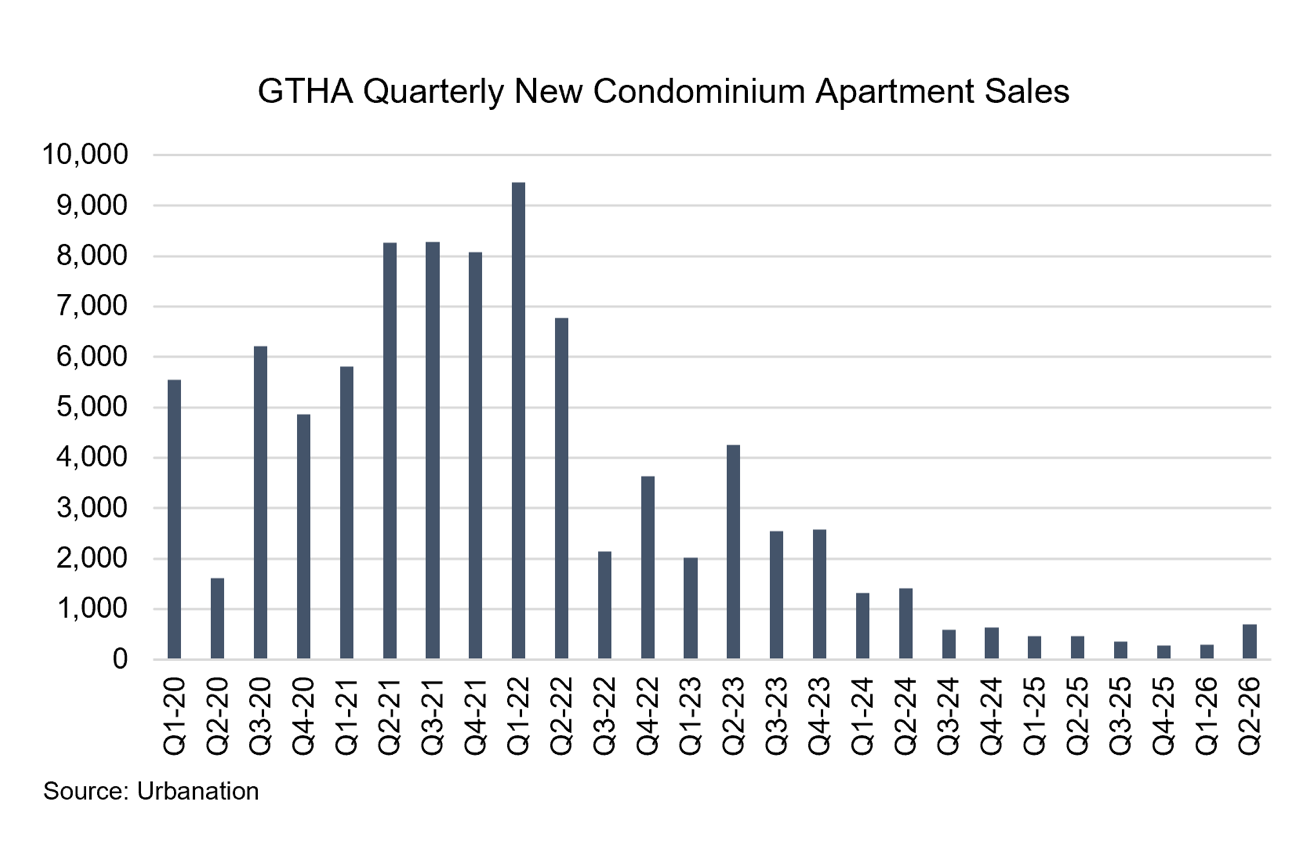
    These figures are still well below the 10-year average, but the market is starting to do what it needs to do, and what the new (and cumbersome) HST rebate is intended to do. Standing inventory is getting sold, and I suspect the second half of this year will look even stronger as the industry figures out how to actually paper and administer this rebate.

    Importantly, the rebate is not helping pre-construction sales (though that’s just one factor). Q2 saw just 50 sales. Basically, nothing. This makes sense because the new rebate requires the purchase agreement to be signed before March 31, 2027. That’s not enough time for most pre-sale programs, but it does create a sense of urgency around standing inventory.

    So, what we are seeing today is a new condominium market that has refound price discovery and is starting to clear out already-built standing inventory, but one that is not producing a meaningful amount of new housing starts. As Urbanation says in its release, “condo supply is set to see its largest ever decline in the coming years.”


    Cover photo by Narciso Arellano

    Chart from Urbanation

  • Housing complexity does not erase fundamental economic laws

    Business in Vancouver just reported the following breaking news: If you build a lot of new housing, it will become more affordable for people.

    Here’s an excerpt:

    Nearly 24,000 rental units are expected to be delivered in the region over the next two years, adding significant supply and intensifying leasing competition, according to Cushman & Wakefield ULC.

    Record construction completions in 2025 and high deliveries in 2026 are pushing down rent growth and creating tenant-friendly conditions, said a first-quarter report from the firm released in May.

    It could take several years to absorb existing inventory, with meaningful rent growth unlikely to resume until 2028, when longer-term supply constraints could re-emerge if development activity slows and immigration resumes, said the firm.

    This is, of course, the YIMBY argument. Increase housing supply, and housing becomes more affordable.

    But critics will argue that housing supply isn’t the main problem. Indeed, there are surveys that indicate skepticism around the overall housing supply argument. Ask people if producing more widgets will lower the price of widgets, and most agree. Ask people if producing more housing will lower the price of homes, and it’s mixed.

    Housing gets a little more complicated because of investors, speculators, foreign buyers, immigration policies, short-term rentals, and other demand-side factors. And at the end of the day, housing supply adjusts to changes in demand at a snail’s pace. So, from time to time, we will get it wrong. We overbuild at the end of the cycle and underbuild at the beginning of it.

    But none of this means that housing supply isn’t fundamental. Understanding the demand side is important, too. But regardless of where we are in the development cycle, when supply outstrips demand, it is going to create downward pressure on rents and help housing become more affordable. That’s exactly what we’re seeing today.


    Cover photo by Peter Skaronis

  • The case for unlocking more urban housing

    Noah Smith, who is a YIMBY urbanist you may know, has a recent piece on his blog called “The American suburbs are better than you think.” I’ll let you all read it on your own, but he goes after some of the common tropes: the suburbs force long commutes, the suburbs are lonely and isolating, and so on.

    But in the end, he more or less lands where I landed in my recent post, “What do homebuyers and tenants actually want?” And that is, there are certainly lots of people who prefer the suburbs (and that’s fine), but we need to get better at building housing within our cities, too. And until we do, we won’t get a clear sense of consumers’ revealed housing preferences.

    Here’s an excerpt from his post:

    I’ve been a relentless advocate of building more dense, walkable cities in America. Not only would this raise GDP (because of improved clustering effects), but it would let Americans live where they want. The demand for life in cities like NYC exceeds America’s willingness to supply these environments; this raises rents in places like NYC, which pushes a lot of people into the suburbs who don’t want to be there. Forcing those city types into the ‘burbs raises rents for people who like suburbia. Basically, everyone would be happy if America had a few more Manhattans and a lot more Brooklyns.

    As I said in my post, I’m all for giving housing consumers as much choice as possible. But the one thing that neither of us touched on in our posts is the simple fact that, as a general rule, urban living is significantly more environmentally sustainable than suburban living on a per-capita basis.

    This is, of course, one of the points of urban greenbelts. They are meant to curb sprawl and encourage intensification. But if we don’t unlock the right kind and amount of housing through intensification, then we are simply constraining supply across the board. We also know that otherwise, developers and consumers will “leapfrog” urban growth boundaries and continue sprawling.

    As an urbanist and developer, I think of it this way: My job is to do what I can to build more dense, walkable communities and figure out (and advocate for) ways to build more attainable housing — specifically, housing that meets the needs of a wide variety of households. And in doing so, I believe that we will retain a segment of people in the city who might have otherwise moved to the suburbs.


    Cover photo by Ivaldo Hadi

  • Canada got re-traded on the Gordie Howe bridge

    I’m trying to understand the new deal that was negotiated for the opening of the Gordie Howe International Bridge (scheduled for July 27, 2026) between Windsor and Detroit. The headlines read: “Tolls won’t be split with the US until the $6.4 billion of debt is repaid. Net revenues will be split with the US for 15 years.”

    As I understand it, the nuance is that the gross toll revenue won’t be split, but the net proceeds — after expenses like debt service, I hope — will be, for 15 years. This is different from the original deal, which had Canada keeping 100% of everything until it had paid off its $6.4 billion debt balance. Importantly, Canada also had complete authority over toll governance.

    This is objectively a worse deal for Canada and we were bullied into it at the last minute with a classic geopolitical re-trade. But how much worse is it?

    The public messaging is that net profits will likely be close to zero, and maybe even negative, in the early years of operations. So it’s not inconceivable that no payments will be made to the US’s local economic development fund until later years. If this is the case, the impact on Canada’s net present value might be negligible. I haven’t seen any of the math, but it’s possible this was a small price to pay to get the bridge open.

    From what I can glean, the most damaging aspects of this re-trade are the following: first, Canada lost sole authority to set its own tolls and govern the bridge — a bridge that we paid for in full! And second, it demonstrates that, at the present time, the US cannot be trusted to honour its agreements.

    Re-trading, of course, happens all the time in politics and business, and the real estate industry is no different. But I would say that there’s a difference between a bad-faith re-trade and a legitimate risk adjustment. Sometimes new information is discovered or the market changes in the middle of a deal, and one party needs a deal adjustment to be able to proceed.

    At the same time, there are also bad-faith re-trades where one party simply wants to apply any leverage it may have, be a bully, and capitalize on deal fatigue. “Ugh, let’s just get this open!” This is a short-sighted practice because it immediately destroys trust and damages your reputation. It may leave you better off on this one deal, but it makes the next ones that much harder.


    Cover photo by Brad Switzer

  • The last-in first-out rule of real estate land

    During development downturns, at least two things tend to be true.

    One, land on the periphery tends to get hit first and recover last. It’s a kind of “last in, first out” principle. During a market expansion, core areas become expensive first, and then demand “spills over” to the periphery in search of opportunity.

    These areas are, therefore, last (or later) to appreciate and first to fall when the market turns. This also means that they’re last to rebound when the market recovers because, generally speaking, demand will start in the core and then move outward.

    And two, execution becomes critical. If you don’t get your product offering right and execute well, you can’t rely on the tide of the market to carry you. We’re seeing exactly this today.

    It is, as we talk about on this blog, extremely difficult to make new projects work in the current market environment, and so few developers are launching and breaking ground, and many projects are getting cancelled.

    But it’s worth pointing out that there are still some projects moving forward, and that’s because they got their product offering right and they executed well. And maybe they leveraged public grants or incentives to help tip the scales of feasibility.


    Cover photo by Ali Köse

  • When old deals come back at new prices

    This has happened to us on more than a few occasions this year. Development sites that we offered on years ago have come back around to us at significantly lower prices. The obvious first thought is, “Shit, good thing we didn’t buy!” At the same time, there’s a reason we didn’t. Typically, it’s because we were trying to make the deal work with a delayed close upon construction commencement, a VTB, or some other form of structure. We didn’t budge on what we needed, and so we didn’t get to a deal.

    When a deal does come back around, it’s interesting to revisit our original pro forma assumptions to see how we did and how our thinking may have evolved. In today’s market, it’s not uncommon for our base rental rates to be even lower than what we were assuming a few years ago. Are we now at the bottom? Only time will tell.

    The paradox of today’s market is that land prices are the lowest they have been since I started in development, but it’s exceptionally difficult to make new projects work. Of course, as soon as it becomes easier to make projects work, land prices will once again reflect that. So if you are looking for opportunities, today’s market is about finding ways to capitalize on cheaper land while protecting for the risks inherent in the current market.

    In other words, you need to be a contrarian. And as we know, if you’re a contrarian and you’re right, there’s a huge upside. But if you’re a contrarian and you get it wrong, well, then at least you went for it! The ideal scenario is that you simply get the timing right, but that involves luck. The things you can directly control are looking at a lot of opportunities, being disciplined in your underwriting, manufacturing structures that reduce risk, and generally being creative.


    Cover photo by Teuku Fadhil

  • What do homebuyers and tenants actually want?

    Since about the mid-2000s, planning policies in the Greater Toronto and Hamilton Area have favoured higher-density development in already built-up areas, instead of on greenfield lands. The objective was to curb urban sprawl, use our already developed lands more efficiently, minimize our environmental footprint, and encourage a built form that is conducive to non-car forms of mobility.

    As an urbanist and promoter of walkable, transit-oriented communities, I applaud this approach. Toronto is far from full. But I also recognize that this has restricted housing supply and shifted the market toward housing types that cost more to deliver for homebuyers and tenants. Reinforced-concrete buildings are more expensive to construct than wood-framed houses in the suburbs. The most affordable housing markets tend to have highly elastic supply.

    A recent report by Frank Clayton for the C.D. Howe Institute agrees. Planning policies in the Greater Toronto and Hamilton Area have become disconnected from consumer preferences, limiting the kind of housing supply that people want the most: grade-related housing. The proposed solution is to increase the supply of serviced greenfield land, reduce the barriers to development, and diversify the housing types built in our traditional suburban subdivisions.

    I think this is an important topic, and I have two immediate thoughts.

    Firstly, is it really true that Canadians and residents in the GTHA have an overwhelming preference for grade-related housing? The 50 people who responded to my Twitter poll seem to generally think so, but as I have argued many times before on this blog, I think it’s hard to know exactly right now. There could be a large segment of households who might prefer to live in a mid-rise courtyard building with a large private green space in the middle and lots of ground-floor amenities. Until this becomes an available housing option, we won’t really know.

    Secondly, unlocking additional greenfield land does very little to change the market forces playing out within our existing urban areas. The Toronto CMA lost about 77,500 people last year to domestic outmigration, presumably because they found greater economic opportunity and/or more affordable housing elsewhere. At the same time, 92% of the housing starts in the City of Toronto in 2025 were apartments. This is not because we’re holding back greenfield land within the city proper boundaries, it’s because intensification is the only option left.

    The broader CMA is a different story. Only about a third of its land area is physically urbanized. The remaining two-thirds is heavily restricted by environmental protections, which is precisely where Clayton sees opportunity for more grade-related housing. “Housing policy cannot succeed if it ignores consumer demand,” says Clayton. “Canadians continue to aspire to ground-related homes. Planning for the housing people want, rather than simply counting units, is key to restoring affordability.”

    I’m all for giving housing consumers as much choice as possible. Not everyone would prefer a Parisian apartment to a house in the suburbs (which is what the algorithms will tell you about me). But let’s not forget that we have yet to solve this problem: How do we create attainable family-friendly housing at scale in our existing urban areas and reorient the city toward a post-car future? Toronto is now an apartment city and this is only going to become even truer, regardless of what happens on the periphery.

    Change is starting to happen with our new major street and multiplex policies, which can be a form of grade-related housing. This typology is just denser, often has no parking, and is delivered in an urban, transit-supportive format rather than a car-dependent subdivision. To argue that “planning policies have missed the mark” is not wrong, but we’ve also been missing the mark by not building enough of what people may want within our urban areas.


    Cover photo by Dillon Kydd

  • Why the office market will eventually rise again

    July 13, 2026 · View original


    Real estate development is cyclical. Supply adjusts slowly to demand, and so it’s common for developers to get ahead of their skis and build too much space. This is what happened in the 1980s when American developers built more office space than in all previous years of the republic’s history (yes, it’s true), and then nationwide vacancy rates went from 4.6% to 16.9%. And it’s what happened following the dot-com crash when office vacancy in Silicon Valley went from almost 0% to over 20%.

    Today, things feel kind of similar.

    According to Cushman & Wakefield, nearly 37% of the office space in downtown Seattle is now vacant. Since 2020, it is estimated that these office properties have in aggregate lost about $15 billion, or almost half, of their value. This has people repeating the regular refrain that “this time is different” and that “the office market may never come back.” And indeed, the commonly held belief is that this time isn’t just cyclical, it’s also structural. How and where we work has changed.

    But unless you believe that offices as a spatial construct will fully cease to exist at some indeterminate point in the future, then the reality is that the demand curve has simply shifted. We may not need office space in quite the same way, but we will still need some office space. This means that, at some point, we will find a new supply-and-demand equilibrium and, at some point, developers will get back to building, and overbuilding, office buildings. It’s just impossible to determine when that might be.


    Cover photo by Zhifei Zhou

  • Toronto is now an apartment city

    July 12, 2026 · View original


    The way CMHC typically tracks and categorizes housing types is as follows: single, semi-detached, traditional row, and then everything else. This “everything else” bucket is called “apartment,” and it includes high-rise apartments, mid-rise apartments, low-rise apartments, duplexes, triplexes, multiplexes, and anything else that doesn’t fit into one of the other categories.

    This taxonomy reflects our bias toward single-family, grade-related housing because if you look at the distribution for a city like Toronto, it doesn’t really make sense to do it in this way. For example, if we were to look at housing starts in Toronto proper for 2025, the distribution looks like this:

    – Single: 5.2% – Semi-Detached: 0.4% – Row: 2.5% – Apartment: 92%

    If we were to look at the entire Toronto CMA, the distribution updates to the following:

    – Single: 12% – Semi-Detached: 0.5% – Row: 14.2% – Apartment: 72.8%

    Do we really need a separate category for semi-detached houses? And would it not make sense to get a bit more granular with the apartment category given that it’s basically what we’re building these days? Obviously, markets vary, but in the case of Toronto, we have flipped to an apartment city.

    Now, if you were to look at an aerial view of the Toronto CMA, you would see the opposite. You would see concentrations of towers surrounded by seas of low-rise housing, and you would be forgiven for thinking differently about the city. But this is a lagging indicator. The leading indicator is housing starts, and it’s pretty clear what that is saying.

    These are important stats to think about because they help illustrate the housing problem that needs to be solved. Last year, Toronto saw a net domestic out-migration of 77,500 people. One possible explanation is that some of these people left for more affordable, single-family housing. For the sake of argument, let’s assume that’s the case.

    A portion of this segment may only be interested in single-family housing, and if that is the case, Toronto will never again create the housing they want at scale. But I would wager that there’s another meaningful segment that would have stayed in Toronto if only they could have found housing that met their needs. And that is the opportunity that exists today for city builders.

    We know that apartments are the future of Toronto, but we also know that they can take many forms, from 100-storey towers to small “missing middle” projects that are still grade-related. The housing solutions we seek are necessarily going to lie within the black box we today call “apartments.”


    Cover photo by Venrick Azcueta

  • Architecture for today

    July 11, 2026 · View original


    Periodically, Twitter will surface posts for me that bemoan modern architecture and advocate for good old-fashioned traditional architecture. Sometimes these posts will share a modern building with a disparaging comment like, “Imagine wanting this over traditional architecture,” and sometimes I will engage because, yeah, I would prefer the modernist building to traditional architecture.

    But let’s be clear: I don’t have an issue with traditional architecture done well, and there are also countless examples of “modern” architecture that I think are truly abysmal. This is not about architectural tribalism. I love Paris and think it is beautiful, but I also think Brazil’s equatorial brutalism is equally beautiful. Both feel authentic.

    Here’s how I would describe my position.

    First, focusing on one style or another is not the goal. Many contemporary architects think of “style” as a bad word. It implies a superficial veneer. Great architecture aims to be something deeper and more intentional. It solves problems, responds to specific conditions, and also presents new ideas.

    Second, the beauty of art, architecture, and design is that they are never created in a vacuum. They always reflect the current cultural environment. The challenge I have with traditional architecture is that I find it curious to try to speak to a moment in time that no longer exists. I am much more interested in authenticity and what the future might bring.

    And third, movements take time. It’s easy to romanticize the past as being better than our current environment. Whether we’re talking about Impressionist painters or architecture free of ornament (in the case of modernism), it is intellectually easier to think the old ways were better. But history has shown us that posterity will almost certainly come to see things differently.


    Cover photo by laura adai