Daily insights for city builders, delivered every morning at 6 AM ET. I’m Brandon Donnelly — a Toronto-based real estate developer and founder of Globizen. I’ve been writing here since 2013.

Tag: madrid

  • The rooftops of Spanish architect Alberto Campo Baeza

    I love the contrast in this villa between the more private spaces, which are housed in a brutalist concrete structure, and the more public spaces, which sit on top and are housed in minimalist glass box that is reminiscent of the Farnsworth House.

    All of this was done in order to maximize views of the surrounding mountains from this upper floor. But it also creates a certain lightness within the next landscape. And I’m sure that the views out are that much better after emerging from such a contrasting space below.

    Located to the southwest of Madrid, the villa was designed by Spanish architect Alberto Campo Baeza in 2000. It’s called the Casa de Blas and it’s currently on the market for €850,000. Listing information over here.

    But I would also encourage you to check out some of the firm’s other work. It’s absolutely magical. One of my favourites is the House of the Infinite, which was designed in 2014 and, in my mind, shares some similarities with the above villa.

    In both the Blas House and the House of the Infinite, the rooftop spaces feel like everything. In some ways, they have been privileged over almost everything else. And so instead of wanting to be inside the houses, the architecture seems to pull you toward wanting to be on top of them.

    Image: ArchitectenWoning
  • Standard elements in non-standard ways

    A few people have now sent me this TED talk by architect Débora Mesa Molina. But I watched it for the first time today. I guess my personal brand is pretty closely associated with architecture and design.

    In it, she talks about her firm’s approach to using overlooked and/or standard building materials in unconventional ways. For example, here, she used stacked precast beams to assemble a house in Madrid (c.2008). The entire structure came together in only 7 days.

    My first reaction is that I like the idea and approach — which is really quite interesting — more than the final designs. I am also curious if there were any cost savings as a result of using “standard” materials. What are your thoughts?

  • One lease for the world

    image

    If you’re looking for more evidence that the way we live and work is changing, then check out a new startup called Roam. They describe themselves as an international network of communal spaces. So far, they have locations in Ubud (Bali), Miami, and Madrid. Buenos Aires and London are coming soon.

    The way it works is that you start by signing a lease for either a week or a month. You get a private room and bathroom, but everything else, from the co-working spaces to the kitchens, are shared amongst the community. Like other co-working and co-living environments, the community they build is critical.

    However, what really differentiates Roam is that you can sign one lease and then live all over the world, freely traveling across their properties. All of the locations are offered up at the same price and you can stay for as long as you’d like.

    In my line of work, I don’t have the flexibility of living like a global nomad. But today, there are many people who can. And I also know that there are many people who would prefer to live like this. It’s liberating in so many ways.

    My friend and I actually had a similar idea to this back in University and we spent some time working on it. At the time, and this was over a decade ago, we felt that there was a segment of people who increasingly wanted to live like global citizens. I still believe that to be true and, clearly, so do others.

    To date, Roam has raised $3.4 million in funding.

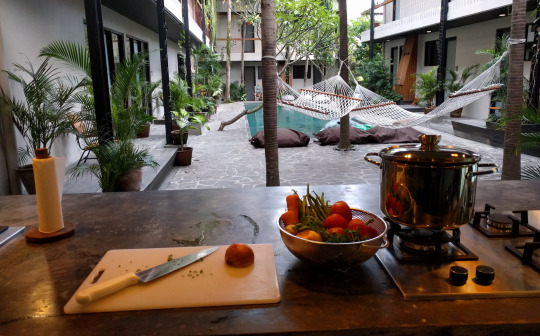
    Image: Ubud kitchen via Roam

  • Urban population densities, compared

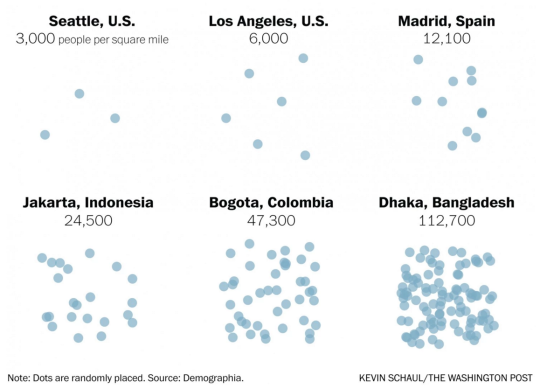
    Earlier this month The Washington Post published an article called, There’s no such thing as a city that has run out of room.

    And what it was really about was that when we say there’s no more room (I guess people are saying this), we are really saying that we just don’t want to allow anyone else to become our neighbor. Because the reality is that urban population densities vary widely around the world. So how can you really call a place full?

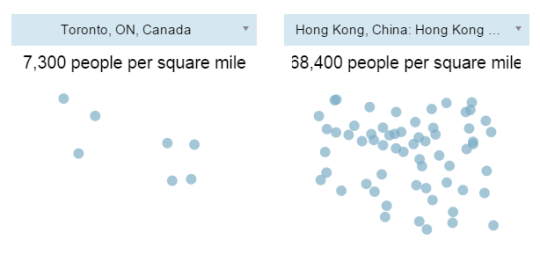
    I’m not sure I feel this pain point as much as the author, but I always find population densities to be a fascinating topic. And accompanying the article was a tool – using data from Demographia – that allowed you to compare the population densities of various cities.

    Here are are two scenarios I ran:

    It’s important to keep in mind that these numbers are averages for the entire economically contiguous region. So it tells you nothing about the potential spikiness of certain areas. That’s why the population density of New York (which includes portions of New Jersey and Connecticut) probably seems low to you.

    Still, it’s fascinating to see how extreme some cities – including some first world cities like Hong Kong – can be. Clearly many cities have a lot of room to become a lot more dense. And I think that would be a good thing.

  • On boulevards vs. freeways

    Toronto’s Director of Urban Design, Harold Madi, recently did a 20 tweet series on boulevards. And since today is Gardiner East day, it seems appropriate to share it with you all. Thanks to Shawn Micallef for using Storify to put it all together neatly. If you can’t see all the tweets below, click here.