Daily insights for city builders, delivered every morning at 6 AM ET. I’m Brandon Donnelly — a Toronto-based real estate developer and founder of Globizen. I’ve been writing here since 2013.
Vishaan Chakrabarti is an architect based in New York City. He is the founder of Practice for Architecture and Urbanism (PAU) and the author of two books.
His first book, published in 2013, was A Country of Cities: A Manifesto for an Urban America. And as the title suggests, it was about the virtues of dense urban agglomerations. You know, the kind of cities that I like and have good bike lanes.
His second book, which just came out, is called The Architecture of Urbanity: Designing for Nature, Culture, and Joy. In this one, he talks about the role of architecture and urbanism in fighting both climate change and social division.
Below is an excerpt from a recent interview in Bloomberg where he discusses the book’s theme of “social friction.” This snippet is also a timely follow-up to yesterday’s post about autonomous vehicles:
Cars are problematic when it comes to connective design. It doesn’t matter if they’re electric because the problem with a car is it’s a divider. It’s a metal bubble and it keeps you from interacting with your neighbors. So the virtues of mass transit, public parks and well-designed buildings in cities are not just that they are good for the climate. They are also good for this sense of social coherence. If we’re going to live up to our promise as a country — a multicultural democracy — we need to have spaces that both reflect and perpetuate that.
I haven’t read the book yet, but it sounds like it’s in the wheelhouse of this blog. If you’d like to, here’s a link.
In this last one, he specifically talks about things like price gouging (starting with the grocery industry) and apartment rent controls. Each is worth a full read when you have the time, but here I’ll leave you all with a few city building-related thoughts.
Marks describes economics as the study of choice. And within these choices, there are many complicated moving pieces and second-order consequences. Take, for example, rent control in New York City. What rent control does is stop the free market from being able to freely set rents. The result:
A person in favor of this arrangement would argue that it maintains affordability and diversity. What it means in purely economic terms is that some people who couldn’t afford to live in New York City if rents were set by free-market forces are able to live there if they’re lucky enough to secure an apartment with regulated rent. But other people who would like to live in New York City and can afford higher rents can’t do so because there are no apartments for them. And lastly, landlords that have apartments that are somehow unregulated can command higher rents than would be the case if additions to the supply of apartments weren’t being discouraged. It’s a matter of personal philosophy whether this is good or bad. But clearly, the laws of economics and the actions of free markets aren’t at work in New York City. Someone in government is making the decisions.
Much like inclusionary zoning in the case of new housing, the tradeoffs with regulated rents are that you get (1) less overall housing supply and (2) more expensive prices for the people that can pay market rents.
You could argue, as Marks suggests, that these are acceptable outcomes; but regardless of your opinion, there are real consequences to this policy decision. There’s no such thing as a “free lunch” in economics, and consequently there’s no such thing as no-cost affordable housing. The question is: Who pays?
Going back to the topic of traffic congestion from yesterday’s post, Toronto’s general reluctance to implement any form of road or congestion pricing is also an economic choice. We have priced our roads so cheaply that demand is always going to outstrip supply. And this is expected. What we are experiencing today is a natural market outcome.
Targeting bike lanes as part of the problem is meant to counter this by increasing road supply. Less bike lanes means more space for cars, right? But the second-order consequence of this choice is that you push people off their bikes (which take up less road space) and into cars (which take up more road space). So demand is also likely to increase.
The stark reality of solving traffic congestion is that it will require greater change. It will mean fewer people driving, more people taking transit and biking, and the people who do continue to drive will have to pay more for it.
Of course, this is not what any politician wants to talk about. As Marks says: “In the world of politics, there can be limitless benefits and something for everyone. But in economics, there are only tradeoffs.” The tradeoff we have decided to make is cheap roads in exchange for crippling traffic congestion.
Roncesvalles Avenue is a successful north-south main street in the west end of Toronto. I say successful, because it is truly a great street. It has transit, bike lanes, a fine-grained built form, and lots of interesting retail:
But it is somewhat unique in that a large section of it is a one-sided retail street. Meaning, it looks like this:
This obviously isn’t a fatal flaw. It remains a wonderful street. And there are lots of examples of thriving one-sided retail streets. Ocean Drive in Miami Beach immediately comes to mind (notwithstanding the fact that locals tend not to go to it).
But conventional retail wisdom does dictate that two sides are better than one. Consider this 2023 report by Cushman & Wakefield ranking the top global main streets across the world. All of the streets that I have been to before are two-sided:
5th Avenue in New York between 49th and 60th (above 60th is, incidentally, when the street converts to single-sided because of Central Park)
Montenapoleone in Milan
The main street of Tsim Sha Tsui in Hong Kong
New Bond Street in London
Avenues des Champs-Élysées in Paris
Grafton Street in in Dublin
Passeig de Gracia in Barcelona
Bloor Street in Toronto
These are all two-sided retail streets.
None of this is to say that the west side of Roncesvalles has nothing going on. It has a diverse mixture of uses, including churches, libraries, apartments, and many other things. But I think there is still an argument to be made that it has been hamstrung by restrictive zoning.
That said, Roncevalles is defined as a “major street” in Toronto’s Official Plan and so it does fall under the city’s new Major Street Study. Maybe that changes things.
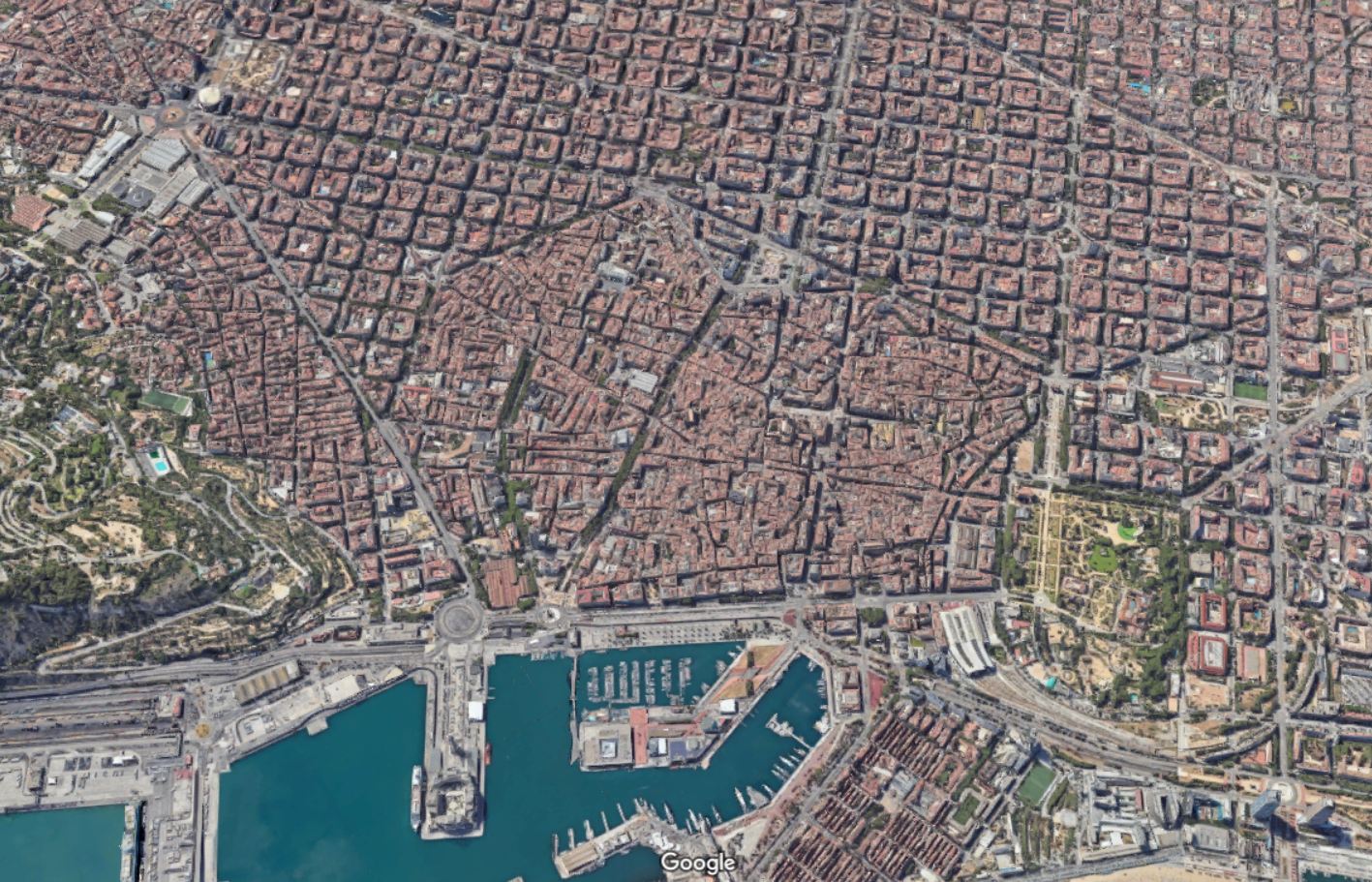
Let’s continue with our theme of city blocks and talk about another city with a noteworthy street grid: Barcelona. Up until the middle of the 19th century, Barcelona was a tiny medieval city hemmed in by 6 km of walls and totalling just over 2 square kilometers. If you look at a map of the city today, it’s pretty easy to see where this was:
This was of course done for military purposes. Barcelona’s medieval walls helped the city resist siege after siege. But the result was also overcrowding, unsanitary conditions, and a generally low life expectancy. So after much debate, it was eventually decided that the walls would need to come down and that the city would need to expand outward.
This then raised the question: how should it be done?
Enter a civil engineer named Ildefons Cerdà. Created in 1860, the Cerdá Plan for Barcelona was a continuous grid of blocks intended to guide the future growth of the city, similar to what the Commissioners’ Plan did for Manhattan. The blocks measured exactly 113.3 by 113.3 meters and each was to have a central open space of at least 800 square meters.
In his original plan, the streets were to be 35 meters wide. But supposedly these were narrowed to no more than 20 to 30 meters due to criticism from the public. Wide streets and more lanes were, I guess, not seen as a benefit in the second half of the 19th century. Either this, or landowners simply wanted bigger buildings.
The Cerdá Plan got approved in 1860 and, today, the city looks like this:
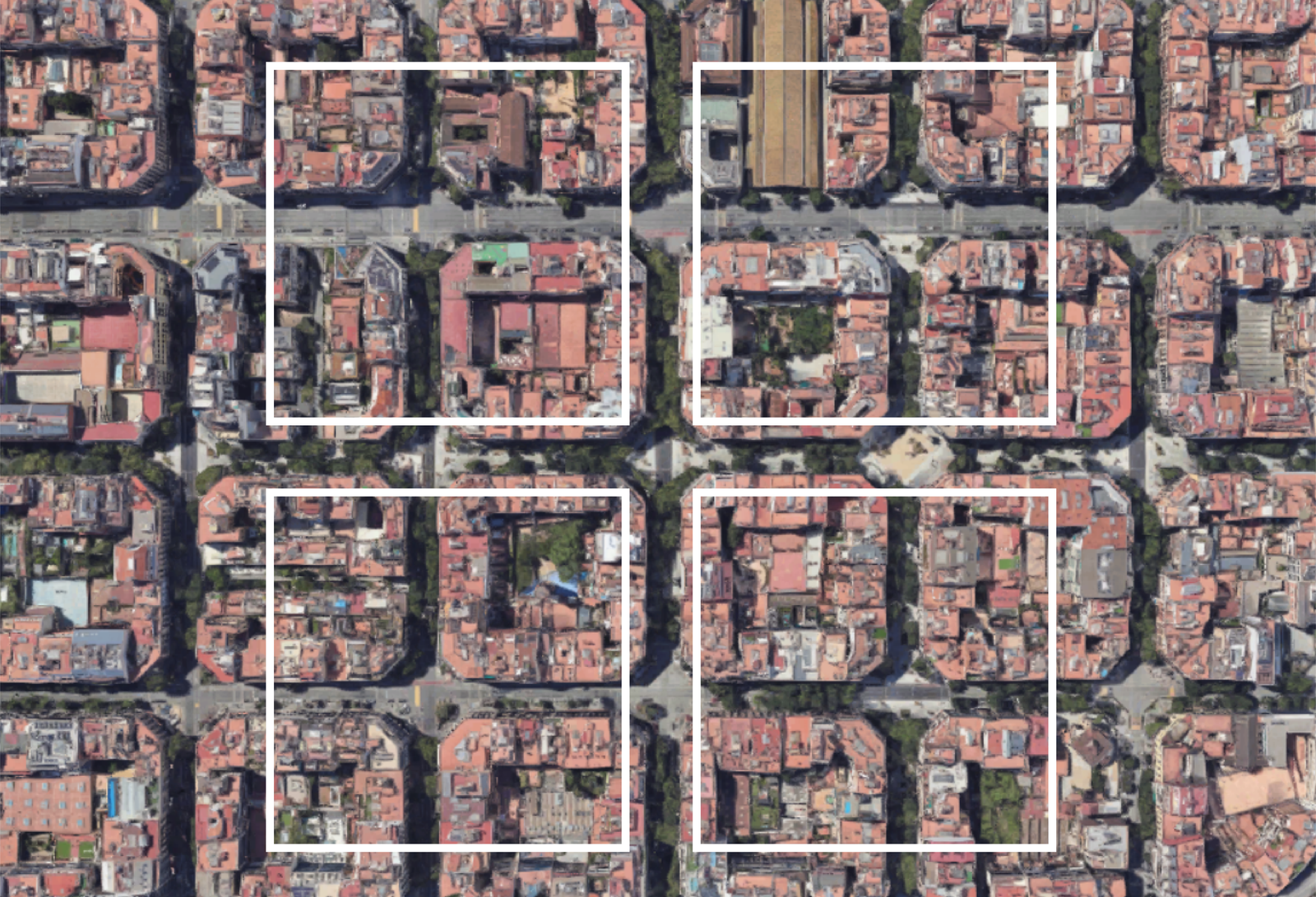
One particularly unique feature of this plan was that the blocks all had/have chamfered corners. This improved visibility at the intersections, as well as created opportunities for public spaces and other uses. For better or for worse, today, you’ll find parking for cars and scooters, bike share stations, ramps leading to underground garages, patios, and more.
The heights of the buildings on each block were also intended to be capped at a consistent height. But even with relatively few tall buildings, the Cerdà Plan led to one of the densest cities in Europe. Today, it is also viewed as a highly livable and desirable city. Hence why the city announced a total ban on short-term rentals. Too popular.
Now for a comparison. Last week we spoke about Salt Lake City’s large city blocks (here and here). And so for fun, here’s what these blocks would look like on top of Barcelona:
The most obvious takeaway is that Salt Lake City has larger city blocks than Barcelona, and that’s one reason why, objectively, Barcelona is more walkable and urban than SLC. But I think you could also view this graphic as a tremendous opportunity.
Barcelona is in the midst of rethinking its urban fabric around something called “superblocks.” The idea here is to cluster blocks together and then concentrate transit and vehicular traffic along its edges, creating a more pedestrian-focused center. For example, in its largest form, a superblock might be a 3 x 3 grid, creating a grouping of 9 city blocks.
But it doesn’t necessarily need to be a 3 x 3 grid. Other permutations are possible and the city plans to eventually introduce over 500 of them.
The first superblock was implemented in 2017 and, not surprisingly, it improved air quality, increased quietness, and led to a significant decrease in car usage (-92%). Interestingly enough, it only led to a moderate increase in car traffic on surrounding streets (+3%). Traffic can be a funny thing.
Creating superblocks out of smaller blocks is naturally easier than the opposite. You have an existing grid to work with. But there’s no reason that the opposite can’t also be done. And I think that’s one way to look at Salt Lake City’s street grid. It already has its superblocks. Now it’s just a question of creating all of its smaller blocks.
Our growing desire — and ability — to live, work, and/or play in other places is, in my opinion, a powerful macro trend. We spoke about that here, here, and here. And one of the things that has obviously empowered this trend is the growth of short-term rentals.
But right now, the winds are not in favor of this model.
In September 2023, nearly a year ago, New York City enacted one of the strictest short-term rental laws to date, requiring hosts to be physically present while a dwelling is being rented. Yeah, that eliminates the majority of use cases.
Then in June of this year, Barcelona mayor Jaume Collboni announced a complete ban of short-term rentals starting November 2028. This is expected to return some 10,000 apartments to the long-term housing market.
Regardless of whether it will be effective, it is obvious why this is being done: housing unaffordability and too many annoying tourists. (We are flying to Barcelona next week and will endeavor to not be annoying.)
But at the end of the day, this is not going to extinguish our underlying desire to live, work, and play around the world. So I think these restrictions will create new opportunities to service this demand. It also strengthens the bull case for the tried-and-true formula of purpose-built hotels.
I’ve been thinking more about yesterday’s post and what it might mean for cities, and I’d like to add some additional thoughts. The report that I linked to looks at what the fiscal implications of WFH have been on a number of US cities (at least so far). That is the chart that I shared summarizing New York City’s “agglomeration losses.”
But along with this, there is an important assumption that we have not yet reached a new equilibrium. In other words, we are still in a period of adjustment, which feels right, especially if you talk to anyone in the commercial real estate industry. And that means that there are alternative and largely unknowable scenarios for the future.
In the report, they study the following three:
Doom loop prevails (current state where city finances get worse)
Recovery (cities regain their pre-pandemic levels of agglomeration economies)
Virtuous boom loop arises
Obviously the objective with their recommendations is to help cities achieve this last one. This is the scenario where cities regain prosperity because firms are able to simultaneously increase their concentration of high-value in-person workers (who benefit from agglomeration economies) and shift all the other stuff to WFH (which allows firms to save money and drive efficiencies).
More specifically, this scenario assumes that agglomeration economies start to grow again; that wages increase because of it; and that firms, overall, become 10% more productive. It also assumes that office real estate values recover to pre-pandemic levels.
The future is, of course, notoriously difficult to predict. But I am optimistic that the best and most desirable cities will figure out how to create a new virtuous boom loop. History has shown us that cities are remarkably resilient.
However, implicit to this discussion seems to be the creation of two classes of workers: workers who are expected to show up in-person and do innovative things with their colleagues, and workers who are encouraged to stay at home and do the tasks that do not benefit from co-location. Of course, lots of people do both of these things. But for the purposes of this post, let’s just compare and contrast these two.
Importantly, these two types of workers are expected to have different wage outcomes (in the above report). For WFH workers, wages are initially modeled to fall because of the loss in agglomeration-related productivity. But interestingly enough, before this wage decline happens, WFH workers are unambiguously better off — they have the same salary and none of the direct costs of going into the office.
On the other hand, in-person workers are modeled to have their wages increase because of the gains in agglomeration-related productivity. The authors of the report have calibrated their models so that these two types of workers eventually become equally well off, once you adjust for changes in wages and things like the direct costs of commuting. But what would this really mean in practice?
To oversimplify, we’re talking about two different types of workers:
An in-person worker who is expected to have higher wages, be more productive, and live closer to a city center because of their need to be physically present
A WFH worker who is expected to have lower wages, be less productive, and live further out (or in a different city) in order to equalize their lower earnings by way of less expensive real estate
If this is how our labor markets evolve, then it strikes me that there could be far-reaching socio-economic implications. What I worry about is further segregation within our cities. The above scenario means doubling down on the role of big cities as centers for innovation and agglomeration economies. But in doing this, how do we ensure that we don’t exclude everyone else?
Once again, I suspect that a good place to start would be lowering the cost of new housing and increasing the pace of production.
One of the interesting things about return-to-office trends is that there’s a meaningful difference between smaller and larger cities. In smaller cities, most people have returned to working in their offices. But in larger cities, this hasn’t been the case. This makes intuitive sense. Larger cities tend to have more expensive real estate (which forces people to decentralize) and, in turn, longer and more punishing commutes. So in a larger city, the individual benefits of WFH (i.e. having zero commute costs) tend to be far greater.
However, in-person interactions are critical to what are known as agglomeration economies. This is why we have things like financial districts — because there are real economic benefits to even competing firms locating proximate to each other. WFH arguably reduces these benefits. And in this recent report called, Doom Loop or Boom Loop: Work from Home and the Challenges Facing America’s Big Cities, the authors, Richard Voith, David Stanek, and Hyojin Lee, have tried to estimate what these agglomeration losses might be for cities like New York, San Francisco, and Philadelphia.
Here’s New York City:
If you agree with their assumptions, then you might also agree with their policy recommendations. Among other things, the report argues that larger cities, like New York City, should be focused on promoting themselves to industries/jobs that benefit the most from in-person interactions, recognizing that WFH isn’t going away. At the same time, cities should understand that reducing the cost and increasing the pace of housing production also helps to reduce agglomeration losses. It keeps more people centralizing around a particular place.
To download the full report, click here. It’s an interesting read.
Street networks tend to be pretty sticky. Meaning, they tend not to change very much, or at all, over time. We have spoken about this before, over the years.
A good example of this is Broadway in Manhattan. Broadway is a world-famous street. And it’s perhaps no coincidence that it’s also the only street that runs the full length of Manhattan and breaks across the city’s regular street grid.
The exact reasons for this are somewhat nuanced. And for a more fulsome backstory, I recommend you watch Daniel Steiner’s recent video on the topic (embedded above).
It is alleged that Broadway started out as the Wickquasgeck trail. Meaning it pre-dates the arrival of Europeans to the island. But regardless, we know that it came before New York’s famed Commissioners’ Plan of 1811, which is the plan that gave the city its grid.
So it would appear that, sometimes, even the most rational of plans can be no match for something even stronger: a street that already exists.
Boy, congestion charges are a pain to implement. Back in 2018, I wrote that New York City was considering a congestion charge for drivers entering Manhattan below 60th Street. Then in 2019, about a year later, I followed up with this post saying that the plan could be adopted as early as April of that year!
That didn’t exactly happen. But I followed up again with a post in 2022 saying that New York City was still considering a congestion charge. And ultimately, it did finally get approved, even if it did take much longer than expected. It was rebranded a congestion relief zone (“relief” sounds a lot less offensive than “pricing”), and it was set to come into effect on June 30, 2024.
This remained the situation until the first week of this month, which is when NY Governor Kathy Hochul held a surprise press conference and announced that the congestion relief zone would be placed on “indefinite pause.” I think that means cancelled. And it happened less than a month before the state was finally set to start collecting money.
There is a legal question around whether she actually had the authority to intervene in this way, but let’s put that aside for now. Irrespective of that, this is a disappointing outcome precisely because we know that road pricing works. If you have a traffic congestion problem, price it, and then you will have less of it.
What’s even more disappointing about this particular instance, though, is that many of us were looking to New York City to show us the way. We were looking for the most walkable and transit-rich city in the US to show people that, hey, road pricing works, and it won’t decimate your CBD.
It is shocking to me that traffic congestion is allowed persist in the way that it does in our cities, and that there remains zero political will to actually address it. Instead of action, we like to preoccupy ourselves with red herrings. If only we didn’t have streetcars, Ubers, and so many bike lanes, then there wouldn’t be congestion.
So what hope do we have now that even New York won’t do what is bold and right? Lots, as always. Cities, now is your chance to do what New York was too scared to do. Who will lead?
Now that phones work on the subway (here in Toronto), I sometimes find myself having to take calls while in transit. And one of the things it has made me realize is that the subway is a very noisy place. It’s not a suitable place for calls.
But interestingly enough, I only really realized this once I started taking calls and once I wanted it to be quiet. Before that, it was just the sounds of the subway and it was perfectly fine from an auditory perspective. And that’s maybe the thing about noise in the city: it’s relative, and it depends on your expectations.
Attempts to regulate the sounds of the city (car horns, ice-cream-truck jingles) continued throughout the 20th century, but they took a turn for the personal in the ’90s. The city [of New York] started going after boom boxes, car stereos, and nightclubs. These were certainly noisy, but were they nuisances? Not to the people who enjoyed them.
And here’s another quote that directly speaks to its relativeness:
In the years that followed, many of New York’s nightclubs migrated to Brooklyn, which remains loud and proud. An analysis of 2019 data ranked it as the loudest borough in New York. It earned this distinction by racking up the most noise complaints to 311—the city complaint hotline. Which raises the question: Was it the noisiest borough? Or was it just home to the densest mix of loud people and people who wanted to control those loud people?
Urban noise is obviously an important consideration. If you have to get up for work at 5 AM and someone or something is keeping you up, that is going to be supremely annoying. But if you’re looking for something fun to do, then a noisy Brooklyn nightclub could be the cacophony of sounds that you’re after.
When I first heard about the issue that we spoke about in yesterday’s post, my mind immediately went to noise. I thought, “That must be it. Well-caffeinated coffee drinkers are disrupting the rest of the neighborhood!” I have no idea if that’s actually a problem in this particular case, but it’s often a thing.