Daily insights for city builders, delivered every morning at 6 AM ET. I’m Brandon Donnelly — a Toronto-based real estate developer and founder of Globizen. I’ve been writing here since 2013.

Tag: interest rates

  • What might happen in 2024

    Yesterday we looked in the rear-view mirror. Today we’re looking forward:

    • The market consensus right now is that this cycle of interest rate increases has come to an end, and that we should see rates start to come down next year. Having confidence that rates won’t go any higher in the near future is what markets need in order to start making more decisions. So this is, of course, positive. At the same time, I don’t think anyone should expect a return to ultra-low rates. Rates today are still low when viewed historically.
    • Lower rates are good for levered assets such as real estate, but I don’t think that our industry has fully felt and processed the impacts of higher rates. Unfortunately, I think that things will get worse (in 2024) before they get better (maybe toward the end of 2024 or perhaps in 2025). This is when a “risk-on” approach will return in commercial real estate. A year ago today, I thought 2023 would be the year for this, but as I said yesterday, I was overly optimistic in terms of my timing.
    • On the residential resale side, I think we will see greater optimism sooner, certainly for the most in-demand cities and areas. There is pent up demand waiting on the sidelines and, once we can get past the current bid-ask spreads and deadlock, I believe we’ll return to a more balanced market in 2024. To be clear, I’m not expecting bidding wars and the like. And because of our housing affordability crisis, I also think the Bank of Canada will be more resistant to lowering rates compared to other central banks. This will help the Canadian dollar.
    • If you’re a buyer of real estate, I generally believe that 2024 will turn out to be a pivotal year for you. Roughly speaking, you win acquisitions in one of two ways: either (1) you pay the most or (2) you believe in something that most other people in the market don’t. This second approach is harder to achieve in bull markets. But in slower markets, the door is open and history has taught us that it can be the foundation in which great fortunes are made.
    • As I mentioned yesterday, I agree with the prognostications that hard costs will soften further next year (perhaps even more than 5% on average). Obviously every market is different. But here in Toronto, I just don’t see us returning to the level of construction starts that we have seen over the last number of years.
    • Since 2021, I have used my hyper scientific Jimmy the Greek Reopening Index to keep tabs on office utilization and the overall return to office. And based on this, 2023 was a positive year. Initially, souvlaki consumption appeared dramatically lower on days like Monday. But I noticed discernible increases as the year went on. However, if you look at actual data, such as what we have from swipe cards, the great return to office seems to have stalled out at around 50%. I don’t think this will hold, though. I continue to believe that of the people who work in offices, most will spend > 50% of each week there. And we will see that in 2024.
    • 2023 was the year of AI. But Fred Wilson makes an excellent point, here. AI is 40+ years in the making. Last year only became the year of AI because a consumer-facing app — ChatGPT — was revealed that captured everyone’s attention. Crypto will eventually have this moment, but it will likely need to marinate a bit longer. Instead, I think 2024 will be the year of augmented reality (AR) and a further blurring of our offline and online worlds. Think digital art, fashion, and other collectibles (such as NFTs).
    • Right now, autonomous vehicles feel like they’re in the trough of disillusionment (within the hype cycle). There were moments last year where it felt like we were finally moving beyond this phase. But then some very suboptimal things happened. I think AVs are our reality in the next 5+ years, which means that for next year we likely want to be focused on the inputs: vision/LIDAR, battery tech, etc.
    • Zooming out, we should be thinking about the above two trends in the context of a broader shift toward greater automation. I think it will feel more insidious than immediate (certainly in 2024), but the longer-term impacts are going to be profound for our society. The so-called gig economy is likely to be impacted first. Eventually the overall economy will create new jobs, but we are still going to need to manage this transition toward more automation.
    • TikTok Shop is where to look for the future of shopping. I think the platform will continue to see strong adoption and ultimately prove to be a dominant e-commerce platform throughout 2024. Amazon, Meta, and others will see this, and try their best to catch up and copy it.
    • At the time of writing this post, the total crypto market capitalization is about $1.74 trillion. This is down from nearly $3 trillion at the peak of the market in 2021. The recent gains suggest that the so-called “crypto winter” might be over, and so combined with lower interest rates and more real-world use cases, I think that 2024 will be another strong year for crypto. Total crypto market cap at the end of the year will exceed its 2021 peak.

    And there you have it. My current thoughts for this upcoming year. I should note that I’m not an economist, analyst, or an expert on souvlaki demand for that matter. But I enjoy writing this post as an annual discipline. It forces me to think critically about the topics that interest me. And in the paraphrased words of Howard Lindzon, it gives me an archive that I can go back to and either cringe at or think to myself, “hey, I could have been a somebody!”

    And with that, a big thanks to everyone who has read this daily blog over the last year. This year marked its 10th anniversary. I wish you much success and happiness in 2024. Happy new year!

  • What happened in 2023

    As per tradition around here, I like to bookend the new year with two posts: a post that revisits my random predictions for the year and a post that talks about what might happen in the year to follow. Today’s post is the former. So let’s see how I did:

    • I thought the interest rate hikes would come to an end in Q1-2023. But that didn’t happen until the summer. I also thought this would lead to a mild recession in Canada. Technically, we are not actually in one, but according to some, we kind of are.
    • I thought the real estate sector would start seeing some distress in the first half of the year, and that a new equilibrium would be found in the second half. This proved to be overly optimistic in terms of timing. A lot ended up being on pause for the entire year, and I now think that my forecast was at least a year too early. The sea change is still underway.
    • Given the overall slowdown in real estate, I felt that construction costs had to see some softening. This did, in fact, happen with some of the “earlier trades”, such as shoring and excavation, and we did see some specific trade pricing, such as concrete formwork, come down by as much as 30%. The smart cost consultants we work with now expect to see overall hard costs come down by a further 5-6% next year in Toronto. This makes sense given construction starts are way down.
    • With me expecting the interest rate increases to stop in Q1, I thought that pre-construction condominium sales would return in a meaningful way by the spring. While we did see some buoyancy around that time, it was short lived. Sales remained nearly shutoff for the entire year, but for maybe a handful of projects. The more successful projects tended to be outside of the Toronto core and at lower price points.
    • With respect to home prices in more tertiary/fringe markets, my sense then, as it is now, was that these prices would remain below the peaks for many years. In addition to the upward momentum created by low rates, my view was/is that some of this pricing was the result of a bet on urban decentralization. I don’t think that has played out as many expected it to, so that’s why I think it will be many years before the pricing we saw in early 2022 returns.
    • The momentum around “expanding housing options” in our low-rise neighborhoods is many years in the making. And a lot of progress was made in 2023. Here in Toronto, we adopted new multiplex policies that now allow fourplexes plus an accessory dwelling (so 5 homes in total) on an as-of-right basis. I continue to believe that this momentum is only going to grow. I also think we will see the arrival of more mixed-use opportunities.
    • I believed that, broadly speaking, urban transit ridership would remain below pre-pandemic levels for all of 2023. This proved to be the case for most US and Canadian cities. But things are improving. For Canada as a whole, it looks like we’ll see full recovery sometime in 2024 based on this trend line.
    • I thought 2023 was going to be the year I took my inaugural ride in an autonomous vehicle. Sadly, this didn’t happen. The sector as a whole also saw some setbacks. Hopefully I’ll get a chance next year.
    • I assumed that Apple would finally release its augmented reality device. And though they didn’t technically release Vision Pro, they did announce it. So I guess that counts for something. I also thought that 2023 would be a big year for “phygital” goods. Maybe it was. Or maybe it was more of a building year. A lot of people are curious to see how Vision Pro does in 2024. It’s not set up for the mass market, just yet, but I think it will do exactly what it is supposed to once it’s out in the wild.
    • Finally, crypto. I know that a lot of you like to skip over these posts, but it is something that I feel strongly about. A year ago, though, I was pretty bearish on Solana. Boy was I wrong. Solana ended the year as the best performing major crypto asset — up 933% at the time of writing this. Oops! However, Ether is also +91%, and I continued to dollar-cost average in all throughout the year.

    Next up: What will, or more accurately, what might happen in 2024.

  • These are not unprecedented interest rates

    BlogTO recently asked: Is it a good time or a bad time to buy a condo in Toronto right now? My unsolicited opinion is that if you are someone who would like a home in Toronto, now is an excellent time to buy it. But that’s not actually what I want to talk about today.

    If you read the post, you’ll come across this line: “She emphasized that these are unprecedented interest rates…” Hmm. I think it’s important to point out that these are not unprecedented rates. Rates today are certainly higher than they have been for about two decades. But they’ve been even higher before and, if you go back to say the 1980s, rates today still look historically low.

    We just got used to ultra low rates and now we need to adjust to them being higher. And we will. The first step is feeling confident that rates won’t go even higher in the short term. Because if you think you know where rates are going to hang out, you can then make decisions around that.

  • Interest rates are expected to start coming down this summer

    Last week was “forum week” in Toronto. (That is, it was the Toronto Real Estate Forum.) And as is the case every year, Benjamin Tal, deputy chief economist of CIBC, opened up the event with his usual macro view of the world. For those of you who missed it (as I did), here are some of his key points (via RENX):

    • The Bank of Canada’s overnight rate will ultimately/likely settle into the 2.75-3% range (currently it sits at 5%). He expects rates to start coming down this summer.
    • Inflation is down, but we’re not yet at the 2% target. The “last mile” is always the toughest.
    • But as we know, the BofC will take a recession over high inflation, any day.
    • The mortgage market has fallen faster than in the early 90s recession. Tal said that the residential real estate market in Canada is right now facing “the biggest test” since then.
    • Canada is in what he calls a “per capita recession”. But for the million or so immigrants that the country accepted over the last year, we’d be in a full-blown official recession.
    • Finally, he called this correction in the housing market both “real” and “healthy”; he spoke about normalcy returning in 1-2 years; and he posited that the market will be “crazy” when it does return because of a supply deficit.

    This last point is an important one. New housing supply is mostly shut off right now. I say mostly because there are obviously still projects under construction, and there have been and there will continue to be some successful launches. But by and large, most developers are waiting right now, principally because the absorption isn’t there. They have no other choice.

    But Canada continues to grow. People from around the world continue to want to move here. And there continues to be a need for a lot more new housing. So when the market does return — and it, of course, will — there is going to be a supply-demand imbalance. And as is always the case in real estate, there will be a lag in responding to this imbalance.

    This is what Tal means by “crazy”.

    Photo by Wiktor Karkocha on Unsplash

  • The end of free money

    Tech analyst Benedict Evans — who has 175,000 subscribers to his weekly newsletter — has just published his big annual presentation about “what matters in tech?” This year’s is called “The New Gatekeepers.” And as is normally the case, he explores a number of macro trends that I think will interest many of you, even if you aren’t in or interested in the tech industry. To check it out, click here.

  • What could happen in 2023

    The central bank tightening and interest rate hikes that we saw last year will come to an end in the first quarter of 2023 as inflation gets under control. This will ultimately lead to a recession but my sense is that it will be more mild than severe. For this reason, I don’t think anyone should expect ultra-low rates to return in the short-term.

    Much of the real estate sector went on pause in the second half of 2022. But ultimately this reset to a more balanced market is going to be necessarily painful for some. And I think we will see that pain play out in the first half of the year. This will obviously be bad for some, but it will create opportunities for others.

    Construction costs tempered in the second half of 2022 and started to show some evidence of price softening. I think we will see more of this in 2023, which will be healthy for the market. Cost management over the last few years has been a meat grinder for the development industry.

    Pre-construction condominium sales for well-located projects will return in a more fulsome way by the spring. This will be driven by buyers now having clarity around where interest rates will be hanging out in the short-term and, in the case of Canada’s largest cities, by record-high immigration levels.

    For the tertiary/fringe housing markets that saw big run ups in pricing during the pandemic, I unfortunately think it will take many years for prices to fully rebound. The price increases we saw in these submarkets were of course a result of low rates, but it was also driven by a view on urban decentralization that in my view did not actually materialize.

    The desire to add more housing to single-family neighborhoods will continue to pick up steam across North America. How exactly this plays out will be market specific, but in Toronto I expect to see new planning policies put in place, as well as supportive building code changes.

    Public transit ridership will remain below pre-pandemic levels throughout 2023. This will continue to exacerbate public finances.

    Autonomous taxis will grow rapidly this year. Companies, such as Cruise, will expand into a number of new US markets and, at some point during the year, I will take my very first ride in an autonomous vehicle.

    2023 will be a big year for augmented reality and “phygital” goods. Last year I thought Apple would release a new product in this space. That didn’t happen, but it will this year. At the same time, we will see more companies releasing products that blur the lines between our online and offline worlds (hence “phygital”). This will include NFTs and other crypto-related things that will start to operate more seamlessly in the background of consumer-facing products/services.

    I continue to be bullish on Ethereum and I think it will overtake Bitcoin in terms of market cap in the next 2-3 years. But I was very wrong about Solana last year. And now I am struggling with its value proposition. Today, layer 2 chains such as Polygon feel more likely to win out. Broadly speaking, I suspect 2023 will be a positive year for crypto, but not a record-setting one.

    In summary, I think we are going to see more pain at the beginning of 2023, but that on the other side of it will be healthier and more balanced markets. This means that we can look forward to the end of the year feeling much better than it does right now. All of this said, please keep in mind that I’m often wrong and that nothing in this post should be construed as actual advice.

    Happy 2023, friends. I’m excited to get going.

  • A real estate sea change

    Earlier this month, Howard Marks published a memo called “Sea Change“, where he argued, among other things, that it is “nearly impossible to overstate the influence of declining [interest] rates over the last four decades.” In fact, he goes on to say that he would be “surprised if 40 years of declining interest rates didn’t play the greatest role of all” in the success that investors have seen since the 1980s. Of course, the reason the memo is called “Sea Change” is because his overarching point is that this tailwind is now over.

    Let’s consider this in the context of commercial real estate. If you bought a real asset at a 4% cap rate (calculated by dividing net operating income by the price of the asset) and were able to put debt on it at say 3%, you would be receiving positive leverage. Your cost of debt is less than the yield that your asset is generating, and so you are in effect magnifying your returns.

    Now let’s imagine a scenario where interest rates decline even further and somebody could put debt on this same asset at 2%. This is likely to put downward pressure on the cap rate, meaning that somebody might be willing to pay more for the same amount of yield. That is, they’re willing to accept a lower yield. This phenomenon is what Howard is describing in his memo. Declining interest rates tend to create upward pressure on asset values. And in the world of real estate, this is referred to as a compression of cap rates.

    But what happens when things go the other way? Well if you had the same real asset generating a 4% yield, but now the only debt you can find is at 7%, then you are in a scenario where, unless you can afford to pay with all cash, you will be receiving negative leverage. Your cost of debt is greater than the yield that your asset is generating. And that’s the thing about leverage: it cuts both ways. It can magnify your returns, but it will also magnify any losses.

    If the only debt that you can find for your asset is now at 7%, then your 4% cap rate is almost certainly going to need to widen/increase. That is, investors are going to want to pay less for the exact same income stream. This is significantly less fun than cap rate compression, where values just seem to always go up. But, it does also create new opportunities for well-capitalized investors.

    All of this is playing out right now. And it is part of the “sea change” that Howard has called.

  • Eight centuries of global real interest rates

    Levered assets, such as real estate, tend to have prices that are correlated with interest rates. Lower rates usually translate into higher asset prices. We are living through this kind of environment right now. And so it is generally valuable to have a view on where rates might go next.

    To do that, it can be helpful to look back at history. And a lot of the time, that look goes as far back as the second half of the 20th century. I wasn’t buying real estate in the 1970s and 1980s, but I am often reminded — by people older than me — that this was a period of high inflation and high interest rates.

    But what about an even longer period of time?

    Paul Schmelzing (visiting researcher at the Bank of England) has a pioneering working paper that was published last year which looks at global interest rates over a 707 year time horizon. His research spans the period of 1311 to 2018 and uses archives and many other sources to try and reconstruct annual rates across the world’s advanced economies.

    Below are two charts from the paper that I found interesting. The first represents the data that was used to weight long-term debt yields across the various advanced economies. My how things change when you take a long enough view. It also shows the share of advanced economy real GDP that is captured by the study (it’s about ~80% — the red line below).

    The second chart shows the headline global real rate from 1317 to 2018. And what Schmelzing discovers is that even when you look across many different monetary and fiscal regimes, real interest rates have never really ever been stable. In fact, when you look as far back as the 14th century, real interest rates have on average declined about 0.6 to 1.6 basis points per year.

    So part of his argument is that what we are seeing today maybe isn’t all that strange; it’s actually expected. For a copy of the full working paper, click here.

    Images: Bank of England

  • Where are rates going?

    Real estate is a highly levered asset class, which means
    that pricing is sensitive to interest rate changes.

    Larry Summers recently published a post on his blog
    where he argued that the Fed (US) is being far too complacent about their
    ability to respond effectively to a future recession. He sees this as their
    biggest monetary policy challenge going forward.

    Given the potential impact to real estate and city building
    as a whole, I thought I would summarize some of his key points:

    • Private sector GDP growth in the US averaged
      1.3% over the last year
    • Since the 1960s, this level of tepid growth has
      typically foreshadowed a recession
    • Larry sees > 50% chance that the US economy
      will enter a recession in the next 3 years
    • 400-500 basis points of monetary easing is
      usually needed to counter recessionary pressures
    • The Feds will likely not have this much room to
      play with when the next recession comes along

    I don’t think anyone could have predicted that rates
    would remain so low for so long. (10-year Treasury = ~1.6% at the moment.) Still,
    my view has been that rates in Canada and the US won’t be posting meaningful
    increases anytime soon. And Larry’s post reinforces that for me.

    What’s your view?

  • Home prices and negative interest rates

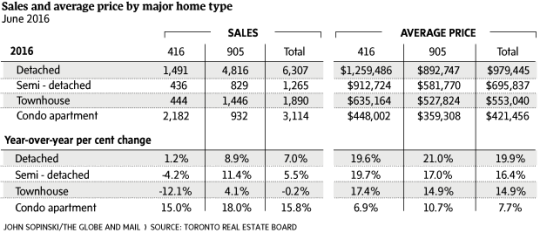
    This morning, I am looking at the following chart of average home prices in the Greater Toronto Area:

    It’s from this Globe and Mail article.

    These are staggering numbers. The average price of a detached home in the suburbs (905 area code) increased 21% year-over-year. In the city (416 area code), the increase was 19.6% YOY. These numbers are almost unbelievable.

    The article focuses on low supply (decrease in listings) and high demand. And that is certainly a big part of what’s going on here in this city, as well as in many others.

    But of course, the backdrop to all of this is our low / zero / negative interest rate environment.

    Larry Summers has a great post on his blog (which I discovered this morning via Fred Wilson) that talks about this “remarkable financial moment.” In some instances, real interest rates are actually negative! (You should read his post.)

    There are always people threatening that interests rates just have to go up. But Larry, as well as others, continue to argue that natural real interest rates are likely to remain close to zero going forward.

    Fred mentions Albert Wenger on his blog this morning and I have written about him before as well, here. In his book World After Capital, Albert argues that capital is no longer the scarce resource of our time. Instead, it has become attention.

    If you believe all of this to be true, then perhaps the numbers at the top of this post aren’t so unbelievable after all.