
Daily insights for city builders, delivered every morning at 6 AM ET. I’m Brandon Donnelly — a Toronto-based real estate developer and founder of Globizen. I’ve been writing here since 2013.

Tag: canada

  • Burnaby backtracks on inclusionary zoning

    The City of Burnaby recently passed an amendment to its inclusionary rental requirements. It has now been removed from the southeast portion of the city, which, according to Burnaby Now, has one of the lowest median incomes in the city.

    Here’s an excerpt from the staff recommendation report that was approved in early October:

    The analysis explored the impacts of increasing the density of developments in the Edmonds Town Centre area to try and improve revenues. However, the results showed that at current values, additional density is not able to offset the costs of providing the non-market housing, and that the equity needed to pursue large developments became prohibitive. As such, it is recommended that inclusionary rental requirements apply city-wide, with a delayed effective date for the Southeast Burnaby CMHC rental zone (the “SE Burnaby CMHC Zone”), until such time that inclusionary rental requirements become financially viable.

    What’s noteworthy about this amendment is that it acknowledges the real costs associated with non-market housing and shows how important high market rents are to subsidizing them. There’s no such thing as no-cost affordable housing. In the end, somebody always has to pay.

  • Canada announces high-speed rail between Quebec City and Toronto — finally!

    The train from Paris to Marseille takes just over 3 hours:

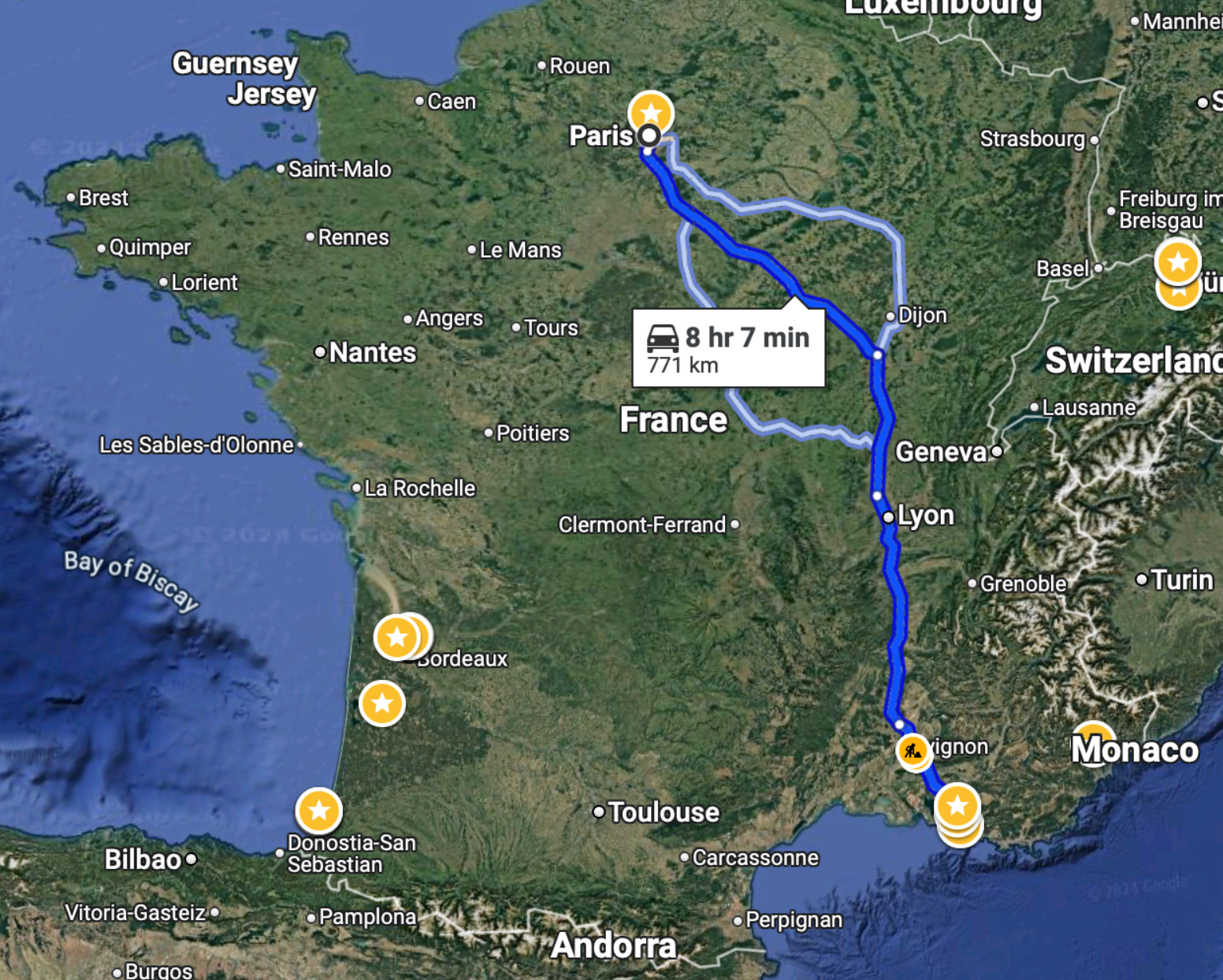
    To drive this same distance, it would take just over 8 hours:

    So unless you had a very specific reason, I don’t know why you’d ever want to drive this route. I certainly hate long drives and would avoid this at all costs.

    On a related note, the Canadian government announced this week that it will actually be moving forward with a high-speed train linking Québec City to Toronto, stopping in Peterborough, Ottawa, Montréal, Trois-Rivières, and Laval. And unlike previous announcements, it will actually go pretty fast — upwards of 300 km/h, which is comparable to what the TGV does on the above route.

    There are three consortia currently competing for this contract, but apparently the federal government has already chosen a winning bidder. An announcement is expected next month. At the same time, the project office owns all of the bids, and so there’s a chance that elements from each of them could be used in the final project.

    According to official messaging, the design alone is expected to take some 4 to 5 years, which is an eternity and way too long. But at least we seem to be moving forward. This rail link is a no brainer. It will compress the geography of an importantly bilingual corridor with nearly 20 million people — about half the population of Canada! It’s our megalopolis.

    Now we just need to move forward with urgency and with an unwavering commitment to creating the best high-speed rail service in the world. Let’s not accept mediocrity. And let’s not cancel it once we’ve already sunk millions into it. That would be a terrible outcome for such an obviously important nation-building project.

    LFG.

  • Weekend cycle around the city

    On Saturday, I went on a bike ride all around Toronto. We cut across midtown (checking in on One Delisle), stopped at the Chester Hill Lookout (which if you grew up in the east end is where you probably went as a teenager to make out), shot down the Don Valley, and then turned west along the waterfront. The weather was perfect.

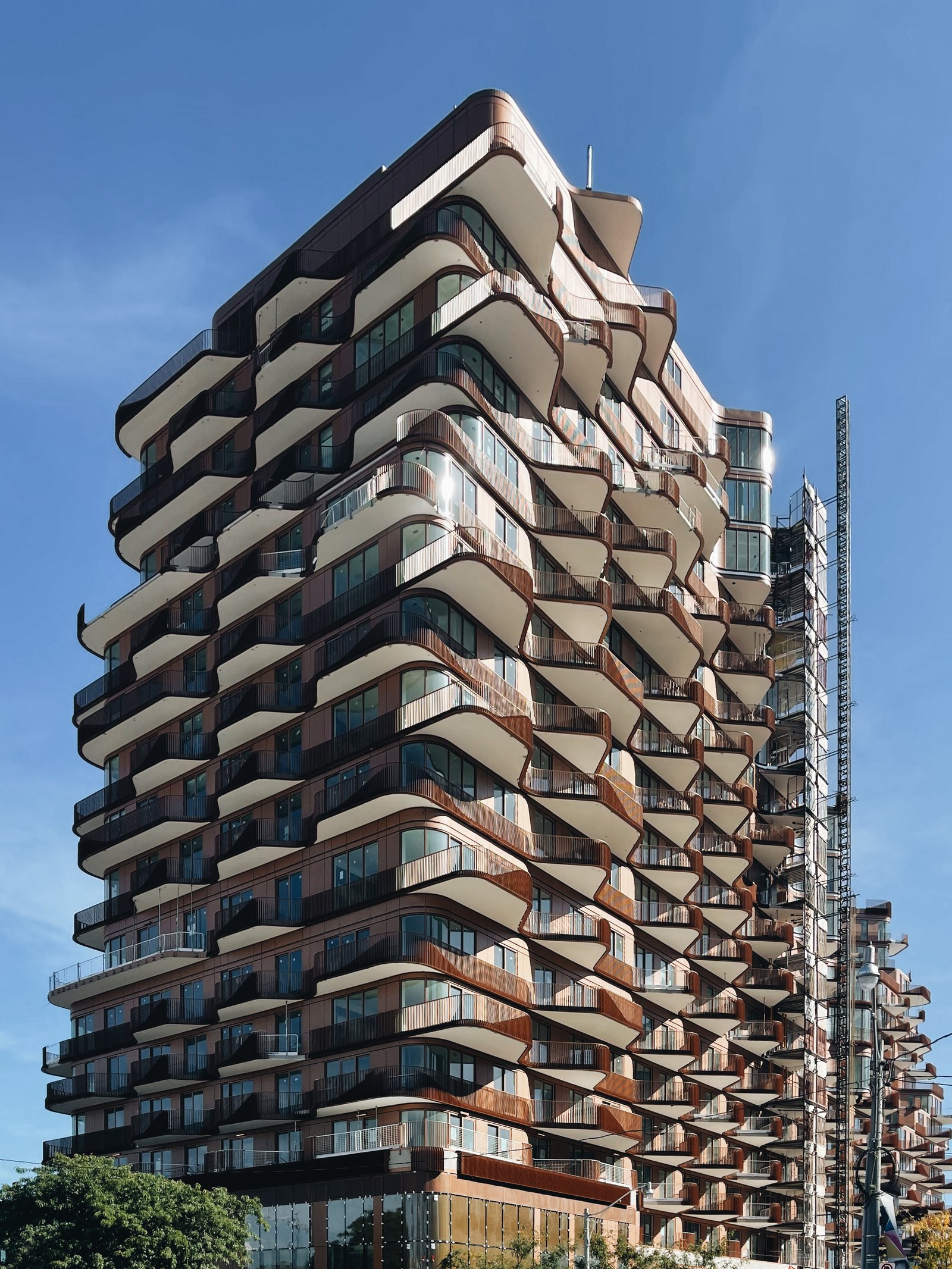
    As we were going along the waterfront, we passed the new Aqualuna building that is under construction on Queens Quay East, near Parliament Street. Being the architecture nerd that I am, I immediately noticed that as you pass by — at the speed of a bike — the balconies create this really nice cinematic effect.

    So I stopped to take these photos (I probably should have taken a video now that I think of it):

    I then tweeted a tweet calling it one of the most beautiful buildings going up in Toronto today. Judging from the responses, most people seem to be in agreement, but a few people questioned the practicality of balconies like this. Namely how private and usable they will be. I don’t disagree, but I still think it’s fine looking building.

    What do you think?

  • Approved but unbuilt

    Recent data from the City of Toronto indicates that there were approximately 106,000 new residential units completed between 2019 and 2023. That averages to about 26,500 homes per year.

    At the same time, Toronto is reporting that 258,397 units are currently approved for development and that 436,421 units are currently under review. The former means that the projects have been approved and that a building permit has been applied for or has been issued. And the latter means that the units are still under review or under appeal.

    These feel like staggering numbers. If we were to use the same completion rate as 2019-2023, it would take over 26 years to build these 694,818 new units (homes approved + under review).

    However, I think it’s safe to assume that not all of these homes will be built; at least not in the short term. Many (perhaps most) of these projects are simply going to evaporate in the current market environment. They’re unfinanceable.

    Because that’s the thing, zoning approved does not necessarily equal built and occupied. And right now, in this market, these two things feel like they’re diverging. Toronto grew by about 207,000 people between 2019 and 2023. And it built about half of this number in new homes.

    When we look back at the next four years, I suspect that this housing supply number will be noticeably lower. This is despite the staggering headline numbers.

  • Unfair labor practice

    At the beginning of this month, the Government of Canada issued this direction, setting out the requirement for all public servants to be “in the workplace” at least three days per week. To ensure some flexibility, it also specified that it didn’t have to be exactly this schedule. But the intent was that public servants would need to spend a minimum of 60% of their regular schedules, in the workplace, whether measured on a weekly or monthly basis.

    Immediately, the Public Service Alliance of Canada reacted and said that it would be filing “unfair labor practice” complaints: “We will be using every recourse we have available to fight this mandate,” PSAC national president Chris Aylward said, arguing that the surprise policy update was “anti-worker” and “fundamentally breaks the trust of workers and unions with the Trudeau government.”

    Now, I understand that there are a whole host of legal considerations with a mandate like this. If remote work has, for example, become an implied term of these employment relationships, then it might be difficult for any employer to call these people back. Thankfully, I am not a lawyer. And so I don’t think this way. It is probably also the case that I’m now in my middle adulthood and have old school views on this topic.

    Because in my mind, this is the government saying, “hey everyone who works for us, we’d like you to come into the office at least three days a week so that we can work together as a team, collaborate, and hopefully innovate.” And this is employees saying, “no way, that’s totally unfair! How dare you demand we come into the office that much?” Like, since when did going into work become such a problem?

    At the same time, Canada is suffering from an existential productivity problem. This country has seen no productivity growth in recent years. And if you compare us to other developed countries, we are near the bottom. Even France — which is stereotypically famous for its relaxed work culture and its ban on after-work emails — is more productive than were are!

    This needs to change or we will remain a deeply troubled country. And like everything, it’s going to require work.

    Photo by Marc-Olivier Jodoin on Unsplash

  • Housing affordability in Canada

    By some measures, housing affordability is, in aggregate, the worst it has been in Canada going back to the 1980s. Below is a chart from RBC showing homeownership costs as a percentage of median household income.

    The previous spike came around the early 90s, but following that, we saw 3 decades of relative affordability. In fact, for a large portion of this timeline, condo apartments look to be hovering around 1/3 of median household income. This is a common rule of thumb for measuring affordability.

    Now obviously things changed pretty dramatically during the pandemic. But that time has ended and a reset is underway. New housing supply has slowed dramatically. Developers are sitting on record levels of inventory. And sellers of all shapes and sizes are clinging, as best they can, to yesterday’s prices.

    With so much uncertainty, it’s challenging, if not impossible, to know exactly how all of this will play out in the coming years. But I suspect that, as time goes on, the above chart is going to start to mirror what we saw in the early and mid-90’s. In other words, affordability is going to improve.

  • Messy intersections

    I am not a transportation engineer, but sometimes I like to, you know, pretend. And lately, I’ve been thinking about how to better design the Toronto intersection of Dundas, Dupont, Annette, and Old Weston (which I touched on briefly over here). It’s a weird 5-point intersection that is often cited as one of the most confusing in the city. And so there’s a lot that could be done.

    Here’s what it looks like today:

    The centerpiece is the Dundas-Dupont Traffic Island, which is actually a city-owned park. It’s not the most generous green space, but the real problem with this park is that it’s very much an island. There’s really only one pedestrian access point — its north end. For the most part, you need to be unlawful in your movements on and off it.

    This is a fairly common occurrence in cities. The island is, almost certainly, a remnant space. It was never explicitly designed; it is just what was left over after they figured out how to connect all of these streets and negotiate the intersection’s grade changes.

    The other signal, that these are remnant spaces, is the paint markings on the street. Their main job is to tell cars where to go. But they’re also unproductive spaces. Nobody is intended to actually occupy them. So what they really say is, “we have too much road and we didn’t know what to do; so we just painted them.”

    If you watch the below video of Claire Weisz (founder of WXY Studio) explaining the work that she has done in New York City, you’ll see remarkable similarities to what I’m talking about here. This sort of thing happens all the time, especially at messy intersections where multiple streets converge. The objective was to connect the streets and the rest became a byproduct.

    But when properly designed, these spaces actually become better for everyone: drivers, cyclists, and pedestrians. And this Toronto intersection strikes me as a perfect candidate. So if my local Councillor Gord Perks is reading this post, I would ask him to do what he can within the city to encourage this kind of positive change.

    And not just here, but wherever there is a street that sucks.

  • Real estate is a byproduct of economic growth

    I sometimes wonder if I wasn’t born and raised in Toronto if I still would have gone to architecture school and become a real estate developer. I mean, if I grew up in Paris, maybe I would have become a fashion designer. Or if I grew up in Park City, maybe I would have started a snowboard company, slash become a ski bum. I would enjoy doing all of these things. And places certainly do influence us, more than most of us probably appreciate.

    My point with all of this is that Canada likes to somewhat paradoxically over index on housing. I say paradoxically because we never seem to have enough of it for Canadians — certainly the affordable varietal — and yet:

    Canada relies heavily on its real-estate sector to power the economy. Housing investment in Canada as a share of gross domestic product reached 8.9% in 2022, according to the Organization for Economic Cooperation and Development, much higher than the 4.8% on average for the 38 member countries in the OECD.

    If you look at all of the industries that make up the Canadian economy, “real estate and rental and leasing” is at the top with 13.01% of GDP (as of 2020). And if you add “construction” on top of this, the total is about 20.09% (again, as of 2020). This feels suboptimal. And I say this as a developer and builder of real estate.

    Real estate is largely a byproduct of economic growth. When someone starts a business and then needs something like an office or a warehouse, that is a positive thing for the economy. Jobs are being created by the business and further jobs are being created by the people who will deliver the space they need. But if you aren’t creating new jobs in the first place, then just dealing in real estate will only take you so far.

    Immigration helps, but it can also create a mirage of growth and prosperity. If you look at real GDP growth across the G7 from 2019 to today, Canada looks pretty good. We’re second (+4.5%) only to the US (+8.9%). But if you look at GDP per capita over the same time period, we’re dead last (-2%), whereas the US remains on top (+7.2%).

    I’m not an economist; I just build things. But in my opinion, this is a problem. We should be doing everything we can to foster a stronger culture of innovation and entrepreneurship in this country. We have the talent. I mean, Ethereum has roots in this city! We just need more people turning this intellect into wonderful new companies.

  • Rear-yard suites and secondary suites built in Toronto over the last decade

    Here is a mapping, from the University of Toronto’s School of Cities, showing the number of “closed” building permits issued in Toronto between 2013 and 2023 for both rear-yard suites (laneway houses and garden suites) and secondary suites (like basement apartments).

    A “closed” building permit probably means that construction is complete. However, it is not uncommon for a permit to inadvertently remain open. This happened to me with Mackay Laneway House. The permit was supposed to be closed, but it wasn’t.

    So here’s the same mapping with open (i.e. active) permits also turned on:

    Three things immediately stand out:

    1. Secondary suites seem to be somewhat evenly distributed across the city.
    2. Rear-yard suites are heavily concentrated in the older areas of the city, flanking the downtown core.
    3. North Toronto is wealthy and isn’t having either of these housing typologies.

    Looking at these mappings, it probably seems like a decent amount of new housing. But that’s not really the case:

    • From 2013 to 2023, Toronto issued 2,209 building permits for secondary suites (1,525 have been closed and 684 remain open as of December 31, 2023).
    • And from 2020 to 2023, Toronto issued 898 building permits for rear-yard suites (192 have been closed and 706 remain open, which does suggest some increased adoption). Rear-yard suites only became permissible in 2018, which is why the date range is shorter.

    To be fair, I would imagine that many secondary suites get built without a building permit. So I think the above number is probably underestimating actual supply. But even still, it doesn’t change the conclusion: A lot more needs to be done to increase the supply of new housing in Toronto.

  • How would you make this street better?

    Let’s resume looking at sidewalks and public spaces.

    If you look in the City of Toronto’s Official Plan for the stretch of Dundas Street West that runs between Dupont Street and Bloor Street West, you’ll find a map that looks like this:

    Red signifies “Mixed Use.” And so if you were to just look at this map, you might naturally assume that, in the real world, this is a continuous main street that connects The Junction neighborhood down to Bloor. But that’s not actually the case. Instead, it looks like this:

    Because of the rail corridor on the east side, it is a single-sided street. And generally speaking, these don’t make for the best retail streets. But it also has narrow sidewalks and a compromised public realm. If you go back to the map I shared yesterday, you get this:

    I don’t think 30cm is entirely accurate here, but that’s beside the point. What matters is that this is just one of many examples in the city of a discontinuous public realm. (Here’s another, undignified example, from Parkside Drive.)

    Over the years, there have been a number of design concepts proposed. Below is one by Brown + Storey Architects that was done I don’t know how many years ago. Their proposal widened the sidewalks along this stretch, and added bike lanes. They also proposed a roundabout at the intersection of Dundas, Dupont, and Annette, which is another matter that needs addressing.

    But none of this has been implemented and I don’t know of any plans to do it. When we were going through the rezoning process for Junction House, we were made aware of some transportation studies that had been done for the above intersection. But that’s about it. There wasn’t an actual ETA.

    However, now that my commute consists of walking up and down this part of Dundas, I’ve been thinking more about how it could be improved.

    I think there’s no question that the sidewalks need to be widened. It would also be helpful if there were crosswalks to facilitate getting off the south end of this exotic island:

    But equally important, I think that something should be done about the single-sided nature of the street. Given that there’s limited width, my mind immediately goes to shipping containers, or something similar, to start activating the east side of the street.

    This has already been done further south on Dundas (east of Bathurst):

    And it could work here too. Already there’s a Blondie’s Pizza anchoring the south end of this stretch (really fantastic pizza, by the way):

    But I would love to hear your ideas, as I’m currently in the market. I also don’t think that you necessarily need to be from Toronto in order to comment. Great streets are great streets. So if it were up to you, what would you change, if anything, about this part of Dundas Street West? Let me know in the comment section below.