Daily insights for city builders, delivered every morning at 6 AM ET. I’m Brandon Donnelly — a Toronto-based real estate developer and founder of Globizen. I’ve been writing here since 2013.

Category: health

  • Healing penny water

    We spent the last few days in Scuol, Switzerland. Scuol is a small mountain town with under 5,000 people (2018 figure) near the eastern border of the country. The town first achieved notoriety in the 1860s because of the various naturally-occurring mineral waters that can be found in the area. They were / are thought to have healing properties, and so a spa tourism destination was created. Skiing and snowboarding were later added to the town’s repertoire.

    We tried the water from this fountain — the Lischana source:
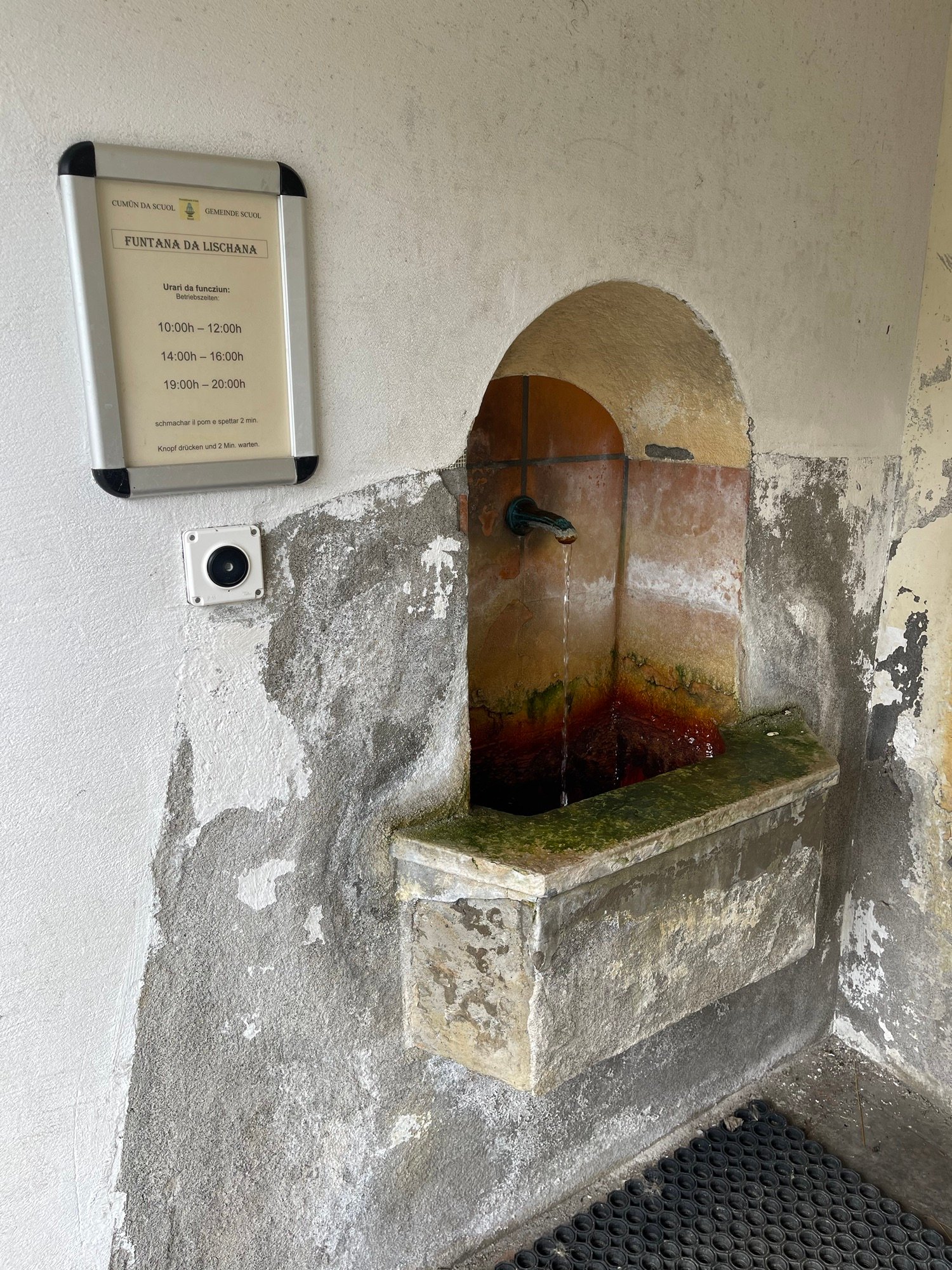
    The best way I can describe the taste is to say, imagine water that has had pennies soaking in it for the last 100 years. That’s what it tastes like, which is not good. But it is rich in magnesium and other things, which is why people (especially athletes) seek it out. It comes out clear from the source but if you let it sit in a bottle it will naturally become carbonated and turn brown. That’s why the embankment above has the color that it does.

    I had a handful of respectable sips. Hopefully that’s enough to make me strong. A big thank you to Klaus, Peter, and Jaimie for the invite to Scuol!

  • Sunday morning is for riding

    This is a fun circuit.

    Go west to the Humber Bay Arch Bridge.

    Shoot up the Humber River and pass under various bridges and subway tracks.

    Arrive in Weston (which, by the way, was established in 1796). Go west on Lawrence to Royal York (there are a couple of hills here that will get your bum up).

    Then bomb down Royal York as fast as you can until you arrive at San Remo Bakery for coffee, donuts, cured meats, and other wonderful things that I don’t normally order.

    The circuit:

  • We’re getting fatter

    I know I know this, but this is still an alarming chart:

    This is saying that, as of 2016, over 36% of Americans were considered to be obese. In Canada, the number was just under 30%. And in the UK, it was just under 28%, which is the highest rate in Europe.

    We often talk about the health benefits of living in a walkable community. And there’s lots of research to back up that this is in fact the case: obesity rates tend to be inversely correlated with higher prevalences of active transportation (walking, cycling, and so on).

    But we also can’t ignore diet. And here’s what has happened in the UK, as well as in other Western countries:

    An increased reliance on cheap, ultra-processed food, which accounts for 57 per cent of what Britons eat according to a 2019 study conducted by researchers at the University of São Paulo, suggests that the health crisis is unlikely to change anytime soon without intervention, argue campaigners.

    It can be hard to eat healthy, especially if you don’t have a lot of money and you live a busy life. But in my view, we need to change the course of this graph. And two very good places to start looking would be (1) our built environment and (2) the Japanese diet.

    Actually, now that I think of it, Japanese cities would be a good place to look as well.

    Chart: FT

  • I became more French & German

    I first did 23andMe back in 2015. And at that time, my ancestry composition looked like this.

    At the highest level, I was 50.6% East Asian & Native American and 49.2% European. Going one level deeper, I was 43.7% Chinese, 16.5% British & Irish, 6% French & German, and 11.5% Broadly Northern European. 23andMe uses the term “broadly” when there’s a DNA match across multiple places and it’s not exactly sure what country or countries it might be.

    Last night, I decided to log back in to 23andMe and see if anything had changed in the 8 or so years since I first did the test and, frankly, since I logged into their website. And it turns out that it has. It seemingly got more precise. I guess that’s the power of more people using the product and more data. Now my ancestry composition looks like this:

    So what changed? Well, at a high level I’m still half Asian and half European. But 23andMe is now telling me that my Chinese roots likely trace back to Guangdong, a southern province that borders Hong Kong. This is news to me as I’m many generations removed and I had always thought it was somewhere more northern, partially because of my height.

    Apparently, I am also no longer British & Irish (0.6%). I am now 31.1% French & German and 3.3% Broadly Northwestern European (admittedly this could include Ireland). This was surprising to me since Donnelly is clearly an Irish last name. Though, my maternal grandmother did indeed have direct French roots.

    Along with this, I became more southern European (13%), with Spanish & Portuguese being the most common match (5.6%). So am I more this than Irish? I don’t know, these matches are pretty far removed and possibly go back 5-8 generations. At the great-grandparent level, I am, according to 23andMe, (1) Chinese and (2) French & German.

    I find all of this extremely fascinating and so I think I’ll spend more time exploring the site and my family tree. They are also telling me that it’s time to order another sampling kit, since I did mine so long ago. I plan on doing that, as well as ordering two for my parents. Let’s see what that does to my ancestry composition.

    Have any of you used 23andMe and found surprising results?

  • Decentralization and public infrastructure

    Decentralization, in the crypto/blockchain/web3 sense of the word, is a crucial thing. Here is an excellent article talking about why it is the key innovation of blockchain technology and why it is a central feature in this new emerging web3 world.

    But of course, it can all get very complicated. So I thought this — and in particular the sentence in bold below — was a good way of describing the benefits:

    …decentralization enables web3 systems to be credibly neutral (they cannot discriminate against any individual stakeholder or any group of stakeholders, which is critical to incentivize developers to build within ecosystems) and composable (to mix and match software components like Lego bricks). As a result, web3 systems function more like public infrastructure than proprietary technology platforms. In contrast to the gated software of Web2, web3 protocols provide decentralized internet infrastructure on which anybody can build and create an internet business. Crucially, in web3, this can be done without the permission of the original deployer of the protocol or the need to use a centrally controlled interface.

    This resonated with me because think about how important public infrastructure is to our cities. Most of us take it for granted that, when we need it, we can just plug in and access electricity, water, sewer, and other public infrastructure.

    But throughout history, these services have been fundamental to the growth of our cities. They empowered scale and better health outcomes, among other things. So it’s exciting to think that we are now living through the creation of something kind of similar in tech.

    Image: a16z

  • Seoul crush

    We have spoken a lot over the years about the benefits of narrow and pedestrian-focused streets. Most recently, I even ran around Europe with a laser distance measuring device to collect a few field samples. Here’s an example from Marseille and here’s an example from Sicily.

    But given all this, I think it is important to recognize that what happened in Seoul over the weekend — a deadly crowd crush that killed over 150 people — is both a horrible tragedy and a result of too many people in a narrow and pedestrian-focused street. So clearly there can be a flip side to what we talk about here. At the time of writing this post, investigations were still ongoing.

    I am not a crowd-control expert, but I have spent time in dense Asian cities during major events and holidays, and never have I felt so claustrophobic. I have lined up for hours to get into subway stations and I have lined up to get into entire city districts — presumably because they were trying to avoid things like what happened this past weekend.

    My heart goes out to all of the people and families that were impacted by this horrific incident.

    🇰🇷 🇨🇦

  • Five global airlines to start using a digital health pass

    The Commons Project and the World Economic Forum are piloting an initiative right now called the CommonPass framework, and a number of airlines, including Lufthansa and Swiss International Air, are expected to start rolling it out before the end of the year.

    What the CommonPass does is allow people and travelers to verify their health status via a digital certificate on their phone. Right now it can confirm that you’ve tested negative for COVID-19 and eventually it will confirm if you’ve received a valid vaccination.

    The framework also asks countries to publish their travel entry criteria in a standard format, so that it’s easy to update and it can be globally understood.

    Of course, much like all of the exposure alert apps that are out there, this is only really useful if people and companies actually start using it. But the travel industry knows that for customer confidence to return, people are going to need to feel safe again. And a digital health pass is one way to help with that.

    Here is a short video explaining how the CommonPass works. If you can’t see it below, click here.

  • Density is not destiny

    Back in March and April, there was a belief that big and dense cities were going to pose a serious problem in the fight against COVID-19. The narrative was that the benefits of urban density suddenly flip to glaring negatives during a pandemic. Elevators are a problem. Public transit is a problem. Busy streets and public spaces are a problem. Instead of density, you want dispersion. There was also some speculation that COVID-19 cases would be somewhat correlated with colder climates.

    The data that we are seeing today suggests the opposite. Note the above chart by Axios. On a per capita basis, COVID-19 cases are now the lowest — and below the national average — in large US cities with populations greater than 1 million people. Where cases are the highest, again on a per capita basis, is in rural areas. Non-metro areas less than 10,000 people. The county with the highest rate also isn’t the coldest of places. It’s Childress County, Texas, where the rate is about 1,265.3 cases per 100,000 people.

    I have a lot of questions about the most important factors affecting transmission rates. Is mask wearing, for example, more important than average temperatures? What is the impact of socio-economic status? I am seeing maps that, unfortunately, suggest this plays a meaningful role. What is really driving these so-called “hot spots?” But what seems clear to me is that density is not necessarily destiny during this pandemic.

    P.S. Here’s a related article on hospital capacities across the United States.

    Chart: Axios

  • How many people are actually using a COVID exposure alert app?

    One of the things that I don’t think we are doing a good job of here in Canada is promoting our COVID Alert app. Most of the people I talk to don’t seem to have it installed on their phones. And most of the people I talk to seem to be nervous about sharing personal information with it, including their location. (That’s not actually how the app works.)

    The thing with exposure alert apps is that they’re only really useful if most people are using them. And they’re only really useful if people who test positive for the virus enter the code that they are given into the app. So it relies on us trusting that other people will do the right thing. I get that. But those same shortcomings apply when we just ask someone if they’ve been exposed to anyone with COVID-19.

    I could be wrong, but my view on this is pretty simple.

    If everyone who had COVID-19 got immediately sick and showed highly discernible symptoms, then this virus would likely be a lot easier to control. Part of the problem, as I understand it, is that some people get really sick and some people don’t get sick at all. But these latter people can still unknowingly spread it around — perhaps to other people who might get really sick.

    Given this variability, it’s critical for us to know who has been potentially exposed and who has not been exposed. Otherwise, we’re running around mostly blind. From what I can tell, exposure alert apps are one of the best ways for us to track transmission. But, of course, it only works if you’ve got the app. For those of you who don’t already have it, you can download it for both iOS and Android by going here.

    P.S. I’m writing this post because it came up with my barber today while I was getting a haircut. He wasn’t all that aware of the app, but he ultimately concluded that we have a problem of education and that he was going to download it. Maybe some of you will do the same after reading this.

  • Learning from the Spanish Flu

    “We learn from history that we do not learn from history.” -Georg Hegel

    Back in March, I was reading everything I could find about COVID-19 and about pandemics. Eventually that tapered off. But this week I decided that it was time to go back and learn a lot more about the 1918 Spanish Flu.

    I’ve just ordered John M. Barry’s 2004 book called The Great Influenza. Bill Gates wrote about it over the summer — after he reread it — and said that it will teach you almost everything you need to know about the influenza. He also said that it’s never been more relevant.

    Despite happening over 100 years ago, there are no doubt lessons that we can learn from this great influenza. The most important being that leadership and honesty, of course, matter a great deal during a time of crisis.

    Barry also argues that the 1918 influenza was responsible for altering the flow of history. He makes the claim (convincingly according to Bill) that it was a contributing factor in the rise of Hitler and the start of World War II.

    So I’m looking forward to receiving my copy later this week. If you’d like to purchase your own, you can do that over here. And if you’ve already read it, please let me know what you thought in the comment section below.