Daily insights for city builders, delivered every morning at 6 AM ET. I’m Brandon Donnelly — a Toronto-based real estate developer and founder of Globizen. I’ve been writing here since 2013.

Tag: atlanta

  • Most Americans do not live in a 15-minute city

    The 15-minute city is a popular topic these days. So here is a recent study that used GPS data from 40 million US mobile phones to estimate the percentage of consumption-related trips that actually adhere to this concept. The unsurprising result:

    The overwhelming majority of Americans have never experienced anything resembling a 15-minute city. The median resident, we found, makes only 14% of their consumption trips within a 15-minute walking radius.

    There is, of course, regional variation. For New York City, the data suggests that 42% of consumption-related trips occur within a 15-minute walking radius. Whereas in more sprawling cities like Atlanta, it’s only 10% of trips. Again, this is not surprising. But it begs the question: What should we do?

    The challenge is that 15-minute cities generally require built environments that are dense, conducive to walking, and filled with a concentration of different amenities. And this is more or less the opposite of the prototypical suburban model, where the car and single-use zoning tends to spread everything out.

    The good news is that zoning is relatively easy to change. For instance, if we want to allow corner stores in our residential neighborhoods, that is a decision we can make. The greater hurdle will be transforming car-oriented communities into places where people might actually want to walk. This is much more difficult.

    But of course, it too can be done.

  • Busiest airports in the world

    There were nearly 7 billion global flight passengers last year, and these were the busiest airports:

    Overall, volumes are up 54% compared to 2021 (not surprising). But we are still down about 26% compared to pre-pandemic levels (2019). The one exception — at least when it comes to this top 10 list — is Denver. It’s right back to where it was in 2019. I wonder why.

    I find this list interesting because, one the one hand, airports are what connect global cities to the rest of the world. If you’re a big and important city, you need a big and important airport. But on the other hand, having a busy airport could also mean that you’re a hub in the hub-and-spoke airline model.

    And that’s what Atlanta is. It is the world’s largest airline hub and the primary hub for Delta Air Lines. Apparently, it was also the first airport to adopt the hub-and-spoke model following deregulation of the industry in the 1970s. Which could be why it’s still number one on this list.

  • Cars make cities less compact

    The relationship between car ownership and urban density is a fairly intuitive one. Below are two charts from a study by Francis Ostermeijer, Hans Koster, Jos van Ommeren, and Victor Nielsen, showing how urban density is inversely correlated with car ownership. In other words, the more people with cars, the less dense that a particular place is likely to be.

    But there’s an interesting chicken-and-egg question here. Does Atlanta, which is near the bottom right in the above chart, have a lot of cars because it wasn’t dense enough to support other modes of transport, or did the prevalence of cars in Atlanta cause the city to spread out and become less dense? And that is exactly what the above researchers set out to determine.

    To do this, they started by looking at the presence of commercial car manufacturers in the above geographies in the 1920s. One of the things they found was that having a car manufacturer in your city at this time appears to have had no effect on population density. But over the long run, rising car ownership seems to have had a sizeable effect on reducing population densities in those places.

    The conclusion they draw from this is the title of this post: cars have made cities less compact, rather than low population densities causing people to go out and buy more cars. This makes some sense to me because cities were doing just fine before we invented cars. But like all transportation innovations that allow us to move faster over longer distances, the car encouraged decentralization.

    There are, of course, all sorts of possible implications for a finding like this. But the authors specifically mention developing countries where car ownership may still be relatively low. This is something to be mindful of because if you put most people into cars, history strongly suggests that it will impact the kind of city that you end up building.

    Chart: Cars make cities less compact

  • Toward more multi-family housing

    This recent article by Brookings is a good reminder of the all too important link between land use policies/patterns and GHG emissions. Because electric vehicles are cool and all, but they’re still not as efficient as just walking around and/or taking transit.

    As has been argued before on this blog, we need to not only electrify our transport network, but we also need to change how we get around. And probably the best way to encourage a modal shift, is to plan and build our cities differently. Something that is simple, but not easy.

    It also turns out that people who live in multi-family buildings tend to consume less energy (on a per capita basis) than those in single-family houses. So there are numerous benefits to encouraging denser housing on top of transit and within mixed-used communities.

    With all of this in mind, here are some interesting charts from the above Brookings article.

    This first one shows new housing permits in the metro areas of Atlanta, Chicago, and Washington DC, according to their urban, suburban, or exurban status. Here, Chicago is an outlier, with the “urban core” (defined as Cook County) now making up about half of all new housing.

    If you look at the entire study period, the number is less. The urban core accounted for about one-third of new housing permits in Chicago, and only 15% of permits in Atlanta and DC. But in all cases, housing permits in the urban core have been increasing since the 2008 financial crisis.

    But here’s the other thing. Looking at these next two charts, there appears to be a clear trendline toward more urban housing typologies. The first of these next two is showing single-family housing permits as a percentage of all new housing. And the second is structure type over time.

    Atlanta is still building mostly single-family housing, but less of it. And based on these charts, Chicago has already passed its inflection point. DC is not far off. Every city region is of course going to be different, but it does look like there is some kind of broader housing shift underway.

  • Adam Neumann has quietly acquired some 4,000 apartment units

    So it was announced today that Adam Neumann — the cofounder and former CEO of WeWork — has been quietly buying apartment buildings across the United States. According to the Wall Street Journal, he is involved in entities that have acquired more than 4,000 apartment suites valued at least $1 billion.

    The buildings, which seem to be fairly typical and have at least a few hundred doors, are located in cities like Miami, Ft. Lauderdale, Atlanta, Nashville, as well as in many other US cities. It’s not clear what the exact plan is for this real estate but people who claim to know things are saying that it will involve “redefining the future of living”, or something along these lines.

    Presumably this means catering to young professionals with cool design, fun amenities, and beer taps. Whatever ends up happening, it is interesting to see some of the cities that he/they are targeting. They are the cities that we’ve all been talking about for many years. You know, the ones that are growing quickly and have greater housing supply elasticities.

  • A catalyst for Westside development — but not yet

    A new 280 acre park is currently under construction in an old quarry on the westside of Atlanta. It’s called Westside Park. When it opens this spring (that’s at least the target), it will be by far the largest park in the city. But already there are concerns that this investment in new public space could be triggering “rapid gentrification” in the surrounding area.

    So earlier this month, the mayor’s office issued an executive order that put in place a 6-month moratorium on all new construction permits in the communities surrounding the park. The order read like this: “…refuse to accept new applications for rezonings, building permits for new construction, land disturbance permits, special use permits, special administrative permits, subdivisions, replattings, and lot consolidations for non-public projects.”

    The objective is to avoid displacement. And since new development means change, this is a way to stop change. (Don’t you just hate when things go and change?) The problem, of course, is that a moratorium on new housing doesn’t stop change and it does nothing to address the desire to live next to this new amenity. It only stymies the supply of new housing to meet this demand. (It’s also incongruent with the park investment being marketed as a “catalyst for new development.”)

    In fact, Joe Cortright (of City Observatory) and Jenny Schuetz (of the Brookings Institution) have both argued — either directly or indirectly — that the above move could actually increase displacement in the surrounding area; because the moratorium on new housing could simply redirect demand toward the existing housing stock. The order does seem to suggest that you can still renovate an existing property.

    I wonder if any studies have been done on the externalities associated with temporary housing supply moratoriums. If so, I would be interested in reading them.

  • Detroit. Move here. Move the world.

    As part of the Amazon HQ2 bid process, a number of cities produced videos. I only discovered them today and so maybe some of you also missed them when they were released last fall. There are videos from Detroit, Boston, Pittsburgh, Philadelphia, Dallas-Fort Worth, Las Vegas, Louisville, Atlanta, and maybe others that I am still missing. 

    Some of the videos are bad. (I’ll let you make your own judgement calls.) I like the idea behind Atlanta’s video, which is the journey of someone named Georgia physically delivering their bid to Seattle. And Philadelphia’s video made me feel really nostalgic about my time there. Those were some great years. 

    But my favorite video is Detroit’s video. It feels authentic. The footage is outstanding. And it feels powerful. Though it is probably too long. It was a good reminder that I’m overdue for a visit. So here is Detroit’s video. If you can’t see it below, click over to YouTube.

    [youtube https://www.youtube.com/watch?v=DO4J_PC1b5M&w=560&h=315]

  • International and domestic migration in the US

    In response to President Trump’s proposed immigration bill, Brookings recently analyzed census data from earlier this year to demonstrate the importance of immigration for growth within much of the United States. 

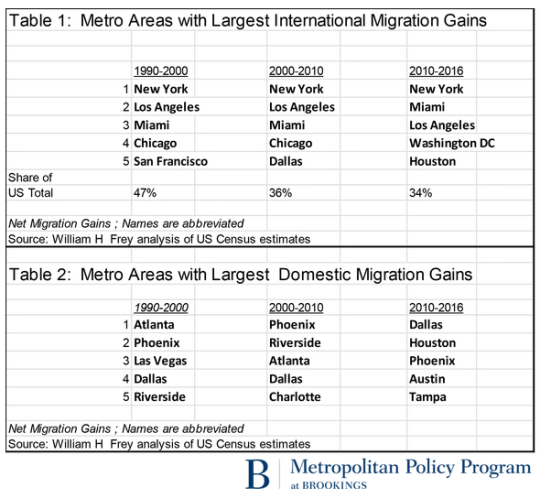
    I’d like to share three tables from their analysis.

    The first two look at international migration grains and domestic migration gains over the last 3 decades (the last decade isn’t quite a decade).

    Here you can see that New York, Los Angeles, and Miami (all port cities) have dominated international migration to the US since 1990. But at the same time, international migration has become less geographically concentrated. From 1990-2000 the top 5 cities received almost half of all immigrants moving to the US. More recently, that number has dropped to 34%.

    Domestic migration is different in that it’s a zero sum game. When one US city gains, another US city loses. Here there is a very clear migration trend toward cities in the southwest – arguably because of weather, job growth, cheaper housing, and probably a bunch of other factors.

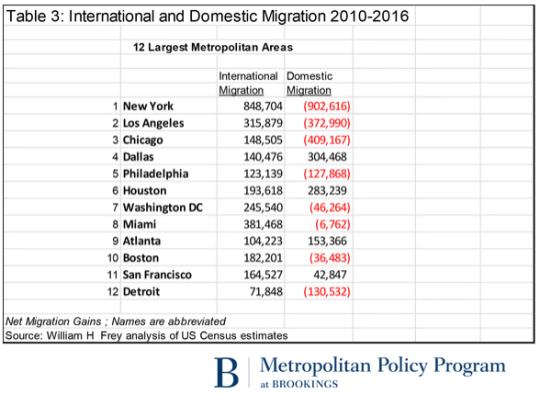
    If we look at actual international and domestic migration numbers over the last 6 years, the 12 largest metropolitan areas look like this:

    The key takeaways here are that 8 of these cities are losing people to domestic migration and only 7 of these cities have a positive net migration number – meaning their population is actually growing.

    What is clear is that the international migration column is a pretty important one if you believe that growth is valuable. 

    If you’re Dallas, Houston or Atlanta, maybe you care a little less about that column. But for most of the other cities, international migration is either the only way you’re growing (look at Miami go) or keeping your population losses in check (see Philadelphia).

  • Sprawling, but affordable

    The Wall Street Journal recently published an interesting article that ties in nicely with two of my recent posts. My post about North American population growth and my post about the San Francisco pro-development group known as BARF.

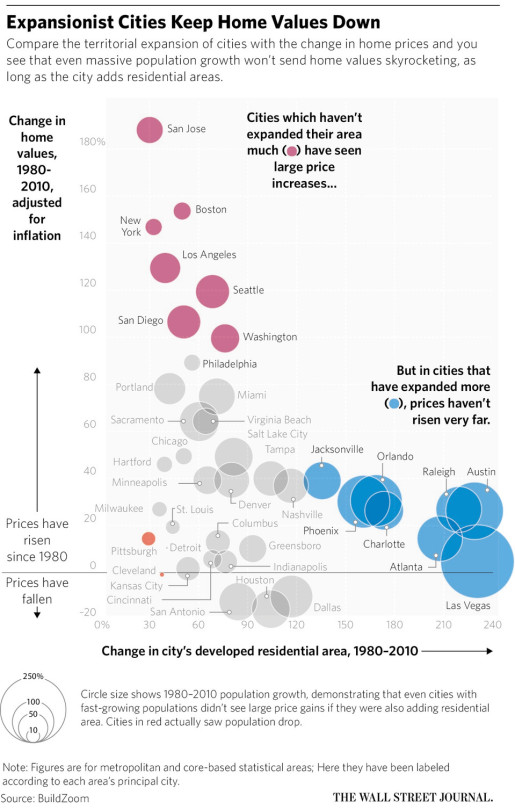
    The WSJ article is about the growing divide between affordable and expensive cities in the US. And the argument is that expansionist, or sprawling, cities are better at suppressing home values and maintaining affordability:

    “The developed residential area in Atlanta, for example, grew by 208% from 1980 to 2010 and real home values grew by 14%. In contrast, in the San Francisco-San Jose area, developed residential land grew by just 30%, while homes values grew by 188%.”

    Now, here’s a chart saying that same thing:

    The reality is that greenfield development (suburban sprawl) generally has far fewer barriers to development than urban infill development. So I’m not surprised to see cities like Las Vegas, Atlanta, and Phoenix clustered towards the bottom right.

    At the same time though, I’m obviously not convinced that sprawl is an optimal outcome. I think there are other costs not reflected in the chart above. So what’s the best solution here, assuming we want to build inclusive mixed-income cities?

  • Population growth across North American cities

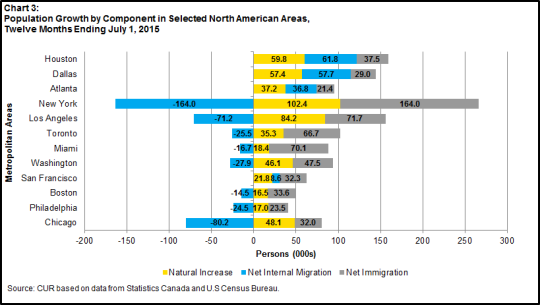
    The Centre for Urban Research and Land Development at Ryerson University recently published the following chart on their blog:

    It’s a look at population growth across a few North American cities, broken down according to natural increases, net internal migration from other parts of the respective country, and net immigration from outside of the respective country.

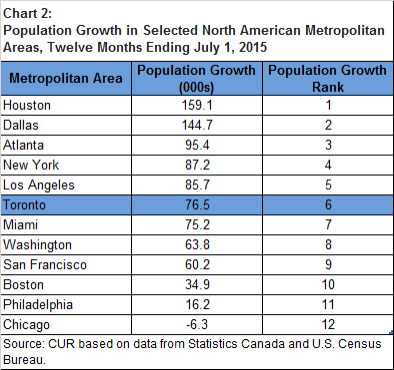
    When you sum up the pluses and minuses shown above, you get to population growth numbers that look like this:

    Houston, Dallas, and Atlanta are monsters in terms of population growth. They’re obviously smaller than New York and Los Angeles, and so on a percentage basis they are really adding a lot of people. Much of this has to do with the ease in which housing can be added in those cities and their relative affordability.

    Toronto is competitive with New York and Los Angeles in terms of an absolute number, but again our base is smaller so on a percentage basis we are growing faster. The big story with Toronto is our dependence on immigration to grow.

    The one city on this list that might surprise some of you is Chicago. Toronto and Chicago share many similarities and are often compared. But when you look at how the Chicago metropolitan area is shedding people, you see that, at least in this regard, it’s in structural decline.