
Daily insights for city builders, delivered every morning at 6 AM ET. I’m Brandon Donnelly — a Toronto-based real estate developer and founder of Globizen. I’ve been writing here since 2013.

Tag: inclusionary zoning

  • The Big Mac theory of housing costs

    Forty years ago, The Economist introduced its now-famous Big Mac Index. It was based on the simple idea that a Big Mac is a damn near perfect universal commodity, and so if you methodically compare its price across countries, it should give you an approximation of the purchasing power parity across a basket of currencies.

    For example, a Big Mac currently costs US$6.22 in the US (as of July 2026 and according to The Economist). But in Switzerland, it works out to US$9.04, and in Taiwan, it’s US$2.42. This suggests that the Swiss franc is overvalued and that the Taiwan dollar is undervalued because, in theory, their currencies should adjust over time to correct such a large variation.
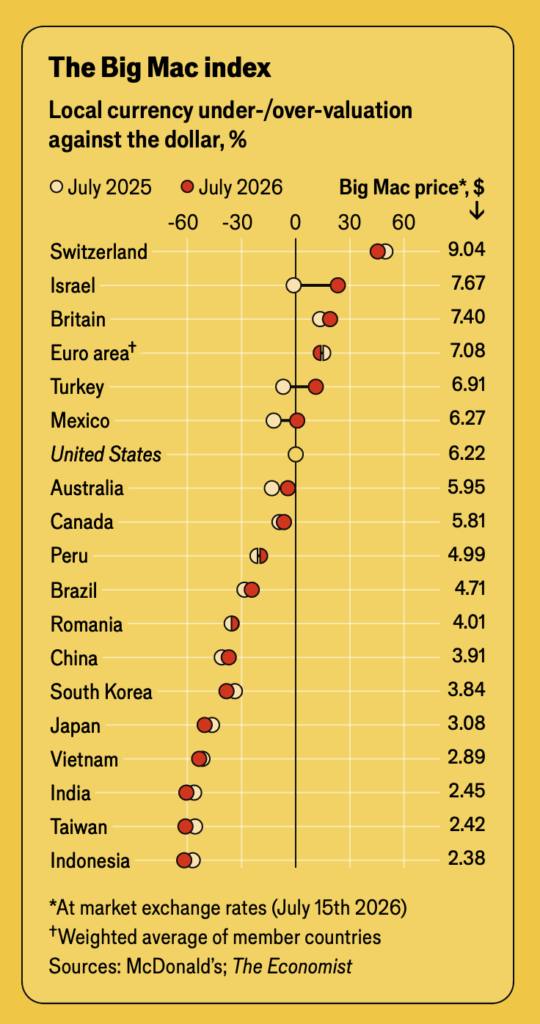
    Now, I’m not an economist, but supposedly there is some directional validity to this line of thinking. However, it’s not entirely accurate. If you look at the various inputs that make up the price of a Big Mac, there are over 60 ingredients, including local real estate prices, the cost of labour, and utility costs.

    Some countries may also have tariffs on certain ingredients, which would drive up the price for local consumers (yes, that’s how tariffs work), and some countries may have a higher willingness to pay for American fast food. If there’s a higher perceived value, McDonald’s can simply charge more.

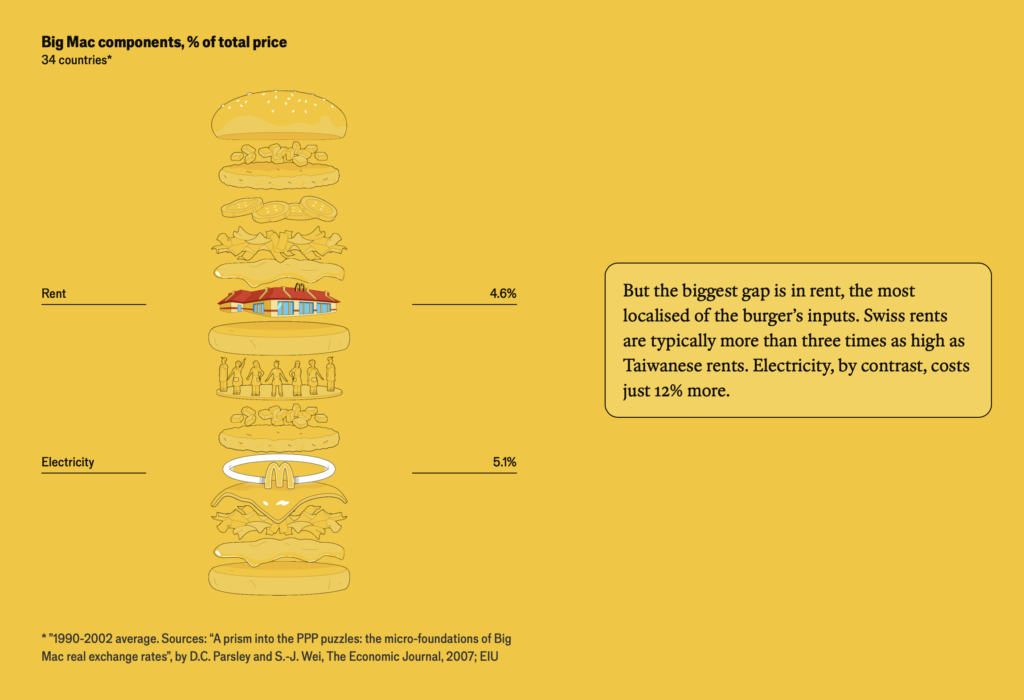
    So, the fact that a Big Mac costs significantly more in Switzerland does say something about the CHF, but it’s also an indicator that retail rents are somewhere around 3x what they are in Taiwan, among many other factors.

    Now let’s consider a product that, unlike the Big Mac, can vary a great deal across countries: housing. A new home requires far more than 60 ingredients, but it similarly reflects local cost structures, including material inputs, labour rates, and any tariffs and taxes that might be levied on the product.

    Every input, from time to development charges, gets factored into its end price, which is why, when a politician claims that something like inclusionary zoning represents a “no-cost affordable housing” solution, I wonder if they’re simply unclear on the economics or if they’re trying to deliberately misrepresent the situation.

    At McDonald’s, the equivalent policy would be to require that every time someone buys a Big Mac, the restaurant must simultaneously offer 20% of a new Big Mac to another customer, below the cost of production. It should be obvious that this practice would require the original customer to pay more for that same Big Mac.


    Images from The Economist

  • Call with a Paris developer

    I had a call with a developer in Paris earlier this week and it was interesting to hear him talk about the new home market over there. It sounded a lot like Toronto. Higher interest rates cooled demand. Individual investors largely disappeared. And now developers are having to rethink their strategies and floor plans (including suite sizes).

    But in his view, this isn’t necessarily a bad thing. It now means that you actually have to be a reasonably good developer in order to have a chance at succeeding. You have to design thoughtful floor plans and build great housing. It’s a return to fundamentals, and I would argue that the same thing is happening here in Toronto.

    My other noteworthy takeaway was around social housing. All new developments in the Île-de-France region are subject to inclusionary zoning. I believe the requirement is 30% of the suites. These suites are then purchased by social housing operators, and it is one of the ways that new supply is created in the market.

    We talk a lot about IZ on this blog, but what’s interesting about this approach is that it becomes a forward sale for the developer. Meaning, it helps to de-risk projects. Before doing anything, you know you’ve sold 30% of your inventory, and somehow the numbers all work. European social housing math is baffling to me.

    I am now wondering if this creates some kind of incentive to keep development costs in check. Because if social housing operators are expected to buy 30% of all new homes, then they too are going to want them to be as cost effective as possible. I’m speculating though; I don’t know that this is the case.

    If you’re a developer or real estate person in Paris, please get in touch. I’d love to learn more about your market and trade notes.

  • Burnaby backtracks on inclusionary zoning

    The City of Burnaby recently passed an amendment to its inclusionary rental requirements. It has now been removed from the southeast portion of the city, which, according to Burnaby Now, has one of the lowest median incomes in the city.

    Here’s an excerpt from the staff recommendation report that was approved in early October:

    The analysis explored the impacts of increasing the density of developments in the Edmonds Town Centre area to try and improve revenues. However, the results showed that at current values, additional density is not able to offset the costs of providing the non-market housing, and that the equity needed to pursue large developments became prohibitive. As such, it is recommended that inclusionary rental requirements apply city-wide, with a delayed effective date for the Southeast Burnaby CMHC rental zone (the “SE Burnaby CMHC Zone”), until such time that inclusionary rental requirements become financially viable.

    What’s noteworthy about this amendment is that it acknowledges the real costs associated with non-market housing and shows how important high market rents are to subsidizing them. There’s no such thing as no-cost affordable housing. In the end, somebody always has to pay.

  • Rent control and road pricing — economics is the study of choice

    Yesterday’s post tried to pit politics against the realities of how we know cities and economics work. So today, I thought I would share a set of memos from Howard Marks (of Oaktree Capital) titled Economic Reality, Political Reality (which he refers to as an oxymoron), and Shall We Repeal the Laws of Economics?

    In this last one, he specifically talks about things like price gouging (starting with the grocery industry) and apartment rent controls. Each is worth a full read when you have the time, but here I’ll leave you all with a few city building-related thoughts.

    Marks describes economics as the study of choice. And within these choices, there are many complicated moving pieces and second-order consequences. Take, for example, rent control in New York City. What rent control does is stop the free market from being able to freely set rents. The result:

    A person in favor of this arrangement would argue that it maintains affordability and diversity. What it means in purely economic terms is that some people who couldn’t afford to live in New York City if rents were set by free-market forces are able to live there if they’re lucky enough to secure an apartment with regulated rent. But other people who would like to live in New York City and can afford higher rents can’t do so because there are no apartments for them. And lastly, landlords that have apartments that are somehow unregulated can command higher rents than would be the case if additions to the supply of apartments weren’t being discouraged. It’s a matter of personal philosophy whether this is good or bad. But clearly, the laws of economics and the actions of free markets aren’t at work in New York City. Someone in government is making the decisions.

    Much like inclusionary zoning in the case of new housing, the tradeoffs with regulated rents are that you get (1) less overall housing supply and (2) more expensive prices for the people that can pay market rents.

    You could argue, as Marks suggests, that these are acceptable outcomes; but regardless of your opinion, there are real consequences to this policy decision. There’s no such thing as a “free lunch” in economics, and consequently there’s no such thing as no-cost affordable housing. The question is: Who pays?

    Going back to the topic of traffic congestion from yesterday’s post, Toronto’s general reluctance to implement any form of road or congestion pricing is also an economic choice. We have priced our roads so cheaply that demand is always going to outstrip supply. And this is expected. What we are experiencing today is a natural market outcome.

    Targeting bike lanes as part of the problem is meant to counter this by increasing road supply. Less bike lanes means more space for cars, right? But the second-order consequence of this choice is that you push people off their bikes (which take up less road space) and into cars (which take up more road space). So demand is also likely to increase.

    The stark reality of solving traffic congestion is that it will require greater change. It will mean fewer people driving, more people taking transit and biking, and the people who do continue to drive will have to pay more for it.

    Of course, this is not what any politician wants to talk about. As Marks says: “In the world of politics, there can be limitless benefits and something for everyone. But in economics, there are only tradeoffs.” The tradeoff we have decided to make is cheap roads in exchange for crippling traffic congestion.

  • Remember unfunded inclusionary zoning?

    Over the weekend, we spoke about how the “GTA condo market is in a state of economic lockdown.” What this generally means is that the math isn’t making sense to build new condominiums. And so the market is necessarily pausing.

    We spoke about what this will likely mean for supply in the coming years, but I think it’s also interesting to talk about this in the context of something else: unfunded inclusionary zoning.

    As a reminder, inclusionary zoning is, in its most basic form, a requirement to build a certain amount of affordable housing as part of new housing developments. And what I mean by “unfunded” is that there are no subsidies or other incentives being provided to the project.

    This means that the cost of providing this housing — and there is an additional cost — needs to be shouldered by the project, which ultimately means the market-rate units need to pay for it.

    Which is why if you look at most policy studies, you’ll often find recognition that, because of this economic reality, IZ tends to work better in areas where home prices/rents are higher. And again, that’s because the market-rate homes need to shoulder the cost.

    We have questioned, many times, on this blog, whether this is the right approach to delivering affordable housing, but I think this question becomes even more critical in our current market environment.

    If the entire market is, for the most part, in a state of economic lockdown, should we really be layering on additional costs and making it broadly more difficult to build any sort of new housing? It seems counterintuitive.

    For more on this topic, check out this recent Sightline article by Dan Bertolet.

  • Montreal’s Diverse Metropolis policy has delivered exactly zero affordable homes

    Montreal has a bylaw that came into effect on April 1, 2021 and that requires developers to contribute to the city’s supply of social, affordable, and family housing. (All three of these have their own definition.)

    Developers can meet this requirement in a number of different ways:

    • They can build the social, affordable, and/or family housing
    • They can contribute land or a building
    • Or they can pay cash-in-lieu

    Usually, I think of inclusionary zoning as being the first of these three bullet points: a hard requirement to build a certain amount of non-market housing. That is not an absolute requirement here, and so I see this policy as being IZ lite.

    Since the bylaw came into force, there have been approximately 150 new projects by private developers in Montreal, according to this CBC article. That has resulted in about 7,100 new market-rate homes. At the same time, it has resulted in exactly zero non-market homes.

    From what I can tell from the article, every single developer has opted for option three: pay the cash-in-lieu instead of actually building the housing. Supposedly this has produced about $24.5 million in new fees, which sounds like a lot. But if you divide it by 7,100 homes, it isn’t all that much: just under $3,500 for each new home.

    So what is clear is that this is the least expensive option. That’s why everybody is choosing it. If the fee was significantly higher and it was cheaper to just build the social/affordable/family housing, then every developer would just do that. This is how development pro formas work.

    But at the end of the day, we are still taxing new housing and new home consumers for the purpose of trying to create a smidgen of more affordable housing. And this has never sat well with me, especially considering that there are plenty of other things that we could be doing to make new housing more affordable for everyone.

  • What are the opportunity costs of not building new housing?

    The stated policy goal of inclusionary zoning is to to produce more affordable housing. We can debate who ultimately pays for this below-market housing, and we have many times before on the blog, but for the purposes of this post let’s just focus on its stated goal.

    Given this ambition, it makes sense to carefully measure the number of affordable homes produced. And that is ordinarily what is done: “We implemented this new policy on this date, and since then we have produced X amount of new affordable housing.”

    It is then likely that we will take X and form opinions on whether it was a successful policy or not. If X seems like a lot, then maybe we think it’s a good policy. And if X doesn’t seem like a lot, then maybe we think it was a bad policy, or perhaps just an ineffective one.

    But what is largely impossible to measure with any real precision is the number of new market-rate homes that are now not being built as a result of a policy. Let’s call this number Y. It is, of course, possible to come up with an estimate by looking broadly at rents across the city, plugging in some development costs, and seeing what pencils. But this is a rough approximation.

    It does not capture the countless times that a developer has looked at a possible housing site, only to come to the conclusion that it is not feasible to build. There is no official Y figure. And any amorphous estimates of Y are going to be easy to ignore by the general public anyway. Unbuilt homes? Opportunity costs? What?

    I am saying (okay repeating) all of this because I continue to feel like most people believe that development will just happen no matter what is thrown at it. There is a housing shortage, right? So developers should just do what they do best and build today. Surely they could if they were genuinely nice people and really wanted to. Hmm.

    What many people seem to ignore (or not know) is that development, and in turn new housing supply, operates under this very simple decision tree:

    • Find development site
    • Underwrite said site
    • If math works, seek capital/investors and then build
    • If math does not work, do not build
    • If math works, but capital doesn’t like it, also do not build (most can’t in this scenario)
    • Repeat

    Just because you aren’t seeing or noticing something, it does not mean that it doesn’t exist and that it’s not happening behind the scenes.

  • What would you do if you were Mayor?

    Let’s assume that you’re Mayor of your city and that, for whatever reason, you have no need to pander to voters. You’re a benevolent dictator. You can do whatever you think is best overall for the city and it will just happen. What would you do? This is more or less the question I asked on Twitter this morning, and I think it’s only fair that I answer my own question. So here is a non-exhaustive list of items that came to mind while thinking of Toronto:

    • Substantially increase the pay of public sector workers throughout the city and bonus them based on measurable outcomes. Forget things like time limits on development applications; instead align incentives. For example, if we’re trying to get more shovels in the ground on affordable housing, incentivize people based on building permits issued. I’ll never forget what Roger Martin told me while I was at Rotman. When he became Dean of the school, Rotman was a whatever business school that wasn’t faring all that competitively in the rankings. One of the problems he discovered was that the school’s professors were getting paid far less than those at Wharton, Harvard, Stanford, and so on. So if you were a star, why would you ever want to teach at Rotman? He immediately matched the salaries of those top-tier schools and then, not surprisingly, the top-tier talent arrived. You get what you pay for.
    • Immediately price roads and congestion, and direct, to the fullest extent possible, the funds toward transit and cycling infrastructure. At the same time, the planning and building of transit would be depoliticized. There would be a reccurring funding stream and a plan that we’re continually building out. Minimize protracted debates. Never stop building. There’s a lot of talk this mayor election about solving traffic congestion. I have yet to see a plan that will actually work. Accurately pricing congestion likely won’t be popular, but I can guarantee you that it will be highly effective.
    • Ensure that property taxes are sustainably covering the costs of operating the city and then, at a minimum, peg all future increases to CPI.
    • Make any new housing development less than 12 storeys as-of-right. That would mean, no rezoning process and no site plan approval; just straight to building permit.
    • Empower the private sector to build affordable housing through incentives and subsidies. Affordable housing isn’t feasible to build on its own, which is why nobody is doing it. Inclusionary zoning also won’t get us there. Make developers want to build it and they’ll do it.
    • Liberalize licensing and cut red tape to empower small entrepreneurs across the city in various industries. A perfect example in my mind is street food. Toronto is the most diverse city in the world with some of the best restaurants, and yet the only thing you can buy on the street is a stupid hot dog. If we empowered small entrepreneurs to setup shop on our streets, we would easily have the best street food scene in the world. And I am positive that there are countless other latent opportunities in this city that are being held back by dumb and archaic rules.
    • Make dramatic improvements to our public realm with an eye toward becoming the most beautiful and livable city in the world. Finally pedestrianize Kensington Market, remove the elevated Gardiner Expressway, make it so that we can swim in the Lake, build beautiful public washrooms all across the city that are actually open and aren’t gross, and the list goes on. And yes, “beauty” should be requirement so that we don’t end up with shit like this.
    • Focus on art, design, culture, and innovation as central pillars of Toronto’s brand. Miami is a good example of what this approach — along with favourable taxes and nice weather — can do for a city. I’ve said this before, but here’s just one example: Toronto is in many ways the birthplace of the cryptocurrency Ethereum. Why is nobody talking about this? Why are we not celebrating and leveraging this? It’s a missed opportunity. Broadly speaking though, I think just having and doing three things can be effective in promoting new ideas for these pillars: have reasonably affordable housing, be a city that young people want to live in, and remain open and tolerant to immigrants.
    • Stop thinking of the night-time economy as a nuisance and instead think of it as a powerful economic development tool. I recently responded to this “night economy survey” that the City of Toronto released and the obvious bias is that nighttime things are seen as a terrible nuisance. In other words, “tell us how do we make all of this less annoying for grouchy voters.” My response was to extend last call to 4am and to start thinking of it as an opportunity to draw in young people, tourists, and whoever else. This complements my previous point.

    This is, again, a completely non-exhaustive list. But if I had to summarize the overall ambition, it would be to make Toronto a truly exceptional and remarkable city. We should never be happy with mediocrity.

    What else would you do? Leave a comment below.

    Photo by Aditya Chinchure on Unsplash

  • Leadership is a great burden

    I went to bed last night watching President Biden’s address to the Canadian Parliament (full transcript, here.). And I woke up this morning to this Globe and Mail article about Canadian competitiveness. In it, Tony Keller talks about some of the things that are broken in this country (shockingly housing comes up), and compares Canada to Argentina (an example of too many bad decisions) and to South Korea (an example of many good decisions).

    All of this got me thinking about leadership.

    Leadership is a great burden. As a leader, people are looking to you for decisions, for direction, and for you to instil confidence. They are also scrutinizing your every word and action. And in today’s world, they are waiting to criticize you on social media and/or make a funny meme out of your most recent misspeak. As a developer, I get to interface with municipal politicians probably more than your average person, and I can tell you with confidence that it is a thankless job I would never want.

    I can only imagine having to constantly worry about your employment and what people are thinking. Given this incentive structure, I’m sure we’d all act accordingly. It is truly public, service. At the same time, I know that it is not only unproductive — but dangerous — to pander to just what is thought to be politically popular. And we have spoken many times before on this blog about housing and land use policies that may be popular, but aren’t at all effective — or worse, are counterproductive.

    What we should be demanding from our leaders are difficult decisions. These are the decisions that probably feel uncomfortable and that may require some personal sacrifice, but that are ultimately the right decisions for our collective long-term prosperity. It is about ambitiously deciding where we want to go and who we want to become, and then taking meaningful actions, however unpopular they may be, to get there.

    Don’t just tell me what I want to hear. Lead me. Push me. Be bold. In the end, we will respect you for your personal sacrifices and the difficult decisions you are making on our behalf. This is the great burden — but also the great opportunity — of leadership, and it behooves us to empower it. To borrow from Tony Keller, “there’s no reason we [Canada] can’t be the most prosperous and successful society on earth.”

  • The inclusionary zoning paradox

    What do you get when you have some of the most stringent affordable housing requirements in the United States? You might think that you get lots and lots of affordable housing, but that is not the case in San Francisco. Paradoxically, you still get some of the most expensive housing in the United States. And part of the reason for this — according to this inclusionary zoning review committee — is as follows:

    Of all 40 scenarios, only four, all of them ownership-based, penciled out while satisfying the inclusionary program. Many of the projects that were designated as feasible, or came close to it, were smaller. That could be because larger structures use more expensive union labor and tend to contain advanced safety systems, like elevators that can operate during fires, said Strachan Forgan, principal at SCB, an architecture and design firm.

    Among the 20 that were rental projects, only one was shown to be feasible, but it did not satisfy the city’s mandatory inclusionary policy. While not yet ready to make recommendations, the committee members accepted the findings as accurate. Multiple development experts who reviewed the analysis for The Chronicle said it appeared to be well done.

    What is often missing from analyses about inclusionary zoning is how many projects it makes infeasible as a result of the requirement. It is not no-cost affordable housing. There are real costs and real impacts. But we like to tell ourselves that this isn’t the case because, at the end of the day, we’re not really that serious about building more housing and building more affordable housing. Too inconvenient. Too disruptive.