Daily insights for city builders, delivered every morning at 6 AM ET. I’m Brandon Donnelly — a Toronto-based real estate developer and founder of Globizen. I’ve been writing here since 2013.

Tag: real estate agents

  • Real estate commissions are probably going to come down

    Real estate commissions on homes in the US are typically between 5-6%. And it is usually split between the seller’s agent and the buyer’s agent (or it goes all to one agent in the case of dual-ended deals). It is also customary for this commission to be paid entirely by the seller (through the proceeds of their sale), though you could argue that buyers end up paying for it indirectly. All of this is generally true in Canada as well.

    This is a good set up:

    • Sellers don’t pay until they sell and have fresh cash
    • Money being deducted from proceeds (the “take rate”) is a lot less noticeable and has a lot less friction than cash you just have to pay out
    • Buyers kind of don’t pay

    This last point is one of the most important features of how real estate commissions work. Because you have one side of the transaction that feels as if they’re mostly not paying, it generally helps to perpetuate the status quo. If both sides had to directly fork out cash, you’d likely have a lot more people saying, “hey, why don’t we consummate this transaction over here, on the side, and not pay these fees.”

    But it turns out that the US Department of Justice isn’t happy about some of these policies and practices. More specifically, when the National Association of Realtors does things like this:

    • Prohibiting multiple listing services (“MLSs”) from disclosing to prospective buyers the amount of commission that the buyer broker will earn if the buyer purchases a home listed on the MLS (“NAR’s Commission Concealment Rules”);
    • Allowing buyer brokers to mislead buyers into thinking that buyer broker services are free (“NAR’s Free-Service Rule”);
    • Enabling buyer brokers to filter MLS listings based on the level of buyer broker commissions offered and to exclude homes with lower commissions from consideration by potential home buyers (“NAR’s Commission-Filter Rules and Practices”); and
    • Limiting access to lockboxes that provide licensed brokers physical access to a home that is for sale to only those real estate brokers who are members of a NAR-affiliated MLS (“NAR’s Lockbox Policy”).

    In fact, these practices were found to be anti-competitive; they were arguably keeping commissions artificially high. So much so that a federal court recently awarded $1.8 billion in damages. It was also decided that no rule or practice should exist that:

    • Prohibits, discourages, or recommends against an MLS or MLS Participant publishing or displaying to consumers any MLS database field specifying the compensation offered to other MLS Participants;
    • Permits or requires MLS Participants, including buyer brokers, to represent or suggest that their services are free or available to a client at not cost to the client;
    • Permits or enables MLS Participants to filter, suppress, hide, or not display or distribute MLS listings based on the level of compensation offered to the buyer broker or the name of the brokerage or agent; or
    • Prohibits, discourages or recommends against the eligibility of any licensed real estate agent or broker, from accessing, with seller approval, the lockboxes of those properties listed on an MLS.

    Some believe that this ruling — which will create more competition — could reduce the $100 billion or so of commissions paid each year (in the US) by as much as 30%. This is possible. I have no idea how this estimate was calculated. But it does make intuitive sense that commissions should come down. This ruling gets at the heart of what sustains the industry: one side of the marketplace needs to feel that they’re, mostly, not really, paying.


  • Register your interest for One Delisle

    Toronto will soon be home to One Delisle — the first residential building in Canada designed by visionary architect, Jeanne Gang of Studio Gang.

    Jeanne Gang is known for challenging the stylistic and technical parameters of architecture. Named one of the most influential people in the world by TIME 100 in 2019, Gang is a MacArthur Fellow and a leading advocate for gender equality in the field of architecture and design.

    Gang and her eponymous studio are responsible for some of the world’s most diverse and compelling buildings and spaces. One Delisle, as seen in the rendering above, will break from convention and refresh Toronto’s skyline. The rhythmic exterior maximizes natural light, views, and outdoor living for residents.

    One Delisle was revealed this evening for the first time to a select group of Toronto’s top real estate brokers. Follow #onedelisle on IG for some of the reactions. It was done online via a livestream, which was exceptional for what it was, but is obviously not as great as being in one room together. That time will return.

    At this point, we are thrilled to announce that we are opening up “limited registration” for the project. If you’d like to register your interest, you can do that now at onedelisle.com. However, to register at this phase of the project, you’ll need to pay a one-time fee of C$150.

    Why are we doing that?

    We’re doing it to ensure that those who are genuinely interested in a One Delisle residence get first access to the project when it launches next year. Anyone who registers during this “limited registration” phase will be guaranteed a private appointment at our sales gallery before the general public.

    So what else do you get?

    In addition to first access — including first access to the project’s terrace suites — limited registrants will receive a copy of Studio Gang: Architecture (retail price, US$100), an invitation to our One Delisle Film Series, an invitation to our launch event (including a talk with Jeanne Gang), as well as other exclusive news and updates.

    The other thing I’d like to point out about the project’s website is that the animation you see on the homepage (pictured above) will, in fact, change depending on the time of day wherever you are and when you visit the website.

    This allows you to get a feel for how the architecture might respond to light and shadow throughout the day and how it might be illuminated at night. What you’re seeing above is an artist’s impression of that night view.

    For more information and to register your interest, visit onedelisle.com.

  • A money back guarantee on your next home

    image

    I’ve written about Opendoor.com a few times. As far as I can tell, they are the furthest ahead in terms of disrupting the residential real estate market. So I like to follow them quite closely.

    They’ve recently launched some new features, so I figured it would be a good time to check-in on what they’re up to. But first – for those of you might not be familiar with Opendoor – here’s what they do.

    Opendoor offers instant liquidity to homeowners by buying homes site unseen. The fee they charge seems to amount to less than 10% of the value of the home. 

    They also say that they typically offer prices that are about 1-3% less than the market value of the home 3 months into the future. (Apparently 3 months is the average time-on-market for the cities in which they operate.)

    Once they’ve bought the home, they then make improvements and put it back on the market. As of today, they are buying about 10 homes a day in the two markets in which they operate (Phoenix and Dallas). They are spending about $75 million a month buying homes.

    To mitigate their risk, they won’t buy a home built before 1960, a home that was pre-fabricated, a home with a solar lease, and so on. They also stick to values that are between $100,000 to $600,000. But apparently this covers off about 90% of homes in the United States. (You can read their full FAQ here.)

    To accomplish all of this, they have raised about $110 million in venture capital.

    What’s fascinating about all of this is that they are starting to create a seamless marketplace. As they continue to buy more homes (and aggregate supply), more buyers are starting to come to their marketplace. They also allow people to easily find local contractors.

    Over time as they gain scale and as their algorithms improve, one could imagine their pricing becoming more competitive, them taking more of the market, and them bearing much less market risk as homes quickly trade. 

    They liken their model to car trade-ins. Apparently 60% of people who buy a new car are trading in an old one. That’s an interesting comparison that I hadn’t thought about before.

    So what’s new?

    Two things

    First, they are offering a 30 day full refund on new home purchases. In other words, if you buy a home through their platform and, for whatever reason, you end up not liking it, they’ll buy it back (minus some transaction costs and so on).

    Second, they are providing a 180-point inspection report to buyers and if anything breaks in the first two years of ownership (presumably it is something that contravenes the inspection), they’ll come and fix it.

    These additions are helpful because it starts to target buyers, which will help them fill out the other side of their marketplace. It also promotes greater transparency because now they’re partially on the hook for the home’s performance.

    I like what they are doing and, again, I can’t think of any other company making such big bets in this space.

  • Why do more people in Quebec sell their home without an agent?

    If you ask most people, they’ll tell you that real estate agents will never ever disappear. 

    Despite the internet, mobile phones, social networks, and companies (here in Canada) such as comFree and PropertyGuys, the bulk of the market still employs an agent when it comes time to buy and/or sell a home. This is true both in Canada and the United States. And it may always be true.

    But there are lots of entrepreneurs and people in the real estate community experimenting with different models. OpenDoor and Open Listings are two new startups out of the US that I’ve been following closely.

    At the same time, there is a certain fraction of the market that is willing to go at it alone. By some estimates this number could be as high as 25% in Canada. Of course, this is a hard number to measure accurately since there isn’t just one method of selling a home privately and many transactions likely go untracked.

    But one thing that I’ve been wondering for awhile now is why the percentage of private home sales is seemingly so much higher in the province of Quebec. According to Wikipedia, this number might be greater than 50%. And a quick search on comFree (duProprio in Quebec) seems to suggest that this may indeed be the case.

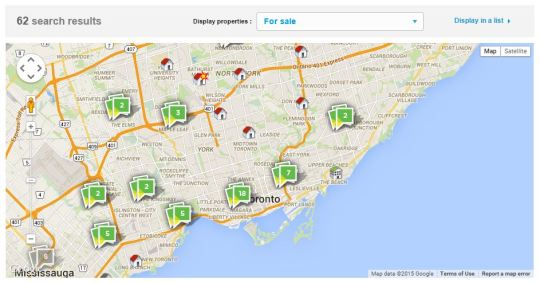
    Here are the comFree search results for downtown Toronto. There are 62 properties.

    image

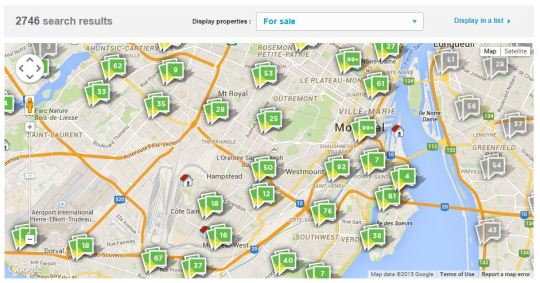
    And here are the duProprio search results for downtown Montreal (notice I tried to maintain the same zoom level). There are 2,746 properties.

    image

    If anyone has any insights on this phenomenon, I would love to hear from you in the comment section below. I don’t know why this is the way it is.

  • Pushing and pulling

    image

    Venture capitalist Chris Dixon recently published an interesting post called, Two eras of the internet: pull and push. In it, he describes two patterns that have emerged within the internet over the past decade and a half.

    Pull (2000s):

    Pull is when you are seeking information, usually an answer to a question. You want to know the closing time of a restaurant, the description of a hotel where you are thinking about staying, the details of an historical event you heard about, etc. You go to your computer and pull the information. The killer app for pulling information was Google.

    Push (2010s):

    Push is when you are using the internet in a more passive way and content comes to you. The killer app for push is social networks, the most popular being Facebook. Information is pushed from user to user via likes, shares, tweets, etc. People tend to push things they find funny, interesting, moving, outrageous, etc.

    Now let’s think about this for a second, because it’s a pretty significant change.

    Google’s mission is to organize the world’s information. And they have certainly made it easier for us to get the information we want. Instead of physically searching for something, you just type in a few keywords and it pops up. But, it still involves us deciding we want something and then pulling the information.

    What’s fascinating to me about push is the idea that content and information comes to you. And it’s one of the reasons that I’ve always found Foursquare more interesting than Yelp – even though Yelp is far more popular as a tool to help you find somewhere to eat, drink and so on.

    When I walk into a restaurant or bar now, oftentimes I’ll see a Foursquare notification popup on my phone showing me a tip that somebody has left: “Try the meatballs – they’re to die for”. I didn’t search for that. I didn’t ask for a recommendation. But Foursquare knew where I was and presented me with that information.

    Now, there are obviously potential downsides to constant interruption, but let’s focus here on the opportunities. How could these same principles to be applied to other industries such as, say, real estate?

    I think there’s a pull and push parallel.

    Today MLS operates in a way like a search engine for homes. You decide you might be interested in buying a home and so you go online and start pulling listings.

    Of course, the vast majority of people also work with a real estate agent. And in a way they’re kind of like your push. They get to know you, they figure out what you’re looking for, and then they push relevant listings and information to you.

    And maybe that’s why nobody has killed off real estate agents – despite the numerous attempts. Everybody has been focusing on new pull platforms (listing platforms) as opposed to a new push platform.

    Who knows.

    But I think it would be naive to think that these emerging push platforms won’t reach far beyond social media.

  • What’s in a neighborhood?

    image

    When I was working on my startup Dirt last year, one of the things we spent a bit of time figuring out was how to classify buildings according to neighborhood. Now, at first blush, this may seem like a fairly easy thing to do. You simply locate the building, figure out which neighborhood it’s in, and then tag it accordingly. But neighborhood boundaries and definitions aren’t as clear cut as you might think.

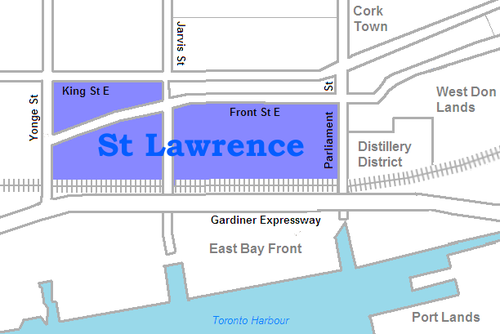
    For example, a lot of you probably know that I live in the St. Lawrence Market neighborhood of Toronto. And indeed, if you look at this Wikipedia definition, I live in that area. But if you look at what they call it, it’s just: “St. Lawrence.” They also specify that it used to be called “St. Lawrence Ward”, but that today most people actually call it “the St. Lawrence Market.” So here you have an example of an evolving and changing name.

    image

    But then there’s the question of boundaries. According to Wikipedia’s definition, the north boundary is Front Street. This means that the North Market Building would be technically outside of the area and so would the Market Square condos. But I suspect that almost everyone would consider these two buildings to be part of the neighborhood. So where exactly is the north boundary? Is it King Street? Or maybe by Front Street they mean that all buildings on the north side of the street are included.

    If you look at the city’s official neighborhood list (which is built from Statistics Canada Census Tracts) you’ll find a completely different boundary and name. According to this list, I live in the “Waterfront Communities–The Island” neighborhood. Obviously nobody, other than maybe somebody who deals with census data, would have any idea what this area is. But it’s how the city tracks its demographic data.

    What this begins to show you is that neighborhood definitions and boundaries aren’t as black and white as they might initially seem. And it’s partially because cities themselves are always in flux. New neighborhoods emerge and old ones reinvent themselves. And as that happens, people start introducing new names and new terminologies.

    image

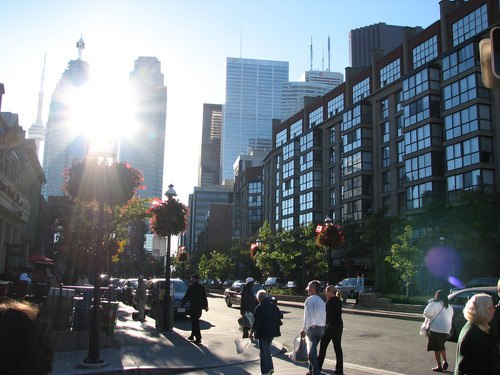
    When I was about 19 years old, people in Toronto used to say they were going out “on Richmond and Adelaide.” Since then, gentrification has pushed many of the bars and clubs out of that area. So people instead go out “on King West” or “on Ossington.” And as people begin to use those terms and identify with an area, new brands are created. Ask anybody who lives downtown and I bet they’ll tell you that King West has its own unique personality and even a type of person who typically lives there. This is an on the ground type of awareness though, which doesn’t get captured in census tracts.

    The other reason neighborhood boundaries can be so fuzzy is because we – the real estate community – are constantly trying to manipulate them for our own benefit. I’m indifferent to the fact that this happens, but it is a reality. Think about how much the neighborhood of Yorkville has been stretched from its original roots north of Bloor Street. If a neighborhood has a good brand, agents and developers will naturally try and leverage it. Homeowners do it all the time too. Would you prefer to say that you live in Seaton Village or the Annex?

    Ultimately, we (my Dirt cofounder and I) decided that neighborhood definitions and boundaries needed to be fluid. They needed to dynamically adjust with the market and come from as many people as possible on the ground. Because at the end of the day if the official documents say one thing, but the majority of city residents believe another, then that official boundary and definition are probably out of date. The crowd wins here.

    We liked this approach because it was organic – just like cities.

    Images: Flickr, Wikipedia, Flickr