Daily insights for city builders, delivered every morning at 6 AM ET. I’m Brandon Donnelly — a Toronto-based real estate developer and founder of Globizen. I’ve been writing here since 2013.

Tag: photographer

  • The Germania Bank Building at 190 Bowery

    I recently mentioned that it would be nice to be able to buy a five-storey building in Soho (New York) for $70,000. Yes, that was in 1968 dollars. But even in today’s dollars, we’re talking less than $600,000. I would gladly buy a cast-iron five-storey building in Soho for that price today if it were somehow possible.

    In response to this post, a reader sent me this (thank you), which is another great example of an artist buying an old buying in New York for what is clearly an absurdly low price. The artist is photographer Jay Maisel, and the building is The Germania Bank Building at 190 Bowery.

    Jay bought the six-storey building in 1966 for $102,000. He then used it as his residence, a studio, and as a place to collect a hell of a lot of things. Though at one point he also rented out some of the other floors to artists like Roy Lichtenstein.

    It is alleged that most people thought the building was abandoned. But this was obviously not the case. Jay sold the building to RFR Holdings in 2014 for $55 million. And in 2019, streetwear brand Supreme opened up in the bottom.

    Today, I understand that Web3 things are also happening in the building. And who knows, it might be the case that we’ll be reading about some of them, in a similar kind of way, fifty years from now.

  • Toilet seat heights in Amsterdam

    I am in Amsterdam right now for the very first time. And after I took in all the bicycles, the beautifully tilting buildings, and its iconic canals, the first thing that struck me was — get this — the height of its toilet seats.

    Now don’t get me wrong, I am a reasonably tall guy. So it’s not that the bowl in my hotel room isn’t comfortable or anything like that. It actually feels quite luxurious. I just know that this thing has got to be taller than your average bowl.

    A typical toilet seat height can be anywhere from 15 to 19” when measuring from the floor to the top of the seat. But I think 17-19” is the most typical range. So how much taller is my Dutch bowl?

    Sadly, I forgot to pack my tape measure on this trip. So I instead used the tallest book I could find in the room as a measuring stick. It happenend to be the above book by Hollywood photographer Matthew Rolston.

    Matthew’s book is 36cm tall and so, by using everything I ever learned in architecture school, I am now fairly confident that my seat is currently sitting at around 21-22” off the ground.

    Dutch people are tall. And so too are the bowls, it would seem.

  • The swimming pools of Paris

    For years, French photographer Ludwig Favre has been doing a series on the swimming pools of Paris. The first one he photographed (and the first photo below) was the Piscine Pontoise. Designed in 1933 by architect Lucien Pollet, Pontoise was one of four pools that he completed for the Piscines de France at that time. Another one of his designs was the Piscine Molitor (second picture below), which is the most famous of the bunch for a few reasons. It was the place to be seen in Paris when it first opened. It was where the world’s first bikini was apparently unveiled. And it was also abandoned and almost demolished, during which time it got filled with street art. If you aren’t familiar with the work of Ludwig, I would encourage you to check out his portfolio. He does an incredible job showcasing these pools, as well as many other aspects of our cityscapes.

  • Architecture of density

    Photographer Michael Wolf died at his home in Hong Kong this week. He was 64. Even if you don’t recognize the name, I am sure that many of you have seen his work. Perhaps his most famous project was “Architecture of Density”, which had him documenting Hong Kong’s extreme urban density from 2003 to 2014. Here is a photo (taken from his website):

    Michael was born in Germany, but grew up in Canada (he went to school in midtown Toronto) and in the United States. He eventually settled in Hong Kong and Paris — both of which became muses for his work. Michael made a career out of documenting cities and the life that happens within them. If you aren’t familiar with his work, I would encourage you to check it out here.

    Photo: Michael Wolf

  • Live/work photography studio on Stoney Lake

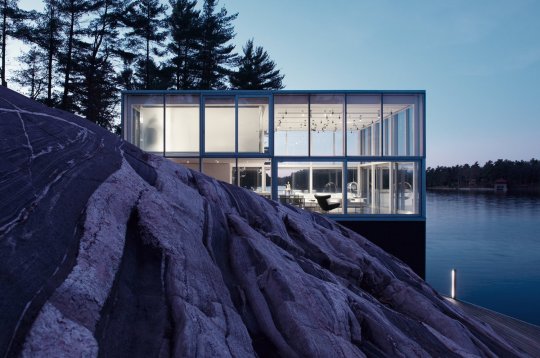
    It’s the dog days of summer right now and I suspect that some of you may be spending your time (or at least some of it) near water. So here is one of my favorite lakeside homes. It is a live/work photography studio sitting on top of a boathouse on Stoney Lake in the Kawartha Lakes region of Ontario. It is by gh3*. They do terrific work.

    image

    I love the relationship to the Canadian Shield (see above). And I love how it is a dramatic departure from the archetypal Ontario cottage. I am more impressed by a project like this (it has 1 bedroom) than I am by a 5,000 square foot “cottage estate.”

    Some of you may be wondering how a largely all glass curtain wall box performs environmentally during these dog days of summer and I am wondering the exact same thing. But it is north facing. And the goal was to create a space that would enable photos not possible in a conventional studio.

    For more on the project, including other photos, go here.

  • Photographing architecture studios

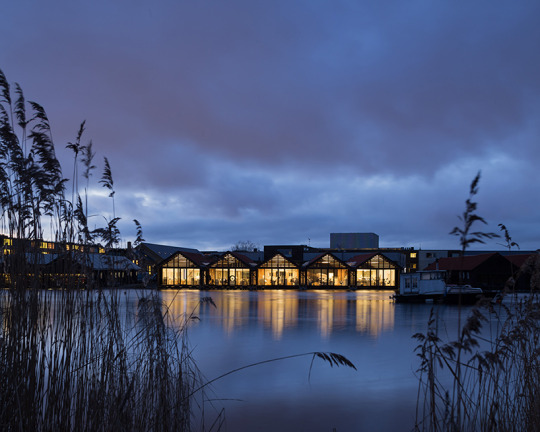
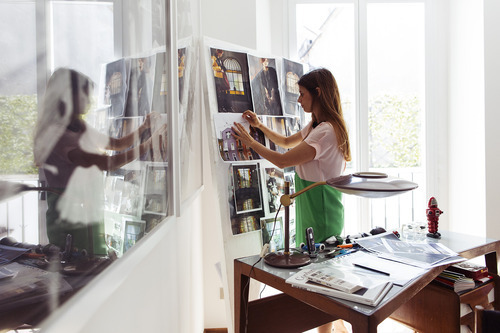
    Marc Goodwin – who is part of a photography studio called Archmospheres – has an ongoing project where he photographs the studios of architects. 

    He has photographed well known practices such as MAD, Renzo Piano, and David Chipperfield, as well as a number of geographic niches such as Paris architecture studios, Nordic architecture studios, and London architecture studios

    He also varies the size of the firm. Some of them only have a few people working out of a small streetfront retail space.

    As an architect, you are pretty much required to have a cool studio space. So this is certainly an interesting photography project to take on. The photo at the top of this post is 3xn in Copenhagen.

    Image: Marc Goodwin via Designboom

  • Assembled realities of the New York landscape

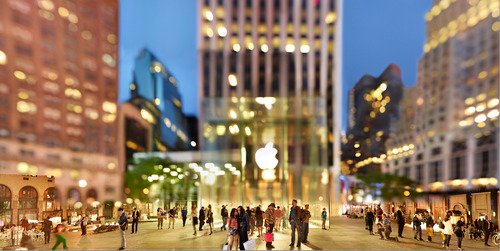
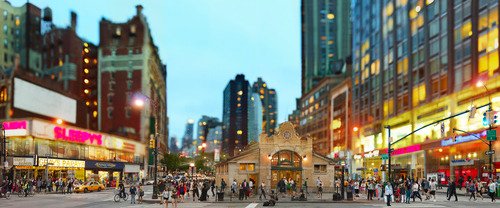
    New York photographer Jeff Chien-Hsing Liao has an upcoming solo exhibition at the Museum of the City of New York next month called Assembled Realities. I just heard about it through CityLab.

    Here’s a bit of background on his work:

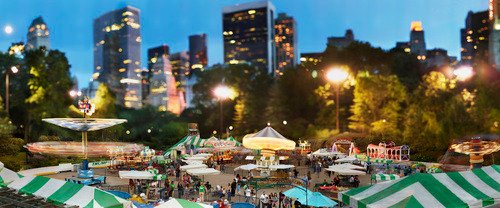
    Pushing the boundaries of traditional documentary photography, Liao (b. 1977) creates large-scale panoramas by combining multiple exposures of the same location taken over the course of several hours. The resulting composite photographs are often fantastical; complex, hyper-real views that no single shot—or the eye—could capture.

    And here’s two more of his photos:

    For higher resolution versions, click here.

    I love how his photos begin to distort reality and how they focus your attention – in many cases – on New York’s vibrant street life. I thought you might all enjoy them as well.

  • In your place

    image

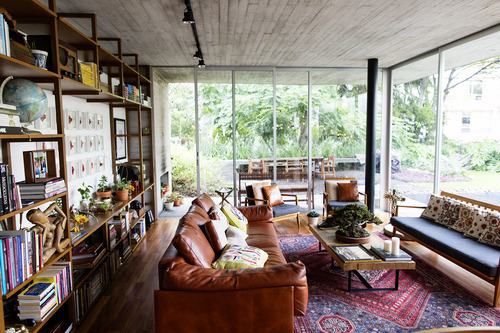
    Ever since I was a kid, I’ve always enjoyed seeing people’s places. I like seeing different homes and I like seeing how people decorate them. Which is why I’m a big fan of photographer Todd Selby’s project, The Selby Is In Your Place

    Starting in June 2008, Selby has gone around and photographed the personal spaces of creative people all around the world–everyone from fashion designers to artists to entrepreneurs. The most recent is the home of Carolina Castiglioni, who is Director of Special Projects at Marni in Milan.

    image

    The project has been a huge success for Todd and his website now receives over 100,000 unique visitors a day. He’s also gone on to publish 3 books. The first was simply called ‘The Selby is In Your Place’. If you’d like to pickup a copy for your coffee table, you can do so here.

  • I got 88 buildings

    The NH Deutscher Kaiser Hotel building in Munich looks like this:

    It’s a fairly conventional tower on top of a podium.

    However, photographer Victor Enrich decided to reimagine what this tower and podium could look like. In fact, he did it 88 times. Here’s the video. And here’s one example:

    The realism of each is incredible. It’s also a fascinating—albeit outlandish—study of what could be.

  • Halfway assimilation in Canada’s arctic

    Yesterday, I discovered a Jerusalem-based Italian photographer by the name of Vittoria Mentasti. She has an ongoing project called “A Woman With Two Names”, that’s exploring the identity of Canada’s Inuit community in Iqaluit, Nunavut. Click on the photo below to see the entire gallery.

    Here’s her language on the project:

    “Iqaluit, the capital of Nunavut, is a city of 7000 people surrounded by tundra and the sea. The only way to get in or out of Iqaluit is from the air. I was interested in the cultural identity shift the Intuit community is experiencing and its consequences. The community, especially its younger members, are trapped between two worlds; they are losing touch with their past and are headed towards an uncertain future.

    The process of forced assimilation carried out by the Canadian Government and the Church during the first half of the 20th century, deprived the Inuit of their social and spiritual customs. The transition away from their nomadic roots to modernized living has led to alcoholism, domestic violence and unemployment; symptoms of a society that is floating between its past and present.

    Photographing off-moments of everyday life, I was looking to depict the sense of isolation, their ancestral connection to a harsh land, and the feeling of not belonging to “The South”, the way Inuit refers to the rest of the world.”

    As one of the most remote and sparsely populated regions in the world, it’s easy to overlook what’s happening here in our country. But there are real problems in our north. In 2011, the Globe and Mail published a Focus Feature on Nunavut where it asked: Is Nunavut a failure of Canadian nation building?

    “The rate of violent crime per capita in Nunavut is nine times what it is in the rest of Canada. The homicide rate is around 1,000 per cent of the Canadian average.”

    I’m not an expert on this matter, but it seems like everybody is picking up on the same phenomenon. We’ve created an in-between society. A society that’s completely ill-equipped to compete in the modern world, but that’s too far removed from its roots to turn back now. They were nomads and now they’re not.

    This is hugely problematic and it’s only going to get worse. Already we’re seeing rising income inequality within “The South.” The returns to being smart are being amplified and twenty somethings with a killer app are turning down billion dollar acquisition offers.

    What do you think this does to the north? I’d bet it makes it much worse.