
Daily insights for city builders, delivered every morning at 6 AM ET. I’m Brandon Donnelly — a Toronto-based real estate developer and founder of Globizen. I’ve been writing here since 2013.

Tag: housing market

  • Over-building and then under-building: Is Toronto headed for a severe shortage of new rental housing?

    As we know — because here’s the data — this is the current state of affairs:

    The GTA condo market is in a state of economic lockdown. The math doesn’t make economic sense from both the demand side (investors) and the supply side (developers), leaving the market at a standstill.

    The above excerpt is from a recent CIBC Capital Markets article by Benjamin Tal (CIBC) and Shawn Hildebrant (Urbanation). And what it ultimately means is that the supply of new condominiums in the GTA is falling and will continue to fall for the foreseeable future. Below are two charts, from the same article, that show that.

    Because of this, I actually think that, if you need or want a place to live, right now is a near ideal time to buy a condominium, especially if it’s from developer inventory (in an already completed project) or it’s a resale. Of course, most people won’t want to do this because they’d rather buy when most other people in the market want to buy. This is how markets tend to go.

    It has been a while since the GTA has gone through one of these real estate cycles, but it is typical: developers are prone to both over-building and under-building. It simply takes too long to build a building, and so it is natural for there to be moments when supply and demand don’t exactly line up.

    Pre-selling condominiums is — in theory only — supposed to protect against too much overbuilding. But as we have spoken about many times before, it can be challenging for end users to buy a new home so far in advance. And so the new condominium market has come to rely on investors who want to buy early and then either sell later or rent later.

    According to the above article (and MLS data), the share of newly completed condominiums used as rentals reached a peak of 34% in 2023. So a third of new condos. My gut tells me that the actual number is much higher. Many rentals never reach MLS. Overall, I think it’s very safe to assume that the majority of new condominiums are owned by investors.

    But right now, fewer investors want to own condominiums, which is why the number of resale listings has spiked this year:
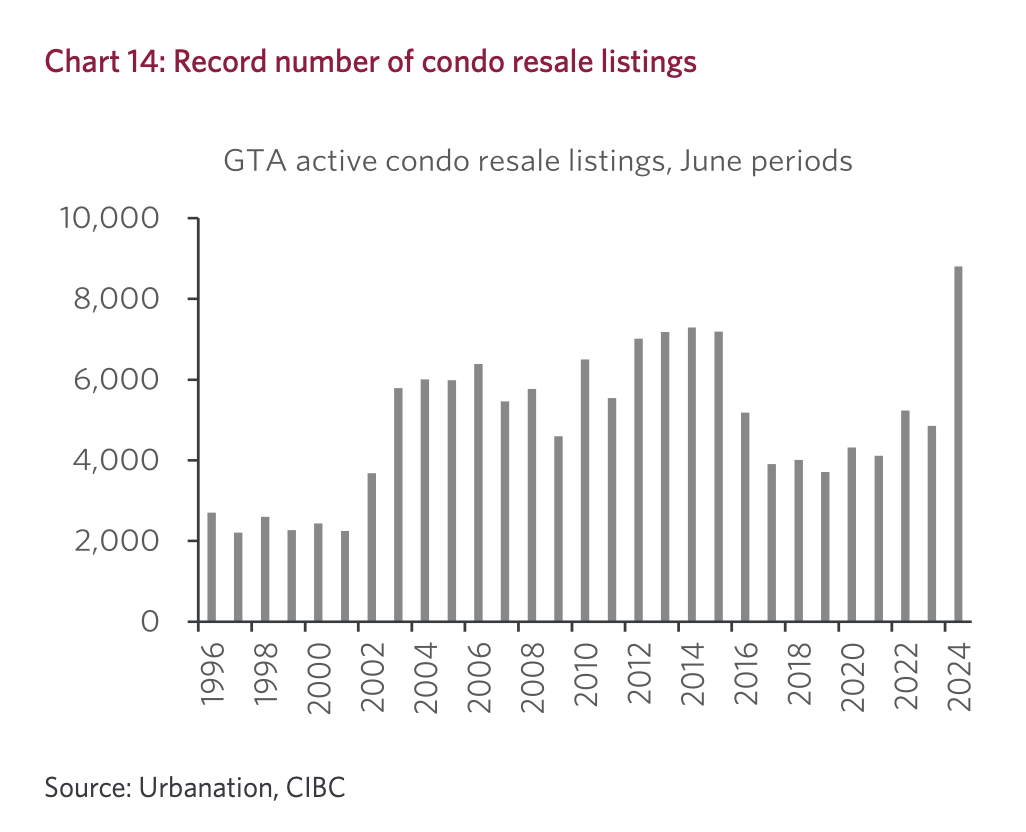
    This is, again, why I think right now is an excellent time to buy a condo. You know, be greedy when others… Regardless, this inventory will need to get absorbed and that will ultimately happen. Some of it will go to end users and some of it will go to investors who can make sense of the rental math and/or want to take a long view on Toronto. But if more goes to the former, we will be losing a lot of new rental housing.

    At the same time, while all of this is going on, construction starts are likely going to remain depressed (chart 3 above). It’s impossible to know how long this lasts, but at some point we will reach a moment in the cycle where we are under-building new housing. Maybe we’re already there. Development simply can’t turn on fast enough when demand spikes. There will almost always be a lag.

    So, since the majority of new condominiums have been serving as new rental housing, there’s a strong case to be made that at some point we will run into a potentially severe shortage of rentals. Condo investors are sometimes vilified in the media, but we will soon find out what happens when you take a big chunk of them out of the housing market.

  • The US is building a lot of apartments right now

    As of November 2023, it was estimated that there were 988,000 homes under construction in multi-family buildings containing 5 or more units. This is in comparison to 680,000 single-family homes, according to US Census data. (Looking at the below graph, it’s also interesting to see how the supply of single-family homes dropped off after the global financial crisis and multi-family apartments took off.)

    All of this means that in 2024, the US is on track to complete more apartments than it has in many many decades. In fact, exactly similar to what we experienced here in Toronto, if you want to find a comparable multi-family supply number, you need to go as far back as the 1970s (see below). Of course, the US had fewer people back then, and so on a per capita basis, it was building more housing.

    Still, all of this new supply is having an impact. Apartment List recently published its national rent report, over here. And overall, it found that:

    Rent increases are currently being moderated by a robust construction pipeline expected to deliver a decades-high number of new apartment units in 2024.

    More specifically, they found that the cities with the most supply are now seeing the largest rent declines:

    Many of the steepest year-over-year declines remain concentrated in Sun Belt cities that are rapidly expanding their multifamily inventory, such as Austin (-7.4 percent year-over-year), Raleigh (-4.4 percent), and Orlando (-3.9 percent).

    If you’re an apartment developer, this is not what you want to see. It means that increased competition is creating downward pressure on rents and that vacancy rates are probably rising. But if you’re someone looking to rent an apartment, this is exactly what you want to see. You want more affordable housing. And so, as a consequence, you want more homes to be built. Because when supply outstrips demand, this is what you get.

    Charts: Apartment List

  • Housing follows money

    One argument that you might be able to make is that home prices follow urban density. New York City, for example, is dense. And homes in New York City tend to be more expensive than those in, oh I don’t know, rural Canada. So with this, you might conclude that development and density are bad — it makes housing more expensive. But then there’s places like San Jose, California. It’s not very dense, and yet it has some of if not the most expensive housing in the US.

    Well, it turns out that housing density and median housing values don’t actually exhibit a particularly strong correlation. A better and much stronger relationship can be found in what Kasey Klimes explains, here, in this excellent post, which is that home prices more accurately follow incomes. In other words, the more high paying jobs that exist in a market, the more likely that housing will be expensive.

    Here is what that looks like for US metros over 1 million people:

    The above chart compares median home value to aggregate income per unit of housing. And here, Kasey discovers an r-value of 0.9, which suggests that “over 81% of median home values in large metros can be attributed to aggregate income per unit of housing.” This explains why San Jose, and San Francisco, are such outliers. They have very high incomes for every unit of available housing, despite the former being not all that dense.

    Okay, so now that we know this, how do we make housing more affordable? One option is to just make people poorer. If you reduce incomes per unit of housing, then home prices will, almost certainly, go down. And this is why poorer cities tend to have more affordable housing. But this is obviously suboptimal. The better option is to keep people wealthy and simply increase the denominator in “aggregate income per unit of housing.”

    Meaning: build more housing!

    Chart: Kasey Klimes

  • What the NAR’s $418 million settlement could mean for the real estate industry

    The $418 million commissions lawsuit that was settled last week with the National Association of Realtors (NAR) is certainly a big deal. The NAR is trying to sound positive, but all signs point to this outcome being meaningful for the industry. TD Cowen Insights is forecasting that commissions paid in the US each year could fall by some $25 to $50 billion (from a total of ~$100 billion). And this is the headline you’ll see everywhere right now. But how might this actually happen?

    As we’ve talked about before, the status quo commissions set up is a good one for agents:

    • Sellers are typically the party who pays 100% of the commissions
    • But sellers don’t pay until the agent sells and they have fresh cash
    • Money being deducted from proceeds (a “take rate”) is a lot less noticeable and has a lot less friction than cash you just have to pay out of pocket
    • Buyers kind of don’t pay — or at least that’s how they’re supposed to feel

    This is “good” because it perpetuates the existing model. If buyers feel like they’re mostly not paying, they’re just going to go to the marketplace with the most supply of homes. And that marketplace is the Multiple Listing Service (MLS). However, this marketplace also does things like tell buyer agents how much commission they will make as part of each deal. And the belief is that practices like this are anticompetitive.

    So as part of the above settlement, the following new rules are expected to go into place by July 2024 in the US:

    • Seller agents will no longer be able to set compensation for buyer agents
    • All fields on MLS displaying broker compensation will need to be removed
    • Furthermore, agents will no longer even need to subscribe to an MLS in order to accept compensation
    • Buyers working with an agent will need to enter into their own buyer broker agreement and negotiate compensation separately
    • However, there’s nothing stopping buyers and sellers from negotiating whatever commission structure they want; the idea is simply that it will be more transparent and negotiated by each participant

    Why this is meaningful is that it decouples buyer agents and seller agents in a way that they aren’t today. Instead of everything originating from the sell side, each side of the transaction is now going to — theoretically at least — negotiate what they believe is fair compensation for their representation. At the same time, there’s no obligation to even subscribe to an MLS.

    This leads us to, at least, two important things to think about:

    1. What is fair compensation? Well, it should depend. If I’m a first-time buyer, I may want someone to walk me through the entire process. But if I’ve done it many times before, maybe I need very little. Or, if I’m an investor looking to renovate homes, maybe I want representation that is also an expert on construction. The point is that, in a truly open market, one should be able to find an agent and pay them based on the value that they’re creating. And this is presumably why everyone is expecting commissions to fall precipitously.
    2. If there’s no obligation to even subscribe to an MLS, does this then open the door for new and more open listing platforms? Right now, I don’t know how this will play out. I’d like to better understand more of the details around this settlement item and what it could mean for the landscape. But I do know that the way to spur the most amount of innovation would be to have the marketplace run on something like a blockchain, and then allow anyone to create their own listing platform on top of it. One day.

    This will be fascinating to watch play out. And I’m sure it’s only a matter of time before it spurs similar changes here in Canada. Expect further coverage of this topic on the blog.

    Photo by Tom Rumble on Unsplash

  • Wonderful real estate

    At the highest level, I agree with the premise of this tweet from The Real Estate God. The overarching argument is that one’s main criteria for selecting a real estate market in which to enter should be “the place with the least competition.” And the reason for this is that less competition equals less price discovery, which then equals more mispriced assets and more opportunities to generate outsized returns.

    Going even further, the argument here is that you’re actually taking on less risk by buying mispriced assets in less competitive markets because you can model reality (things like in-place cash flows and market rents) as opposed to betting on the future (things like rental growth and/or cap rate compression). Said in a different way, it’s easier to find deals and “make money on the buy”; and, once again, I would mostly agree with this.

    But in my mind there’s a very important caveat. And it’s akin to the advice that the late Charlie Munger supposedly gave to Warren Buffet: “Forget what you know about buying fair businesses at wonderful prices; instead, buy wonderful businesses at fair prices.” While it is true that you might find wonderful pricing in less competitive markets, there remains the question of whether you’re also buying wonderful real estate.

    And I think that’s an important consideration.

  • Condominiums — affordable or luxury?

    It is disappointing to me that we often vilify all condominiums as being “luxury condos.” I think the rhetoric is disingenuous and I think it distracts us from finding more productive solutions. As Mike Moffatt points out in this thread, if you look at virtually all major cities in Canada, the most affordable housing options are going to be condominiums and not low-rise freehold houses.

    In his case, he looked at current for sale listings in London, Ontario, and found that for homes under $400k, about 81% of them were condominiums, and for homes over $1,200,000, only 4% of them were condominiums. Again: the real “luxury homes” are the low-rise houses that not the condos.

    Now to be fair, John Pasalis is not wrong in responding to the thread and saying that on a per pound basis, or a per square foot basis, condominiums are actually more expensive. I’ve been saying this for years on the blog. When measured this way, mid-rise buildings are one of if not the most expensive housing typologies.

    So John’s argument is that, while condominiums may be the more affordable option for 1-2 person households, if you’re a family in need of more space, low-rise housing is likely going to be more affordable for you on a per square foot basis. And I would agree with this statement.

    The problem with this approach in the real world, though, is that people don’t buy and afford homes based on this metric. You can’t go to a bank and say, “I want to buy this house for $1.7 million dollars because it’s only $680 per square foot when I include the basement, and that’s better value than this 700 square foot condominium selling for $1,400 psf.”

    Sorry, the bank is going to tell you what total price you can afford based on your income. And that’s why condominiums in our market have tended to serve as a critical entry point for first-time buyers. They’re the most affordable option in terms of their total sale price.

    So in my view, labelling all condominiums as “luxury” is not exactly productive. It ignores their role in providing more affordable homes; it overlooks the supply constraint that low-rise houses represent in most of our cities; and it’s a distraction from the more systemic issue at hand: how do we make housing more affordable for everyone, including families?

    Photo by Marcos Paulo Prado on Unsplash

  • What might happen in 2024

    Yesterday we looked in the rear-view mirror. Today we’re looking forward:

    • The market consensus right now is that this cycle of interest rate increases has come to an end, and that we should see rates start to come down next year. Having confidence that rates won’t go any higher in the near future is what markets need in order to start making more decisions. So this is, of course, positive. At the same time, I don’t think anyone should expect a return to ultra-low rates. Rates today are still low when viewed historically.
    • Lower rates are good for levered assets such as real estate, but I don’t think that our industry has fully felt and processed the impacts of higher rates. Unfortunately, I think that things will get worse (in 2024) before they get better (maybe toward the end of 2024 or perhaps in 2025). This is when a “risk-on” approach will return in commercial real estate. A year ago today, I thought 2023 would be the year for this, but as I said yesterday, I was overly optimistic in terms of my timing.
    • On the residential resale side, I think we will see greater optimism sooner, certainly for the most in-demand cities and areas. There is pent up demand waiting on the sidelines and, once we can get past the current bid-ask spreads and deadlock, I believe we’ll return to a more balanced market in 2024. To be clear, I’m not expecting bidding wars and the like. And because of our housing affordability crisis, I also think the Bank of Canada will be more resistant to lowering rates compared to other central banks. This will help the Canadian dollar.
    • If you’re a buyer of real estate, I generally believe that 2024 will turn out to be a pivotal year for you. Roughly speaking, you win acquisitions in one of two ways: either (1) you pay the most or (2) you believe in something that most other people in the market don’t. This second approach is harder to achieve in bull markets. But in slower markets, the door is open and history has taught us that it can be the foundation in which great fortunes are made.
    • As I mentioned yesterday, I agree with the prognostications that hard costs will soften further next year (perhaps even more than 5% on average). Obviously every market is different. But here in Toronto, I just don’t see us returning to the level of construction starts that we have seen over the last number of years.
    • Since 2021, I have used my hyper scientific Jimmy the Greek Reopening Index to keep tabs on office utilization and the overall return to office. And based on this, 2023 was a positive year. Initially, souvlaki consumption appeared dramatically lower on days like Monday. But I noticed discernible increases as the year went on. However, if you look at actual data, such as what we have from swipe cards, the great return to office seems to have stalled out at around 50%. I don’t think this will hold, though. I continue to believe that of the people who work in offices, most will spend > 50% of each week there. And we will see that in 2024.
    • 2023 was the year of AI. But Fred Wilson makes an excellent point, here. AI is 40+ years in the making. Last year only became the year of AI because a consumer-facing app — ChatGPT — was revealed that captured everyone’s attention. Crypto will eventually have this moment, but it will likely need to marinate a bit longer. Instead, I think 2024 will be the year of augmented reality (AR) and a further blurring of our offline and online worlds. Think digital art, fashion, and other collectibles (such as NFTs).
    • Right now, autonomous vehicles feel like they’re in the trough of disillusionment (within the hype cycle). There were moments last year where it felt like we were finally moving beyond this phase. But then some very suboptimal things happened. I think AVs are our reality in the next 5+ years, which means that for next year we likely want to be focused on the inputs: vision/LIDAR, battery tech, etc.
    • Zooming out, we should be thinking about the above two trends in the context of a broader shift toward greater automation. I think it will feel more insidious than immediate (certainly in 2024), but the longer-term impacts are going to be profound for our society. The so-called gig economy is likely to be impacted first. Eventually the overall economy will create new jobs, but we are still going to need to manage this transition toward more automation.
    • TikTok Shop is where to look for the future of shopping. I think the platform will continue to see strong adoption and ultimately prove to be a dominant e-commerce platform throughout 2024. Amazon, Meta, and others will see this, and try their best to catch up and copy it.
    • At the time of writing this post, the total crypto market capitalization is about $1.74 trillion. This is down from nearly $3 trillion at the peak of the market in 2021. The recent gains suggest that the so-called “crypto winter” might be over, and so combined with lower interest rates and more real-world use cases, I think that 2024 will be another strong year for crypto. Total crypto market cap at the end of the year will exceed its 2021 peak.

    And there you have it. My current thoughts for this upcoming year. I should note that I’m not an economist, analyst, or an expert on souvlaki demand for that matter. But I enjoy writing this post as an annual discipline. It forces me to think critically about the topics that interest me. And in the paraphrased words of Howard Lindzon, it gives me an archive that I can go back to and either cringe at or think to myself, “hey, I could have been a somebody!”

    And with that, a big thanks to everyone who has read this daily blog over the last year. This year marked its 10th anniversary. I wish you much success and happiness in 2024. Happy new year!

  • What happened in 2023

    As per tradition around here, I like to bookend the new year with two posts: a post that revisits my random predictions for the year and a post that talks about what might happen in the year to follow. Today’s post is the former. So let’s see how I did:

    • I thought the interest rate hikes would come to an end in Q1-2023. But that didn’t happen until the summer. I also thought this would lead to a mild recession in Canada. Technically, we are not actually in one, but according to some, we kind of are.
    • I thought the real estate sector would start seeing some distress in the first half of the year, and that a new equilibrium would be found in the second half. This proved to be overly optimistic in terms of timing. A lot ended up being on pause for the entire year, and I now think that my forecast was at least a year too early. The sea change is still underway.
    • Given the overall slowdown in real estate, I felt that construction costs had to see some softening. This did, in fact, happen with some of the “earlier trades”, such as shoring and excavation, and we did see some specific trade pricing, such as concrete formwork, come down by as much as 30%. The smart cost consultants we work with now expect to see overall hard costs come down by a further 5-6% next year in Toronto. This makes sense given construction starts are way down.
    • With me expecting the interest rate increases to stop in Q1, I thought that pre-construction condominium sales would return in a meaningful way by the spring. While we did see some buoyancy around that time, it was short lived. Sales remained nearly shutoff for the entire year, but for maybe a handful of projects. The more successful projects tended to be outside of the Toronto core and at lower price points.
    • With respect to home prices in more tertiary/fringe markets, my sense then, as it is now, was that these prices would remain below the peaks for many years. In addition to the upward momentum created by low rates, my view was/is that some of this pricing was the result of a bet on urban decentralization. I don’t think that has played out as many expected it to, so that’s why I think it will be many years before the pricing we saw in early 2022 returns.
    • The momentum around “expanding housing options” in our low-rise neighborhoods is many years in the making. And a lot of progress was made in 2023. Here in Toronto, we adopted new multiplex policies that now allow fourplexes plus an accessory dwelling (so 5 homes in total) on an as-of-right basis. I continue to believe that this momentum is only going to grow. I also think we will see the arrival of more mixed-use opportunities.
    • I believed that, broadly speaking, urban transit ridership would remain below pre-pandemic levels for all of 2023. This proved to be the case for most US and Canadian cities. But things are improving. For Canada as a whole, it looks like we’ll see full recovery sometime in 2024 based on this trend line.
    • I thought 2023 was going to be the year I took my inaugural ride in an autonomous vehicle. Sadly, this didn’t happen. The sector as a whole also saw some setbacks. Hopefully I’ll get a chance next year.
    • I assumed that Apple would finally release its augmented reality device. And though they didn’t technically release Vision Pro, they did announce it. So I guess that counts for something. I also thought that 2023 would be a big year for “phygital” goods. Maybe it was. Or maybe it was more of a building year. A lot of people are curious to see how Vision Pro does in 2024. It’s not set up for the mass market, just yet, but I think it will do exactly what it is supposed to once it’s out in the wild.
    • Finally, crypto. I know that a lot of you like to skip over these posts, but it is something that I feel strongly about. A year ago, though, I was pretty bearish on Solana. Boy was I wrong. Solana ended the year as the best performing major crypto asset — up 933% at the time of writing this. Oops! However, Ether is also +91%, and I continued to dollar-cost average in all throughout the year.

    Next up: What will, or more accurately, what might happen in 2024.

  • Zurich is hot

    Zurich is today one of the hottest real estate markets in Europe:

    And based on UBS’ Global Real Estate Bubble Index for 2023, it also has the highest bubble risk:

    According to Bloomberg, there are a number of reasons for this: low housing supply, a constrained geography, a key interest rate that is less than half of the ECB’s, and Google. Google is one of the largest employers in the city, with more than 5,000 employees. And supposedly the starting salaries for a software developer there can reach 200,000 Swiss francs (nearly CA$300,000).

    I also just learned that the minimum wage in Switzerland is 23.90 Swiss francs per hour. Based on 160 hours per month, that’s 3,824 francs per month or 45,888 francs per year. In Canadian dollars, that’s over $68,000 per year. Pretty healthy. Although, as we can see here, Zurich is also expensive.

    Charts: Bloomberg & UBS

  • The Citadel effect

    Last year, the formerly Chicago-based hedge fund Citadel announced that it would be moving its global headquarters to Miami. (Though to be clear, the company still has an office in Chicago.) Today, the Miami housing market is feeling the effects:

    “They’ve been buying here aggressively,” said Michael Martinez, a real estate agent with Sotheby’s in Miami, who recently brokered the sale of a $5mn home in Coconut Grove, a quiet salubrious suburb, to a Citadel employee. Most of the luxury homes he has sold in recent months have been to hedge fund buyers, half of them from Griffin’s firm, he estimates. “The Citadel migration is definitely occurring.”

    But it’s not just Citadel.

    According to another agent quoted in the article, there are many other “hedge fund buyers” active in the market, and many/most of them are buying all cash. In desirable suburbs like Coral Gables and Coconut Grove, homes between $3-7mm now account for about 40% of all listings.

    I remember visiting family in Miami in and around the GFC of 2007-2008. It was at this time that I really fell in love with the place. You could see how it was using art and culture to carve its identify. It was (and still is) this really exciting and sexy place.

    But it was also reeling from the GFC. I remember seeing listings for large and newish 2-bedroom waterfront condos for ~US$150k in some areas. If I had any money, this likely would have been a smart move given how Miami has grown since then.

    So I think this story is less about the Citadel effect and more about Miami’s continued rise as a global city and global financial center. Notwithstanding the whole climate risk thing, this city region has some pretty powerful tailwinds.

    Photo by Ryan Parker on Unsplash