Daily insights for city builders, delivered every morning at 6 AM ET. I’m Brandon Donnelly — a Toronto-based real estate developer and founder of Globizen. I’ve been writing here since 2013.

Tag: traffic congestion

  • This is what happens when you price roads

    As a general rule, road pricing isn’t popular. But that’s not because it doesn’t work. The problem is that it works too well, and people don’t like the idea of driving less and paying for roads (that currently have a zero marginal cost).

    Here’s a recent study by Robert Bain and Deny Sullivan that looked at just how well it can work. In it, they examine 76 data points from 16 countries, including roads, bridges, tunnels, and cordons (areas).

    The question: What happens to demand once the marginal cost of using a road goes from $0 to some cost greater than zero? (As part of this, they also looked at whether the road or bridge in question has viable alternatives.)

    The results:

    The median traffic reduction was 25%. But the interquartile range was -17% to -44%. This is all very significant. Said differently, the traffic impact in nearly a quarter of the examples was -45% or more. So almost a halving of traffic congestion.

    These reductions are obviously a function of the cost of using each road, but regardless, the overarching takeaway remains the same: You may not like or want road pricing, but it totally works.

  • Toronto’s highway 407 is doing what it is supposed to do

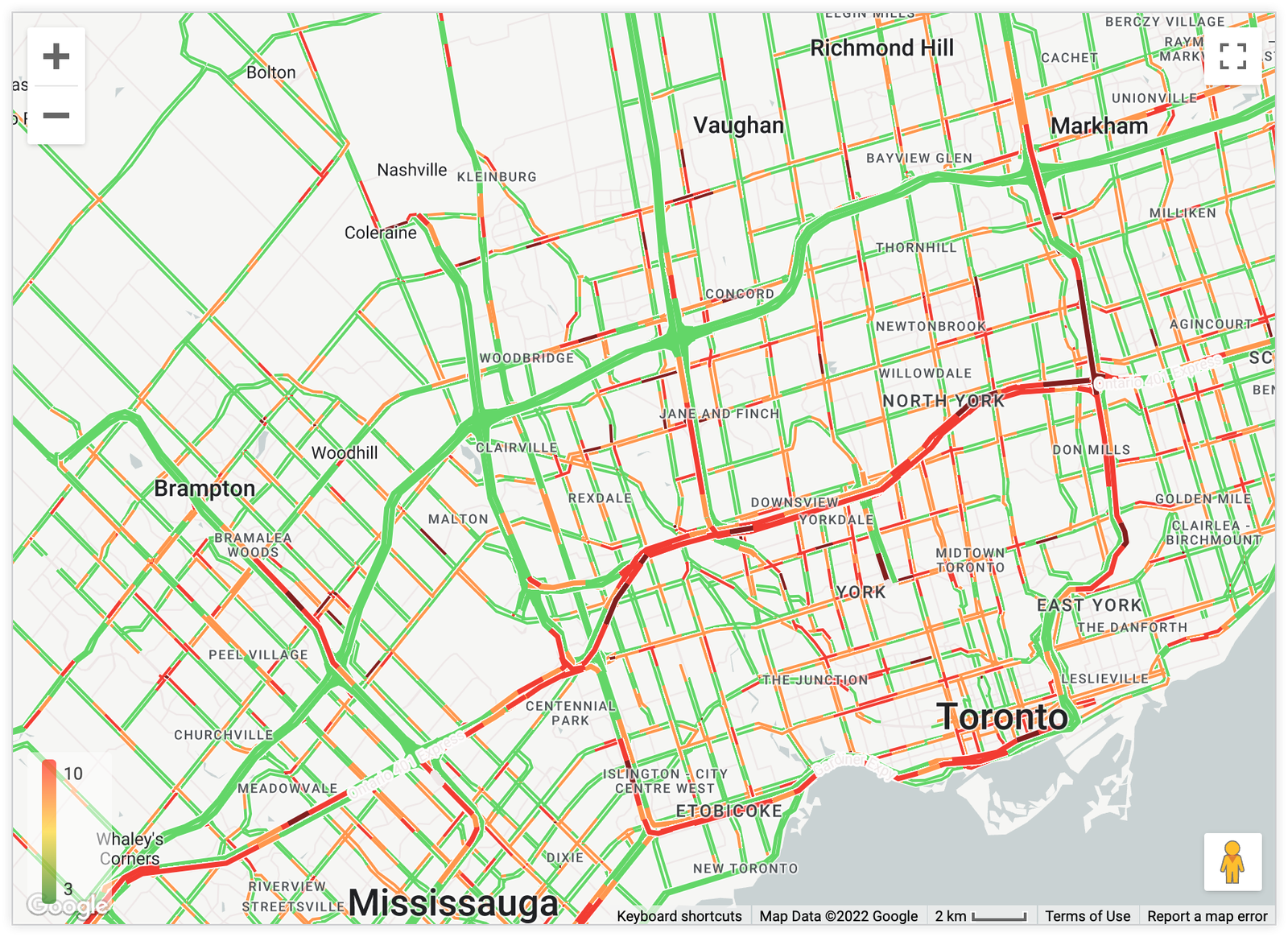
    In Google’s guide to its maps, there is a section on live traffic congestion, and in it, this image is used:

    It is a map of the Toronto region, and not surprisingly, it is showing traffic congestion on the 401 highway. But what’s interesting about this image is that there’s no traffic at all on the 407 express toll route. (This is the green highway running generally parallel and north of the 401, for those of you who aren’t familiar with Toronto.)

    This is, of course, accurate. A 2019 study by the Canadian Centre for Economic Analysis called the Economic Impacts of Highway 407 found that, at the time, an average of 413,000 drivers were using the 407 highway each weekday. And of these trips, more than 85% of vehicles were travelling at or above 100 km/h. This translates into a traffic congestion index of almost zero.

    During this same time, the highway 401 through Toronto showed that about 85% of vehicles were travelling below 50 km/h. Meaning, lots of congestion. This also had a significant impact on collision and fatality rates. On the 407, both were about half of what they were on the 401. (I couldn’t find any more decent data, but if you have it, please share it in the comments.)

    The reason for these differences is simple: the 407 charges for congestion. Here are the current per kilometer weekday rates for light vehicles travelling westbound:

    Naturally, there are people who think the 407 is too expensive and that it shouldn’t have been privatized. But the reality is that it works; really well in fact. And this is the only method that has been proven to reliably combat congestion. We can go ahead and spend a gazillion dollars building a new tunnel under the 401, and double the number of lanes (it’s already 18 lanes at its widest point), but we already know that it won’t solve our congestion problem.

    Either we price roads and congestion, or we don’t. But if we don’t, then we need to be brutally honest with ourselves about the economic trade off that we are making: free/underpriced roads = traffic congestion, and accurately priced roads and congestion = less traffic. The choice is ours. But know, there’s no such thing as a free lunch.

  • Toronto’s congestion crisis needs solutions, not politics

    People in Toronto are deeply and rightly frustrated about our traffic. We have truly world-class congestion. But here’s the thing, the way we’re going about solving this problem is all wrong.

    Transportation staff seem to believe that congestion charges would not reduce or deter traffic from coming into Toronto. Never mind all the global precedents, never mind that we have the tolled 407 highway to look to, and never mind that economics tells us that when the price of something increases, the quantity demanded decreases.

    Instead, we seem to think that we can solve this problem with fewer bike lanes, improved traffic management, and better policing, including higher fines for disobedience. (Interestingly enough, higher fines are supposed to deter people, but congestion charges won’t do the same. I’m confused.)

    None of this will fix the mess we’re in.

    This is a case of politics over data and experience. Identify something that people are pissed off about, and then create the illusion that you’re doing something to fix it. Good politics. But the reality is that this problem is much trickier to solve. It will require vision and meaningful change. That’s a much tougher sell.

    Think of this way. Can you identity a large car-oriented global city with millions of people that doesn’t have a traffic congestion problem? Even the Katy Freeway in Houston, which counts as many as 26 total lanes, has a congestion problem. And the last time I checked, it didn’t have any bike lanes.

    https://twitter.com/joshuahind/status/1837347617304424620

    Now let’s look at the largest city region in the world — Tokyo. The city proper has about 14 million people and the broader region has about 41 million. This is the entire population of Canada in one city region, and yet it’s generally viewed as being one of the most well-run and efficient cities in the world. How do they do it?

    Here are the modal splits within Tokyo’s 23 wards (2018 data):

    • 36% public transport (rail and bus)
    • 27% passenger cars
    • 23% walking
    • 14% bicycles and motorcycles

    Now compare this to the splits in Toronto’s census metropolitan area (2021 census data):

    • 76% passenger cars
    • 16% public transport
    • 5% walking
    • 1% bicycles
    • 2% other

    Of course, if we were to look at the modal splits within the core of the city they would look quite different and much closer to Tokyo’s numbers. This is why it can be so hard to achieve consensus on many city building issues — we are quite literally a divided and different kind of city.

    In the end, this is the root cause of our traffic problem. The vast majority of people in this city region drive. And they are not to be blamed. It’s because we’ve designed this to be the only practical option.

    But if we’re serious about solving congestion, it’s going to require some bold changes. It’s going to require reducing this 76% figure. We can fool ourselves into thinking that better construction coordination, fewer bike lanes, and higher fines will somehow solve this enormous and deep-rooted problem, but the inconvenient truth is that they won’t.

    What we need are real solutions. Is anyone going to take the lead?

  • Why do we choose traffic?

    Scott Stinson gets a lot right in this recent Toronto Star article about road pricing:

    There is a simple tool to combat traffic congestion that has been proven to be effective. There are real-world examples of where it has been deployed to great and long-lasting success. It’s called road pricing. And we seem to be deathly afraid of it.

    This is even if the benefits are real and measurable:

    Jonas Eliasson, director of travel accessibility at the Swedish Transport Administration, has first-hand experience with the effects of the congestion charge implemented in Stockholm in 2006. Public polling showed two-thirds of voters were against the road-pricing plan before it was introduced in a pilot program. A local politician called it the “most expensive way ever devised to commit political suicide.” But after it began, Stockholm traffic levels dropped by 25 per cent, more than double initial estimates. In a subsequent referendum, Stockholm residents voted to adopt the congestion charge permanently.

    There are lots of reasons why road pricing is commonly opposed, but at the end of the day, it works, and we know all too well — especially here in Toronto — that the status quo sucks:

    “Over the years, transportation economists and planners have pointed out that there really is no other solution to traffic congestion than more efficient pricing,” he said in an interview. “So every time somebody said ‘No, I don’t want road pricing or congestion pricing,’ they’re actually saying, ‘I want traffic congestion.’”

    I’ve been writing about this topic for almost as long as I’ve been writing this blog. So at this point, I think we just need to run a pilot. No more studies and reports. No more protracted debates.

    Let’s try it out and see how many people prefer (1) less traffic congestion and (2) more money for alternative modes of transport.

  • NYC’s congestion relief zone is now on indefinite pause

    Boy, congestion charges are a pain to implement. Back in 2018, I wrote that New York City was considering a congestion charge for drivers entering Manhattan below 60th Street. Then in 2019, about a year later, I followed up with this post saying that the plan could be adopted as early as April of that year!

    That didn’t exactly happen. But I followed up again with a post in 2022 saying that New York City was still considering a congestion charge. And ultimately, it did finally get approved, even if it did take much longer than expected. It was rebranded a congestion relief zone (“relief” sounds a lot less offensive than “pricing”), and it was set to come into effect on June 30, 2024.

    This remained the situation until the first week of this month, which is when NY Governor Kathy Hochul held a surprise press conference and announced that the congestion relief zone would be placed on “indefinite pause.” I think that means cancelled. And it happened less than a month before the state was finally set to start collecting money.

    There is a legal question around whether she actually had the authority to intervene in this way, but let’s put that aside for now. Irrespective of that, this is a disappointing outcome precisely because we know that road pricing works. If you have a traffic congestion problem, price it, and then you will have less of it.

    What’s even more disappointing about this particular instance, though, is that many of us were looking to New York City to show us the way. We were looking for the most walkable and transit-rich city in the US to show people that, hey, road pricing works, and it won’t decimate your CBD.

    It is shocking to me that traffic congestion is allowed persist in the way that it does in our cities, and that there remains zero political will to actually address it. Instead of action, we like to preoccupy ourselves with red herrings. If only we didn’t have streetcars, Ubers, and so many bike lanes, then there wouldn’t be congestion.

    So what hope do we have now that even New York won’t do what is bold and right? Lots, as always. Cities, now is your chance to do what New York was too scared to do. Who will lead?

  • 10 years of radical change in Paris

    I know that many of you already know this, but it’s pretty remarkable what Paris has been able to achieve over the last 10 years:

    Paris has closed more than 100 streets to motor vehicles, tripled parking fees for SUVs, removed roughly 50,000 parking spots, and constructed more than 1,300 kilometers (800 miles) of bike lanes since Mayor Anne Hidalgo took office in 2014.

    The result is that, according to city officials, air pollution in the capital has declined by about 40% since 2011. And bicycle usage has increased by some 70% — this is since 2019.

    Now, Paris does happen to be blessed with a dense urban fabric. But that doesn’t necessarily mean that this transformation was simple or easy. The difference is will. Most Parisians seem to support these actions.

    So the next time you’re stuck in traffic and cursing some scapegoat, maybe consider what you would be willing to do to dramatically reduce traffic congestion. Would you be open to radical change in your city?

  • Why we shouldn’t blame Uber for traffic congestion

    It has become fairly common to blame Uber (and ridesharing in general) for increased traffic congestion. I hear it all the time: “If only there weren’t so many Ubers on the road, traffic would flow more freely.” While there are studies suggesting that “deadheading” miles do have a negative impact and that Uber can draw people away from public transit (that’s bad), I think it’s important to consider the bigger picture here. So let’s try and do that today.

    Firstly, let’s think about who traffic congestion directly impacts (indirectly it’s everyone). If you’re a pedestrian, you don’t care about traffic congestion. In fact, maybe you gain satisfaction from seeing other people stuck in it. (There’s even a German word for this feeling.) Similarly, if you’re riding the subway, taking any form of transit on its own right-of-way, or riding a bike, you likely also don’t care about traffic congestion. It doesn’t directly impact you.

    Where you do care about congestion is if you’re in something like a bus that is stuck in traffic or if you’re driving. In the former case, you’re probably thinking, “hey why can’t these people take the bus like me. Then we’d have less traffic!” And in the latter case you’re probably thinking, “if only there weren’t so many Ubers and bike lanes, then I wouldn’t be stuck in traffic!” Ironically, this is arguably the biggest segment of people who feel they are being impacted by Ubers.

    Secondly, let’s think about how Uber vs. driving might impact traffic congestion differently. In both cases, I would think that the majority of use cases involve one person (excluding drivers in the case of Uber) going to their desired destination. So from a raw space per person perspective, they both take up a similar amount of urban space.

    The differences are that the Uber likely had some amount of deadhead miles. In other words, it spent time driving around looking for its next passenger. And it likely targeted already busy areas because that’s where it was more likely to find someone. Individual drivers don’t do this. They go from point A to point B.

    However — and this is a big however — drivers do require parking once they get to where they’re going. Ubers don’t. This both takes up more space and oftentimes requires some amount of circling around. This is a significant difference and it begs the question: which is worse? Deadhead miles or all of the parking that cars generally require? I would argue the latter.

    Where I’m going with all of this is that I think the criticism of Uber is misdirected. It doesn’t get at the real underlying problem. If traffic congestion exists, it is because they are too many cars for a finite amount of road space. This includes the people who choose to drive themselves around. In fact, you could argue that they’re the most impactful to cities. The way you solve this is simple: you price congestion and you encourage alternative forms of mobility.

    Everything else is just a distraction.

  • Density is good, but let me explain

    I tweeted this out last week:

    Not surprisingly, the responses were divided. Some responded saying that beauty is more important than density, and a lot of people were quick to point out that there’s good density and there’s bad density. And because I can appreciate both of these comments, it made me think that I should probably elaborate on my glib tweet.

    The points I was trying to vaguely imply are the following.

    More often than not (at least for North American cities), I think our problem is not too much density, it’s too little. This translates into cities that aren’t walkable, aren’t conducive to transit, and that are overall less sustainable. Right now, every mayoral candidate in Toronto is promising to fix our crippling traffic congestion. I don’t know how they’re going to do it, but they’re promising it because they know it’s something people are pissed off about.

    But here’s my take: counterintuitively, the problem is not enough density. The problem is that too many people in our region have no reasonable way to get around without a car. So they’re forced to drive. The way you fix this not as simple as more traffic enforcement or better signal timing. Good luck! You fix it through density, because density is what makes other forms of mobility suddenly possible.

    All of this is not to say that density alone will render you a great city. Obviously things like beauty also matter a great deal. But in my opinion, density is a fundamental component. Because what good is beauty if you don’t have any urban vibrancy? The answer is that you probably don’t have a real city.

    The other point I was trying to make is that space and density are both relative and oftentimes difficult to understand. We think building height and density are correlated, but that’s not always the case. Look at Paris or Barcelona. We also like to make a lot of spatial rules that we think are right and make our cities better: streets should be at least this wide, buildings should be no taller than the width of the street, and so on.

    But here (pictured above) is a street that narrows to around 6 meters and has buildings that are probably 2.5-3x the width of the right-of-way. Sure, it also happens to be beautiful, historic, and Italian. But what would happen if you maintained this same beauty and made the street 5x as wide and lined up parking in front of the stores?

    Somehow it wouldn’t be as enjoyable as what you see here.

  • Istanbul may have the worst traffic congestion in the world

    I just learned about the TomTom Traffic Index today. It covers 404 cities across 58 countries, and uses anonymized traffic data from more than 600 million drivers (people who use TomTom’s tech) to come up with a list of the cities with the worst traffic congestion.

    Here’s the global top 10 (for 2021):


    And here’s the North American top 10 (also for 2021):

    The way to interpret these congestion level percentages is to think of them as additional time over and above baseline free-flowing traffic times. For example, a 62% congestion level for Istanbul, means that a trip that would take 30 minutes without any traffic congestion, will instead take, on average, 18.6 minutes longer (0.62 x 30 minutes).

    We all like to complain about traffic in our home city, but these percentages certainly help to put things into a global perspective.

  • Are car tunnels the solution to traffic congestion?

    Elon Musk recently posted this Twitter survey asking if we, the people, would like “super safe, Earthquake-proof tunnels under [our] cities to solve traffic.” It was leading in that the “no” response was, “No, I like traffic.” And it was initially vague in that it wasn’t clear how these tunnels would be used. Though, most of us could probably guess. Elon later added in the thread that these road tunnels would be for zero emission vehicles only and they would be limited to EVs (from all auto companies, not just Tesla). Finally, Elon stated that these tunnels are not intended to replace other solutions, such as light rail, rather to supplement them.

    At the time of writing this post, nearly 1.5 million people had responded to the survey and about 67% of them said “definitely” to Earthquake-proof tunnels. Elon’s reaction: “Stop whining, subway Stalinists, the people have spoken.” Notwithstanding the majority, this is a divisive topic and the reactions are mixed. City planner Brent Toderian responded by saying that this “solution” would merely result in more cars, more driving, and more emissions. Steve Jurvetson, on the other hand, argued that this would be the cheapest way to add lanes and prepare for the inevitable EV-only future. (Steve sits on Tesla’s board and recently launched a venture fund that, among other things, invests in sustainable mobility.)

    The crux of this divide is a view about how cities should work. And it often becomes like dogma. Is it optimal for us to all be driving around in individual vehicles — EV or not? Will autonomous vehicles actually help solve the traffic problem? Or is building on the backbone of mass transit the only way to properly design a big and efficient city? Whether it’s lip service or not, Elon seems to acknowledge that both cars and transit are important, and that both can work together to supplement each other.

    What is clear to me is that cities, at the scale of say Tokyo, wouldn’t function nearly as efficiently if it weren’t for their extensive fixed rail networks. At the same time, there are many cities (or portions of cities) that do not have the prerequisite population and employment densities to support this same level of transit investment. And that has created a strong pull away from transit (and active transport such as cycling) toward private vehicles. Sprawling cities signal to people that they should probably be driving. This is one of the reasons why land use should never be separated from mobility discussions.

    How autonomous vehicles change all of this remains to be seen. Though I do think it will make cars less private and more public transit-like. Studies show that most of us are pretty good at coming up with incremental improvements to the things we already know and understand. i.e. This is how I would make this car better. But we’re far worse at coming up with and predicting tectonic shifts in the landscape. And autonomy is probably one of those shifts. But as long as our built form remains heterogeneous, I am inclined to believe that a mixture of mobility solutions will be needed. Maybe that means car tunnels. Or maybe it doesn’t.

    Photo by Ricardo Gomez Angel on Unsplash