Daily insights for city builders, delivered every morning at 6 AM ET. I’m Brandon Donnelly — a Toronto-based real estate developer and founder of Globizen. I’ve been writing here since 2013.

Tag: new development

  • Call with a Paris developer

    I had a call with a developer in Paris earlier this week and it was interesting to hear him talk about the new home market over there. It sounded a lot like Toronto. Higher interest rates cooled demand. Individual investors largely disappeared. And now developers are having to rethink their strategies and floor plans (including suite sizes).

    But in his view, this isn’t necessarily a bad thing. It now means that you actually have to be a reasonably good developer in order to have a chance at succeeding. You have to design thoughtful floor plans and build great housing. It’s a return to fundamentals, and I would argue that the same thing is happening here in Toronto.

    My other noteworthy takeaway was around social housing. All new developments in the Île-de-France region are subject to inclusionary zoning. I believe the requirement is 30% of the suites. These suites are then purchased by social housing operators, and it is one of the ways that new supply is created in the market.

    We talk a lot about IZ on this blog, but what’s interesting about this approach is that it becomes a forward sale for the developer. Meaning, it helps to de-risk projects. Before doing anything, you know you’ve sold 30% of your inventory, and somehow the numbers all work. European social housing math is baffling to me.

    I am now wondering if this creates some kind of incentive to keep development costs in check. Because if social housing operators are expected to buy 30% of all new homes, then they too are going to want them to be as cost effective as possible. I’m speculating though; I don’t know that this is the case.

    If you’re a developer or real estate person in Paris, please get in touch. I’d love to learn more about your market and trade notes.

  • How to cheapen a new building

    Anyone who has ever worked on a development pro forma will know that the process generally works like this: You start with a bunch of assumptions. You assemble those assumptions in a way that will allow you to determine if the project in question is feasible. And then, you realize that almost everything is more costly than you initially thought and that the project may not actually work. Oh shit.

    In fact, a sure-fire way to know that you’re on the right track is if the numbers sort of don’t work. If the returns look too good to be true, they almost certainly are and you’re likely missing something big and meaningful. As we have talked about before on this blog, development happens on the margin. That means that you have to work at it. You have to be creative. And often you have to find ways to increase revenues and cut costs.

    The common way to find money is through something known as value engineering, which is just a fancy way of saying, “I need to cut costs, so let’s see what I can tolerate losing from this project.” That’s generally how it works. And we do it on every project. You’re trying to find high-cost items with relatively low perceived value.

    This process often gets a lot of criticism because people view it as a distasteful cheapening of a project. But the reality is that it is usually an important part of maintaining project feasibility. You may really want to use that fancy material you can only get from Switzerland, but maybe development charges were just increased and now you need to offset those new costs by finding savings somewhere else.

    This isn’t a perfect analogy, but imagine you were shopping for a new car. You might start out by wanting the fully-loaded version, but then you see the price and realize you can’t afford it. So you decide to start trimming features and add-ons until you get to a place where you feel more comfortable. I would imagine this happens with cars, and I’m not sure it’s right to point to that person after and say, “oh my god, I can’t believe you cheaped out and didn’t buy the fully-loaded version.”

    At the same time, I think it would be perfectly reasonable to argue that you don’t need to spend a lot of money to (1) care deeply about the work that you do and (2) have taste. You can’t fight the economic realities of the world, but you can care and you can be creative. And I don’t think it’s too much to advocate for these things.

  • Toronto proposes at 49% increase to development charges

    The big news this week for Toronto city builders is that the city has put forward a proposal to substantially increase development charges. Here’s a tweet storm that I published earlier today on the topic, and here’s a summary of what the new fees might look like:

    To translate this into a specific example, let’s assume that you’re building a 300 unit apartment building with 180 one bedroom suites and 120 two bedroom suites.

    Under these proposed DC rates, this would translate into charges of about $9.6mm for the one bedroom suites and $9.8mm for the two bedroom suites, totaling over $19.4mm in DCs alone. But keep in mind that there would be other charges on top of this for parkland dedication, community benefits, and a bunch of other things.

    When our cost consultant ran the numbers back in 2019, the estimate was that about a quarter of the price of a new condominium in Toronto was going to government fees and taxes. But with the above increase and with the introduction of policies like inclusionary zoning, I am sure that the number is higher today.

    These are easy fees to hide. Most people don’t know they exist. And a lot of people don’t seem to like new development and new housing. Property taxes on the other hand are highly visible and highly sensitive. So that tax tends to be left alone, especially by comparison.

    But these increases are hugely impactful. It means that developers across the city will now need to start looking at increasing rents and prices in order to try and offset it. If they can’t, they won’t build. And if they can, it will mean that the housing that does ultimately get built will be that much more expensive.

  • Does new housing supply need better economic incentives?

    I watched a bit of the English leadership debate the other night. Eventually I got frustrated and went to bed, but I understand that housing affordability and overall affordability were important topics.

    What is clear, to anyone who cares to look, is that in most big cities we are not building enough new housing. According to the above Economist article (linked in the above tweet), the “rich world” has seen new housing production drop by about 50% (relative to population) since the 1960s.

    There are many reasons for this. But part of the problem is bureaucracy. Things move exceedingly slow. And another part of the problem is community opposition. Urban sprawl can be easier to swallow because there’s an out-of-sight-out-of-mind phenomenon at work. Stuff may be happening, but it’s not happening in my backyard.

    But now that so much of what we do is centered around intensifying existing neighborhoods, we are faced with a battle between the incumbents (existing residents) and the future residents of a community that don’t have nearly as much say — if any at all.

    What I like about the Economist article is their line of thinking for how to address this dynamic, which, at the end of the day, is rooted in what I will call expected selfishness.

    The approach is around aligning incentives. How could we better structure the delivery of new housing so that more stakeholders stand to directly benefit? Because as we have seen with laneway housing here in Toronto, homeowners will gladly build in their backyard when they stand to benefit directly.

  • Net new housing units in New York City since 2010

    Here are a few interesting stats from a brief report that New York City published this month about their supply of new housing units:

    • From January 1, 2010 to June 30, 2020, New York City delivered 205,994 net new housing units across the five boroughs.
    • This total includes 202,956 units from new construction and 29,161 units from the alteration/conversion of existing buildings. However, it also factors units that were lost as a result of demolition (-17,400) or alteration (-8,723).
    • Brooklyn saw the most supply, followed by Manhattan. The four highest-growth Community Districts were responsible for 1/3 of all new housing additions. These CDs are all formerly non-residential areas that were rezoned to allow living.
    • Manhattan saw the greatest loss in housing units as a result of alterations (people combining units). This was most prevalent in wealthy neighborhoods such as the Upper East Side, Upper West Side, and Greenwich Village.

    What is interesting about this last point is that it shows you that cities are far from static. New York City lost 26,123 housing units during the above time period, with 8,723 units being lost to alterations and people combining units.

    The orange areas on the above map are neighborhoods which actually became less dense over the last decade. And of course, this phenomenon is not unique to New York City. We are seeing the same thing play out in some/many neighborhoods in Toronto.

    What this mean is that the role of new development is really twofold. It allows a city to grow (i.e. house new New Yorkers), but it also replaces lost housing and relieves some of the pressures on the existing housing stock. I don’t think many people appreciate this dynamic — or perhaps they don’t care.

    For a copy of the full report (it’s only two pages), click here.

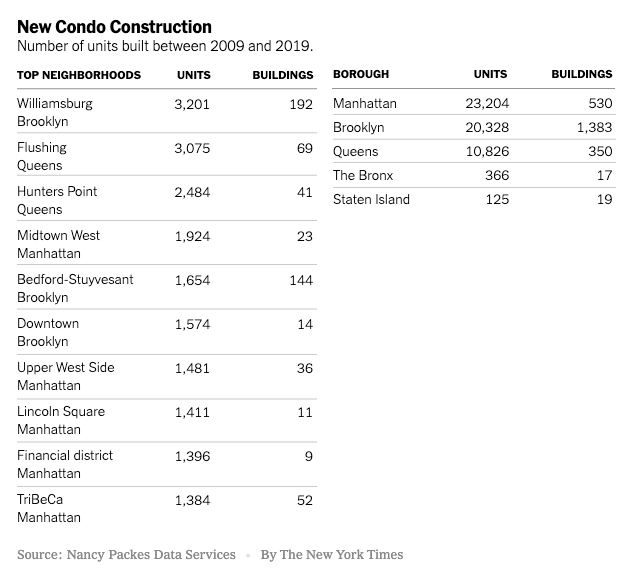
  • Number of condo units built in New York City between 2009 and 2019

    A decade of ultra luxury condos. The New York Times published this story over the weekend talking about how the luxury condo boom of the 2010s transformed New York City, and in particular Brooklyn.

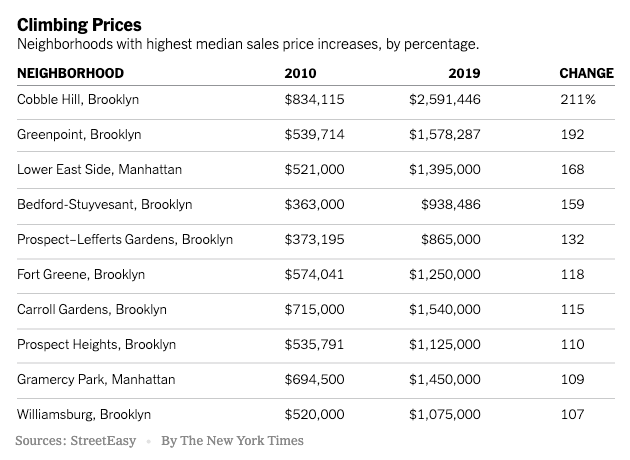
    Below are two tables from the article: (1) The number of units built between 2009 and 2019 across the five boroughs and the city’s top neighborhoods, and (2) the neighborhoods with the highest median sale price increase.

    The overarching theme is that New York built too many “super-high-end condos” geared toward global capital flows. According to one developer interviewed for the article (Gary Barnett of Extell Development), it was unprecedented.

    Apparently, the problem segment remains the $5 million to $10 million market. There’s simply too much inventory, and that has developers both delaying launches and going with much smaller (and hence more affordable) unit mixes.

    One stat that stood out for me was the new condo premium over resales. In 2011, the average sale price of a new condo in the city was about $1.15 million, which represented about a 9% premium over resale pricing.

    While it is typical to see a premium over resales (the same is true in Toronto), the average price of a new condo in 2019 rose to $3.77 million, representing a 118% premium over resales.

    For the rest of the article, click here.

  • 17 years of inventory in Miami

    Miami has historically had a volatile housing market because of its position as a second-home destination and because of its dependency on Latin American buyers. There is perhaps no other housing market in the US with the same kind of overall reliance on capital from abroad. This recent article by Candace Taylor in the WSJ is yet another reminder that we are once again in one of those cycles. Below are two excerpts that I found interesting. Note the stats, particularly the last bit in bold. It is also a reminder that when housing supply exceeds demand, usually something happens: prices come down.

    At the same time, new condos launched just as the owners of older units looked to cash out. There were 691 condo sales in Miami Beach in the first quarter of 2019, down 24 percent from 909 in the first quarter of 2015. During the same period, single family homes sales dropped to 81 from 117. The threat of climate change has had some impact on Miami home buyers’ decisions. A 2018 study showed that the value of single-family homes near sea level in Miami-Dade County rose more slowly than that of homes at higher elevations. But agents said a greater threat to the high-end market is inventory buildup.

    Meanwhile, a strong dollar incentivizes international buyers to sell the units they already own, even at below-market prices. The result is a glut of condos for sale, both new and resale. In December 2018, there were 3,663 condo listings for sale in the greater downtown Miami area—more than double the 1,591 for sale in December of 2013, according to an Integra Realty Resources report. Sunny Isles, where new buildings include the 53-story Jade Signature, the Porsche Design Tower and the Turnberry Ocean Club, is estimated to have about 17 years of inventory of condos priced at $5 million and up.

  • Toronto’s first all-female condo project

    Real estate development has historically been, and unfortunately still is, a male dominated business. (The story of Florence Casler is, however, a great outlier.) If you want some empirical evidence for this, pay attention to the length of the line for the men’s bathroom the next time you’re at a real estate conference or event.

    This needs to change. Which is why my good friend Taya Cook (of Urban Capital) has just announced, in partnership with Sherry Larjani (of Spotlight Development), the first all-female development project in Canada. It’s called Reina and it’s planned for a vacant site at 689 The Queensway, Toronto. Here is an excerpt from a recent RENX article:

    “We’re embarking on this project to create more visibility for women in real estate development, and to inspire younger women to see career possibilities,” said Cook, the director of development at Urban Capital, in a release announcing the project. “It’s a huge industry and a massive economic driver for the region. For some reason it has been seriously lagging behind in gender equity.”

    Two things are probably important to mention about the team and project.

    Firstly, the women developing Reina are all leaders and key decision makers. This is important for the project’s broader mission, but also because it will likely remove male biases from the design process. Everything from architecture to construction will be led by women and will incorporate a “female perspective.” Secondly — and this just makes the narrative even better — the site used to house a strip club.

    Congratulations Taya, Sherry, and the rest of the project team on a terrific development and initiative: “Condominiums designed by women. Developed by women. Built for everyone.” Follow Reina on Instagram, here.

    Image: Reina Condos

  • The biggest challenge in revitalizing the Rust Belt

    image

    Jason Segedy, who is the Director of Planning and Urban Development for the city of Akron, Ohio, recently penned a two-part series in the American Conservative about urban revitalization in the Rust Belt. Part two is specifically about the importance of new housing in “cities left for dead.”

    As I was reading through the piece, my first thought was that it would be a good follow-up to yesterday’s post on “winner-take-all-urbanism.” The contrast between alpha cities like San Francisco and Rust Belt cities like Akron is stark.

    The former city can’t build housing fast enough. And the latter city was forced to implement a citywide, 15 year, 100% residential property tax abatement program just to induce new investment. Any and all new housing is eligible.

    But as I got further down the article, I was struck by something else. I was surprised to hear Segedy say that, rather than market forces, community opposition is “perhaps the biggest challenge of all” when it comes to delivering new housing in these markets.

    Here is a longish excerpt that I would encourage you to read:

    Although you might think that people living in neighborhoods with a large number of abandoned houses and vacant lots would be thrilled to see new houses being built, you might be surprised to learn how often this is not the case. Sometimes neighbors prefer to have the vacant lot remain as green space. Sometimes they worry that the new housing will not be expensive enough, and will bring their property values down. Other times, they worry that the new housing will be too expensive, and will bring their property values (and taxes) up.

    When it comes to new housing, everyone is a critic. I have heard people complain that housing which they will never live in is too dense; that housing which they will never purchase is too expensive; that housing which they will never be inconvenienced by will generate too much traffic; and that housing which they will never look at is not architecturally appealing.

    After 23 years as an urban planner, I can honestly report to you that, contrary to popular belief, most people are strongly in favor of heavy-handed and draconian government regulation of private property—as long as it is someone else’s private property, and not their own.

    Residents and community activists who are opposed to new housing often demonize the real estate development profession as being “greedy”, overlooking the fact that their own home was developed by a developer, built by a builder, and sold by a realtor—most likely for a profit. This isn’t to argue that every development professional is a white knight, but it is important to remember that the vast majority of people who work in the real estate and construction sectors are not the enemy of neighborhoods. Without them, there would be no neighborhoods.

    According to Segedy, Akron has lost 32% of its peak population. Cleveland has lost 58%. And Detroit has lost 64%, leaving almost 1/3 of its land parcels vacant. (These are 2017 figures.) Surprisingly, this doesn’t appear to change how many people feel about new development. 

    No more new housing. We’re full. Unless, of course, that housing is for me.

    Photo by Nolan Issac on Unsplash