Daily insights for city builders, delivered every morning at 6 AM ET. I’m Brandon Donnelly — a Toronto-based real estate developer and founder of Globizen. I’ve been writing here since 2013.
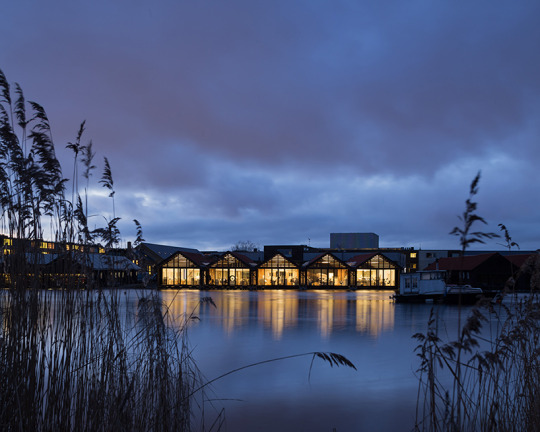
So I just learned that architects Bjarke Ingels and Rut Otero live in a converted Norwegian houseboat in Copenhagen’s harbor. A friend of mine sent me the Architectural Digest article this morning with the caption, “now I want one.” The space is exceedingly cool and interesting, but supposedly the heat and water stop working on occasion. Minor annoyance, I suppose. But in addition to being cool and interesting, there’s also a resiliency argument. Houseboats don’t have to worry about sea level rise, because they just float. (Could this type of floating housing be deployed at scale? Ingels thinks so.) In this case, they also repurposed an existing structure, which is generally more sustainable than building something new. I guess I’ll take one as well.
Well this is an interesting concept. One part allotment garden and one part summer home. Copenhagen’s kolonihave is a community of small homes and gardens within biking distance of Copenhagen’s city center. A place to get away and maybe plant some fresh mint for mojitos. It shares some similarities with the Toronto Islands (land trust) in that the owners own their home, but lease the land. Except in the case of Toronto you’re not allowed to use your island residence as a summer home. If you want to live on the islands, you need to tough out the winters and make it your principal residence. Regardless of the ownership structure, there is something clearly endearing about these small homes and gardens. And I bet that there would be a lot of demand for something like this if it could be done at any sort of scale.
Sidewalk Toronto is currently looking for “12 smart, creative, and caring people who are interested in the future of Toronto’s waterfront and how we [Sidewalk Toronto] can responsibly incorporate technology to improve urban life.”
Each Fellow will complete a 2-day orientation session in Toronto; 6 days in Amsterdam and Copenhagen; 5 days in New York City and Boston; 3 days in Vancouver; and then do a final 2-day working session back in Toronto before presenting their takeaways.
This feels like a response to the criticism that Sidewalk Toronto wasn’t doing enough to listen to the community and that it simply wanted to build a tech-infused neighborhood that could serve us more ads – but it’s cool nonetheless.
If you’re between 19-24 years old and you live in Toronto, you can apply here. It sounds like a fun opportunity for young city builders. I know that I certainly would have been all over it when I was in that age bracket.
The Gehl Institute has just launched (in beta) something called the Public Life Data Protocol. It was developed by the Institute, as well as by Gehl (the practice), the Municipality of Copenhagen, the City of San Francisco, and Seattle’s Department of Transportation.
The goal of the protocol is to improve the way in which we collect, share, and compare public space information. It is about improving public life in public spaces.
To do this, they have proposed a series of metrics that measure everything from “posture within the space” to “objects brought into the space.” They also propose spatial metrics that help to analyze public life in relation to its physical context.
Gehl is a real leader in this space. I commend them on opening up their methodology and working to create “a common language for people data.” Great data will only help us to build more human-centered cities.
To download a full PDF of the protocol, click here.
He also varies the size of the firm. Some of them only have a few people working out of a small streetfront retail space.
As an architect, you are pretty much required to have a cool studio space. So this is certainly an interesting photography project to take on. The photo at the top of this post is 3xn in Copenhagen.
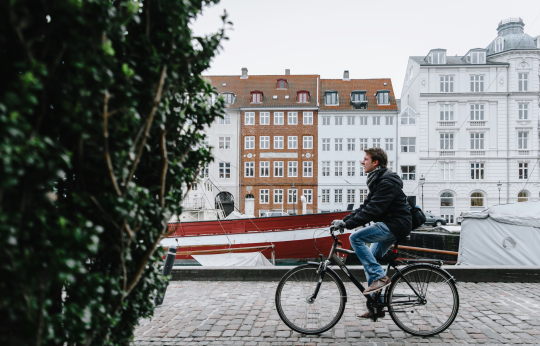
The following paragraph is a great way to describe urban cycling and to explain how our built environment can explicitly invite certain behaviors:
“If you want people to drive, build more automobile infrastructure. If you want people to bike, build better bike infrastructure. In San Francisco, as in most US cities, we’ve treated the idea of bike infrastructure as secondary to optimizing traffic flow, and have wound up protecting parked cars with bike lanes instead of the opposite. Because of this our bike lanes are plagued with double-parking. While enforcement is an important piece of the puzzle, we usually fail to admit how inviting a striped space between parked cars and traffic appears to an Uber driver. Our built environment invites a driving behavior that causes cyclists to spend much of their commute pushed into traffic, encouraging a culture of every-man-for-himself cycling behavior, adding to the discouraging perception that bikes are for the young and fearless only. This perception is elevated by the fact that bicycling deaths in San Francisco are hovering at least four times higher than the average rate in Copenhagen, a city with ten times as many cyclists.”
This snippet is from a blog post written by Alex Schuknecht (urban designer with Gehl). In the posts he also contrasts the cycling cultures of San Francisco and Copenhagen – two cities of similar size and density, but with fundamental differences. It’s a good read.
Many of us probably assume that we are agents of our own lives. We decide what we do and when we do it. We’re our own boss. That’s at least how I want to feel.
But the built environment is distinct from the natural environment in that we design it. It is not a given. And the environments we collectively choose to fund and build will ultimately have a significant impact on the way we “choose” to live our lives.
This gets back to the first line of the above quote: build more of this; get more of that. It’s also related to the startup mantra: “you make what you measure.” If all we’re measuring is traffic flow, then that’s the kind of city we will make. And that’s certainly be done.
I don’t think a lot of us think in these terms. But we should.
Toronto can’t make up its mind right now as to whether it would like to invest in additional cycling infrastructure.
Of course, we have a history of vacillating on topics like this. And I think it’s because we’re at a tricky inflection point. We are weaning ourselves off of the car, but most parts of the city remain underserved by transit and heavily dependent on the car.
Much of the focus of the paper is on the cost-benefit analysis that the City of Copenhagen uses to make its cycling investment decisions. Here is an excerpt from ScienceDaily:
“If the costs to society and the costs to private individuals are added together, the impact of the car is EUR 0.50 per kilometre and the impact of the bicycle is EUR 0.08 per kilometre.
The study by Stefan Gössling and his colleague also shows that if we only look at costs/benefits for society, one kilometre by car costs EUR 0.15, whereas society earns EUR 0.16 on every kilometre cycled.
“The cost-benefit analysis in Copenhagen shows that investments in cycling infrastructure and bike-friendly policies are economically sustainable and give high returns,” says Stefan Gössling.”
So there you have it. Now I thought we could debate this in the comment section. Your thoughts?
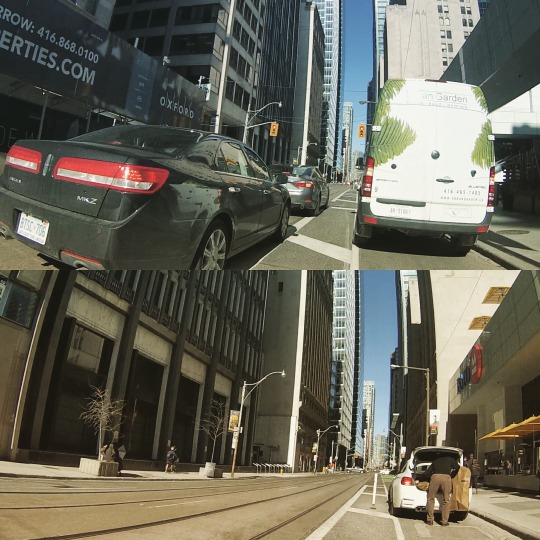
P.S. The images at the top of this post were taken by me using my new GoPro bicycle handlebar mount.
On Monday of this past long weekend, I went for a quick bike ride over to the Beaches, up to Little India, and then back down to the St. Lawrence Market.
The ride along Lake Shore and through the Beaches is one of my favorites. Minus a few awkward twists and turns as you leave the East Bayfront, it’s generally smooth sailing. It feels a bit like a bike highway.
It took me about 24 minutes to get to the beach, which means I was traveling on average just over 20 km/h. If you lived in the Beaches and worked downtown, that would be a perfectly reasonable commute in my mind.
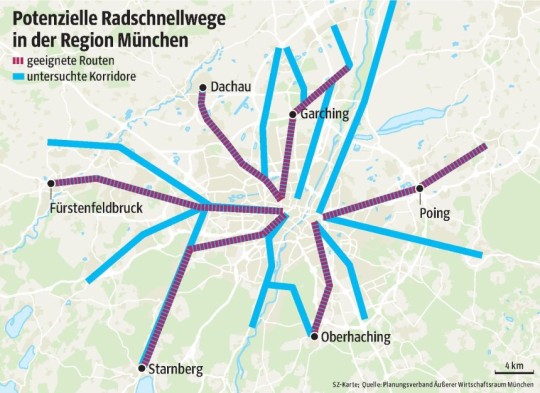
And it’s for reasons like this that Munich is looking to invest in a huge network of bike highways. They’re calling it a Radschnellverbindungen – which I might start ambitiously calling some of the bike paths in Toronto – and the idea is to connect the city with all of the suburbs.
Below is a map of the routes they’re looking at. The purple lines are “suitable routes” and the blue lines are corridors they’ve looked at it. If I’m wrong in my translation, blame Google.
They are still in the feasibility stage, but the idea is for each bike path to be 4 meters wide and have no cross streets or traffic lights – essential a highway for bikes.
And if you think this all sounds like a pipe dream, check out this video of the recently opened Cykelslangen (Cycle Snake) in Copenhagen.
Architect Bjarke Ingels recently gave a talk at the WIRED by Design conference. I’m a big fan of his work and so I think you’ll really enjoy the talk. What I like is how process driven his firm is. As he explains at the beginning of the video, they always start by researching and analyzing the situation before figuring out how they’re going to intervene. That’s what informs their designs.
Click here to watch the video. It’s about 20 minutes long.
Last night I was out for drinks with a friend of mine who runs an architecture firm in the city called Reflect Architecture. We started talking about the importance of marketing and storytelling in city building and then got onto the topic of Danish architect Bjarke Ingels and his firm BIG.
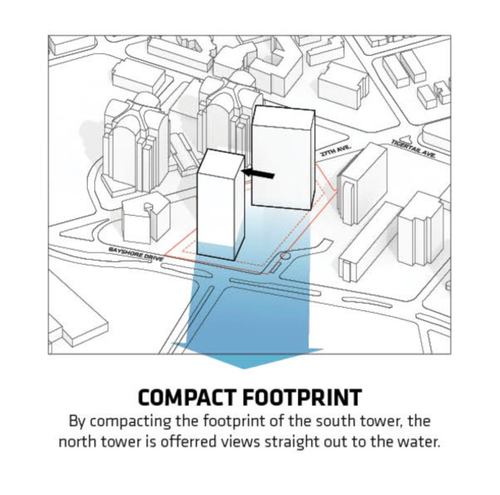
At only 39, Bjarke Ingels has become a celebrity architect at a relatively young age. He’s working on projects all over the world from Vancouver to New York to Shenzhen. And he describes his work as a combination of “shrewd analysis, playful experimentation, social responsibility and humour.” But what has always interested me about BIG is their use of dead, simple, diagrams (see above for an example).
A diagram is just a graphic way of communicating information. And lots of architects use them as a design tool. But what BIG does is use them to create a narrative around each and every project. If you look at their website you’ll see that every project is presented using a series of diagrams that outline the process used to arrive at the final design. You’ll never just see the final product. You always see the steps involved. Click here for an example from Vancouver.
What’s powerful about this approach is that it demonstrates that there’s a logic behind every design outcome (even if sometimes it might be contrived or done after the fact). It’s not form for the sake of form; it’s form as a result of the uses in the building, the urban context, and so on.
But at the same time, I think it taps into a deeper psychological phenomenon: people love stories. In fact, research shows that when we’re told stories, our brains actually become more active. We pay closer attention.
I mean, just think about how much people enjoy hearing about rags-to-riches stories. Nobody likes to talk about some rich person who was born rich. That’s not an exciting or interesting story. And it changes how we perceive that person. We want to hear about that guy or girl who came over from a war torn country and built an empire from nothing. Now that’s a good story.
What I’m getting at is that I think a big part of Bjarke’s success has come from his ability to masterfully storytell and market both himself and his projects. Architecture schools don’t usually teach you how to market and sell; they teach you how to design. But the reality is that you need to sell. And storytelling is a great way to do that.