
The Katy Freeway in Houston has 26 lanes at its widest, and after a $2.8 billion expansion between 2003 and 2008, commute times reportedly increased by 30-50%.
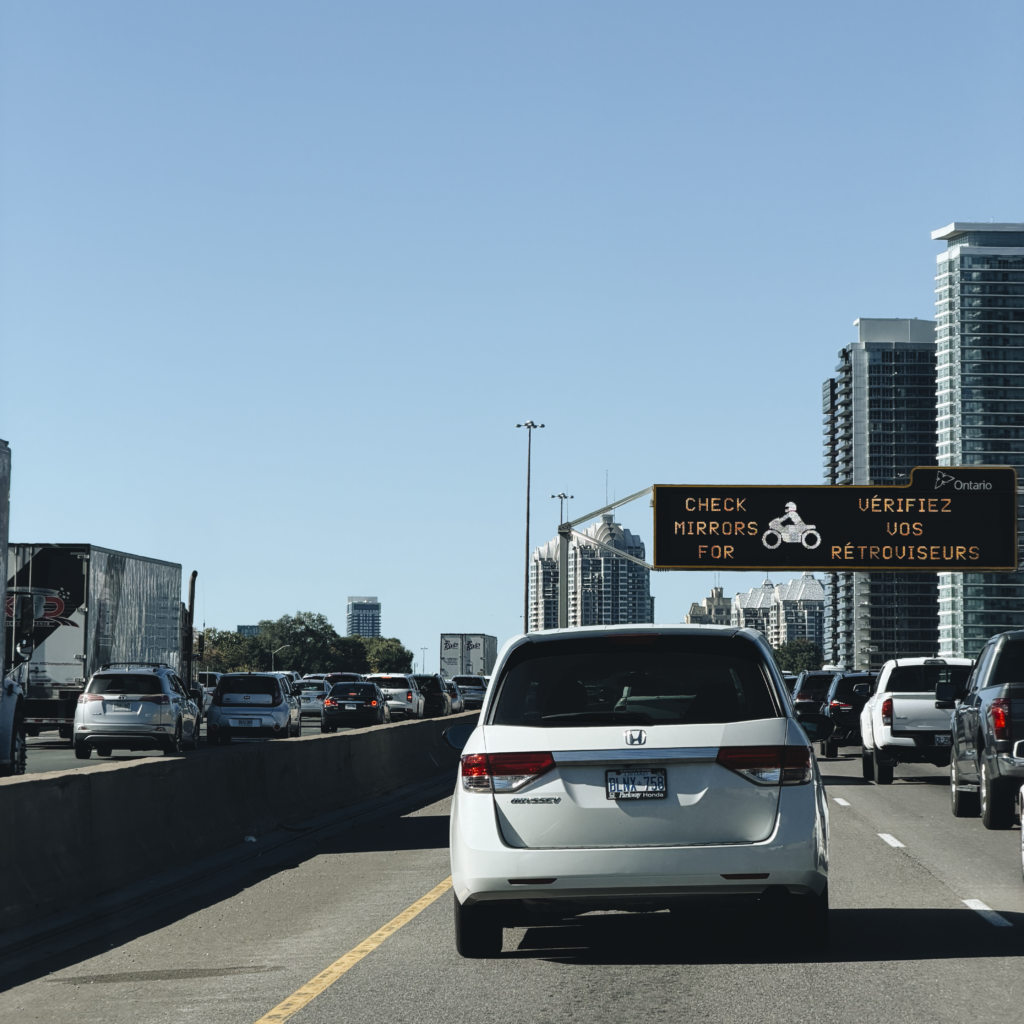
Highway 401 in Toronto has 22 lanes at its widest and is ranked as the busiest highway in North America with an average of ~500,000 vehicles per day. It does not flow freely at most times throughout the day.
Avenida 9 de Julio in Buenos Aires is one of the widest surface avenues in the world, but traffic congestion didn’t improve until lanes were converted into a bus rapid transit line.
Sheikh Zayed Road in Dubai ranges from 12-16 lanes and acts as the main high-capacity spine for what is a linear, car-dependent global city. It too is known for its traffic congestion.
The common thread among all of these examples is that, irrespective of the width and number of lanes, none of these cities have solved the problem of traffic congestion. I challenge you to think of a counterexample. And that is because it is impossible to build a large, economically vibrant global city centered primarily around private automobiles without suffering severe traffic congestion.
The car is the most spatially inefficient mode of transport for cities, and this doesn’t change with tunnels or with autonomous vehicles (at least sufficiently to make this statement wrong). The fundamental issue is one of space: too many cars for a finite amount of road capacity.
People who live in car-dependent communities are reluctant to accept this reality, but the only proven solution to congestion is to reorient away from the car toward more efficient modes of transport, namely mass transit. And one of the most effective ways to make this switch is to price roads and congestion.
This is not to say that individual cars don’t have a place in global cities; they of course do. It is to say that it’s impossible to rely on them as the primary means of mobility without there being negative consequences.
It’s also worth pointing out that one of the core features of cities is agglomeration economies, which is to say that the spatial concentration of activities leads to cost savings, productivity gains, and greater innovation. Cars demand the exact opposite: spatial dispersion.
Which would you rather optimize for?
Leave a Reply