
Daily insights for city builders, delivered every morning at 6 AM ET. I’m Brandon Donnelly — a Toronto-based real estate developer and founder of Globizen. I’ve been writing here since 2013.

Tag: dubai

  • The growth of branded residences

    A branded residence is, as the name suggests, a residential building with a known branded attached to it. Historically, these have tended to be hotel brands. But it really just needs to be any brand that people know, care about, and will pay a premium for. So it could also be a fashion brand, a car brand, or whatever else.

    This is a growing segment of the residential market. According to UK-based Savills, there were only 15 or so of these “schemes” in the 1990s (the UK uses scheme in lieu of project, which always sounds conniving to me), but by the end of this decade they expect the pipeline of branded residences to exceed over 1,200.

    I would also argue that projects designed by celebrated architects and/or designers are a form of branded residence. And this is not being captured in Savills’ number above.

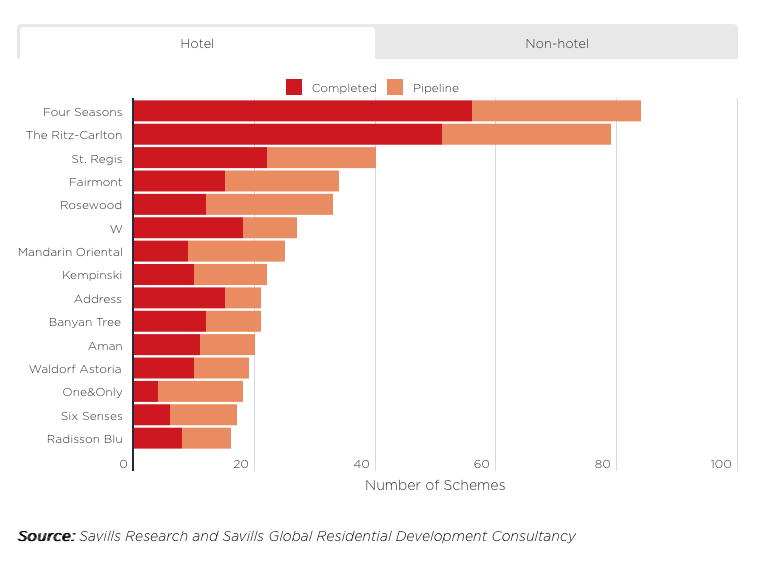
    Whatever your definition, today, the branded residence capital of the world seems to be Dubai, which feels right. And the biggest brands, by what appears to be a long shot, are Four Seasons and Ritz-Carlton (hotel side), and YOO and Trump (non-hotel side). Here are the full rankings from Savills:
    This is an interesting part of the real estate business for a few reasons. One, it makes sense. A New Balance shoe that gets co-branded with Aimé Leon Dore unlocks additional value for both sides. ALD has a brand that certain people care about. So, of course the same would be true of real estate paired with the right brand.

    Two, it’s a growing market, and I think this is aided by the fact that development is an intensely local business — so it can be hard to grow a globally-significant brand on your own. Sometimes you just need to borrow someone else’s.

    And three, it’s usually a less risky approach to getting your name on buildings. Branded residences typically operate on a licensing model, which means developers pay for the right to use the brand. The brand may also capture some of the upside in the form of a percentage of sales. That’s less risky than putting up your own money.

  • Do great cities need tall buildings to help them thrive?

    In other words, are tall buildings a prerequisite to competing in today’s global economy? It’s an interesting question. And Jason Barr — professor of economics at Rutgers University-Newark — does think they are an important ingredient. So much so that he wrote a book on the topic called, Cities in the Sky: The Quest to Build the World’s Tallest Skyscrapers. While Jason does acknowledge that not every city needs them, he does suggest that not having them could hinder a global city:

    If you look at Paris’ global ranking in terms of its importance in the world economy, as measured by the size and number of international firms, it’s falling. Paris in 2000 was ranked fourth, and by 2020, it was down to eight, losing out to skyscraper cities such as Singapore and Dubai.

    In the last decade, Paris has shrunk by 122,000 residents. As reported by Forbes, “Many of those leaving are choosing either the suburbs or countryside around Paris, or they are relocating to France’s smaller cities such as Bordeaux, Lyon, and Toulouse.” By limiting its building stock, Paris is driving up housing prices, pushing out residents, and causing suburban sprawl.

    While I agree that tall buildings are important “geography-shrinking machines”, what we’re really talking about is using land more intensely. We’re talking about urban density. But you don’t necessarily need tall buildings to have high population densities. Consider Barcelona, which is one of the densest cities in Europe, and consider this comparison between Paris (few tall buildings) and Vancouver (more tall buildings).

    So is the argument simply that density is good for cities, and that tall buildings are one way to achieve that? Or is it that, now that cities like Paris are built out (albeit at very high densities), the only option for growth is to go up? I guess I’ll have to read his book.

  • How Muji is collaborating with Japan’s housing agency

    This is a familiar story that is, of course, not unique to Japan:

    “Danchi”, or apartment blocks built by Japan’s housing agency during the country’s high-growth period, may look grim and outdated in today’s Tokyo, where flashy glass and steel towers reign.

    However, I only just learned that, since 2013, the Japanese houseware brand Muji has been renovating apartments within these housing blocks in an attempt to reduce vacancies:

    But danchi are becoming hip again, thanks to modern renovations by lifestyle brand Muji, which is turning the poky, multi-room flats into open-plan studios.

    The above excerpts are from a 2015 article, but this partnership between Muji and Japan’s Urban Renaissance (UR) Agency continues to this day. Today, they’re also focused on creating a greater sense of community within these danchi neighborhoods.

    It’s a logical collaboration. Both want to bring good and affordable design to the masses. And obviously there are brand benefits for Muji. It’s a way to expose more people to their products.

    But what I find particularly interesting is that it, once again, shows the potential of a strong brand within the real estate industry.

    According to the same 2015 article, as soon as Muji completed its first round of apartment renovations, UR saw 2x the number rental applications from people in their 20s and 30s. Perhaps the number is even higher today.

    Clearly what happened is that you had young followers of the brand who said to themselves, “oh if Muji is involved, it must then be cool and nice, and so I’d like to live there.”

    I mention this because, as a gross generalization, real estate companies don’t seem to focus on their own brands in the same way other companies do. (Again, I’m making a gross generalization.)

    Instead, they often rely on 3rd party brands — hotel brands, fashion brands, and whatever else — to augment as needed. (See “Dubai is now the capital of branded residences.”)

    Maybe this is truly the optimal way to do it. Just partner as needed. Or maybe more real estate companies should invest in their own brand.

    Photo by taro ohtani on Unsplash

  • The global cities attracting talent, visitors, and investment

    Earlier this month, Resonance Consultancy published its 2024 World’s Best Cities ranking. Or, in their words: its definitive power ranking of the 100 global cities that it believes are shaping tomorrow.

    These are always fun to flip through, which is I guess why people do them and why people look at them; but I do think it’s important to look at the underlying methodologies. Otherwise, what does “world’s best” even really mean?

    In this case, they’re looking at global cities through the lens of three key categories: livability, lovability, and prosperity. More specifically though, the report looks at factors that are demonstrated to have moderate to strong correlations with attracting talent, visitors, and/or businesses.

    This makes it distinct from rankings that are more focused on things like livability. Because according to Resonance, factors such as commute times, crime, and housing affordability don’t tend to correlate strongly (at least in the short-term) with a city’s ability to attract talent, tourism, and investment.

    While this may seem a bit counterintuitive, it does also make sense. People don’t move to London because they’re looking for affordable housing and a reasonable commute. They move to London because they want to be in the center of the world.

    And yes, London tops their power ranking:

    The top of this ranking isn’t all that surprising. It’s the usual suspects. But I continue to be impressed by how quickly Dubai has transformed itself into a top global city. Also impressive is how Dublin punches above its weight of just over 500,000 people.

    I am medium surprised to see Hong Kong nowhere on this first page (there are another 65 cities not shown here). It usually features as a top global city. But presumably this is the result of Beijing meddling. People are looking elsewhere — like Singapore.

    For the full list of cities and to download a copy of the report, click here.

  • Dubai is now the top “super-prime” residential market

    People continue to buy expensive homes:

    Global super-prime ($10m+) residential sales bounced back in Q1 2023, with 417 sales across the 12 markets tracked in Knight Frank’s new Global Super-Prime Intelligence report. That’s up 11% on the 376 recorded in Q4 2022 and the highest volume since Q2 last year.

    The biggest market in Q1 this year was Dubai (88 sales), followed by Hong Kong (67), New York (58), Los Angeles (46), Singapore (37) and London (36). While volumes rose in Q1, the total value of sales fell 4% to $7.2 billion. The most expensive average super-prime sales took place in Geneva ($23.8m) and London ($20.4m)

    What is perhaps most interesting, though, is how central Dubai has become in the flows of global capital. In 2019, Dubai accounted for 2% of all super-prime sales in the 12 markets that Knight Frank tracks.

    Today, looking back at the most recent 12-month period, Dubai now accounts for 17% of all super-prime sales, placing it ahead of London, New York, and Los Angeles.

    Part of this jump likely has something to do with the “housing disaster” that Dubai was going through back in 2019. But even still, it is impressive to see just how quickly the city has managed to build and position itself as an alpha global city.

    I much prefer walkable cities, but clearly there are enough other people who don’t care about that sort of thing.

  • Calm down, Dubai

    Knight Frank just published the 17th edition of its annual “The Wealth Report.” I have spoken about this report many times before on the blog because I generally find them really interesting. So today I’d like to share two items from this latest one.

    The first item is their most recent Prime International Residential Index (PIRI). What this does is track prime residential prices across 100 key city, sun, and ski locations. “Prime”, in case you are wondering, is defined as the most desirable and most expensive properties in each market — generally the top 5%.

    Look at Dubai go:

    When I see a chart like this I usually start at the top and then immediately start scanning for Toronto. Here, it’s more or less in the middle with a 4.1% increase. Totally reasonable. Prime property in Auckland and Wellington, on the other hand, didn’t fair as well in 2022.

    The second item is this very wonderful diagram showing flight connectivity before Covid (12 months to March 2020) and then post-Covid (12 months to December 2022):

    The way to read this diagram is that the most connected cities — ranked by the number and quality of flight connections — get pushed toward the center. They also get bigger. Less connected cities, on the other hand, slide toward the edges. All of the cities also generally gravitate toward their main regional connections.

    The most obvious change is the greatly weakened connectivity of Chinese cities. This is not surprising given their zero-Covid approach. Moscow also seems to get rightly pushed out to the side.

    Another story is the continued rise of both Singapore (to the likely detriment of Hong Kong) and Dubai. I have only been to Dubai once, and I couldn’t figure out how to navigate its sea of roads and highways, or how to locate an actual city center where humans walk around (though the historic Bur Dubai area was interesting).

    But there is no denying that Dubai has become a pretty important global city.

  • Transit-oriented vs. single-family

    Michael Beach used to have a YouTube channel where he “looked at Google Maps a lot.” Meaning, he would pan around various cities and comment on their planning and overall built form. Technically the channel still exists, but he stopped making new videos a few years ago. Here is one where he talks about Dubai being “an absolute mess” (3.8 million views) and here is one where he looks at North York (in Toronto) and asks: “why is it here?”

    The most important point from his North York video is that it illustrates the deep divide that exists in Toronto (and other North American cities) between single-family “Neighbourhoods” (a defined planning term) and higher-density transit nodes, where things like tall buildings are allowed to go.

    In the case of North York, this contrast is perhaps at its most stark. Even the street network is designed to stop these two urban forms from commingling with each other too much. There are ring roads that surround the transit-oriented density, and separate, more suburban streets on the other side of it:

    This contrast is why there are so many people talking about the “missing middle.” And I’m sure that if you started asking random people on the street, most would agree that it would be nice if we could build more moderately-scaled housing. You know, like those buildings you see in Paris.

    The problem: Where should it go? Some people would probably suggest the left side of the above ring road. Just don’t build as tall, okay? But this kind of land is already a scarce commodity in a city like Toronto. We need these tall buildings because most of the city is codified to look like the right side of the above ring road.

    So if we have any chance of actually finding the missing middle, it is going to need to happen here, on the right side. Some progress has been made, not just in Toronto but across North America, with accessory dwellings (laneway suites). But it’s not going to be enough.

    This was simply a first step. It was us finding a solution to, “how can we add some more housing here without changing the look and feel and character of these residential streets in any way?” But even this small and incremental change has proven to be exceedingly controversial. People still react to new laneway suites like this:

    https://twitter.com/evboyce/status/1624840523516182528?s=20&t=Q9gCZfTGLz51rVyupxJDPg

    There are complex dynamics at play here.

    If you’re a homeowner that decides to create a new rental home at the rear of your property, you might be viewed as greedy. You are creating something (a home) that someone needs, and you intend to make a small margin on the transaction. It’s like making and selling bread for a small margin, except that selling delicious bread to people is typically viewed in a positive light. On the other hand, ensuring that the value of your house remains as high as possible is generally good practice here. Greed doesn’t factor in this way because, you know, single-family homes.

    There is no surprise why the missing middle is missing. It is missing because we have decided that we want it to be. But hey, $2,145 per month seems like a very reasonable price for a 2-bedroom house.

  • 50U

    There is a new book out right now about the United Arab Emirates called 50U. It has been fifty years since the confederation of the seven Gulf states was officially declared (December 2, 1971), and so the book is a celebration of that. The format is 50 portraits of people, places, and plants (yes, plants) that tell the story of the UAE.

    Included in the book is an excerpt of a 2009 talk by architect Rem Koolhaas (of OMA) about his reading of Dubai. ArchDaily published an abridged version over here and I thought it was an interesting read. Few people think about cities as deeply as Koolhaas does, and few can express their thoughts in such a rational and Dutch-like way. Here’s a snippet of the talk:

    I came here first in 2004. We were asked to do a major building on the site which is marked by the flag. Then, two years ago it was the exact moment… I became increasingly nervous about the mission of architecture and the uses of architecture. And I really became almost desperate… that the incredible pressure of the market economy was forcing architecture itself into increasingly extravagant conditions. Seemingly, Dubai seemed to be the epicenter of that extravagance. So, I came with deeply ambivalent feelings. It seemed as if the idea of the city and the metropolis itself had been almost turned into a caricature, not a coherent entity but maybe a patchwork of theme parks. And those themes would become the bogus and increasingly bizarre characters that were perhaps partly mythical and partly real.

    I’ve only been to Dubai once. It was back in 2008 or 2009. And to be honest, it wasn’t my favorite city; I think primarily because I enjoy walking cities and Dubai is largely the opposite of that. It felt like a patchwork of theme parks that you had to drive around to — ideally in an exotic car while being as flashy as possible.

    Now if these theme parks were within walking distance (and the drinks were good), that would be an entirely different story.

  • How the world changed over the last 37 years

    Google Earth has a feature called Timelapse that combines millions of different satellite images to show you how the world has changed over the last 37 years — sometimes for the better and sometimes for the worse. It’s a feature that’s been out for a few years, but they just made it available in 3D. Some of you may have also missed the feature if you don’t normally use Google Earth. So here’s an overly wondrous video (also embedded above) showing off the new feature, and here is a dedicated site that allows you to quickly try out Timelapse in 2D. Dubai’s “coastal expansion” is one of the places you can quickly land on and its growth over the last few decades is always mind boggling to see. But of course, there are also many other important Timelapses that should be viewed. A number of them speak to our environmental impacts on the world.

  • Dubai’s housing crisis

    This week Bloomberg reported that Dubai is facing a “housing disaster” as a result of overbuilding. There’s simply too much supply coming onto the market. About 30,000 units are expected to be completed this year, which the industry believes is about 2x actual demand. As a result, the industry — yes, the development industry — is calling for a 1-2 year pause on all new construction in the city so that the excess units can be absorbed and demand can catch up.

    I’m not an expert on the Dubai market. And I’ve only been to the city once. But my sense is that there are relatively few barriers to new supply, especially compared to markets like Toronto and San Francisco. And so it’s not surprising to hear that supply is and has been outstripping demand. According to Bloomberg, the market peaked about 5 years ago.

    For the industry to call for a moratorium on new construction it must mean that there’s concern of a prolonged housing slump and perhaps even some sort of systemic collapse. But if the objective is more affordable housing, than you might argue that Dubai has been doing a pretty good job of that. Here is a global city with a “housing crisis” on the opposite end of the spectrum. So what is it that makes Dubai different than, say, London or San Francisco?

    Photo by David Rodrigo on Unsplash