Daily insights for city builders, delivered every morning at 6 AM ET. I’m Brandon Donnelly — a Toronto-based real estate developer and founder of Globizen. I’ve been writing here since 2013.

Tag: buenos aires

  • This is how many more people Toronto could house if it increased its population density

    As a follow-up to yesterday’s post about infill housing and overall urban densities, let’s look at some basic math.

    The City of Toronto has an estimated population of 3,025,647 (as of June 2023) and a land area of 630 square meters. That means that its average population density is about 4,803 people per km2. Obviously this number will be higher in some locations, and lower in others. But overall, this is the average.

    Now let’s consider how many people we could actually fit within the existing boundaries of the city (city proper not the metro area) if we were to simply match the average population densities of some other global cities around the world.

    Again, what this chart is saying is that if we took the same physical area (Toronto’s 630 square meters) and just increased the population density to that of, say, Paris, we would then have a total population of over 13 million people and we’d be housing an additional 10,011,573 humans on the same footprint.

    I am not suggesting that this is exactly what should be done. (Though, you all know how much I love Paris.) What I’m suggesting is that calling a place “full” isn’t exactly accurate. How would you even measure that? What someone is really saying is that they are content with the status quo in terms of built form and density.

    Note: The above population densities were all taken from Wikipedia, except for Toronto’s figures, which were taken from here.

  • Drive and listen

    Who needs to travel when you have, this? This, is a site called Drive & Listen, which allows you to drive around cities — well, watch vides of people driving around cities — while listening to local radio stations. It’s oddly fascinating in an I-spend-hours-on-Google-street-view kind of way. (It’s okay if you do that too.) A colleague sent out the link this morning and I thought it was a pretty clever idea, particularly right now, when many/most of us are yearning to travel, but can’t. The first cities I visited were Buenos Aires, Tokyo, Sao Paulo, Lisbon, Berlin, and, of course, Toronto.

    Photo by Sasha • Stories on Unsplash

  • Barriers to entry: Salvador vs. Toronto

    Netflix has a new docuseries out about Latin American street food. I watched two episodes of it last night. The first was about a chef from Buenos Aires, Argentina and the second was about a chef — named Dona Suzana — from Salvador, Brazil. Even if you aren’t necessarily into food shows, it’s a good way to remind yourself just how much you probably miss traveling right now.

    The story of Dona Suzana is an interesting one. Before opening her restaurant, she was doing laundry in order to make ends meet. Then at one point, the City of Salvador came to her community in order to undertake a large construction project. They needed someone to cook food for the construction workers and so they asked her if she would do it.

    Since she had always dreamed of being a chef, she jumped at the opportunity and took out a loan to buy everything she needed in order to fit out her kitchen. She cooked for the workers and everyone loved the food. But she never ended up getting paid. They stiffed her.

    That turned her off cooking for a bit and it was not until a trio of graffiti artists were working in her community and looking for a place to eat that she tried her hand at it again. They offered to pay her in advance and persuaded her to make them something. She agreed and the food was a huge hit.

    In fact, the group of artists loved the food so much that they made her a sign with the name “RéRestaurante” (titled this way because Dona has a stutter) and began sharing photos of her dishes on social media. All of a sudden she had people showing up at her door. And today she has people from all around the world showing up at her door.

    This is a wonderful success story. But I think it also says something about land use policies. As far as I can tell from the episode, she setup her restaurant at her place of residence — a community along the waterfront where her husband fishes and where she uses his catches for her renowned dishes.

    Here in Toronto, we are operating in an environment where if you try and setup a coffee shop in a residential “Neighbourhood” — like, for example, Contra at 1028 Shaw Street — you might spend a few years fighting with your neighbors and battling it out at LPAT hearings in order to get the appropriate permissions.

    I’m not necessarily suggesting that we should do away with all zoning (or maybe I am). But I would like to draw your attention to this contrast. Because one has to wonder whether RéRestaurante Dona Suzana would exist today and be known around the world had the barriers to entry not been so low for her. Of course, had there been more rules, maybe she wouldn’t have gotten stiffed the first time around.

    Either way, I am currently in the market for some dende oil.

    Photo by Milo Miloezger on Unsplash

  • One lease for the world

    image

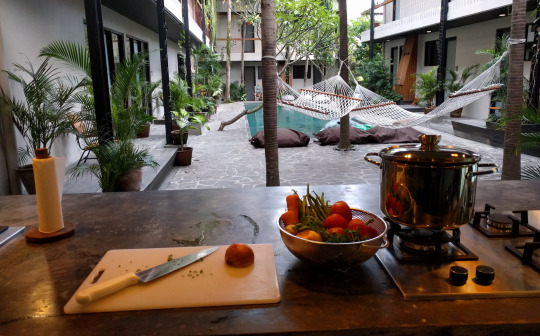
    If you’re looking for more evidence that the way we live and work is changing, then check out a new startup called Roam. They describe themselves as an international network of communal spaces. So far, they have locations in Ubud (Bali), Miami, and Madrid. Buenos Aires and London are coming soon.

    The way it works is that you start by signing a lease for either a week or a month. You get a private room and bathroom, but everything else, from the co-working spaces to the kitchens, are shared amongst the community. Like other co-working and co-living environments, the community they build is critical.

    However, what really differentiates Roam is that you can sign one lease and then live all over the world, freely traveling across their properties. All of the locations are offered up at the same price and you can stay for as long as you’d like.

    In my line of work, I don’t have the flexibility of living like a global nomad. But today, there are many people who can. And I also know that there are many people who would prefer to live like this. It’s liberating in so many ways.

    My friend and I actually had a similar idea to this back in University and we spent some time working on it. At the time, and this was over a decade ago, we felt that there was a segment of people who increasingly wanted to live like global citizens. I still believe that to be true and, clearly, so do others.

    To date, Roam has raised $3.4 million in funding.

    Image: Ubud kitchen via Roam