
Daily insights for city builders, delivered every morning at 6 AM ET. I’m Brandon Donnelly — a Toronto-based real estate developer and founder of Globizen. I’ve been writing here since 2013.

Tag: urbanation

  • Over-building and then under-building: Is Toronto headed for a severe shortage of new rental housing?

    As we know — because here’s the data — this is the current state of affairs:

    The GTA condo market is in a state of economic lockdown. The math doesn’t make economic sense from both the demand side (investors) and the supply side (developers), leaving the market at a standstill.

    The above excerpt is from a recent CIBC Capital Markets article by Benjamin Tal (CIBC) and Shawn Hildebrant (Urbanation). And what it ultimately means is that the supply of new condominiums in the GTA is falling and will continue to fall for the foreseeable future. Below are two charts, from the same article, that show that.

    Because of this, I actually think that, if you need or want a place to live, right now is a near ideal time to buy a condominium, especially if it’s from developer inventory (in an already completed project) or it’s a resale. Of course, most people won’t want to do this because they’d rather buy when most other people in the market want to buy. This is how markets tend to go.

    It has been a while since the GTA has gone through one of these real estate cycles, but it is typical: developers are prone to both over-building and under-building. It simply takes too long to build a building, and so it is natural for there to be moments when supply and demand don’t exactly line up.

    Pre-selling condominiums is — in theory only — supposed to protect against too much overbuilding. But as we have spoken about many times before, it can be challenging for end users to buy a new home so far in advance. And so the new condominium market has come to rely on investors who want to buy early and then either sell later or rent later.

    According to the above article (and MLS data), the share of newly completed condominiums used as rentals reached a peak of 34% in 2023. So a third of new condos. My gut tells me that the actual number is much higher. Many rentals never reach MLS. Overall, I think it’s very safe to assume that the majority of new condominiums are owned by investors.

    But right now, fewer investors want to own condominiums, which is why the number of resale listings has spiked this year:
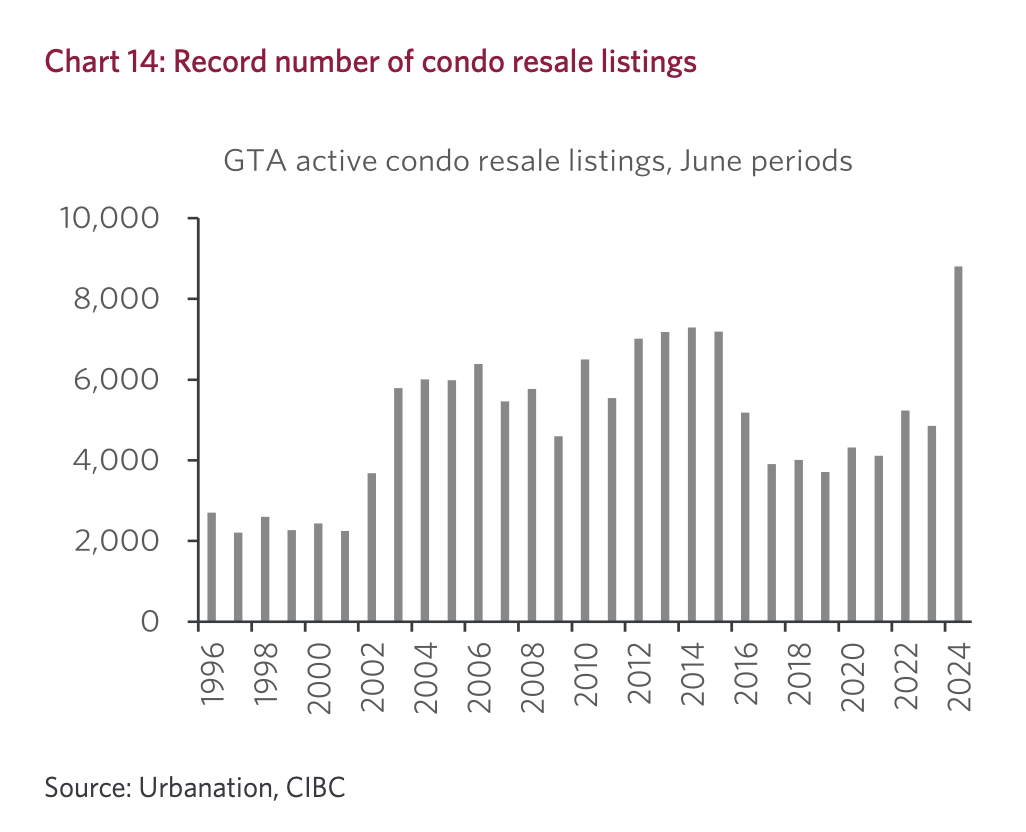
    This is, again, why I think right now is an excellent time to buy a condo. You know, be greedy when others… Regardless, this inventory will need to get absorbed and that will ultimately happen. Some of it will go to end users and some of it will go to investors who can make sense of the rental math and/or want to take a long view on Toronto. But if more goes to the former, we will be losing a lot of new rental housing.

    At the same time, while all of this is going on, construction starts are likely going to remain depressed (chart 3 above). It’s impossible to know how long this lasts, but at some point we will reach a moment in the cycle where we are under-building new housing. Maybe we’re already there. Development simply can’t turn on fast enough when demand spikes. There will almost always be a lag.

    So, since the majority of new condominiums have been serving as new rental housing, there’s a strong case to be made that at some point we will run into a potentially severe shortage of rentals. Condo investors are sometimes vilified in the media, but we will soon find out what happens when you take a big chunk of them out of the housing market.

  • 1,688 new condominiums were sold last quarter in the Toronto region

    Urbanation just released its Q2-2024 condominium market survey for the Greater Toronto & Hamilton Area (GTHA), and we should probably talk about some of the data:

    • The new condominium market reported 1,688 sales in the quarter. Outside of Q2-2020 (the pandemic), this is the lowest in the past 20 years. Note: This number is self-reported by developers.
    • Of the 3,625 homes launched for pre-sale during the quarter, only about 17% got absorbed/sold. That’s about ~616 homes, which isn’t very much when you spread it out across the region’s projects.
    • Unsold inventory increased to 25,893 homes. Urbanation equates this to 34 months of supply, versus a more “balanced level” of 10-12 months. This number breaks down to 15,157 homes in pre-construction projects, 9,788 homes in projects under construction, and 948 homes in recently completed buildings.
    • This is higher than Urbanation’s 20-year average, but the way I see it is that the ~15k homes in pre-construction projects could very quickly evaporate. If those projects don’t get to construction (and most probably won’t in the short term), then that inventory will disappear from the market. On the other hand, the ~11k homes under construction or recently completed is a hard number. These homes exist, or will soon exist, and they’ll need to get absorbed at some point.
    • There are also going to be homes that are currently sold, but where buyers ultimately say “yeah, I’m not going to be able to close.” So there will be some non-zero percentage of homes that will need to be reabsorbed. I don’t know what this percentage will be, but if it’s something like 5%, that’s not nothing. (See below for the number of condominiums under construction right now.)
    • Not surprisingly, average asking prices for unsold homes only declined about 2.6% over the past year. Prices have remained markably sticky. And this is how you know that development happens on the margin. Because developers are infinitely better off selling homes and starting construction, compared to holding lots of unsold inventory and starting construction, whenever. The fact that developers aren’t dropping prices to sell more homes demonstrates that they can’t. They’re hitting the floor of financial feasibility.
    • Finally, last quarter saw 727 new condominium homes start construction. In theory, this could have been a single tall building, though that probably wasn’t the case. As new starts fall, the number of condominiums under construction will naturally also fall. The current number is 87,508 homes, which is almost 19,000 less than a year ago. I expect this number to keep coming down.
  • Cost-plus price floor

    Oftentimes, it feels like there is a perception that developers price new housing with the fattest of margins. Meaning, if only developers were less greedy, housing could be more affordable. But as we have spoken about many times before, real estate development is a competitive industry; therefore, projects happen on the margin.

    Ordinarily, the prices you see are the result of a cost-plus pricing strategy. Developers figure out what it will cost to build and develop, they add on a margin that they think their investors will accept, and then they determine what sticker prices they need to make the project financially feasible.

    I’ve been writing about this approach for many years, but today it’s even more obvious. According to Urbanation’s Q1-2024 condominium report, new unsold condominium inventory in the GTA is currently sitting at approximately 23,815 units. This is up 30% YoY and is equal to about 23 months of supply. Two years ago in Q1-2022, this number had reached an 18-quarter low of 8,726 units.

    Developers are highly motivated to sell and move their projects forward. Time is a killer, especially today. So the logical explanation for this rising inventory is simply that they can’t sell it. Their cost-plus pricing doesn’t overlap with what most buyers in the market are willing to pay. Like I said, development happens on the margin.

    In theory, there is always a price where buyers would be willing to transact. If I listed a beautiful condominium for $100k today, many people would want to buy it. Supply would quickly run out. The problem is that no developer can build for this. There is always a very real price floor and, right now, that floor doesn’t seem to be low enough for many buyers.

  • Toward more rental housing

    The Greater Toronto and Hamilton Area is expected to see 6,821 new rental homes completed this year. This is a “multi-decade high”, according to Urbanation’s latest rental report. Indeed, you need to go back to the 1970s to get rental supply figures of this magnitude.

    A big part of this has to do with the fact that we are now taxing rental housing less. Toward the end of last year, the federal government removed their portion of the HST on new rental housing and, then in November, the province of Ontario followed with theirs.

    This was “a big first step” for the industry, according to leading apartment developers like Fitzrovia.

    But there’s another reason that many developers are now looking to purpose-built rentals: fewer people are buying new condominiums. And if you can’t presell condos, well then you’re going to need to find another path forward for your land.

    However, flipping over to rental is not necessarily a panacea. The margins are generally razor thin (+/- 50 bps). It requires more and different capital (typically). And you need to believe in some fairly non-consensus assumptions (high rent growth, low cap rates, etc.).

    It’ll be interesting to see how many developers are able to successfully flip over to rental and how sustained this rental supply number will be.

  • More sellers than buyers

    This week, Urbanation released its condominium market update for Q1-2024. And I’d like to point out two data points. Firstly, across the Greater Toronto & Hamilton Area (GTHA), there were 1,461 new condominium sales for the quarter.

    This is the lowest quarterly total since Q1-2009 (the global financial crisis) and the second lowest total since the mid-1990s. (Remember when we spoke about right now being the toughest market since the early 90s?)

    Secondly, during this same time period, 2,361 new condominiums began construction across the region. This represents a 52% annual decrease. So all in all, fewer people are buying new homes and fewer new homes are starting construction.

    What is obvious is that the market is slow right now. What is not obvious is what happens next. It’s unknowable. There’s risk. My gut is that the market will come back more slowly than many people are expecting, or perhaps hoping. There’s inventory that needs to work its way through the system first.

    But ultimately it will come back. Toronto is one of the greatest cities in the world and there remains a need for more homes. Which is why I continue to believe that, if you are in the market for a new one, now is arguably a wonderful time. You get to buy when most others aren’t.

  • Closing risk

    Urbanation is forecasting that approximately 27,000 condominium suites will finish construction and be ready for occupancy this year in the Greater Toronto Area. This is some sort of a record, and is naturally the result of record pre-construction sales over the last cycle.

    This number is going to come down given that construction starts are declining, but before that, these suites will need to get absorbed into the market. And that’s why I think that one of the biggest risks for our industry this year is going to be closing risk.

    In other words, you’ve got the pre-sales, but will the purchasers actually show up and close on their homes?

    It is for this exact reason that most/all construction lenders want to see pre-construction purchasers pay at least 10% in deposits before they’ll advance their loan. It is also why the most risk-averse developers won’t start construction until they have even more than 10% sitting in trust. The more hard money a purchaser has paid, the more likely they are to close.

    It can be easy to forget this when the market is on fire and you’re more preoccupied with holding back inventory because you think that sale prices will be higher in the future. But it’s prudent to remember these times. They are a naturally occurring part of real estate cycles.

    The most risk adverse execution strategies will likely leave some money on the table in the best of times. You won’t be profit maximizing. However, they’ll leave you more protected in the worst of times. That’s how risk and reward work.

  • Why are construction starts down?

    Last year in the Greater Toronto Area, condominium construction starts fell to a 9-year low of 15,891 homes. And this year, condominium construction starts are forecasted to fall to a 15-year low of 11,500 homes (though new sales are expected to rebound). Both of these figures are from Urbanation’s Q4-2023 market data.

    One possible explanation for this drop in construction starts could be that developers are somehow colluding to keep supply low and prices high. Another one could be that more developers are right now independently speculating that prices will be higher in the future, and so they think it’s better to just wait. But both of these explanations would be wrong.

    The correct answer is that more developers are unable to start construction because the market isn’t there. In the case of Toronto’s condominium market, this means that the pre-sales aren’t there. This might seem obvious, but there seems to always be a contingent of people who believe that developers can choose to build whenever they want.

    It is for this same reason that some people think that zoning approvals should have an expiry date. Call it a use-it-or-lose-it approach. But as I think we can see in the above numbers, developers don’t control the market. And so I would never want to be in a position where I need to start construction by a certain date, or else.

    That’s not entirely within my control. In fact, sometimes it’s completely out of my control.

  • A lot less new housing

    During COVID, every developer was terrified that their costs were going to run way from them. According to this recent Globe and Mail article, residential building costs increased 55% since 2020. At the same time, city fees were being increased and some people, for whatever reason, believed this would not have an impact on home prices. Developers will always seek to profit maximize and charge whatever the market will bear, so why bother trying to reduce costs? This is/was one school of thought.

    Despite this cost fear, the market managed to keep up for a period of time. Capital was cheap, as we all know. And that kept things going, until it was no longer the case. According to the same Globe article, there are 83 residential projects and 28,428 homes that have not launched (sales) over the last two years in the Greater Toronto Area because of market conditions. This year alone, the number is estimated at 14,000 homes. So supply has fallen off, and that’s because demand and buying power have fallen off.

    But let’s think of this in economics terms. Price and quantity demanded are usually inversely correlated. Meaning, if the price of something goes up, demand will go down. And if the price of something goes down, demand will go up. So in theory, there are still prices that will get 28,428 people excited to buy a new home. I mean, if I were to list a condo in downtown Toronto for $500 psf right now, I’m pretty sure that most with the means would jump at the opportunity.

    The problem is that whatever these prices are, they are largely beneath the floor price of where most developers can build to today. Developers weren’t bluffing, costs really are too high now. And when this happens, the answer is simple: you can’t build. A new equilibrium will eventually be found. But in the short-term, we should all expect new housing supply to remain limited. And because there’s always a lag with real estate, the effects of this shortage will be felt in the years to come.

  • Cheap mortgages are something to hang onto

    If you really need a new home, then I guess this makes sense:

    We thought rising mortgage rates would crush the homebuilders, and bet against Pulte in the FT stockpicking contest. But the exact opposite happened: high rates froze the existing house market by giving homeowners a huge incentive not to move — their irreplaceable cheap mortgages. That left new homes as almost the only game in town for anyone who really needs to buy a home. Pulte has been one of the best- performing stocks in the S&P 500. Never pick stocks, even in a stupid stockpicking contest, on the basis of superficial research.

    And here’s a chart that supports this argument (new homes as a % of total single-family home inventory, including resales):

    It’s an interesting nuance.

    But it’s certainly a different story here in Toronto with new condominium sales. According to Urbanation, in the first half of this year, the Greater Toronto Area sold 6,727 new condominium homes. This is down 59% compared to 2022, and represents the slowest first six months in a decade.

    In this case, higher rates have dramatically slowed the market.

  • Families in multi-family buildings

    There is an ongoing debate in Toronto, and many other North American cities, about how to encourage more families to live in multi-family buildings. And here that has generally translated into (1) mandating a certain number of larger family-sized suites and (2) creating design guidelines to better equip both suites and buildings for families.

    But what we often ignore is the very real economic reality of buying a large family-sized suite. If you look at the latest Q3-2022 data from Urbanation, the average price of a new condominium in the entire Greater Toronto Area right now is about $1,427 psf.

    So if assume that a good family-sized suite is, oh I don’t know, 1,200 sf, the average price would be about $1.7mm, before you add in any parking (if necessary).

    If this is too big and you can get away with something more similar to a post-war bungalow — let’s say 900 sf — you’re still at nearly $1.3mm, again before any parking. At these sorts of prices, you have a few options, particularly if you’re willing to sprawl outward. And I think it’s important to recognize this.

    The other hurdle remains our industry’s requirement to pre-sell suites in order to obtain financing and start construction. What this effectively means is that you need buyers who can say to themselves, “I’m probably going to need a family-sized suite for the 1.4 kids I may have in 4-5 years.” This isn’t for everyone.

    So if we are truly serious about encouraging more families in multi-family buildings (which is an obviously good idea), I think it can’t just be viewed as a design problem and/or the result of greedy developers who just want to profit maximize by building smaller suites. We need to be looking at both the cost structure behind these homes and new ways to finance them.