Daily insights for city builders, delivered every morning at 6 AM ET. I’m Brandon Donnelly — a Toronto-based real estate developer and founder of Globizen. I’ve been writing here since 2013.

Tag: realtor

  • What the NAR’s $418 million settlement could mean for the real estate industry

    The $418 million commissions lawsuit that was settled last week with the National Association of Realtors (NAR) is certainly a big deal. The NAR is trying to sound positive, but all signs point to this outcome being meaningful for the industry. TD Cowen Insights is forecasting that commissions paid in the US each year could fall by some $25 to $50 billion (from a total of ~$100 billion). And this is the headline you’ll see everywhere right now. But how might this actually happen?

    As we’ve talked about before, the status quo commissions set up is a good one for agents:

    • Sellers are typically the party who pays 100% of the commissions
    • But sellers don’t pay until the agent sells and they have fresh cash
    • Money being deducted from proceeds (a “take rate”) is a lot less noticeable and has a lot less friction than cash you just have to pay out of pocket
    • Buyers kind of don’t pay — or at least that’s how they’re supposed to feel

    This is “good” because it perpetuates the existing model. If buyers feel like they’re mostly not paying, they’re just going to go to the marketplace with the most supply of homes. And that marketplace is the Multiple Listing Service (MLS). However, this marketplace also does things like tell buyer agents how much commission they will make as part of each deal. And the belief is that practices like this are anticompetitive.

    So as part of the above settlement, the following new rules are expected to go into place by July 2024 in the US:

    • Seller agents will no longer be able to set compensation for buyer agents
    • All fields on MLS displaying broker compensation will need to be removed
    • Furthermore, agents will no longer even need to subscribe to an MLS in order to accept compensation
    • Buyers working with an agent will need to enter into their own buyer broker agreement and negotiate compensation separately
    • However, there’s nothing stopping buyers and sellers from negotiating whatever commission structure they want; the idea is simply that it will be more transparent and negotiated by each participant

    Why this is meaningful is that it decouples buyer agents and seller agents in a way that they aren’t today. Instead of everything originating from the sell side, each side of the transaction is now going to — theoretically at least — negotiate what they believe is fair compensation for their representation. At the same time, there’s no obligation to even subscribe to an MLS.

    This leads us to, at least, two important things to think about:

    1. What is fair compensation? Well, it should depend. If I’m a first-time buyer, I may want someone to walk me through the entire process. But if I’ve done it many times before, maybe I need very little. Or, if I’m an investor looking to renovate homes, maybe I want representation that is also an expert on construction. The point is that, in a truly open market, one should be able to find an agent and pay them based on the value that they’re creating. And this is presumably why everyone is expecting commissions to fall precipitously.
    2. If there’s no obligation to even subscribe to an MLS, does this then open the door for new and more open listing platforms? Right now, I don’t know how this will play out. I’d like to better understand more of the details around this settlement item and what it could mean for the landscape. But I do know that the way to spur the most amount of innovation would be to have the marketplace run on something like a blockchain, and then allow anyone to create their own listing platform on top of it. One day.

    This will be fascinating to watch play out. And I’m sure it’s only a matter of time before it spurs similar changes here in Canada. Expect further coverage of this topic on the blog.

    Photo by Tom Rumble on Unsplash

  • Wonderful real estate

    At the highest level, I agree with the premise of this tweet from The Real Estate God. The overarching argument is that one’s main criteria for selecting a real estate market in which to enter should be “the place with the least competition.” And the reason for this is that less competition equals less price discovery, which then equals more mispriced assets and more opportunities to generate outsized returns.

    Going even further, the argument here is that you’re actually taking on less risk by buying mispriced assets in less competitive markets because you can model reality (things like in-place cash flows and market rents) as opposed to betting on the future (things like rental growth and/or cap rate compression). Said in a different way, it’s easier to find deals and “make money on the buy”; and, once again, I would mostly agree with this.

    But in my mind there’s a very important caveat. And it’s akin to the advice that the late Charlie Munger supposedly gave to Warren Buffet: “Forget what you know about buying fair businesses at wonderful prices; instead, buy wonderful businesses at fair prices.” While it is true that you might find wonderful pricing in less competitive markets, there remains the question of whether you’re also buying wonderful real estate.

    And I think that’s an important consideration.

  • Toward positive ZOPAs

    This example, by Matt Levine, is a funny way to understand how many negotiations work:

    In negotiations, it is often helpful to have someone else, some “absent principal,” to blame for your position. You go to a car dealership, the salesperson says “this car costs $25,000,” you say “I want to pay $21,000,” she says “I like you, I want you in this car, but my boss won’t let me go lower than $24,000,” you say “$22,000,” she says “I really want this to work out, let me check with my boss,” she goes into the break room and watches TikToks on her phone for five minutes, she comes back and says “my boss is really mad at me but I talked him down to $23,500.”

    The boss is a crutch, an excuse. The salesperson is adversarial to you — she wants to charge more, you want to pay less — but wants you to feel like she’s on your side, so you trust her and agree to her proposals.

    Now, Matt ultimately goes on to talk about how in some situations, such as in the financial industry, this could be considered criminal behavior. But that’s a more nuanced topic for his column, and not for this blog. Here, we’re just going to use it as a lead-in to say that negotiating is kind of important for real estate.

    In fact, when I was in grad school, my mentors used to always say to me, “everyone should take a negotiating class.” And so I went and did that. It was a lot of fun. I remember us being given “positions”, and then we’d have to go out and see what we could negotiate.

    One particular concept that I often find myself coming back to is something referred to as the “ZOPA.” The Russians in my class were quick to point out that this sounds like the word ass in their language, but in the world of negotiating it stands for “Zone of Possible Agreement.”

    What it describes is whether there’s an overlap between what both parties are willing to accept. For example, if a buyer is willing to pay as much as $100 for a particular piece of real estate, and the seller is willing to go as low as $80, then there is a positive ZOPA of $20.

    This means that a deal should theoretically happen. However, interestingly enough, I discovered in my classroom simulations that negotiations can still arrive at an impasse, even with a positive ZOPA. Some people want to do deals, and some people like to extract everything they can from a negotiation.

    Of course, if you have a negative ZOPA (i.e. no overlap in what the parties are willing to accept), then it’s obviously pretty hard, if not largely impossible, to come to a deal. And since 2022, you could say that the real estate industry has been characterized by a greater number of negative ZOPA scenarios.

    But if my predictions for this year are correct, then 2024 will be the year where we start to see some more positive ones.

  • Real estate commissions are probably going to come down

    Real estate commissions on homes in the US are typically between 5-6%. And it is usually split between the seller’s agent and the buyer’s agent (or it goes all to one agent in the case of dual-ended deals). It is also customary for this commission to be paid entirely by the seller (through the proceeds of their sale), though you could argue that buyers end up paying for it indirectly. All of this is generally true in Canada as well.

    This is a good set up:

    • Sellers don’t pay until they sell and have fresh cash
    • Money being deducted from proceeds (the “take rate”) is a lot less noticeable and has a lot less friction than cash you just have to pay out
    • Buyers kind of don’t pay

    This last point is one of the most important features of how real estate commissions work. Because you have one side of the transaction that feels as if they’re mostly not paying, it generally helps to perpetuate the status quo. If both sides had to directly fork out cash, you’d likely have a lot more people saying, “hey, why don’t we consummate this transaction over here, on the side, and not pay these fees.”

    But it turns out that the US Department of Justice isn’t happy about some of these policies and practices. More specifically, when the National Association of Realtors does things like this:

    • Prohibiting multiple listing services (“MLSs”) from disclosing to prospective buyers the amount of commission that the buyer broker will earn if the buyer purchases a home listed on the MLS (“NAR’s Commission Concealment Rules”);
    • Allowing buyer brokers to mislead buyers into thinking that buyer broker services are free (“NAR’s Free-Service Rule”);
    • Enabling buyer brokers to filter MLS listings based on the level of buyer broker commissions offered and to exclude homes with lower commissions from consideration by potential home buyers (“NAR’s Commission-Filter Rules and Practices”); and
    • Limiting access to lockboxes that provide licensed brokers physical access to a home that is for sale to only those real estate brokers who are members of a NAR-affiliated MLS (“NAR’s Lockbox Policy”).

    In fact, these practices were found to be anti-competitive; they were arguably keeping commissions artificially high. So much so that a federal court recently awarded $1.8 billion in damages. It was also decided that no rule or practice should exist that:

    • Prohibits, discourages, or recommends against an MLS or MLS Participant publishing or displaying to consumers any MLS database field specifying the compensation offered to other MLS Participants;
    • Permits or requires MLS Participants, including buyer brokers, to represent or suggest that their services are free or available to a client at not cost to the client;
    • Permits or enables MLS Participants to filter, suppress, hide, or not display or distribute MLS listings based on the level of compensation offered to the buyer broker or the name of the brokerage or agent; or
    • Prohibits, discourages or recommends against the eligibility of any licensed real estate agent or broker, from accessing, with seller approval, the lockboxes of those properties listed on an MLS.

    Some believe that this ruling — which will create more competition — could reduce the $100 billion or so of commissions paid each year (in the US) by as much as 30%. This is possible. I have no idea how this estimate was calculated. But it does make intuitive sense that commissions should come down. This ruling gets at the heart of what sustains the industry: one side of the marketplace needs to feel that they’re, mostly, not really, paying.

  • Every home is for sale; it’s just a question of price

    Over the last few weeks, a number of people have told me that, when it comes to their current home, they have a number in mind. They more or less said, “I’ve already spoken with my husband/wife about it and, if someone were to offer us $X, we would sell and move immediately.”

    What’s fascinating about this is that it’s a form of housing supply that generally doesn’t exist anywhere right now. Sure, the people I was speaking with would sell and move for a price, but how does something like this actually happen? How do buyers find them?

    I suppose it could happen through word of mouth. I now know their prices and so if someone I know were interested in such homes, I could tell them. It is a low probability, but it’s still a possibility. Alternatively, someone (an agent or otherwise) might just show up on their doorstep and make them an offer. My dad actually sold his last home this way.

    But again, how likely is this to happen? It doesn’t seem scalable. And this is why Zillow used to have something called a “Make Me Move” listing. Rather than a traditional listing, it was a listing for, “I don’t necessarily need to sell, but if you offered me $X, I would move.” For whatever reason, though, Zillow no longer offers this service. Presumably, it’s because it wasn’t working. Hmm.

    Here’s how I’m thinking about it.

    Today, most housing markets are binary. A home is either for sale or it’s not. Sometimes enterprising people manage to secure an “off-market home”, but generally speaking the market is binary. If a home isn’t for sale, most people don’t usually bother with it. Mostly because they can’t easily find it.

    But market conventions aside, the conversations I’ve been having suggest that it’s actually more of a gradient. On the one side are people who really don’t want to sell. Maybe they’re never sellers. Let’s pretend that the home has been in their family for generations and so to convince them to sell you’d probably have to offer them an absurdly high price and that might not even do it.

    On the other end of this gradient are people who are ready to sell today. In an extreme example, they might even need to sell by a certain date, or else. In this case, a below-market price could get them to sell. They are highly motivated and one sure-fire way to increase speed is to lower price.

    But for everyone else in between, it is a big unknown gray area where price and desire to sell are, I would think, inversely correlated. As desire to sell increases, expectations around price probably need to come down until they reach a point where the market can bear it and a transaction will occur. This is my hypothesis at least.

    But if it’s true, and there’s a big untapped gray area, then the housing market is a lot bigger than we think it is.

  • Redfin is rolling out an online purchase option for homes

    There’s a lot of money at work right now trying to reinvent the way that homes are bought and sold. Perhaps the most popular trend is “instant buying” or algorithmic home buying. I have been writing about this for years, mostly because of Opendoor. But now there are lots of companies competing in this space. With this model, home sellers get the benefit of an almost immediate sale, though usually it’s at a slightly lower price.

    Redfin, on the other hand, is returning to something that it first tried out back in 2006: a buy now button on its online listings. It failed back then. But maybe it was simply too early. The feature allows unrepresented buyers — that is, buyers without an agent — to make online offers. Naturally, it’s far from a single click process. But when accepted, the seller ends up paying about half the amount of commission.

    According to the New York Times, the company started testing the feature in late March in the Boston area. Of the 120 homes listed on Redfin with a “start an offer” button, 5 ended up being purchased via an online bid. That’s more than I would have expected. But Redfin positions these offers as being the stronger option because they save sellers money. There’s also an option to tour the home on your own.

    Given this initial response, the company is now working to roll out this feature nationally, market by market. Is this the future of home buying?

  • Real estate startup Knock raises $400 million

    I have been writing about the real estate startup Opendoor for many years here on the blog. Another promising startup in this space is Knock, and today it was announced that they just raised a $400 million Series B round (led by Foundry Group).

    They share some similarities with Opendoor, but they are also different in that their focus is on home trade-ins. They tell you what your current home is worth, help you find a new home, and then coordinate “a seamless swap.” For more on how they work, go here.

    One of the ways in which they are similar to Opendoor is that they front the cash for new home purchases. In the case of Opendoor, they buy your home with the plan of selling it in the future. And with Knock, they buy your home with the understanding that your old home will get sold.

    It is certainly a more capital intensive model compared to the way that home sales are handled today. But many investors are clearly betting that it is exactly what is needed to change the status quo. 

    (Credit to Jeremiah Shamess for sharing the above news with me today.)

  • Federal court upholds decision that TREB’s housing sales data should be available online

    The Toronto Real Estate Board (Canada’s largest real estate board) and the Competition Bureau have been fighting for years over whether TREB’s housing market sales data, including realtor commissions, should be publicly available online.

    The Competition Bureau, as well as many forward thinking realtors, believe that gatekeeping historical sales data is stifling competition and innovation. It is. But TREB has been arguing – for a number of years I might add – that it is genuinely concerned about consumer privacy.

    Well on Friday the Federal Court of Appeal ruled that TREB cannot prevent its members from freely publishing data about what properties have sold for. This is a positive, albeit a small, step forward for open data and innovation.

    But perhaps not surprisingly, TREB has already said it would appeal the decision to the Supreme Court of Canada and apply for an order staying the release of the above data until this new appeal gets decided.

    So there’s still more fighting to take place. Nevertheless, I do have a few thoughts.

    The claim by TREB that they are deeply concerned about consumer privacy is nonsense. Call up any realtor in this city and they’ll tell you and send you whatever historical sales data you want. This is about maintaining an information asymmetry that forces more consumers to connect with agents.

    But as many sensible realtors have already explained publicly in the media, if gatekeeping information is such a critical component of the value that TREB members bring to clients – and the board is certainly clinging to it – then realtors and/or the industry have a serious problem on their hands. 

    Time to evolve.

    I would also argue that our current archaic setup distorts the market. There’s simply too much friction associated with accessing good sales records and so the result is greater opacity in the market. Say all you want about the efficacy of realtors, more friction = less engagement. Free the data and empower members to leverage and build on top of it.

    In my view, this is a positive step forward. But it still feels like a small one. I’m actually surprised by how long this status-quo battle has been going on. Hopefully it gets wrapped up soon so everyone can get on with what matters most: innovating.

    Photo by Fernando Reyes on Unsplash

  • Transparent offer platform

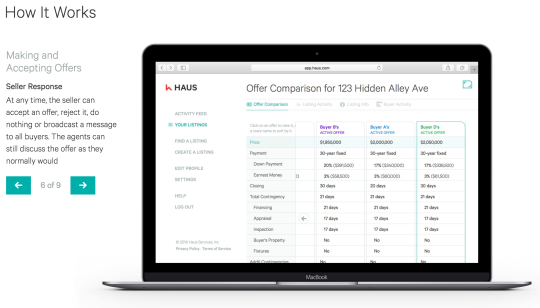
    A new “transparent offer platform” called Haus has just launched in California to serve the residential real estate market. The way it works is that all offers are submitted online. And once an offer has been confirmed, it – along with all of its terms – gets revealed to every other potential buyer. See image below.

    image

    I’ve seen a number of different iterations of this same idea, which tells me that this is a well-identified problem in the real estate market. Here’s a snippet from a recent TechCrunch article announcing Haus:

    “We think the openness will create a more efficient market and that the number of offers and price will ultimately be dependent on demand,” said Haus GM Sarah Ham. “Bidding wars are a common, almost accepted, part of the real estate process today. But with our approach, buyers know where they stand. Buyers will know what they need to offer to make their offer competitive, but they also won’t negotiate against themselves.”

    I completely agree that this is a problem that needs to be solved. It will create a more efficient marketplace. However, in this market, I suspect that the current information asymmetries largely benefit sellers, to the detriment of buyers. So I wonder if the supply-side of the marketplace will be willing to participate at scale. What’s really in it for them?

    Side note: Haus is the latest project from Expa, which is a “startup studio” that works on its own ideas, as well as partners with other founders. I am very interested in this approach to creation because I think you have to try and make a lot of things if you want to do truly innovative things.

  • A money back guarantee on your next home

    image

    I’ve written about Opendoor.com a few times. As far as I can tell, they are the furthest ahead in terms of disrupting the residential real estate market. So I like to follow them quite closely.

    They’ve recently launched some new features, so I figured it would be a good time to check-in on what they’re up to. But first – for those of you might not be familiar with Opendoor – here’s what they do.

    Opendoor offers instant liquidity to homeowners by buying homes site unseen. The fee they charge seems to amount to less than 10% of the value of the home. 

    They also say that they typically offer prices that are about 1-3% less than the market value of the home 3 months into the future. (Apparently 3 months is the average time-on-market for the cities in which they operate.)

    Once they’ve bought the home, they then make improvements and put it back on the market. As of today, they are buying about 10 homes a day in the two markets in which they operate (Phoenix and Dallas). They are spending about $75 million a month buying homes.

    To mitigate their risk, they won’t buy a home built before 1960, a home that was pre-fabricated, a home with a solar lease, and so on. They also stick to values that are between $100,000 to $600,000. But apparently this covers off about 90% of homes in the United States. (You can read their full FAQ here.)

    To accomplish all of this, they have raised about $110 million in venture capital.

    What’s fascinating about all of this is that they are starting to create a seamless marketplace. As they continue to buy more homes (and aggregate supply), more buyers are starting to come to their marketplace. They also allow people to easily find local contractors.

    Over time as they gain scale and as their algorithms improve, one could imagine their pricing becoming more competitive, them taking more of the market, and them bearing much less market risk as homes quickly trade. 

    They liken their model to car trade-ins. Apparently 60% of people who buy a new car are trading in an old one. That’s an interesting comparison that I hadn’t thought about before.

    So what’s new?

    Two things

    First, they are offering a 30 day full refund on new home purchases. In other words, if you buy a home through their platform and, for whatever reason, you end up not liking it, they’ll buy it back (minus some transaction costs and so on).

    Second, they are providing a 180-point inspection report to buyers and if anything breaks in the first two years of ownership (presumably it is something that contravenes the inspection), they’ll come and fix it.

    These additions are helpful because it starts to target buyers, which will help them fill out the other side of their marketplace. It also promotes greater transparency because now they’re partially on the hook for the home’s performance.

    I like what they are doing and, again, I can’t think of any other company making such big bets in this space.