Daily insights for city builders, delivered every morning at 6 AM ET. I’m Brandon Donnelly — a Toronto-based real estate developer and founder of Globizen. I’ve been writing here since 2013.

Tag: apartments

  • An overview of rental housing in France

    Rental housing in France is both heavily regulated and supported through dedicated public funds. Here’s a high-level overview of what that means (via this 2021 Brookings case study by Arthur Acolin):

    • Homeownership rates in France went from 35% in 1954 to 56% in 2001
    • As of 2018, 58% of French households own, 40% rent, and the remaining 2% supposedly get free housing from either their employer or a family member
    • Not surprisingly, younger households are most likely to rent (the figure is > 60% for people aged 18-29)
    • Household size seems to play a major factor in how likely people are to live in public housing
    • France has some 4.5 million public housing units and 17% of all households live in them (which represents about 43% of all renter households)
    • Within the unsubsidized rental market, 93.5% of households live in homes owned by individual investors (this is as of 2013) and only about 3.5% live in homes owned by institutional investors
    • This is pretty typical of Europe, where multi-family isn’t an established real estate asset class like it is in North America; so for those of you who like to hate on individual condo investors, check out France
    • In the decade between 2010 and 2020, 28 metro regions in France adopted some form of rent control and, in a few markets, like Paris and Lille, there are also maximum rents that can be charged for specific housing types

    If you’re interested in rental housing, Brookings also has articles covering the US, Germany, Spain, Japan, and the UK. They can be found here.

  • Adam Neumann raises $350 million to revolutionize the apartment market

    Today it was announced that venture firm a16z has made a $350 million investment in Adam Neumann’s new residential rental company called Flow (which is kind of ironic).

    The company is set to launch in 2023 and nobody on the outside seems to be entirely clear on how it plans to revolutionize the multi-family rental market, but supposedly this funding round values Flow at more than $1 billion and supposedly Neumann will be rolling in the 4,000 or so apartments that he has been buying up.

    In any event, here’s how a16z described the opportunity (I think the key sentence is probably the one about creating a system where renters become like owners):

    Only through a seismic shift in the way industry relationships are structured and the mechanisms through which value is delivered can we hope to address the underlying problems of the current system and build the solution. Doing this requires combining community-driven, experience-centric service with the latest technology in a way that has never been done before to create a system where renters receive the benefits of owners. This means rethinking the entire value chain, from the way buildings are purchased and owned to the way residents interact with their buildings to the way value is distributed among stakeholders. And given the fragmented nature of the ecosystem today, we can only hope to accomplish any of this by bringing every aspect of the living experience together.

    What I will say is that I think it’s great to see this amount of innovation-focused money flowing into the residential real estate space, which is, after all, the biggest asset class in the world and one that could certainly use some fresh ideas. Apparently it’s also the biggest funding round that a16z has ever done.

    But I also find a16z’s characterization of the problems a bit odd. Renting an apartment is described as this soulless and profoundly lonely experience where you’re so ashamed of where you live that you’re even hesitant to invite friends over. They also conflate house with home, as if to say that you can’t have the latter without the former.

    On second thought, maybe these are exactly the right problems to be solving. It is our biases that we need to do something about.

  • Adam Neumann has quietly acquired some 4,000 apartment units

    So it was announced today that Adam Neumann — the cofounder and former CEO of WeWork — has been quietly buying apartment buildings across the United States. According to the Wall Street Journal, he is involved in entities that have acquired more than 4,000 apartment suites valued at least $1 billion.

    The buildings, which seem to be fairly typical and have at least a few hundred doors, are located in cities like Miami, Ft. Lauderdale, Atlanta, Nashville, as well as in many other US cities. It’s not clear what the exact plan is for this real estate but people who claim to know things are saying that it will involve “redefining the future of living”, or something along these lines.

    Presumably this means catering to young professionals with cool design, fun amenities, and beer taps. Whatever ends up happening, it is interesting to see some of the cities that he/they are targeting. They are the cities that we’ve all been talking about for many years. You know, the ones that are growing quickly and have greater housing supply elasticities.

  • New York City is budgeting $30.8 billion in property tax collections

    According to the WSJ, New York City is budgeting to collect $30.8 billion in property taxes for fiscal year 2021. These tax bills will go out on June 1 and payments will start becoming due on July 1, which is the start of the city’s fiscal year. Here’s how the collections break down across houses, apartments, and commercial properties:

    Overall — and despite the fact that values have softened in the wake of COVID-19 — this year’s property tax budget represents a 5.7% increase over FY2020. The reason for this is that each year the city completes its annual assessments on January 5. And so according to the city’s January numbers, everything is just fine.

    Supposedly this January 5 date is usually non-negotiable. A lawyer is quoted in the Journal article saying that under normal circumstances, if your house were to burn down on January 6, you would still have to pay all of your taxes for the upcoming fiscal year.

    Time will tell if this time is different. But it is interesting, though not surprising, to note just how significant property taxes are to New York City’s overall tax collections. They represent a little more half of all taxes collected.

  • Where renters want to move

    Every quarter, Apartment List publishes something that they call their Rental Migration Report. What they do is use search data from their website to determine where their (registered) users are hoping to move to and from. Their first report of 2020 is now out and below is their list of the most attractive US metros. It is based on search data from June to December, 2019.

    Now, it’s important to note that this is really only a form of intent — taken from one particular website. This list may not, and probably doesn’t, accurately mirror how and where people are actually migrating within the US. But it is still interesting to see what is top of mind for Apartment List’s users. (If there were multiple search inquiries during a visit to the site, they counted the first metro area.)

    Beautiful mountains. Great snowboarding/skiing. And a burgeoning tech ecosystem. I am not at all surprised to see Denver at the top of this list.

    Images: Apartment List

  • Two-up, two-down

    Feargus O’Sullivan is doing a series in CityLab right now on the “home designs” that define four European cities: London, Berlin, Amsterdam, and Paris. The first one is on London’s classic “two-up, two-down” design, which refers to a two storey home with a living room and kitchen on the ground floor and two bedrooms on the second. It’s a simple design, but one that has supposedly endured.

    O’Sullivan argues that for many, or perhaps most in Britain, this is what a “home” feels like. It’s grade-related and there are two floors. Indeed, only 14% of British people live in an apartment, compared to 57% in Germany (a majority). This percentage is much higher in London, with about 43% of people living in an apartment. But about 25% of the population still lives in some sort of attached house.

    Home equals house. And for us North Americans, this is of course relatable. But the Germany example is a reminder that this is not necessarily universal. Attitudes toward housing are cultural. And cultures can and do change. I am seeing that happen right now in Toronto. Some of us are becoming less like the British and more like the Germans.

  • An apartment dwelling city

    Toronto’s Chief Planner, Gregg Lintern, posted this on Twitter a few days (if you can’t see it below, click here):

    A couple things came to mind when I saw this.

    First, it’s a reminder that census data is painfully slow. Five years is a long time and a lot can and will change during that time period, including the kind of built form that people are living in.

    Second, I agree with Gregg. Toronto is in the process of transforming into a majority apartment/condo dwelling city (if it hasn’t already), and it signals a pretty important juncture in our city’s history.

    It also begs an important question: How should our planning response change and adjust as this percentage of urban dwellers continues to creep upward?

  • Berlin approves rent freeze on existing apartment buildings

    Berlin just approved a five year “rent freeze” on apartments in the German capital. The rent caps will be implemented on January 1, 2020, but will apply retroactively to all rental agreements from June 18, 2019 onward (which is when the decision was made). It is estimated that this new law will apply to some 1.5 million apartments.

    The move is in response to rapidly rising apartment rents, which grew about 12% in 2017 alone. So I can appreciate where this is coming from.

    From what I have read, it will not apply to new construction, which is the first thing I checked when I saw the decision. That would have almost certainly choked off any new apartment construction in the city. With a capped top line, it wouldn’t take long for costs to increase and make new rental construction infeasible.

    That said, a similar squeeze is liable to happen for existing buildings. It is one thing to cap rents (revenue), but what about utility, maintenance, labor, and other operating costs (expenses)? As costs rise and operating margins tighten, it can become exceedingly difficult to reinvest in, or even maintain, an apartment building.

    For more on the announcement, here’s an article from FT.

  • DANCHI DREAMS

    Below is an interesting Kickstarter project by photographer and art director Cody Ellingham. I think many of you will appreciate it. It is a photobook of Japanese public housing apartments, which are known as Danchi. All of the photos were taken by Cory at night, hence the dream part. The book is about the promise that these projects represented in the post-war years, but it is also about their decline in the subsequent decades.

    https://www.kickstarter.com/projects/cbje/danchi-dreams-a-photobook-of-japanese-public-housi/widget/video.html

  • Manhattan apartment rents post biggest decline since 2011

    A friend of mine sent me this article earlier today with a sarcastic comment about the relationship between housing supply and rents.

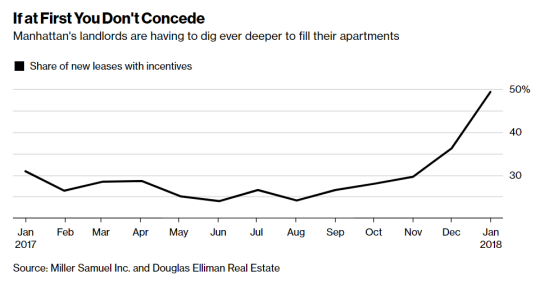
    The article talks about how rents in almost every Manhattan neighborhood have fallen compared to a year ago because of a flood of new apartment supply coming online. The median rent dropped 3.6% (year-over-year) which is the biggest decline since October 2011.

    image

    There has also been a spike in the number of leases with some sort of incentive attached to it (see above). As a landlord you typically want to use incentives, such as free rent, before resorting to lower face rents. Because lower rents mean a lower overall net operating income, which in turns depresses the value of your property.

    But sometimes you have no choice:

    “Landlords have finally realized, ‘OK, we have to adjust these prices because the concessions aren’t doing as much,’” said Hal Gavzie, who oversees leasing for Douglas Elliman. “Customers are looking past the concessions being offered and just looking for the best deals they can find.”

    A few weeks ago I wrote about a similar story playing out in Seattle. It’s almost as if excess housing supply is driving down rents.