
Daily insights for city builders, delivered every morning at 6 AM ET. I’m Brandon Donnelly — a Toronto-based real estate developer and founder of Globizen. I’ve been writing here since 2013.

Tag: accessory dwelling units

  • Toronto is looking to remove garden suite zoning permissions from this street

    Toronto has been making great progress when it comes to allowing more housing in its low-rise neighborhoods. We now allow laneway suites, garden suites, multiplexes, and soon we’ll allow 6-storey apartments. But interestingly enough, there is one small part of the city that is looking to regress. This past summer, council asked planning staff to bring forward a zoning by-law amendment to remove garden suite permissions for some of the properties backing onto Craven Road, near Danforth and Coxwell.

    Here’s a community consultation flyer that went out to residents and that shows the affected properties:

    We’ve spoken about Craven Road before. It’s a relatively odd street with a unique history. Its most obvious characteristic is that it’s a kind of single-sided street. For the most part, there are homes on the east side of the street, but no homes on the west side. On the non-home side there is typically a garage, or the longest municipally-owned fence in the city. Here’s some of the backstory on Craven Road’s infamous fence (which occurs on a stretch further south), and below is what the study area in question looks like today:
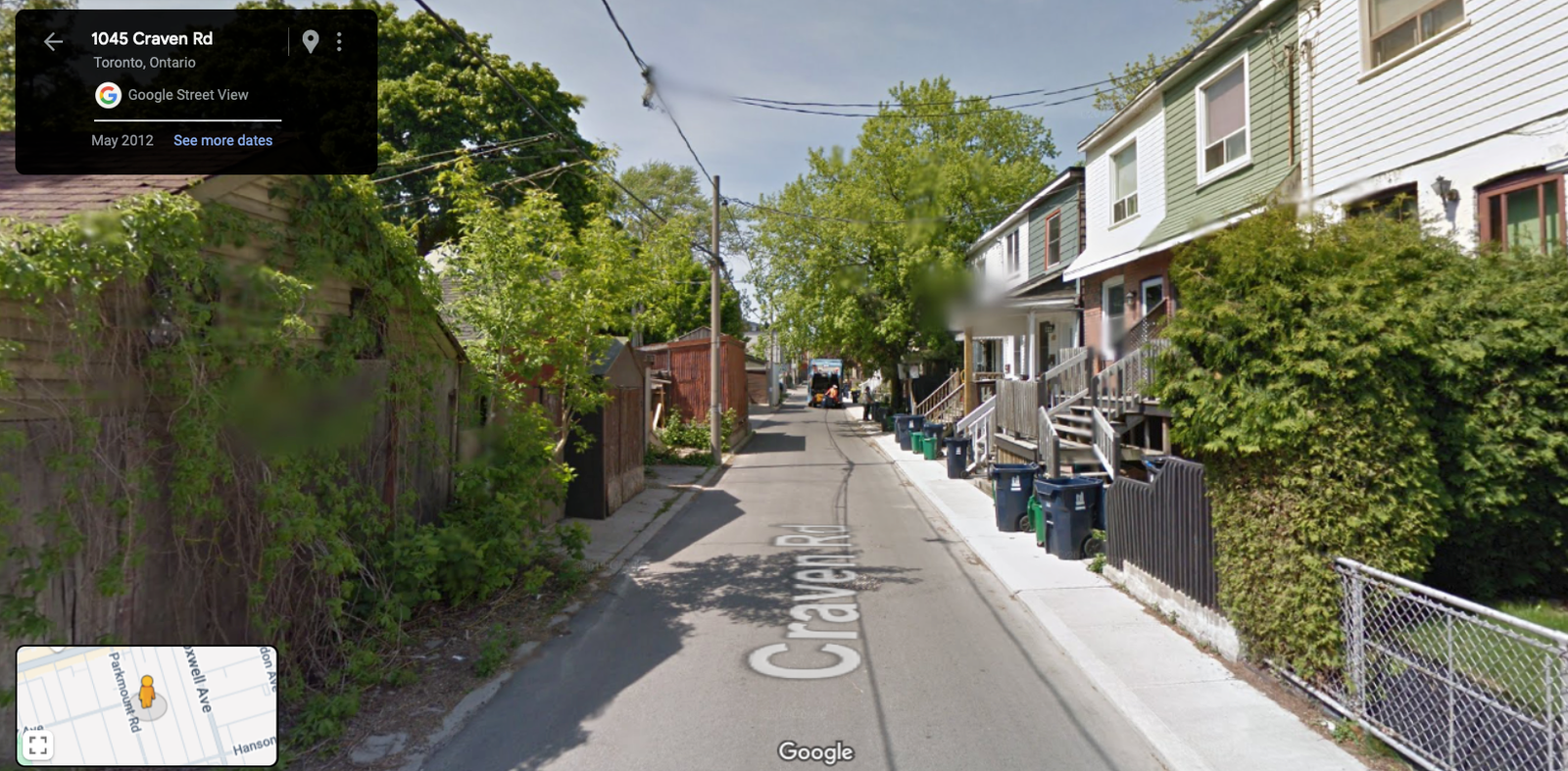
    So why remove the garden suite permissions here? The answer is to block housing. The people who live on Craven Road like it the way it is and don’t want anyone to build new housing on the other side of the street. What’s interesting about this is that it roughly mirrors what happened over a century ago. We couldn’t figure out how to broker a deal between two adjacent streets and so we just said “screw it, let’s build a really really long fence and call it a day.”

    Today we’re saying, “yeah, we really need more housing in the city, but I dunno, somebody might get upset here.” There is nothing sacrosanct about the old garages, or the fence, that line the west side of Craven. It is a street, proximate to a major subway station, that is missing homes on one entire side. It’s low hanging fruit for infill housing. In fact, there’s an easy argument to be made that garden suites aren’t nearly enough density for a location like this. We should be encouraging a lot more.

    But this is just my opinion. If you’d like to share yours, the City of Toronto is hosting a community meeting this week on September 19, 2024 from 7 – 830 PM. To participate, register here.

  • How effective will a catalog of home designs be at improving housing supply?

    Last week, the Canadian federal government announced that it will be developing a catalog of pre-approved housing designs in order to accelerate the delivery of new homes.

    This is not a new idea. A similar approach was taken after the Second World War in order to quickly house veterans returning home. But in this current iteration, the catalog is expected to be focused on missing middle housing such as small multiplexes and student housing, and then later on higher-density construction.

    We have also spoken about this idea before in the context of ADUs in Los Angeles. And at that time, I wrote that the way to encourage more of something is to reduce friction. I continue to believe that this is the case, and so I do think that pre-approved designs are a positive thing, especially for smaller projects.

    However, it’s important to keep in mind that this is not the biggest barrier to new housing supply. The problem is not that developers and builders are all sitting around thinking “if only I had a design for a 5-unit multiplex.” The problem is that they’re sitting around thinking “if only I could make some money building a 5-unit multiplex.”

    So while reducing the barriers to entry is a good thing, the really important question for the designs in this upcoming catalog is: Can developers actually make any money building them? Because if the answer is no, it doesn’t matter that they’re pre-approved and ready to go. They won’t be built.

    Hopefully somebody is thinking about this because it will take some work. Every market is different. What works in one place, may not work in another. On top of this, what works today, may not work tomorrow.

  • Longer-term benefits of Airbnb for housing supply

    There is a commonly held view that short-term rentals (such as the ones you might find on platforms like Airbnb) are bad for housing affordability because they take long-term rentals out of the market and they help to drive up property values. And there’s evidence for this. A study published in Harvard Business Review found that home-sharing alone might be responsible for about 20% of the average annual rent increases across the US.

    Findings like these have encouraged municipalities around the world to put restrictions in place for STRs. But like most policy issues, there are nuances. And the thoughtful answers are rarely as obvious as they may initially seem. This has been part of my complaint around inclusionary zoning. It sounds good when politicians say it: let’s just get developers to build us free affordable housing. But again, there are nuances to consider.

    Short-term rentals are similar. A recent follow-up study that was again published in Harvard Business Review has actually uncovered some interesting longer-term benefits to STRs.

    Using residential permit data, Airbnb listings, and STR policies across the US, the team found that when you look over a longer time horizon, Airbnb listings actually tend to increase the supply of residential housing. On average, a 1% increase in Airbnb listings led to a 0.769% increase in permit applications. Supply is of course good for a whole host of reasons, one of which is boosting the local tax base.

    Conversely, they found that restricting STRs tended to reduce the supply of new housing and renovations. After new regulations were put in place affecting STRs, Airbnb listings fell on average by about 21% and residential permits fell by 10%.

    Restrictions also seem to have a direct impact on the construction of things like accessory dwelling units (laneway and garden suites for us here in Toronto). When analyzing data in and around the borders between jurisdictions in Los Angeles County, the researchers found that areas without STR regulations saw 17% more ADU permit applications compared to the areas that had restrictions.

    For the 15 US cities that the team studied, they conservatively estimated that STR restrictions reduced property values by about $2.8 billion and impacted tax revenues by about $40 million per year. Some cities, like Chicago, have also found success using STRs as an economic development strategy in distressed neighborhoods, which would further bolster the tax base.

    All of these findings suggest that a more nuanced approach to STR policies is probably merited.

    Photo by Andrea Davis on Unsplash

  • Toronto releases draft garden suite regulations

    As most of you know, laneway suites (a form of accessory dwelling unit) are permitted “as-of right” across the City of Toronto. This has led to an explosion of new laneway housing. One framing contractor that I know recently told me that he is now doing a new laneway house every month. Incredible considering how out-there they were only 10 years ago.

    However, there are a few barriers to participation with the current policies, one of which is that you need to be adjacent to a laneway in order to have an eligible lot. So the City has been working on adapting these policies to suit residential properties without a public lane. These new accessory dwelling units are being referred to as “garden suites.”

    The draft garden suite regulations are now available online and will be heard at Planning and Housing Committee next week. The recommendations are that these regulations form the basis for further community engagement, and that a final report be brought back to the Committee in Q4 of this year.

    This final report is expected to recommend Official Plan policies and Zoning By-law regulations so that garden suites, along with laneway suites, can be as-of-right across the city. This is great news. So if you have a lot without a public lane and you’re considering an ADU, now might be a good time to start planning.

    The best place to start doing that would be with these draft regulations.

  • Garden suites are coming to Toronto next year

    With laneway suites permitted as-of-right across the entirety of Toronto, the City is now looking to other forms of accessory dwelling units and other ways to increase the supply of rental housing. The next frontier is likely to be something that the City is broadly referring to as garden suites. And the timing is likely to be as early as next summer. Here’s how they’re defining it (taken from this recent report):

    Garden Suites are sometimes referred to by other names, such as “coach houses”, “tiny
    homes”, and even “granny flats”. However they are all effectively the same idea – a
    detached accessory dwelling unit generally located in the rear yard of a detached
    house, semi-detached house, townhouse, or other low-rise dwelling. It is generally
    smaller in scale, functioning as a separate rental housing unit. Garden Suites are similar
    in form and function to Laneway Suites, which are currently permitted across the City in
    all low-rise residential zones in the city-wide Zoning By-law, 569-2013. To avoid any
    confusion between these terms, the City is considering all types of detached-accessory dwelling-unit to be a Garden Suite, for the purpose of this review, with the exception of a
    Laneway Suite, which is already permitted and defined within the Zoning By-law.

    The above report will be going to Planning and Housing Committee on December 8, 2020. The goals are to kickstart the public consultation process and to come up with the necessary recommendations to permit garden suites by the second quarter of 2021. Like laneway suites, they are expected to be as-of-right. That means straight to building permit. No variances (and contentious Committee of Adjustment meetings) required.

    This is great news and I’m looking forward to seeing garden suites become a reality in 2021. For more information about what’s happening on December 8th, click here.

  • Laneway house support map

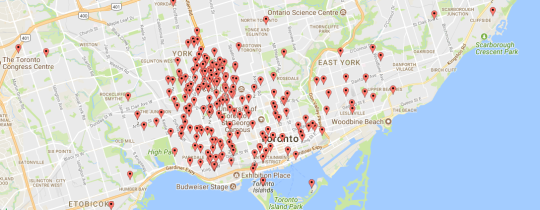
    I posted the following image to Twitter this morning:

    It’s a map of some of the people who support my proposed laneway house (in midtown Toronto) and have signed their name at lanewaylove.com.

    To me, this is an incredible demonstration of the kind of broad-based support that exists in this city today for laneway housing/suites.

    I met with some of my neighbors last week to discuss the proposal and one of them said to me: “I can tell that you’re genuinely passionate about this idea.” 

    My response: “You’re absolutely right. I am. This is not just about my singular project or the money. This is about something much bigger for the city.”

    Clearly, many others see that as well. 

    I know that there’s been a lot of laneway talk on the blog over the past few weeks and months. It’s been on my mind as I prepare for my project’s hearing next month.

    For those of you who have no interest in laneway housing/accessory dwelling units, rest assured that the laneway content should subside (a little) after the summer.