Daily insights for city builders, delivered every morning at 6 AM ET. I’m Brandon Donnelly — a Toronto-based real estate developer and founder of Globizen. I’ve been writing here since 2013.
About a year ago, Portland enacted “Inclusionary Housing” policy requiring new apartment buildings of 20 units or more to offer up a portion of the units at below market rents.
Developers are able to select from a few different options and the rents are calculated according to a percentage of the city’s median family income (30-80%). I’m not sure how this policy would apply to new condo buildings.
This is an interesting account by The Portland Mercury of what this policy may be doing to the housing market. I say may because it’s only been a year and there could be other factors at play.
Between 2013 and 2017, Portland typically built between 3,000 and 6,000 new units per year. Since the IH policy went into effect on February 1, 2017, 682 new units have applied for permit.
About half are coming from one developer who appears to be building the requisite affordable units in exchange for no parking minimums. They are now proposing buildings with zero parking.
Again, in all fairness, it’s only been a year. But already Mayor Ted Wheeler is looking at other incentives to encourage more new construction in the central city. The biggest levers: height and density.
Forty years ago, The Economist introduced its now-famous Big Mac Index. It was based on the simple idea that a Big Mac is a damn near perfect universal commodity, and so if you methodically compare its price across countries, it should give you an approximation of the purchasing power parity across a basket of currencies.
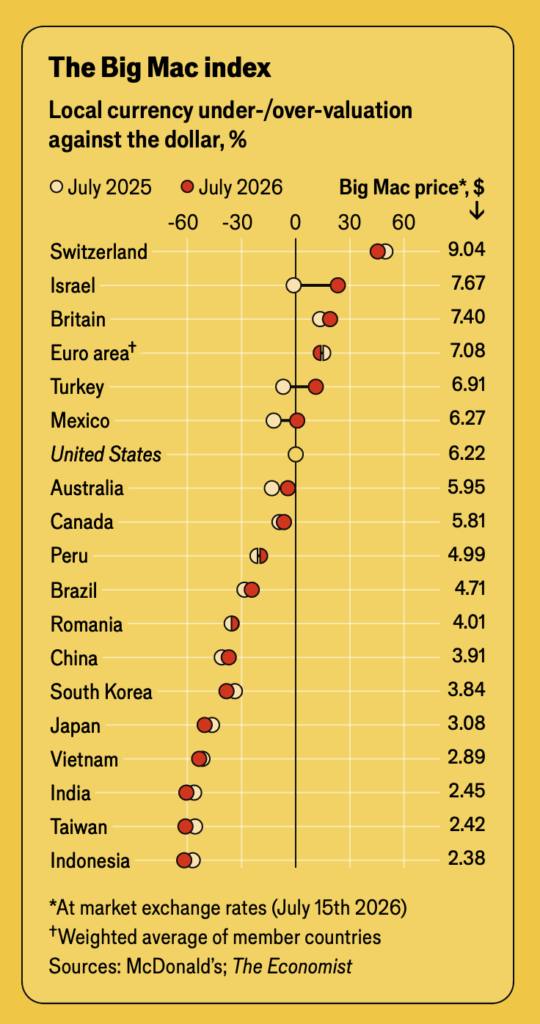
For example, a Big Mac currently costs US$6.22 in the US (as of July 2026 and according to The Economist). But in Switzerland, it works out to US$9.04, and in Taiwan, it’s US$2.42. This suggests that the Swiss franc is overvalued and that the Taiwan dollar is undervalued because, in theory, their currencies should adjust over time to correct such a large variation.
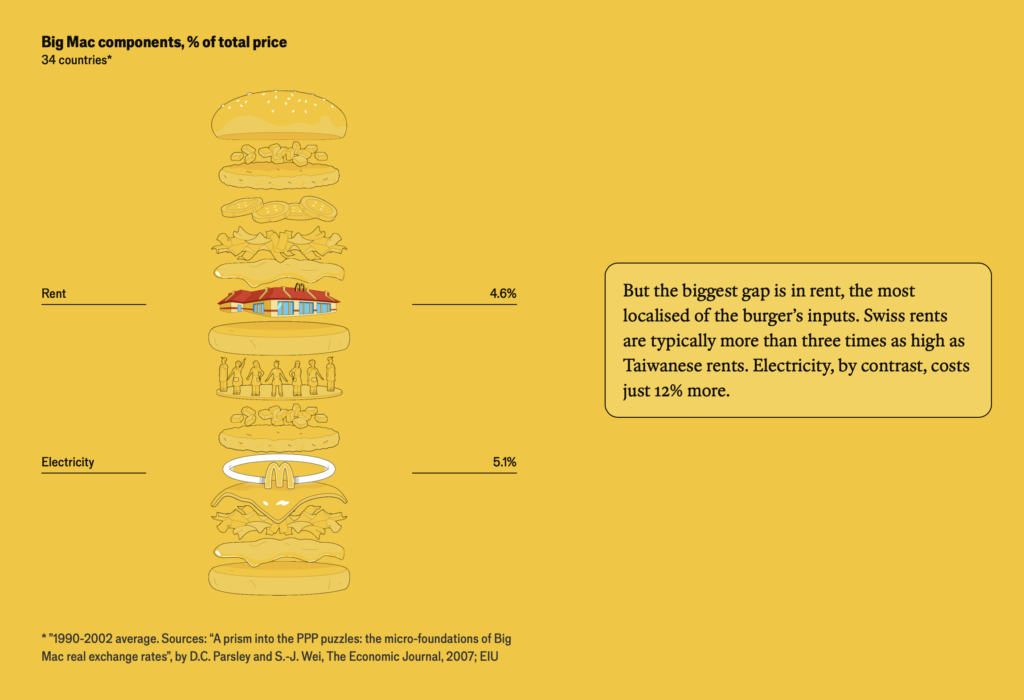
Now, I’m not an economist, but supposedly there is some directional validity to this line of thinking. However, it’s not entirely accurate. If you look at the various inputs that make up the price of a Big Mac, there are over 60 ingredients, including local real estate prices, the cost of labour, and utility costs.
Some countries may also have tariffs on certain ingredients, which would drive up the price for local consumers (yes, that’s how tariffs work), and some countries may have a higher willingness to pay for American fast food. If there’s a higher perceived value, McDonald’s can simply charge more.
So, the fact that a Big Mac costs significantly more in Switzerland does say something about the CHF, but it’s also an indicator that retail rents are somewhere around 3x what they are in Taiwan, among many other factors.
Now let’s consider a product that, unlike the Big Mac, can vary a great deal across countries: housing. A new home requires far more than 60 ingredients, but it similarly reflects local cost structures, including material inputs, labour rates, and any tariffs and taxes that might be levied on the product.
Every input, from time to development charges, gets factored into its end price, which is why, when a politician claims that something like inclusionary zoning represents a “no-cost affordable housing” solution, I wonder if they’re simply unclear on the economics or if they’re trying to deliberately misrepresent the situation.
At McDonald’s, the equivalent policy would be to require that every time someone buys a Big Mac, the restaurant must simultaneously offer 20% of a new Big Mac to another customer, below the cost of production. It should be obvious that this practice would require the original customer to pay more for that same Big Mac.
One of the common criticisms of new housing is that it’s designed for rich people and that it does nothing to help the housing situation of average citizens. The YIMBY response to this is, “Well, yes, it does actually, because supply eases overall housing pressures and because of the filtering effect.” This is the process whereby housing becomes gradually more affordable and available to people as new housing is built and vacancies are created. But most people don’t like this explanation. It feels slow and indirect.
Here’s something that might help.
In this recent study, researchers looked at the downstream effects of a new condominium tower in Honolulu called The Central Ala Moana. Completed in 2021, the building contains 512 units, of which 60% are income-restricted (310 units) and 40% are market-rate (202 units). It was developed under a state affordable-housing program that gave the developer height and density bonuses, plus fee waivers totalling about $13 million in exchange for delivering income-restricted units. (In my opinion, this is directionally preferable to unfunded inclusionary zoning mandates.)
Using address-history microdata, the researchers tracked who moved into the new condominium tower, and constructed detailed vacancy chains across multiple rounds of moves. Here’s what they discovered:
> Among documented vacancies, the 202 market-rate units produced 87 downstream vacancies (0.43 vacancies per initial unit), while the 310 income-restricted units produced 90 (0.29 vacancies per unit). Thus, market-rate units are more likely to generate a downstream vacancy. The main mechanism is new household formation: movers into income-restricted units are more likely to be a newly formed household, leaving family or roommates at the prior address and thus preventing a vacancy from being created.
In absolute numbers, they found that the completion of the building induced more than 500 local vacancies in the three years after construction, by setting off a chain of moves. Importantly, the researchers also found that the homes being vacated were, on average, about 40% less expensive than those in The Central. So even though a new building may be more expensive than the existing housing stock (which is generally the case or else the development wouldn’t happen), it does generate benefits.
It eases overall housing supply constraints and expands affordability in the local housing market.
The vast majority of new purpose-built rental housing in Canada relies on CMHC-insured loans to make them financially feasible. In 2024, CMHC estimated that their construction financing programs backed an estimated 88% of new rental starts across the country.
But anyone in the industry will tell you that the terms in which these loans are made available to developers are constantly changing. And I think it’s pretty clear that many of the changes being made are intended to push, maybe force, developers into building some percentage of affordable homes as part of their projects.
At the political narrative level, this makes sense: Canada needs more affordable housing. But it’s important to remember that homes pegged to below-market rents are not financially feasible to build on their own. So, unless equivalent subsidies are being somehow provided, the remaining market-rate homes will be forced to shoulder the additional costs.
We talk about this a lot on the blog (see inclusionary zoning posts), and I don’t see it as an equitable solution. But there’s also the problem of it further choking off new housing supply. And my sense is that that’s exactly what is happening. It’s only getting harder to underwrite new rental housing — certainly in cities like Toronto.
This will have the opposite effect on overall affordability. It also increases the probability that my supply predictions will prove roughly correct. I can’t see a world where new rental supply is able to step up and fill the gap being left by new condominiums, a large portion of which was serving as new rental housing.
Toronto is on a path toward a severe housing shortage, and it’s very hard for the private sector to do much about it in the current market environment. When that will change remains to be seen.
One of the fundamental principles that we espouse on this blog is that land use and transportation planning are integral to one another. This matters if you’re trying to build a big, bad global city because there are limits to what you can accomplish with car-oriented planning. Eventually traffic congestion becomes unbearable and the model starts to breakdown (consider Toronto and Atlanta right now).
This means that, if you’d like to continue scaling, eventually you’ll need to start getting serious about transit-oriented development and other forms of mobility. Japan is one of the best examples of this. But the key prerequisite for this is urban density. This is the unlock that makes transit practical and convenient for people.
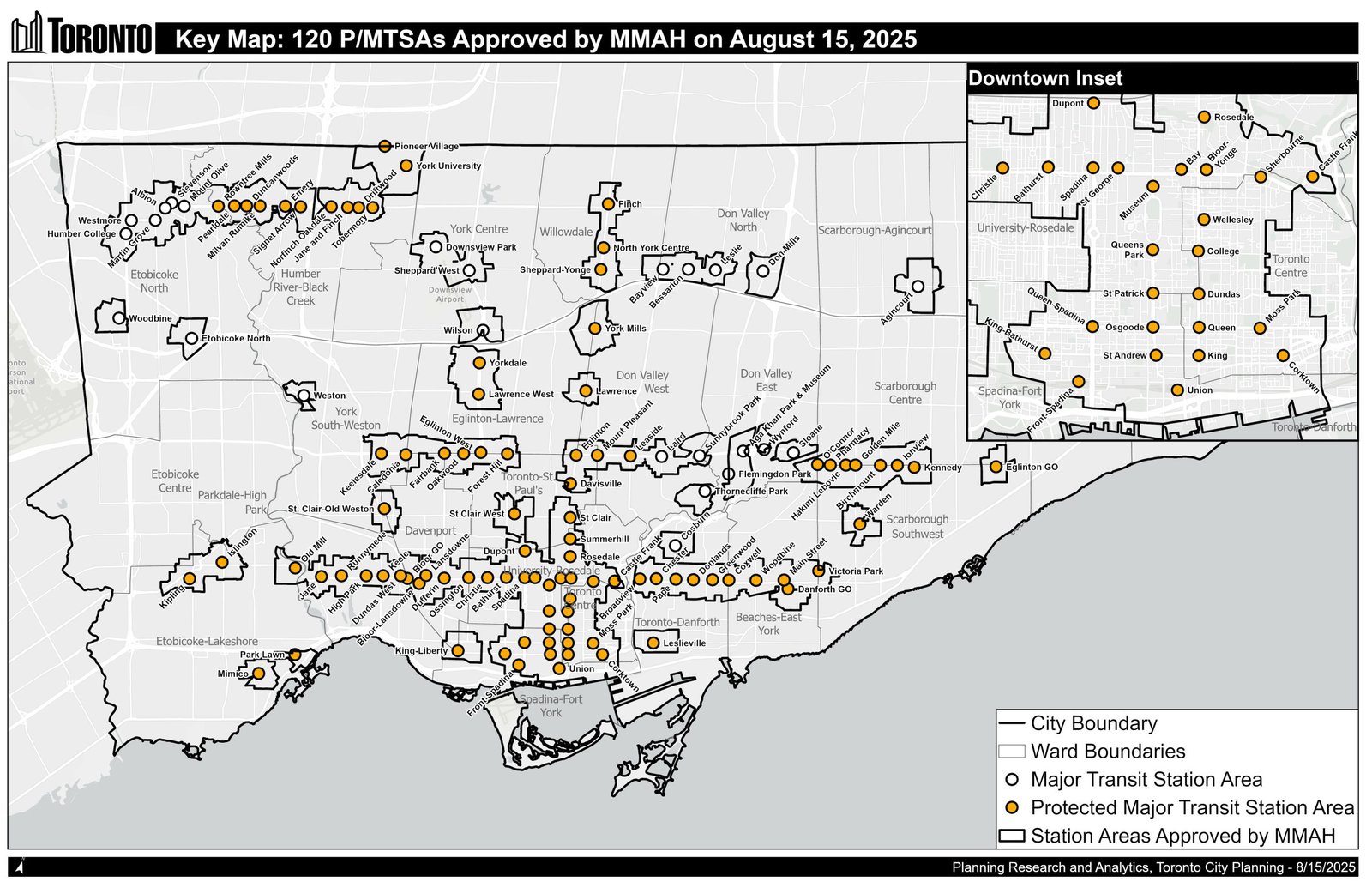
That’s why this week’s planning announcement is a big one for Toronto. On August 15, the Government of Ontario (through the Ministry of Municipal Affairs and Housing) approved, with some modifications, 120 Major Transit Station Areas and Protected Major Transit Station Areas in the City of Toronto. Here’s a summary of the MMAH’s decision via the City’s website, and below is a map of the transit station areas. (Note that some station areas are missing from this map and are still under review.)
At a high level, these are areas that fall within an approximately 500-800 meter radius of transit stations, and would therefore be less than a 10-minute walk for most people. It’s land that is best suited to transit-oriented development and that would strengthen any new/existing transit investments. For example, if you have an existing station that is underperforming from a ridership standpoint, the best solution is more density within its immediate catchment area.
Because of this, Ontario’s Provincial Planning Statement prescribes the following minimum density targets for MTSAs:
– 200 residents and jobs per hectare for subways – 160 residents and jobs per hectare for light rail or bus rapid transit – 150 residents and jobs per hectare for commuter or regional rail
And to satisfy these requirements, cities need to demonstrate how they have planned for these minimum targets.
PMTSAs are a subset of MTSAs and come with some additional features, such as minimum unit counts and/or floor space indexes (floor area ratios). These are also the only transit areas where cities have the option of enabling Inclusionary Zoning, which is something they may do when the market rents in an area are high enough that the subsidies required to build affordable housing can be shifted onto the tenants paying market rents. (My views on inclusionary zoning can be found, here.)
Over the coming weeks, everyone in the industry is going to be analyzing the implications of this new approval. Overland (which is a legal firm that we work with) just posted on their blog that their review is underway and that they’ll be posting something shortly. But in the meantime, I’d like to say that this is meaningful progress (and one that has been a longtime coming).
It acknowledges the important link between land use planning and mobility, and it better aligns our policies to support a post-car city. Of course, in many ways, this is an obvious thing to do. I started this post by calling it a fundamental principle of city building. But city planning happens slowly and incrementally. If you’re following along, you’ll see that Toronto is in fact growing up as a big, bad global city.
At the end of last year, I wrote this post arguing that development value has shifted from land to the build. And in it, I argued that it’s no longer viable to be a high-density land developer in Toronto. The practice of buying land, rezoning it for a higher-and-better use, and then selling it for a margin, is over — at least for the time being.
It’s also not easy to find value in the execution of new builds, but it’s a better place to be looking. Because today, as we underwrite new development sites, we are seeing land prices (on a per buildable square foot) that are similar to what they were back in 2017 when we were assembling the land for Junction House. Meaning that, in some cases, land prices have been nearly flat over this 8 year period. This is despite a total inflation rate of approximately 25% and an average annual decline in the value of money of 2.86%.
This is not all that surprising, though. Land should, in theory, be the residual claimant in a development pro forma; so it should be one of the first things to reset during a market downturn. However, in the past, I have referred to land prices as being sticky in the face of changing cost structures, such as development charge increases and/or new inclusionary zoning policies. So which is it, Brandon?
Well, one way I think about this is that land prices tend to be sticky in the short term. Nobody wants to immediately take a loss. And as long as prices/rents continue to exhibit strong growth, there’s a chance that these new costs will get absorbed into somebody’s pro forma and that land prices won’t need to adjust downward. But turn off demand and reverse price/rent growth, and now there’s no other option but for land prices to come down.
This is what we’ve been seeing in Toronto since 2022.
One perverse way to think about development is that it is a tool to transfer costs away from people who don’t want to pay for stuff to people who don’t know they’re paying for stuff. Two good examples of this are development levies and inclusionary zoning. Inclusionary zoning is a popular policy tool to create affordable housing because nobody feels like they’re directly paying for the requisite subsidies (i.e. no public money) and it does, to varying degrees, result in affordable housing.
Cambridge, Massachusetts, for instance, enacted IZ policy in 1998 and, up until the market turned in 2022, it created just shy of 1,600 affordable homes. This only works out to ~66 units per year, but Cambridge doesn’t build that many new homes. Starts over the last five years have hovered somewhere around 500 new homes per year. But now starts are falling and new projects simply aren’t penciling (as is the case in many cities).
> The project at 2400 Mass. Ave. helps explain why. With 60 condominium units, North Cambridge Partners figured their project would generate about $108 million in sales if all the units were sold at market prices, said Tim Rowe, the developer’s lead investor, who is also the founder and CEO of the Cambridge Innovation Center. But with 12 of those units sold at far-lower “affordable” prices under the city’s inclusionary rule, that amount drops to about $90 million. > > The developers figure they’ll sell the market rate units at somewhere around $1,500 per square foot, or perhaps a bit less. That’s a very steep figure, one that’s partially driven by high construction costs and the need to offset the discount on the affordable units. The price for affordable units, under the city’s rules, would come in closer to $275 per square foot. > > Rowe estimates the six-story, 72,000-square-foot building would cost $85 million to build, leaving the developers with $5 million in profit. But to come up with that $85 million to begin with, they’d need to find an equity investor willing to put up about 35 percent of the money — $30 million — and then borrow the rest. The investors the developers have talked with about financing the project are seeking such a high rate of return that the project would need to net roughly $16 million, Rowe said, $11 million more than what the developers currently project to make.
I’m impressed the developer shared this much about their economics.
What is clear is that the affordable units don’t come close to covering the close to $1,200 psf it would cost to build the building. And so somebody has to cover this shortfall. Nobody wants to spend public money on this and so it gets passed onto the market-rate buyers who don’t exactly know what they’re paying for, but frankly don’t have a choice either way if they need a new home.
When the market is robust, this can clearly work. But when the market softens, it can shut off development. Today, there’s debate in Cambridge about whether the 20% requirement should be lowered to spur more supply. This would certainly help but it gets at the real conundrum of inclusionary zoning. Lowering the burden will create more market-rate housing. And so what is the most equitable and ideal percentage of affordable housing that should be mandated in IZ policies?
In other words, exactly how much cost should we transfer from the people who don’t want to pay for stuff to the people who don’t know they’re paying for stuff? In my view, it shouldn’t just be new homebuyers who pay to subsidize the creation of new affordable housing. Why only them? If there’s collective agreement that more affordable housing is a good thing for our cities, then there should be a more broad-based solution.
I had a call with a developer in Paris earlier this week and it was interesting to hear him talk about the new home market over there. It sounded a lot like Toronto. Higher interest rates cooled demand. Individual investors largely disappeared. And now developers are having to rethink their strategies and floor plans (including suite sizes).
But in his view, this isn’t necessarily a bad thing. It now means that you actually have to be a reasonably good developer in order to have a chance at succeeding. You have to design thoughtful floor plans and build great housing. It’s a return to fundamentals, and I would argue that the same thing is happening here in Toronto.
My other noteworthy takeaway was around social housing. All new developments in the Île-de-France region are subject to inclusionary zoning. I believe the requirement is 30% of the suites. These suites are then purchased by social housing operators, and it is one of the ways that new supply is created in the market.
We talk a lot about IZ on this blog, but what’s interesting about this approach is that it becomes a forward sale for the developer. Meaning, it helps to de-risk projects. Before doing anything, you know you’ve sold 30% of your inventory, and somehow the numbers all work. European social housing math is baffling to me.
I am now wondering if this creates some kind of incentive to keep development costs in check. Because if social housing operators are expected to buy 30% of all new homes, then they too are going to want them to be as cost effective as possible. I’m speculating though; I don’t know that this is the case.
If you’re a developer or real estate person in Paris, please get in touch. I’d love to learn more about your market and trade notes.
As we have talked about many times before, the best answer to this question is that it’s worth whatever money is left in your pro forma once you’ve accounted for everything else. This is what is called the “residual claimant” in a development model. And it means you start with your revenue, you deduct all project costs, including whatever profit you and your investors need to make in order to take on the risk of the development, and then whatever is left can go to pay for the land.
This is the most prudent way to value development land; but of course, in practice, it doesn’t always work this way. In a bull market, the correct answer to my question might be, “whatever most market participants are willing to pay.” And sometimes/oftentimes, this number will be greater than what your model is telling you, meaning you’ll need to be more aggressive on your assumptions if you too want to participate. (Not development advice.)
Given that determining the value of land starts with revenue, one way to do a very crude gut check is to look at the relationship between land cost and revenue. This is sometimes called a land-to-revenue ratio. And historically, for new condominiums in Toronto, you wanted a ratio that was no greater than 10%. Meaning, if the most you could sell condominiums for was $1,000 psf, then the most you could afford to pay for land was $100 per buildable square foot.
However, this is, again, a very crude rule of thumb. I would say that it’s only really interesting to look at this after the fact. Because in reality, things never work this cleanly. For one thing, there is always a cost floor. Don’t, for example, think you can buy land in Toronto for $80 pbsf and sell condominiums for $800 psf, because this will not be enough to cover all of your costs. You will lose money.
Secondly, there are countless variables that have a huge impact on the value of development land. Things like a high required parking ratio, development charges and other city fees, inclusionary zoning, and so on. All of these items are real costs in a development model, and so they will need to be paid for somehow.
Typically this happens by way of higher revenues (in a rising market), a lower land cost (in a sinking market), or some combination of the two. But in all of these cases, it means your land-to-revenue ratio must come down to maintain project feasibility. This is why suburban development sites typically have a lower ratio — too much loss-leading parking, among other things.
Of course, there are also instances where the correct answer could be a land-to-revenue ratio approaching zero, or even a negative number. In this latter case, it means your projected revenues aren’t enough to cover all of your other costs, excluding land. For anyone to build, they will require some form of subsidy. And this is basically the case with every affordable housing project. They don’t pencil on their own. (For a concrete example of this, look to the US and their Low-Income Housing Tax Credits.)
So once again, the moral of this story is that the best way to think about the value of development land is to think of it as “whatever money is left in the pro forma once you’ve accounted for everything else.” Because sometimes there will be money there, and sometimes there won’t be.
In this last one, he specifically talks about things like price gouging (starting with the grocery industry) and apartment rent controls. Each is worth a full read when you have the time, but here I’ll leave you all with a few city building-related thoughts.
Marks describes economics as the study of choice. And within these choices, there are many complicated moving pieces and second-order consequences. Take, for example, rent control in New York City. What rent control does is stop the free market from being able to freely set rents. The result:
A person in favor of this arrangement would argue that it maintains affordability and diversity. What it means in purely economic terms is that some people who couldn’t afford to live in New York City if rents were set by free-market forces are able to live there if they’re lucky enough to secure an apartment with regulated rent. But other people who would like to live in New York City and can afford higher rents can’t do so because there are no apartments for them. And lastly, landlords that have apartments that are somehow unregulated can command higher rents than would be the case if additions to the supply of apartments weren’t being discouraged. It’s a matter of personal philosophy whether this is good or bad. But clearly, the laws of economics and the actions of free markets aren’t at work in New York City. Someone in government is making the decisions.
Much like inclusionary zoning in the case of new housing, the tradeoffs with regulated rents are that you get (1) less overall housing supply and (2) more expensive prices for the people that can pay market rents.
You could argue, as Marks suggests, that these are acceptable outcomes; but regardless of your opinion, there are real consequences to this policy decision. There’s no such thing as a “free lunch” in economics, and consequently there’s no such thing as no-cost affordable housing. The question is: Who pays?
Going back to the topic of traffic congestion from yesterday’s post, Toronto’s general reluctance to implement any form of road or congestion pricing is also an economic choice. We have priced our roads so cheaply that demand is always going to outstrip supply. And this is expected. What we are experiencing today is a natural market outcome.
Targeting bike lanes as part of the problem is meant to counter this by increasing road supply. Less bike lanes means more space for cars, right? But the second-order consequence of this choice is that you push people off their bikes (which take up less road space) and into cars (which take up more road space). So demand is also likely to increase.
The stark reality of solving traffic congestion is that it will require greater change. It will mean fewer people driving, more people taking transit and biking, and the people who do continue to drive will have to pay more for it.
Of course, this is not what any politician wants to talk about. As Marks says: “In the world of politics, there can be limitless benefits and something for everyone. But in economics, there are only tradeoffs.” The tradeoff we have decided to make is cheap roads in exchange for crippling traffic congestion.