
Forty years ago, The Economist introduced its now-famous Big Mac Index. It was based on the simple idea that a Big Mac is a damn near perfect universal commodity, and so if you methodically compare its price across countries, it should give you an approximation of the purchasing power parity across a basket of currencies.
For example, a Big Mac currently costs US$6.22 in the US (as of July 2026 and according to The Economist). But in Switzerland, it works out to US$9.04, and in Taiwan, it’s US$2.42. This suggests that the Swiss franc is overvalued and that the Taiwan dollar is undervalued because, in theory, their currencies should adjust over time to correct such a large variation.
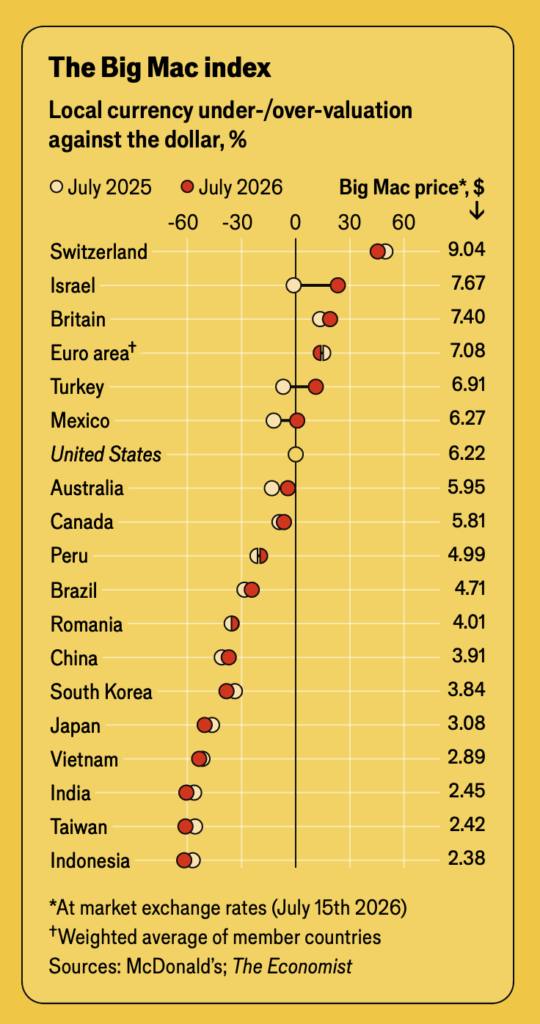
Now, I’m not an economist, but supposedly there is some directional validity to this line of thinking. However, it’s not entirely accurate. If you look at the various inputs that make up the price of a Big Mac, there are over 60 ingredients, including local real estate prices, the cost of labour, and utility costs.
Some countries may also have tariffs on certain ingredients, which would drive up the price for local consumers (yes, that’s how tariffs work), and some countries may have a higher willingness to pay for American fast food. If there’s a higher perceived value, McDonald’s can simply charge more.

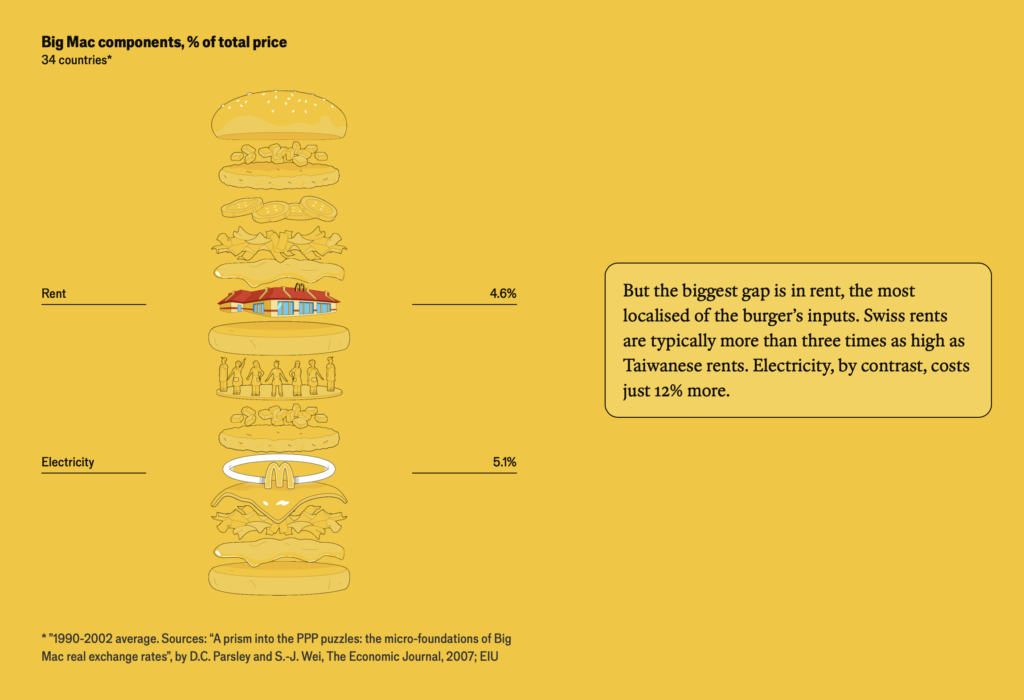
So, the fact that a Big Mac costs significantly more in Switzerland does say something about the CHF, but it’s also an indicator that retail rents are somewhere around 3x what they are in Taiwan, among many other factors.
Now let’s consider a product that, unlike the Big Mac, can vary a great deal across countries: housing. A new home requires far more than 60 ingredients, but it similarly reflects local cost structures, including material inputs, labour rates, and any tariffs and taxes that might be levied on the product.
Every input, from time to development charges, gets factored into its end price, which is why, when a politician claims that something like inclusionary zoning represents a “no-cost affordable housing” solution, I wonder if they’re simply unclear on the economics or if they’re trying to deliberately misrepresent the situation.
At McDonald’s, the equivalent policy would be to require that every time someone buys a Big Mac, the restaurant must simultaneously offer 20% of a new Big Mac to another customer, below the cost of production. It should be obvious that this practice would require the original customer to pay more for that same Big Mac.
Images from The Economist
Leave a Reply