Daily insights for city builders, delivered every morning at 6 AM ET. I’m Brandon Donnelly — a Toronto-based real estate developer and founder of Globizen. I’ve been writing here since 2013.

Search results for: “inclusionary zoning”

  • How developers in London responded to an expansion of inclusionary zoning

    Eric Jaffe, of Sidewalk Labs, recently wrote about an interesting research paper — from the Journal of the American Planning Association — that looked at the developer response to an inclusionary zoning policy change in London. The full research paper can be found over here.

    The change was an expansion to existing mandatory IZ policies. Between 2005 and 2008, each of the 33 local authorities in Greater London reduced the minimum threshold for new housing projects. Previously it only applied to new developments with 15 or more units, but it was reduced to projects with 10 or more units. In other words, projects with a total of 10-14 units were now subject to IZ, whereas they were previously exempt.

    These feel like small unit counts, but I guess it speaks to the scale of development happening in London. You generally need pretty high prices to make these kinds of boutique projects pencil out. By comparison, the IZ threshold here in Toronto is expected to be 100 or more units.

    In any event, here’s what happened in London:

    Before the policy change developers were effectively building up to the 14 unit mark (to avoid IZ). Following that new supply dropped off. After the change, developers simply adjusted their project sizes and built more projects with less than 10 units.

    Interestingly enough, the researchers found that there was generally no net loss of new homes during the study period (2004 to 2014); developers simply built more projects with lower unit counts. But more importantly, the team discovered that the policy change only kind of worked.

    The increase in affordable housing was modest. The researchers uncovered a net increase of two affordable units per borough, per year, among projects within the 10-14 unit band. That’s something. But London is a big place.

    Of course, this is a response to a particular kind of policy change in a particular kind of market. Development is a local business and it’s oftentimes hard to generalize. But it does speak to the fact that there are nuances, complexities, and market distortions to consider when it comes to land use policies.

    Photo by Aaron Gilmore on Unsplash

  • Toronto green-lights new inclusionary zoning policy

    Toronto’s new inclusionary zoning policy went to Planning and Housing Committee this week. Agenda item, here. The recommendations were approved, which means that the item will move onto City Council next month for final approval.

    Here’s a summary of some what is being proposed (though keep in mind that I am not a planner and you should probably do your own due diligence if you’re looking to buy land and/or develop here):

    • IZ to come into force next year in 2022.
    • IZ to only apply on projects with 100 or more residential units.
    • Three distinct market areas across the City with differing set aside rates (see below charts). This strategy acknowledges the fact that you generally need submarkets with expensive housing and rising prices to be able to absorb the financial burden of the affordable housing units. I’ve written a lot about this dynamic on the blog. Relevant posts, here.
    • It’s in the chart, but it’s perhaps worth repeating: Purpose-built rental projects will not be required to deliver any affordable housing units at the outset of this policy. This is important to note because the margins on purpose-built rentals are razor thin.
    • The set aside rates are planned to increase to 8-22% by 2030.
    • The affordable units will need to remain affordable for 99 years. And the rents and prices are to be geared toward low and moderate income households, which are currently defined as those earning between $32,000 and $92,000.
    • Clear transition period for the development industry.
    • Ongoing monitoring of the policy to make sure it doesn’t suck.

    If you’re interested, the full staff recommendation report can be found here and the draft OPA and zoning by-law can be found here and here.

  • The numerical impacts of inclusionary zoning

    Our cost consultant, Finnegan Marshall, gave our team a presentation today on what’s happening with construction costs in Toronto and across Canada. I’ve said this before, but hard costs are no joke right now.

    One of the areas that they focused on was the impact that inclusionary zoning is likely to have on development economics here in Toronto. To illustrate the point, a sample high-rise condominium pro forma was used. Think something in the 30-35 storey range.

    Assuming a requirement of 10% affordable (the policy details are still TBD), there is going to be a real cost to development pro formas that will need to be somehow paid for.

    One school of thought is that land prices will simply adjust downward. In this case, the landowner would be the one paying. I don’t think this will be the case (land prices tend to be sticky), but if they were to adjust downward, it would need to drop by $44 per square foot buildable to maintain the project’s margins in this example. (That’s $13.2 million on a 300,000 sf project.)

    If, on the other hand, the price of the remaining market rate condominium suites were to increase to offset the cost of the affordable component, they would need to increase by $91 per square foot. This translates, in the above example, into a sticker price increase of approximately $60,000 per suite.

    These numbers are, of course, not exact. That is not the point of this post. Every project is different. But hopefully it gives you an idea of some of the levers that will invariably need to be pulled when inclusionary zoning comes into force.

    My sense is that this latter scenario is more likely to happen. I have yet to see land prices adjust downward in the face of rising costs. So all of this is likely to be bad for broad-based affordability, but good if you want to be bullish on market rate home prices.

  • What would you like to know about real estate development? (Also, inclusionary zoning)

    I asked this question on Twitter this morning because I am planning to write more development-related posts. It’s a topic that seems to be of interest to a lot of people. One question that I received was about the kind of profit margins that Toronto developers have been making over the past few decades. More specifically: How much have they increased? My response was that they haven’t increased. In fact, if anything, they’ve been compressing as a result of rising/additional costs. (I’ve touched on this before in posts like this one about cost-plus pricing.) I think a lot of developers are actually wondering how much elasticity is left in the market to continue absorbing these cost increases.

    Follow-up question to my response: Why then does this report by Steve Pomeroy claim that developers could still make a 15% margin even if they earmarked 30-40% of their units as affordable? Well, this was news to me so I went through the report and committed to responding on this blog. To be more precise, the report finds that there’s room in as-of-right developments to dedicate 10% affordable in medium-cost areas and 25% affordable in high-cost areas. For rezoned sites, the numbers are 30% affordable in high-cost areas and 15% affordable in medium-cost areas. These are a potentially dangerous set of takeaways for a few reasons.

    Very little mid-rise and high-rise development happens as-of-right in the City of Toronto. I don’t know what the exact percentage is, but I suspect it’s low. It would be very difficult to buy land if you were valuing it on this basis. And when you are valuing it — that is, running a development pro forma — it’s not enough to pull averages from a cost guide and run high-level numbers. You can start there, but ultimately you’re going to have to get more granular. Are you factoring the hundreds of thousands of dollars (more for bigger projects) that the City will charge you to occupy any public right-of-ways? What about your public contribution monies? This has historically been hard to estimate because the math that is used is akin to a secret recipe.

    In this particular report, they assume a 100-unit building with 88,750 square feet of gross floor area. Since GFA typically factors some allowable deductions, the gross construction area for the project is going to be greater. Let’s assume it’s 5% more — so about 93,190 square feet. This is how your construction manager will think about and do take-offs for the project. In the report, they peg total construction costs at $23,208,480. That works out to just shy of $250 per square foot (costs divided by above grade GCA). You cannot build a reinforced concrete residential building with below-grade parking for this number in Toronto. In today’s market, and at this small of a scale, you might be looking at $350 to 400 psf.

    On the low end of this range, that would mean your costs have just gone up by $9.4 million — which just so happens to be the expected developer/builder profit in this model. Except now you’re underwater and you won’t be able to finance and build your project. It’s probably time to look at your revenues and see if you can increase your projected rents at all. This is what I was getting at with cost-plus pricing. I would also add that I/we typically shy away from projects of this scale. There isn’t a lot of margin for error. One or two surprises and you might be cooked. So with or without inclusionary zoning, these can be challenging projects that many developers won’t even look at.

    My point with all of this is twofold: development pro formas are delicate and margins aren’t as generous and locked-in as most people seem to think. More often than not we end up passing on sites because we simply can’t make the numbers work. The land is just too expensive. Development happens on the margin. So talking about developers “absorbing” the costs of inclusionary zoning is perhaps the wrong way to frame this discussion. A more appropriate set of questions might be: Who is going to pay for the cost of inclusionary zoning? Are landowners going to suddenly drop their prices? Is the City going to reduce their development charges/impact fees? Or will developers wait until market prices and rents increase so that they can cover these new costs? This latter scenario is how it has worked so far.

    If you have other questions about development that you would like me to take a stab at answering, please leave a comment below or tweet at me.

  • These 3 things happened after Portland enacted inclusionary zoning

    On February 1, 2017, an inclusionary zoning ordinance came into effect in Portland, mandating that all new residential projects with 20 or more units dedicate a portion of the building to affordable housing.

    For the first year, the requirement was 8% of all units for households earning 60% of the Area Median Income or 16% of all units for households earning 80% of the AMI. I’m not sure if it was or is possible to do a blend of the two income levels.

    After the first year, the requirement was supposed to step up to 10% and 20% of all units, respectively. But that step up was never enacted, which had many industry analysts arguing that it was a clear signal the ordinance was not performing as intended.

    According to Joe Cortright of City Observatory (which is based in Portland), the new ordinance largely resulted in 3 things happening:

    (1) Developers rushed to get new applications in during the transition period so that they would not be subjected to the new IZ rules; (2) applications increased for projects with less than 20 units (avoid the rules by building smaller); and (3), following the initial transition surge, building permit applications, as a whole, dropped off.

    This last point is what usually comes up in debates around inclusionary zoning. Does the requirement to build affordable housing actually reduce overall housing supply?

    I’ve written about this before, but the math is pretty simple. Inclusionary zoning policies are a drag on revenue and a direct cost to the project. What that means is that something else will need to give in order for the numbers to balance.

    That could come in the form of lower costs (such as an impact fee abatement) or in higher rents on the balance of the units. But this latter approach is easier said than done. Sometimes you need to wait for the market to “catch up”, which could be what some developers in Portland are doing.

    They’re waiting for housing to get more expensive — overall — so they can then offset the pro forma drag from the affordable units.

  • The impact of inclusionary zoning on development feasibility

    image

    After my recent post on inclusionary zoning in Ontario, I was asked to provide my comments on the draft regulation and on how inclusionary zoning could and will impact development feasibility. So I will endeavor to do that today.

    It’s important to first understand the costs and inputs that go into a development pro forma and how overall project feasibility is determined. For simplicity, let’s breakdown the costs as follows:

    – Land

    – Soft Costs

    – Financing Costs

    – Municipal Fees/Charges

    – Hard Costs

    All of these costs buckets are significant. For a project to be feasible, you obviously need the revenues of the project to be greater than the above costs. There also needs to be a remaining profit margin that is commensurate with the risk profile of the project and that meets your investor’s return expectations. Most developers rely on outside equity and debt to finance their projects.

    One of the misconceptions that I often hear is that people seem to think that the profit margin on projects is so great that developers could simply build affordable housing (or do many other things) if they weren’t so greedy. The reality is that development happens on the margin. It’s not easy to find sites and projects that make any sort of financial sense. More often than not they don’t.

    The other reality is that in a growing market all of the above costs are also continually increasing. If revenue (i.e. rents and condo prices) is also growing, as has been the case here in Toronto for many many years, then developers can generally absorb reasonable increases and continue building. But if revenue stops growing, grows at a slower pace or, worse, shrinks, then feasibility could disappear and development would stop.

    Now let’s talk specifically about inclusionary zoning. IZ is typically an incentivized or mandated requirement to provide a certain number of below-market housing units as part of new developments. Affordable housing is important. That’s why a number of cities already have inclusionary zoning policies – though it remains a fairly controversial tool.

    From a development feasibility standpoint, a mandatory inclusionary zoning requirement represents a decrease in revenue. There’s now a percentage of the units that can no longer be rented or sold at market prices. And so to maintain the project’s feasibility – because remember development happens on the margin – something has got to change.

    There are a few options.

    Option One: You could simply try and pay less for the land. As we have talked about many times on this blog, land is supposed to be the residual claimant. Work backwards from revenues and your other costs to determine what can be paid for the land. The problem with this option is that land prices tend to be sticky.

    Many or most landowners don’t give a shit about your development pro forma. They often have a number in mind and if you try and tell them that development charges just went up and you can’t pay as much for their land, they’ll simply sit on it and wait for someone else – even if that means waiting for the market to catch up (i.e. waiting for rents to go up).

    Option Two: Charge more for the remaining market units. If the market is sufficiently robust, perhaps this is an option. This is one of the reasons why inclusionary zoning often produces more units in markets where there’s already strong demand for new housing.

    But it’s also one of the reasons why IZ is controversial. You’re asking the other renters/buyers in the project to effectively subsidize the below market units. And there is research out there (previously posted on this blog) suggesting that in some instances IZ policies have created additional upward pressure on market rents and home prices.

    Option Three: Incentives are provided by the municipality to offset some or all of the additional burden placed on the project. This could come in the form of a density bonus, financial contribution, a waiving of other municipal charges/fees, and so on.

    Though I have questions about the details, this is something that was proposed in Ontario’s draft regulation (albeit not to the extent that the industry wanted). Now you know why I said and why I believe that these offsets are important to the industry and to overall housing affordability.

    My hope with this post was to provide the developer’s perspective, but also take a very matter of fact approach to inclusionary zoning. Most people recognize the importance of affordable and accessible housing. The question is how best to execute.

    Photo by Toa Heftiba on Unsplash

  • Inclusionary zoning is coming to Ontario

    On Monday the province of Ontario posted a draft regulation intended to establish a framework for inclusionary zoning. It builds on a bill that passed last year allowing municipalities – should they choose – to require affordable housing in new developments and redevelopments.

    Below are some, but not all, of the things that are being considered in the draft regulation. Some of these items were recommendations made by the development industry through the Ontario Home Builders’ Association (OHBA) and the Building Industry and Land Development Association (BILD).

    – The total number of affordable units or gross floor area dedicated to affordable housing units would not exceed 5% of the total units or 5% of the total gross floor area (excluding common areas). This number increase to 10% in high density transit station areas.

    – The affordable period would be a minimum of 20 years but no greater than 30 years.

    – There may be opportunities to provide the inclusionary zoning units off-site.

    – The policies would only apply to developments / redevelopments with 20 or more units.

    – The affordable component could not be used to determine community benefits under Section 37. Section 37 would also not apply if the proposed development (with IZ) is in a location where a development / community planning permit is used.

    – Municipalities would be required to offer incentives to help offset the IZ cost burden, but only if the development is not subject to a development / community planning permit. The incentives could include a waiver or reduction in application fees, parkland dedication fees, development charges, and so on. These offsets are very important to the industry and the affordability of the market rate units. But interestingly enough, increases in height and/or density are not being contemplated as a possible incentive or financial contribution.

    – The financial contribution would be based on the following formula: (A – B) x 0.4. A is the total sum of the average market price for all of the affordable housing units and B is the total sum of the affordable price for all of the IZ housing units. In other words, the intent is that municipalities would be required to offset 40% of the costs associated with providing the affordable units.

    Click here for the rest of the draft regulation. The OHBA also published this media release following the draft. They like the “partnership model” but were advocating for a 50/50 public/private cost share on all government-mandated units.

    If you’re looking for more reading on inclusionary zoning, check here, here, and here.

    Photo by Omair Khan on Unsplash

  • More thoughts on inclusionary zoning

    Alan Ehrenhalt recently published a balanced piece in Governing that largely reflects my own views on inclusionary zoning. It’s called: Why Affordable Housing Is So Hard To Build.

    His argument is that there are lots of cities trying to build more affordable housing, but that most strategies have not yet proven to be all that successful.

    I’ve written a few posts on inclusionary zoning. The most recent is this one. And though I believe that a mix of incomes is a critical component of good city building, I am having a hard time believing that inclusionary zoning is the silver bullet that will get us there. Admittedly, it sounds like a great idea. But how does that translate into reality?

    Here’s a snippet from Alan’s article (shout out to Daniel Hertz of City Observatory who seems to get cited in almost every article I read these days):

    Just about every city that has tried an inclusionary zoning law in recent years has had a similar experience. In some cases, the results have been much worse. According to BAE, Chicago’s inclusion law produced $19 million in 11 years, but only 760 affordable units. Thirteen years of inclusionary zoning in Seattle brought the city $31.6 million in fees and a grand total of 56 units. As the urbanist Daniel Hertz wrote recently, inclusionary zoning has been “more powerful as a symbol than as a way of helping people.”

    Of course, the devil is in the details. Many inclusionary zoning policies allow cash in lieu of actual housing:

    San Francisco actually has had an inclusionary zoning law since 2002, and it has been a flop. It mandates a 12 percent affordable set-aside, but allows developers to escape the mandate by paying a fee to the city. As in Arlington, this is what they have done. A study by the research firm BAE Urban Economics found in 2014 that after 12 years the San Francisco law had brought in $58.8 million in developers’ fees and had generated 1,560 units. That’s better than nothing, but it’s a drop in the bucket for a city facing an affordability problem in virtually every neighborhood.

    All this said, I’m still not so sure that it’s as simple as eradicating the cash in lieu option and forcing mandatary inclusionary zoning. As Alan rightly points out in his article, if we set the bar too high, then all of a sudden it starts making some market rate housing infeasible to build. 

    And if this ends up lowering the overall supply of new housing, then we could be hurting affordability while at the same time trying to mandate more of it. Does that make sense? Clearly this is not as simple as it may seem.

    I get the appeal for cash poor cities. It sounds like free affordable housing. But I’m always suspect of “free” lunches. In any event, I think we can all agree that this is an important discussion to be having.

  • Thoughts on inclusionary zoning

    Ontario is looking to pass legislation that would allow municipalities in the province to implement something known as inclusionary zoning. If passed and should municipalities decide to use this tool (Toronto almost certainly would), developers would then be required and/or incentivized to include some percentage of affordable housing in their new market rate developments. 

    Politically, inclusionary zoning tends to be popular. It’s believed to be a way for governments to create new affordable housing using relatively small public subsidies. Not surprisingly though, the development industry generally hates IZ. It’s another cost that needs to be added to the development pro forma – though some municipalities rightly offset these additional costs with additional density, breaks on levies, and so on.

    What I always think about when this topic comes up is the broader economic impact of the land use policy. Because I’m suspect that it’s as simple as: mandate affordable housing; get more affordable housing for free. Generally there are always trade-offs.

    So here’s some reading material for you all this morning.

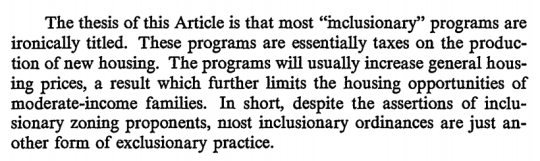
    In a classic paper (1981) by Yale Professor Robert C. Ellickson – called The Irony of Inclusionary Zoning – he argues that these practices can actually increase general house prices:

    image

    As a counterargument Owen Pickford over at The Urbanist argues that IZ simply reduces land prices as a result of the new tax. Land, after all, is the residual claimant. Therefore, he believes it’s an effective affordable housing policy. (I’m not so sure I believe that land prices would decrease in practice.)

    There’s also debate about the effectiveness of inclusionary zoning to actually deliver affordable housing at a meaningful scale. City Observatory wrote a post that looked at the total number of units produced (through IZ) across a number of American cities and the results were spotty. It should, however, be noted that not all inclusionary zoning policies are mandatory.

    Finally, the Furman Center for Real Estate & Urban Policy at New York University published a housing policy brief back in 2008 that looked at this exact topic. While they admit that the data is scarce, they come to the conclusion that IZ had no meaningful impact on the prices and production of single-family housing in San Francisco, but that IZ seems to have slightly decreased production and slightly increased pricing in the suburbs of Boston.

    What this last point suggests is that inclusionary zoning policies are not all created equal. So like all difficult questions, the answer to this one is likely: it depends. If anyone can point me to better data on inclusionary zoning, I would love to see it.

  • Is inclusionary zoning a good or bad thing for cities?

    Today is Christmas Eve. It’s the season of giving. So I thought it would be appropriate to talk about affordable housing.

    Yesterday, Mitchell Cohen – who is a real estate developer and the president of The Daniels Corporation – wrote an opinion piece in the Toronto Star talking about just that. It was called: A perfect storm for action on affordable housing.

    Here’s a snippet that summarizes the things he believes we should be doing:

    Municipalities across Ontario also have significant tools at their disposal to make a difference. To date, these tools have not been co-ordinated to achieve maximum bang for the buck. Property taxes can and should be waived not only for affordable rental homes but for affordable ownership homes as well. Additionally, cities can and should waive all development levies and other municipal fees for affordable rental and ownership housing.

    Combined, these two measures provide municipalities with powerful leverage to implement inclusionary zoning — the most important tool in the affordable housing tool box. Inclusionary zoning on a city-wide basis creates a level playing field, an opportunity for a constructive partnership between municipalities and private sector developers to create both affordable ownership and rental homes within every new building approved for construction.

    For those of you who might be unfamiliar with inclusionary zoning, it’s essentially a zoning requirement to build a certain number of affordable units in any new construction project. It originated – as far as I know – in the US, but has been fairly controversial since the outset.

    So today I thought we could have a discussion on the merits of inclusionary zoning. Do you think it’s a good or bad thing for cities? Is it really the most effective way to deliver affordable housing at scale? Leave your thoughts in the comment section below 🙂

    I don’t have a strong view on inclusionary zoning, but I do believe that affordable housing and a mix of incomes is critical to cities and neighborhoods.

    I do, however, wonder if it’s one of those things that seems to make a lot of sense, but actually has a bunch of negative externalities associated with it. Maybe the answer is to just prototype the idea and then iterate on it.

    What do you think?