Daily insights for city builders, delivered every morning at 6 AM ET. I’m Brandon Donnelly — a Toronto-based real estate developer and founder of Globizen. I’ve been writing here since 2013.

Category: Places

  • Toronto needs a summer bathing culture

    July 6, 2025 · View original


    > Tweet: Man, Toronto in the summer is something else. I love this city.

    While this is true, I do I have some suggestions. At the top of the list is this: Toronto needs to make better recreational use of Lake Ontario and its waterways. More specifically, it needs a summer bathing culture.
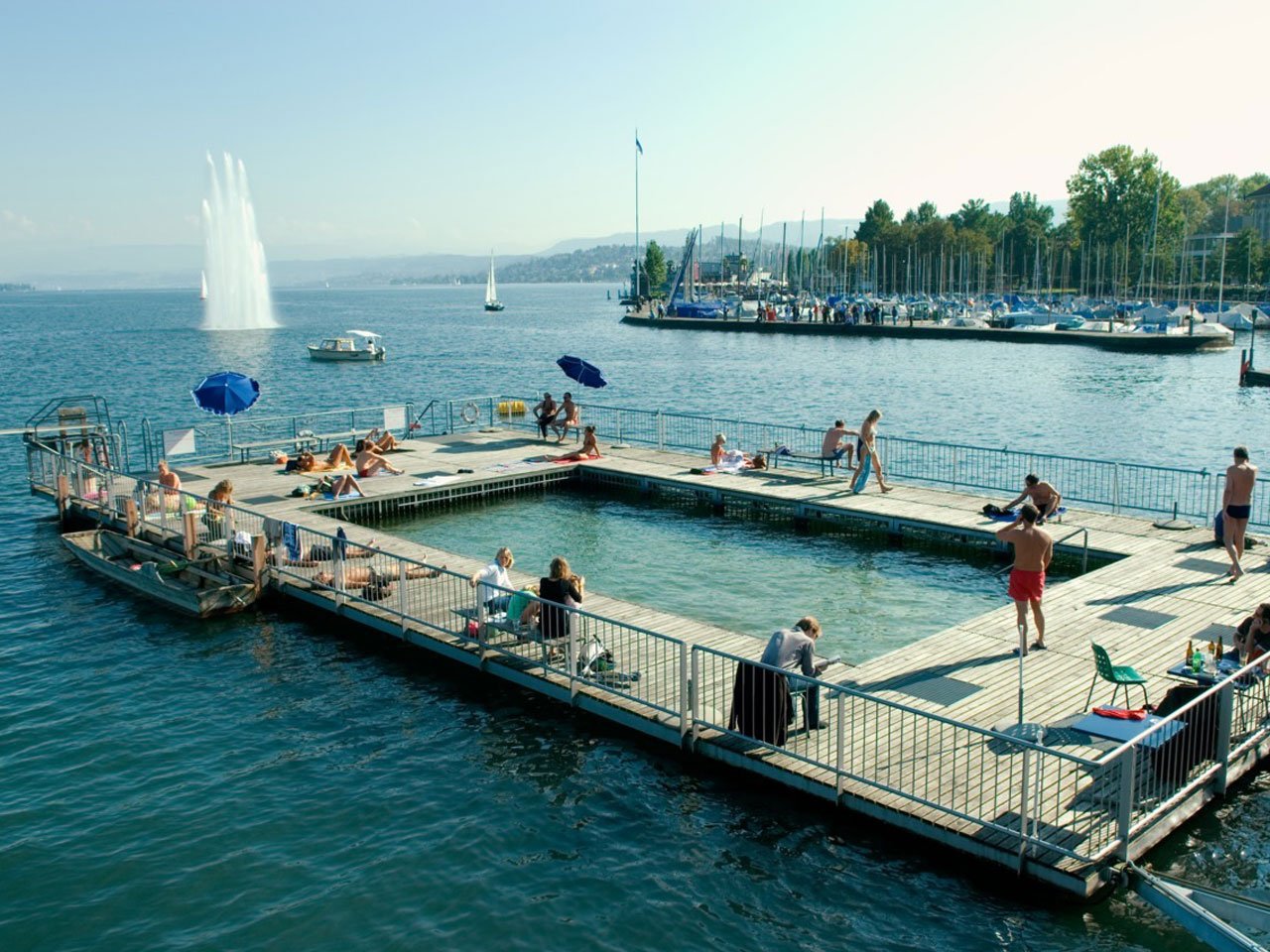
    One of the gold standards for this is easily Zürich. The city has a long history of urban swimming right in Lake Zürich and the Limmat River. And because the city has some of the cleanest urban water in the world, all that is really needed are platforms leading straight into water. But Zürich also has a rich history of beautiful public bathhouses (called Badis). These facilities accommodate the obvious daytime functions, but they also transform at night into bars, clubs, and event venues. It’s for these reasons that their seasonal opening in May is often viewed as the official opening of summer in the city. This is what Toronto needs. So how do we make that happen?

    The obvious first step is that we need clean water, which means we need to eliminate the poop. This remains a problem and here’s why (taken from this 2014 document):

    > About 30% of the land area, which is really in the older area of the city [of Toronto], is serviced by combined sewers. That’s a single pipe that carries both raw sewage and stormwater runoff when it rains. Inherent in the way these systems were configured back in the late 1800s and up to about 1950 is that during heavy rains there’s a spillage of combined sewer overflow, as we call it. It’s a mixture of raw sewage and stormwater runoff. We have about 80 outfalls across the city, 34 of which discharge to Lake Ontario.

    The good news is that we’re working on it. In 2018, Toronto started on the largest stormwater management program in the city’s history with the promise that it will virtually eliminate the release of combined sewer outflows into the Lower Don River, Taylor-Massey Creek and Toronto’s Inner Harbour. I don’t know enough, technically, to say whether this will get us all the way there, but I do know that it is absolutely crucial to making Toronto more like Zürich. Zürich also some combined sewers, but they use large retention tanks to hold excess wastewater and prevent it from overflowing into Lake Zürich and the Limmat River.
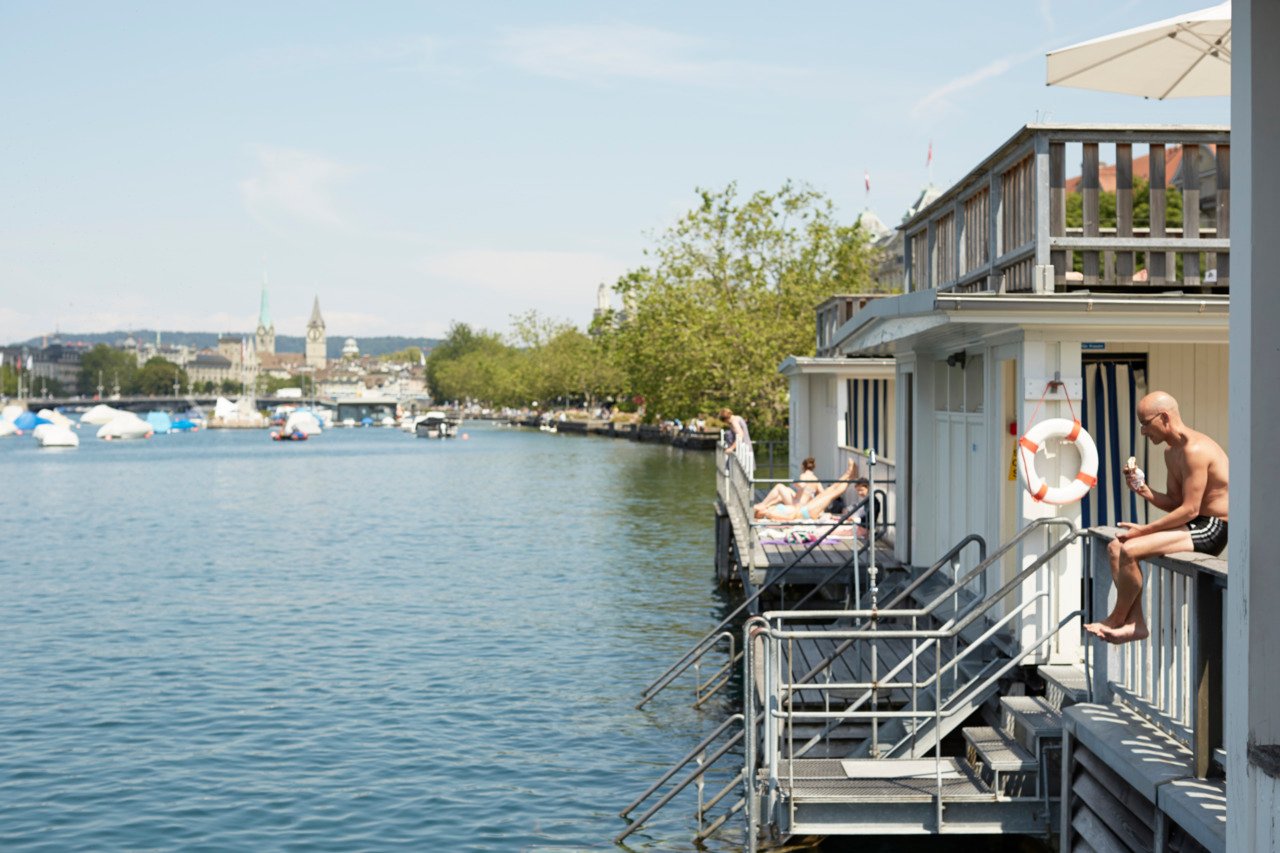
    The second step is that we need to invest in incredible bathhouse facilities. From what I can tell, this is also a work in progress. As part of the preliminary design for the Parliament Slip (in the city’s central waterfront), there is a proposal for a floating barge and two outdoor pools. There may even be a snack bar! (Let’s hope it’s a lot more than that.) This won’t be the same experience as swimming directly in Lake Zürich, but it will still be awesome and Toronto should make it happen.

    But there are other opportunities. One that often comes to mind for me is Sunnyside Bathing Pavilion. Originally constructed in 1922 and renovated in 1980, today it mostly feels abandoned, other than the mediocre cafe facing the boardwalk (and yes, the adjacent pool). It’s severely underutilized and under kept. What we ought to do is host an international design competition and challenge the world to rethink it and its relationship to the lake, just as we did for our central waterfront. And of course, we should do this in parallel with making our bodies of water some of the cleanest in the world.

    Toronto needs a summer bathing culture.

    Photos from Zürich Tourism

  • Toward more family-friendly housing on Toronto’s major streets

    July 5, 2025 · View original


    Yesterday afternoon, our team had a productive in-person meeting with senior planning staff at the City of Toronto. The purpose of the meeting was to talk about the challenges associated with delivering infill missing middle housing and to brainstorm the possible solutions.

    Some of the key topics that we discussed: Type-G loading / garbage requirements, amenity space requirements, right-sizing the Site Plan Control process, single-stair exiting, the cost of connecting to Toronto Hydro, the challenges with assembling small lots, specifics of the Major Street Study, and a bunch of other things. So many of the things that we regularly talk about on this blog.

    We also walked everyone through the site we had under contract but eventually dropped because the margins were just too thin. This included opening up our pro forma, projecting it onto the screen, and going through it line-by-line. We are happy to do this because we think this transparency helps everyone truly understand the obstacles.

    What’s clear is that we all want to see more family-friendly housing lining our avenues and major streets. And so there’s a real feeling of collaboration during meetings like the one we had yesterday. We’re all at the stage of “what is it going to take? Let’s figure it out!” This can-do attitude makes me feel optimistic that we are going to get there. And once we do, Toronto will be that much better for it.

    It was also nice having an in-person meeting back at City Hall. To be honest, I can’t remember the last time I did that. But it used to be standard operating procedure. We’d all arrive early, huddle in the cafe at the bottom of the building for a pre-meeting, and then look around to see what other teams/projects were also on deck with the city. It made me feel nostalgic — and older.

    Enjoy the weekend, everyone.

  • Toronto reneged on its commitment to allow six-unit buildings

    July 3, 2025 · View original


    Alex Bozikovic of the Globe and Mail wrote an excellent piece talking about what I wrote about last week in Old Toronto, and then the rest. Here are some of the zingers:

    > And Mayor Olivia Chow? She barely spoke. She ultimately supported the compromise, but she declined to stand up for a bolder vision. For a mayor elected with a mandate to address housing and equity, that silence was striking. > > Meanwhile, the opposition – led by suburban councillors – offered little beyond incoherent panic. “We are risking suburban alienation,” said Parthi Kandavel of Scarborough Southwest, as though allowing modest apartment buildings might rupture the civic fabric. “A one-size-fits-all approach does not fit the bill.” > > For Mr. Kandavel, as for a thousand politicians before him, one-size-fits-all is fine as long as that “one size” gives the loudest homeowners exactly what they want – and preserves economic segregation by keeping tenants away from where they don’t belong.

    He goes on:

    > In Mr. Kandavel’s ward, at least 52 per cent of residents lived in apartments as of 2021. Nearly half are renters. To speak as if tenants are invaders is to insult the very people he represents. > > If the federal government decides to withhold that $60-million, it would be entirely justified. A city that won’t allow a sixplex – a building the size of a large house – is not serious about housing, about urbanism, or about its own future.

    Cover photo by Julian Gentile on Unsplash

  • Old Toronto, and then the rest

    June 27, 2025 · View original


    This week, Toronto once again demonstrated that there are two cities within our city: There’s Old Toronto and then there’s the rest of Toronto. The former generally corresponds to the boundaries of Toronto prior to amalgamation in 1998. It represents a city that was built around streetcars and subways and is therefore embedded with certain urban sensibilities. Then there’s the rest of Toronto. This part of the city ranges from being reluctantly urban to overly hostile toward it. And it shows up in many areas, from its modal split to its voting patterns.

    This week it showed up in a debate to permit multiplexes with up to six homes (sixplexes) in all residential neighborhoods city-wide. It is also important to note that adopting this zoning change is a prerequisite to the city accessing $471.1 million in funding from the federal government. But this is not how City Council voted this week. Instead, a “compromise motion” had to be put forward that isolated sixplexes to Toronto and East York District, and Ward 23 in Scarborough. In other words, we are not that far off from splitting Toronto between Old and the rest.

    I’m glad that something, instead of nothing, got done. But it’s disappointing that Mayor Olivia Chow did not stand up and show any leadership on this recommendation from planning staff.

  • How Tokyo manages to be so clean without any public garbage bins

    June 22, 2025 · View original


    One city that we didn’t talk about from Monocle’s recent Quality of Life Survey, but that regularly appears on the list, is Tokyo. In this year’s ranking, it was bestowed with “best for cleanliness.”

    > All of this isn’t to say that there’s no rubbish in Tokyo but, overall, it’s much tidier than other cities of a comparable size. Tokyo spends a fortune on keeping things presentable. The Clean Authority of Tokyo’s waste management budget for the central wards is ¥105bn (€640m) this year, of which ¥83bn (€507m) is dedicated to cleaning. But the secret to the city’s sparkle is that it’s not simply the work of city employees: it’s a collective job.

    If any of you can remember my “Takeaways from Japan” post from this earlier this year, you might recall that cleanliness shows up in my first point. It is absolutely astounding that the largest city in the world — it almost has the entire population of Canada — manages to be so clean. On top of this, it manages to achieve this with almost no public garbage bins.

    If you’ve been to Tokyo, you’ll know this. There are very few places to throw out your garbage in a public space. This is perhaps the irony of Tokyo’s cleanliness. But it works because of the expectation that people will take their garbage home and then sort it according to the city’s strict separation rules. And of course, this is what people do.

    That said, there are some other reasons for the lack of public bins, namely the 1995 subway sarin attack. There remains a deep fear that garbage bins might be used to conceal a terrorist device, which is why if you do see a garbage bin, it’ll often be transparent in nature so that nothing nefarious can be concealed. But by and large, the Tokyo approach seems to work because everyone wants it to.

    This reminds me of an incident when our ski and snowboard group was there in February. We were walking around Harajuku and a few of us decided to indulge in a set of elaborate desserts involving crepes, various fruit-like mixtures, and an absolutely excessive amount of whipped cream. You know, the sort of thing you’d never order if you were at home.

    One of us ended up wearing their dessert. He had it on his face, his chest, his hands, and somehow all over this jacket sleeves. There was whipped cream everywhere. He needed to abandon ship immediately and rid himself of what remained of his dessert. Except, there were no garbage bins anywhere! This is despite being on one of the busiest tourist streets in the city (see cover photo).

    It became a mission to get himself cleaned up. But what he absolutely did not do is litter. That’s just not how one conducts oneself in Japan — with or without public garbage bins.

    Cover photo by Elton Sa on Unsplash

  • France just banned smoking in all public spaces

    June 21, 2025 · View original


    One of my least favorite things about Europe is the experience of sitting on a cafe terrace and having someone smoking beside you while you’re trying to enjoy a gelatinous pig foot from Au Pied de Cochon. (I kid; gelatinous pig foot isn’t my favorite.)

    So here’s some news: France has just announced that, starting July 1, smoking will be banned from nearly all public spaces, including parks, beaches, public gardens, and bus stops. That said, the ban does not yet include cafe terraces. So I can still expect my gelatinous pig foot experiences to be horribly ruined.

    Still, this is a giant step in the right direction, especially for a country with one of the highest smoking rates among OECD countries. As of 2023, the national average for daily smokers was estimated at 23% for adults aged 18 to 75. The region with the highest percentage of smokers was the southeast (~29.5%) and the region with the lowest percentage of smokers was Greater Paris (~21.9%).

    In addition to varying by region, smoking is also strongly correlated with socioeconomic status. INSEE, France’s national statistics agency, estimated the following daily smoking rates as of 2022:

    – 42.3% of unemployed adults – 33.6% of people in the lowest income tier – 30.8% of people without a degree (baccalauréat level) – 16.8% of people with higher education (above baccalauréat level)

    But even among high-income groups, the rates are significantly higher than what you’d find throughout the rest of Western Europe, and in places like Canada and the US. We’re in the 10-11% range. All of this is why the French health ministry is now aiming to create a generation “free of tobacco” by 2032.

    The majority of French people also seem to support this new public space ban; which maybe isn’t surprising, given that the majority don’t smoke.

    Cover photo by Marie-Sophie Tékian on Unsplash

  • The tallest building in Utah

    May 17, 2025 · View original


    Salt Lake City has two recently completed luxury multi-family developments. Or perhaps I should say, at least two.

    The first is The Worthington by Chicago-based developer Convexity Properties. It has 31 floors and 359 apartments. Leasing started last summer and seems to be going well.

    The second is the Astra Tower by Kensington Investment Company, which is being managed by Greystar. It has 41 floors, 377 apartments, and is 451 feet tall, making it the tallest building in the state of Utah. Construction was completed at the beginning of this year and, according to Building Salt Lake, it’s already about 30% occupied with full stabilization forecasted for summer 2026.

    It’s interesting to compare these projects to multi-family developments here in Toronto.

    First of all, the reported average rent for Astra is US$3 per square foot, which works out to ~C$4.19 psf for us Canadians at today’s exchange rate. I would say that this is at least ~15% lower compared to where I would expect most Toronto developers are underwriting new projects. This suggests to me that it’s more cost effective to build in SLC.

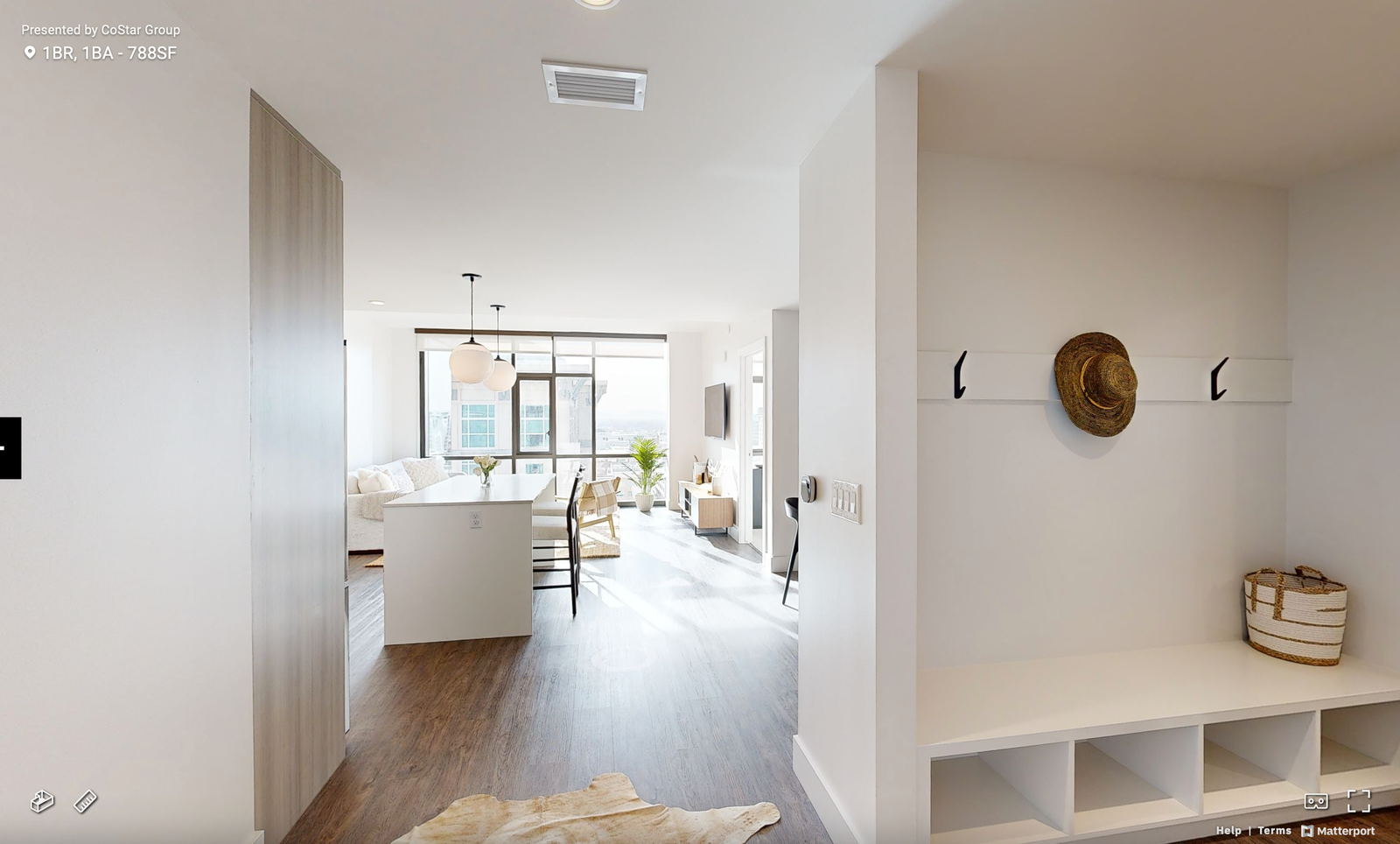
    The product is also different. On Astra’s website, they have two virtual tours.

    The first is for a studio apartment at 554 sf and the second is for a one bedroom at 788 sf. These are meaningfully larger than new apartments in Toronto. Here, the first would have to be a one bedroom and the second would be at a minimum a one bedroom plus den, though probably a two bedroom.

    Every market has its nuances. In the case of SLC, the model suites appear to be very clearly competing with low-rise housing. The one bedroom has a dedicated entrance foyer, there’s a separate dining area, and the bedroom has carpet, among other things. It reminds me of earlier multi-family vintages in Toronto.

    Of course, one really unique feature you get here is views of the Wasatch mountain range (see cover photo above). It’s a special feeling being in an urban center where you have mountains all around you, and it’s one of the primary reasons why an increasing number of people are being drawn to Utah.

    Congratulations to the team on successfully completing such an ambitious project. It’s exciting to see SLC continue to grow and urbanize.

    Cover photo via the Astra Tower

  • Doors Open Toronto

    May 13, 2025 · View original


    Every May, Toronto hosts something called Doors Open, which entails buildings around the city opening up their doors for free to the public. It’s an opportunity to visit buildings of architectural, historical, and/or cultural significance that might normally be closed to the public.

    This year, over 150 buildings are participating, including a number of sites that are new this year. You can find the complete list here.

    When I was in architecture school, I used to always make a point of going. But I honestly can’t remember the last time I participated. That’s a shame, and so this year I’m going to try and check off some sites.

    If you’re around the weekend of May 24-25, you may want to do the same. The new St. Lawrence Market North building is on the list, as is the Consulate General of the Republic of Bulgaria.

    I sometimes describe Toronto as a city where you need to scratch beneath the surface to find its true architectural beauty. It doesn’t hit you in the face as much as it does in some other cities. But it’s there. And initiatives like Door Opens Toronto are a great way to help you see it.

    Cover photo by Scott Webb on Unsplash

  • Do you travel to places or hotels?

    May 2, 2025 · View original


    I was reminded of this duality the other day while listening to a Scott Galloway podcast where he talked about his love for expensive hotels, and how he travels to hotels, not to places. This is a bit abnormal. Traditionally, people stay at a hotel because there are things they want to see and/or do in the place where the hotel happens to be located. Meaning they choose the place first, and then figure out where they’re going to stay after.

    But there is also a statistically significant percentage of travellers who work in the opposite direction. Scott seems to be one of them. Now, his examples were all at the highest end of the spectrum, and that makes intuitive sense. If your M.O. is to travel to hotels, and you’re kind of agnostic to place, then presumably the hotels are going to be super nice. But I don’t think this market segment only exists at the very top. I don’t stay at the same kind of hotels as Scott, but I still love hotels.

    One example that I have talked about before is Tuba Club in the south of Marseille. Bianca and I stayed here a few summers ago. We read somewhere that it was about to open, we loved the vibe, and so we organized our travel itinerary just so we could stay there. We ended up loving Marseille (so much so that we went back), but Tuba came first. It was the catalyst.

    A local example I can give is the Drake Devonshire in Prince Edward County, Ontario. When it opened in 2014, “The County” was not on my radar. Maybe I had been there as a kid? I don’t know. But as soon as it opened, I wanted to go, as did many others judging by the lack of room availability. The design by John Tong was a hospitality offering that just wasn’t available in the rest of southern Ontario at the time.

    This is a powerful position to be in for a hotel. Because it means that through some magical combination of design, brand, service, and experience, you have a product that people specifically want. They’re not just stopping by and need a place to stay, they’re actively seeking you out. This is not to say that location doesn’t matter; it does. But it is to say that a highly-coveted offering that people love is always better to have than not.

    And if you get it right, there’s the opportunity that people will even choose you over place.

    Update: A previous version of this post incorrectly stated that John Tong had passed away. John unfortunately had a severe stroke, but he did not pass away. Sorry, my mistake, John!

    Cover photo by Toni Osmundson on Unsplash

  • New York’s declining share of millionaires

    May 1, 2025 · View original


    There is a nonpartisan, nonprofit think tank based in New York called the Citizens Budget Commission (or CBC). And this week they launched Competitive NYC. The intent is a kind of dashboard that provides insights into NYC’s overall competitiveness — specifically its ability to attract and retain both residents and businesses. I won’t summarize all of the findings; if you’d like to take a look, you can do that here. But I did want to point out one finding.

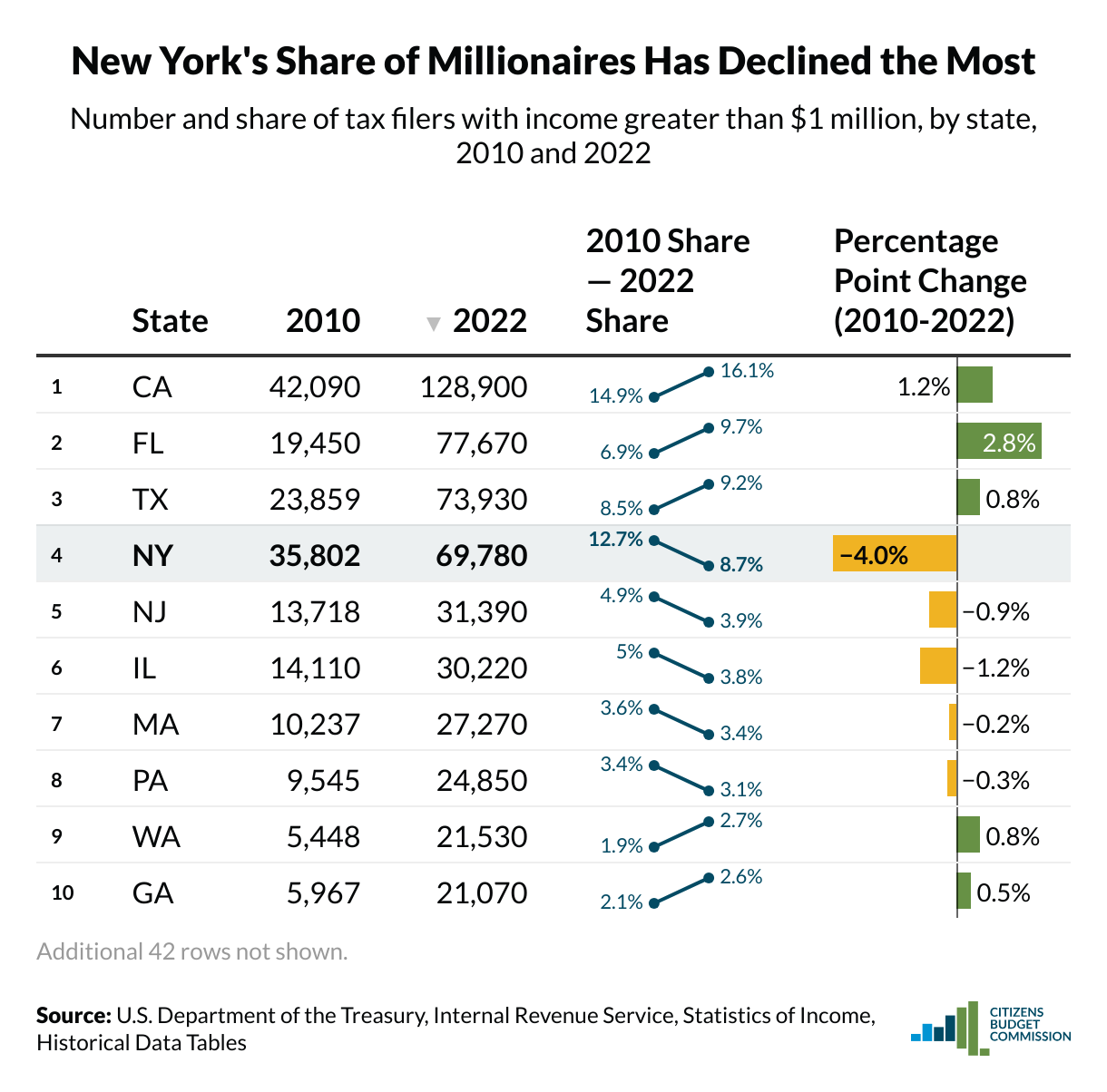
    Here’s a chart showing the top 10 states for people with incomes greater than $1 million:

    The number of “millionaires” in New York state increased from 35,802 in 2010 to 69,780 in 2022, but its share of US millionaires declined the most. Previously it was 12.7%, and in 2022 it had dropped to 8.7%. On the other end of the spectrum, the state with the biggest share gain was Florida.

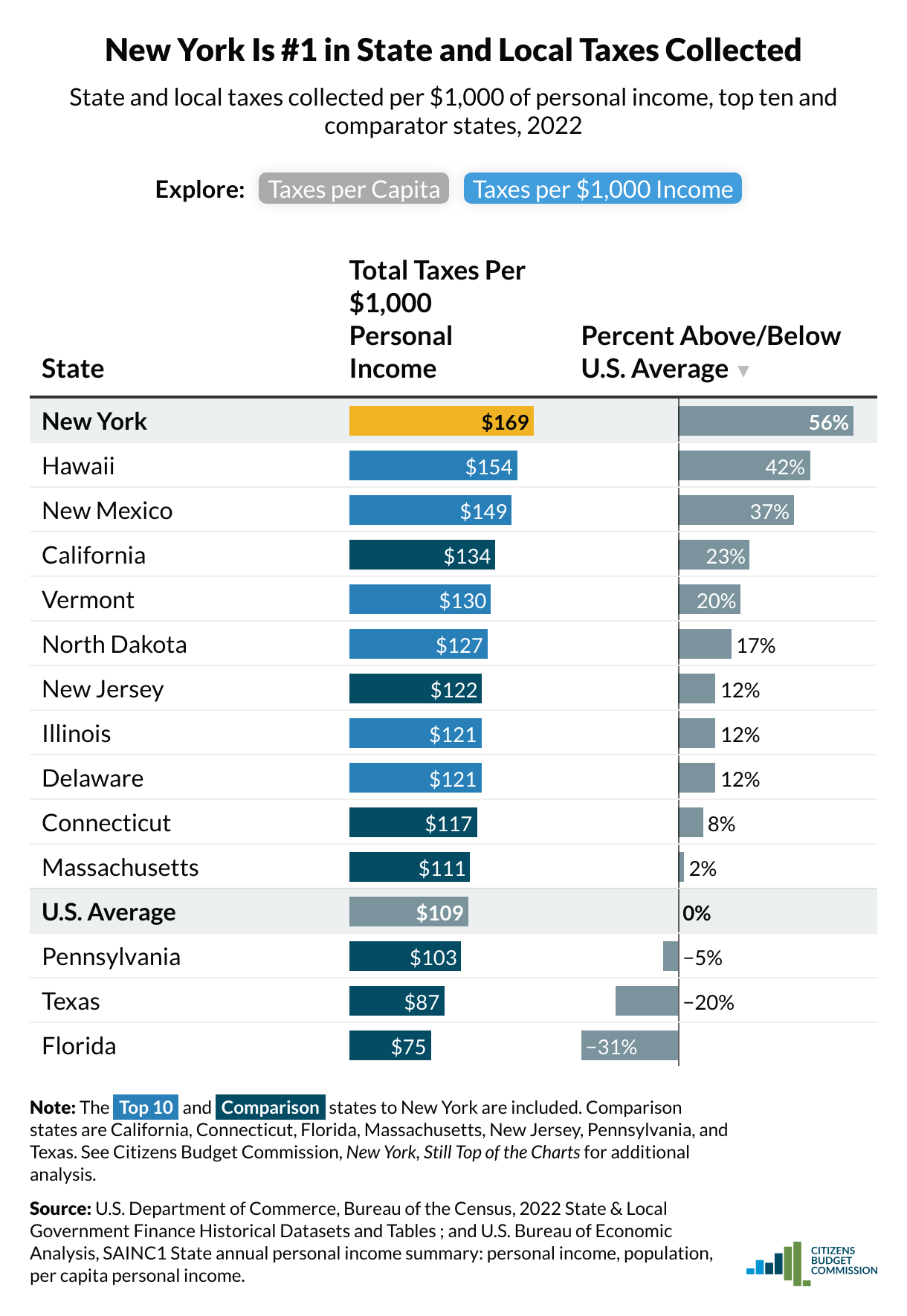
    The tracker goes on to suggest that high taxes may be a factor for households moving out of New York City. Here’s a chart showing taxes per $1,000 of personal income:

    New York state is the highest and is 56% above the US average, whereas Florida is 31% below the average. Florida also has the sunshine thing going for it. This migration trend aligns with what was talked about a lot during the pandemic. Between April 2020 and July 2022, NYC lost nearly half a million residents, a chunk of which went to Palm Beach and Miami-Dade Counties.

    It’s a reminder not to take competitiveness for granted, especially when there’s a clear trend toward places with warmer weather. People can and will vote with their feet.

    Cover photo by Andre Benz on Unsplash; charts from CBCNY