Daily insights for city builders, delivered every morning at 6 AM ET. I’m Brandon Donnelly — a Toronto-based real estate developer and founder of Globizen. I’ve been writing here since 2013.

Category: Places

  • Looking back at the Toronto real estate market in the 90s

    April 27, 2025 · View original


    Longtime readers of this blog might remember a post that I published back in 2016 where I talked about the genesis story of Toronto-based developer David Wex and his company Urban Capital Property Group. In it, I wrote about his first project at 29 Camden Street in the Fashion District. It had a total of 55 condominium suites and an average price per square foot of ~$195. And it took somewhere around 2 years to pre-sell enough of the suites for construction financing.

    The reason I bring this up today is because when I originally wrote the post, it seemed so far from reality. In 2016, I said that these same 55 suites could be sold within 2 hours at $800 psf! But now things have changed once again. The market realities that David was facing in the mid-90s with Camden Lofts feel remarkably similar to today. Selling even 55 suites might not be a sure thing. And this is the first time in over 2 decades that the market has been like this.

    So for fun, let’s consider what happened in the late 80s and 90s. The Toronto housing market peaked in 1989 at an average price of approximately $273,698 (according to the Toronto Regional Real Estate Board). It then went on to decline 27% over the next 7 years, finally bottoming out at approximately $198,150 in 1996. So it took around 8 years for the market to stabilize.
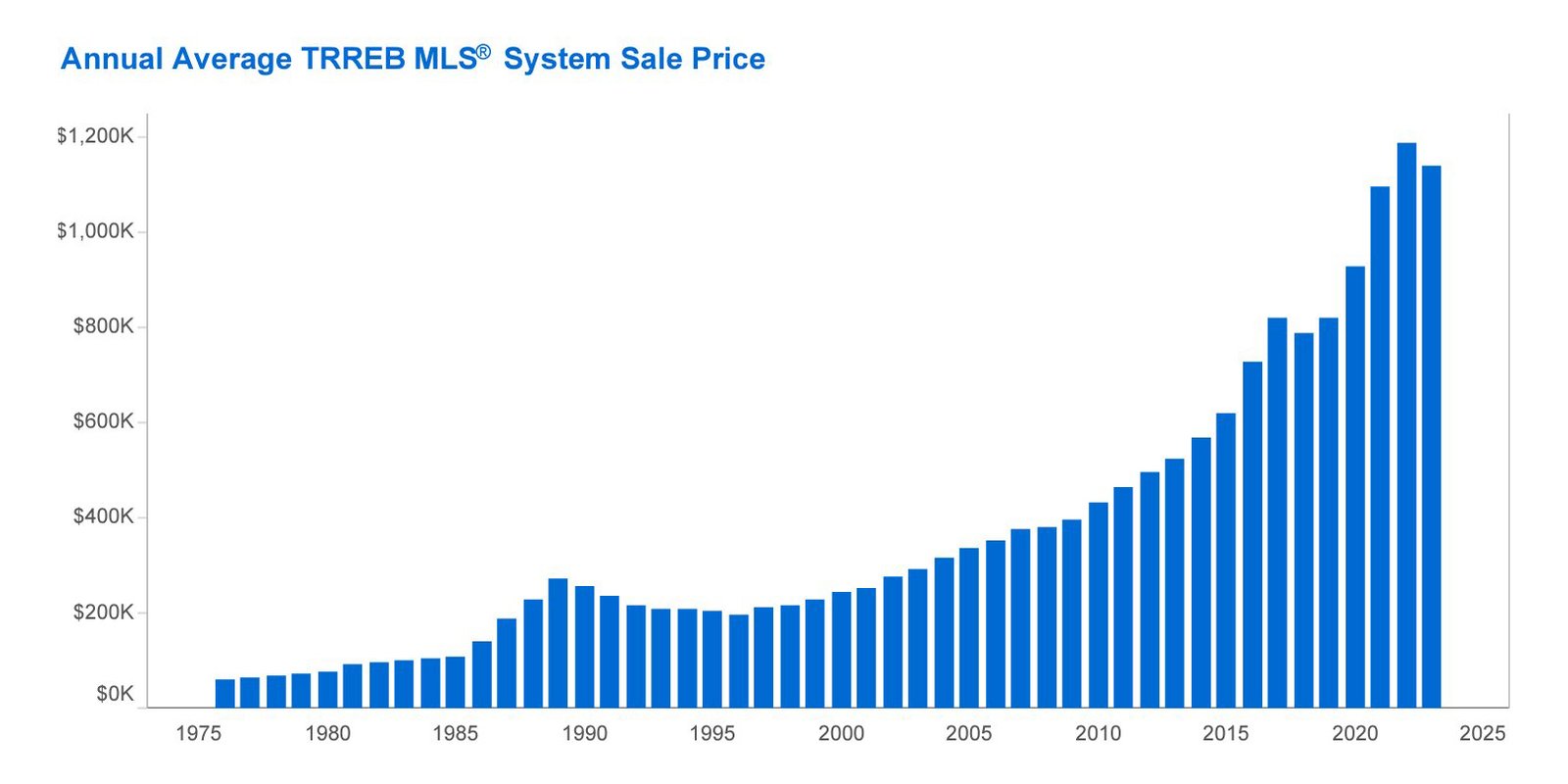
    Of course, the market took even longer to return to its 1989 peak. The average home price crossed $275,000 in 2002, which means it took 13 years in nominal dollars. However, $275k in 1989 is the equivalent of around $610k in today’s dollars. So in real dollars, it actually took until 2011 for the market to return to its prior peak, which is some 22 years later!

    I’m not arguing that the exact same thing will play out with this cycle. Who knows, Toronto is a different city. But I have suggested that 2028 could be the year where we’re on the other side of this downturn. The average home price peaked, most recently, in 2022 at ~$1,194,600. Since then, it has come down by around 8.5% (as a broad average). If the market does turn positive in 2028, that’ll be 6 years after the peak.

    Only time will tell.

    Chart from the Toronto Regional Real Estate Board; cover photo by Melvin Lai on Unsplash

  • Why aren’t Japanese toilets more popular?

    April 5, 2025 · View original


    Things have been pretty serious around here lately. We’ve been talking a lot about isolationist tariffs that make zero economic sense and that have been blatantly miscalculated, and so let’s switch gears and talk about something a little more fun: toilets.

    If any of you remember my post from earlier this year called “Takeaways from Japan,” you might remember this:

    > Our toilets are in the stone ages. You’re not going to get yourself clean with just paper. You need a comfortable warm seat and highly adjustable jets of water. I never fully appreciated this need before the trip, but now I’m a true believer. It’s time for a new toilet.

    Well, I meant it when I said it:

    This week, I finally got around to installing a new TOTO WASHLET seat on my existing toilet. My bathroom may now look a little more geriatric, but it’s a fantastic quality of life upgrade that more people, outside of Japan, should adopt. So why don’t they?

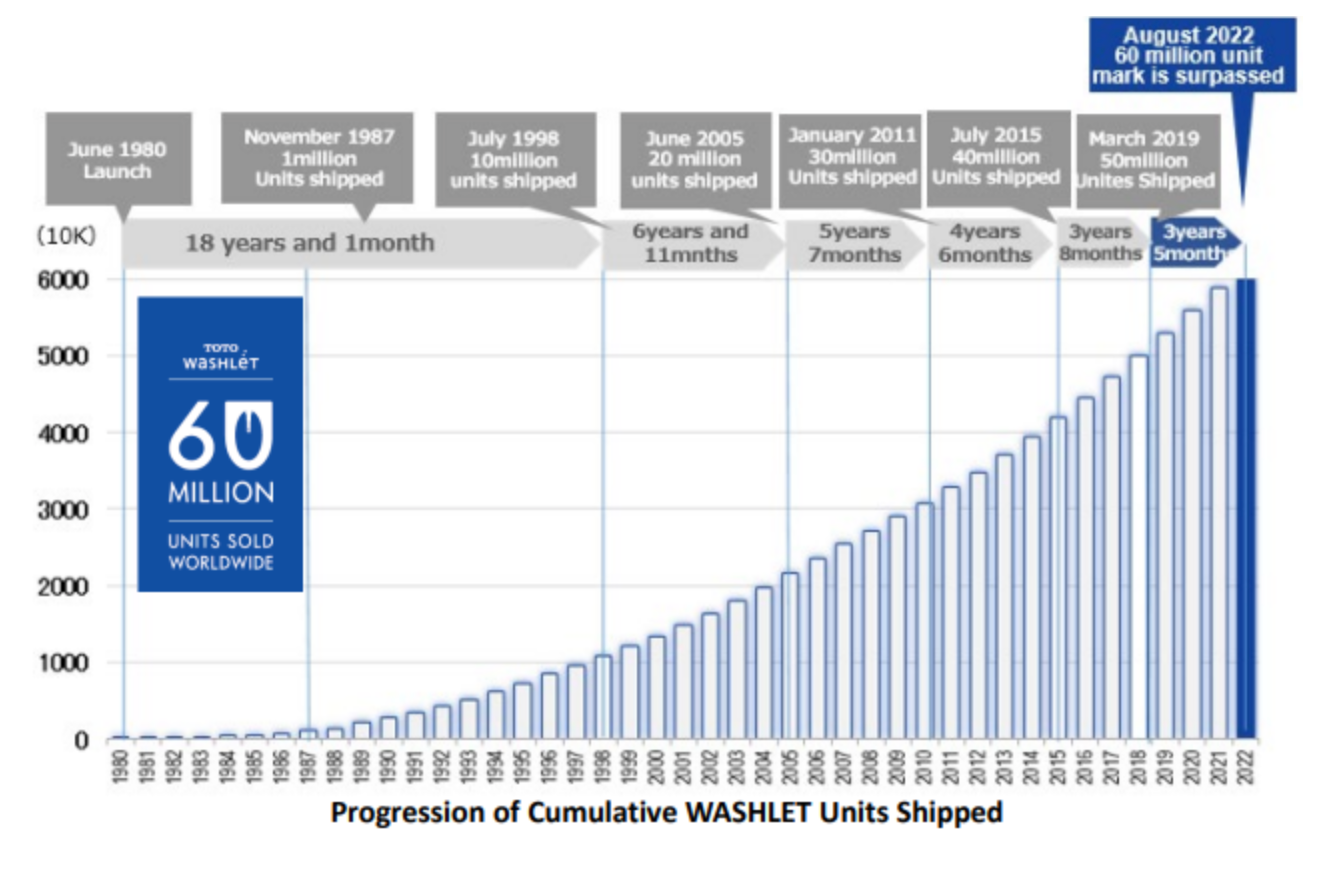
    The TOTO WASHLET seat was first created in 1980. And since then (and up until 2022), the company has reported selling more than 60 million units, with the majority of them being sold in Japan. As of 2021, it was believed that over 80% of Japanese households were equipped with some sort of heated bidet toilet.

    Market penetration is much lower in the West. In the US, ChatGPT think it’s less than 5%. And based on anecdotal evidence, this does not seem far off. I almost never see them in public places (though The Butcher Chef here in Toronto has one) and I rarely see them in people’s homes.

    My gut is that it’s a combination of a lack of awareness and people thinking it’s weird and/or unhygienic. I mean, is that wand clean? But if you travel to Japan, you will have an aha moment. So maybe TOTO needs to figure out a way to export this moment to the rest of the world through, oh I don’t know, some sort of public toilet program.

    Note: This post is not sponsored by TOTO. But I really wish it were, because then maybe I would have gotten my seat for free.

  • Sundance Film Festival is moving from Park City to Boulder

    March 29, 2025 · View original


    YouTube video

    This past Thursday, the Sundance Institute announced that it will be moving the Sundance Film Festival from Park City to Boulder starting in 2027. This is sad. Sundance has been based in Park City since 1981 and it’s the largest independent film festival in the US. Last year (2024), it is estimated that it created 1,730 jobs for residents, contributed $132 million in GDP to Utah, and produced about $13.8 million in state and local tax revenue.

    Here’s what Park City Mayor Nann Worel had to say following the announcement:

    > “For over 40 years Park City wasn’t just the host of the festival, we were its home. We helped shape the identity of Sundance with our unique energy, our colorful people, our undeniable spirit,” Worel said. “The world came here for film, yes, but they stayed for something more. They stayed for the feeling this town gave them. So, yes, I’m disappointed. Deeply. I know many of you are, too.” > > “To our community: We are not defined by one event. Our creative spirit is deeper than any single festival. And while Sundance may be leaving, Park City isn’t going anywhere,” Worel said.

    As I understand it, Utah offered to nearly double the amount of funding that they provide to the arts festival. But that clearly wasn’t enough. There’s also speculation that the festival left because it had overgrown Park City and/or because Colorado is viewed as being more liberal. There are people in Utah who do not approve of some of the content shown at said festival. I have no idea as to the actual reasons. But I do think it’s a real loss for Utah.

    Cover photo by Spencer Davis on Unsplash

  • New York’s congestion pricing is doing what it’s supposed to do

    March 28, 2025 · View original


    New York City was supposed to terminate its congestion pricing program last Friday because, well, Trump told them to. But they didn’t do it and so harsh words were exchanged and then the deadline was extended for another 30 days. (This sounds oddly familiar.) Who knows what happens next month, but we are able to accurately quantify the benefits of nearly 3 months of congestion pricing.

    Firstly, it’s generating a lot of money. In the first two months of operation, congestion pricing has already brought in over $100 million in new revenue for the city. This is important because it’s money that can be used for transit and other infrastructure improvements.

    Equally important is the fact that this money was generated by creating measurable value for drivers. For all of the river crossings that lead into the CBD, average weekday travel times this past January are lower compared to January 2024. And in some cases, they’re lower by a lot. The Holland Tunnel, for example, saw travel times drop by 48%.

    Lastly, it’s encouraging more people to take public transit. Here’s a chart from Sam Deutsch over at Better Cities showing the increases in ridership since the program was implemented:

    The MTA as a whole is now averaging about 448,000 more public transit riders per day. And to put this number into perspective, Sam reminds us that Washington DC has the second most-used public transit system in the US and that it sees an average of about 304,000 total riders per day (January 2024 figure). So in other words, New York’s congestion pricing bump alone was nearly 1.5x DC’s entire ridership base.

    Some critics will argue that NYC’s subway is dangerous and that this program unfairly pushes people toward it. But crime data suggests otherwise. New York’s subway also saw over a billion rides in 2024! So I don’t know how you argue that less people should be taking it. It’s pretty clear that this is what moves the city. Imagine if the above went the opposite way and 448,000 more people started driving to work.

    Some people may not like it, but the reality is that congestion pricing is doing exactly what it’s intended to do: reduce traffic congestion, make money, and encourage more sustainable forms of urban mobility.

    Cover photo by Wells Baum on Unsplash

  • Paris votes to pedestrianize an additional 500 streets

    March 25, 2025 · View original


    This past Sunday, Paris voted in favor of greening and pedestrianizing an additional 500 streets in the capital (5-8 per neighborhood). This will add to the 300 or so streets that have already received this treatment since Mayor Hidalgo started her second term in 2020. And as a result of this expansion, it is estimated that about 10,000 on-street parking spaces will be removed, which represents about 10% of the city’s total inventory.

    Exciting. But who voted for this? Of the Parisians who voted, 66% voted in favor of the initiative. And it carried in 14 of 17 arrondissements (with the 1st, 2nd, 3rd, and 4th counted as one). But similar to prior referendums, voter turnout was extremely low: only 4.06% of eligible voters showed up (approximately 56,500 people). And this is after the voting age was lowered to 16 years old for the first time.

    For context, when Paris voted on whether electric scooters should be banned, 7.46% of voters showed up. So while low, this situation is not entirely unique. Though it does, once again, raise the question of whether the outcome of this referendum truly reflects public opinion. My outsider view is that it probably does. Because I take the apathy to mean some level of support, or at the very least, an absence of strong aversion.

    Think, for example, about who shows up at community meetings for new development projects. The vast majority of people in attendance have concerns they would like to air. It’s very rare for someone to show up and say, “I didn’t have much going on tonight so I decided to come by and see everyone. I have no real concerns. Project looks cool. Carry on as you were.”

    If you agree with this logic, well then it suggests that many/most Parisians do generally support more pedestrianized streets, even if it means the removal of parking. That’s an accomplishment in my books.

    Cover photo by Maximilian Bungart on Unsplash

  • Paris has a hell of a lot of vacation rentals and second homes

    March 20, 2025 · View original


    Last week, we spoke about affordable housing in Paris. Today, let’s talk about tourist rentals in the city. The city of Paris and Greater Paris (i.e. la Ville de Paris and la Métropole du Grand Paris) recently commissioned Apur (which is a non-profit that I regularly follow) to do two studies on this topic. The first was for Paris proper and the second was for Greater Paris. What they found is super interesting:

    – In August 2024, Greater Paris had 149,936 tourist rentals, of which 124,988 were available for immediate booking. This represents an 84% increase compared to August 2023, which is a massive number, but maybe not entirely surprising given that Paris hosted the Olympics last summer. – Paris proper had 97,975 listings in August 2024 and 90,299 in December 2024. Overall, the city sees fairly muted seasonality. It’s also worth noting that 31% of these listings belong to hosts that own multiple properties (that is, at least two).

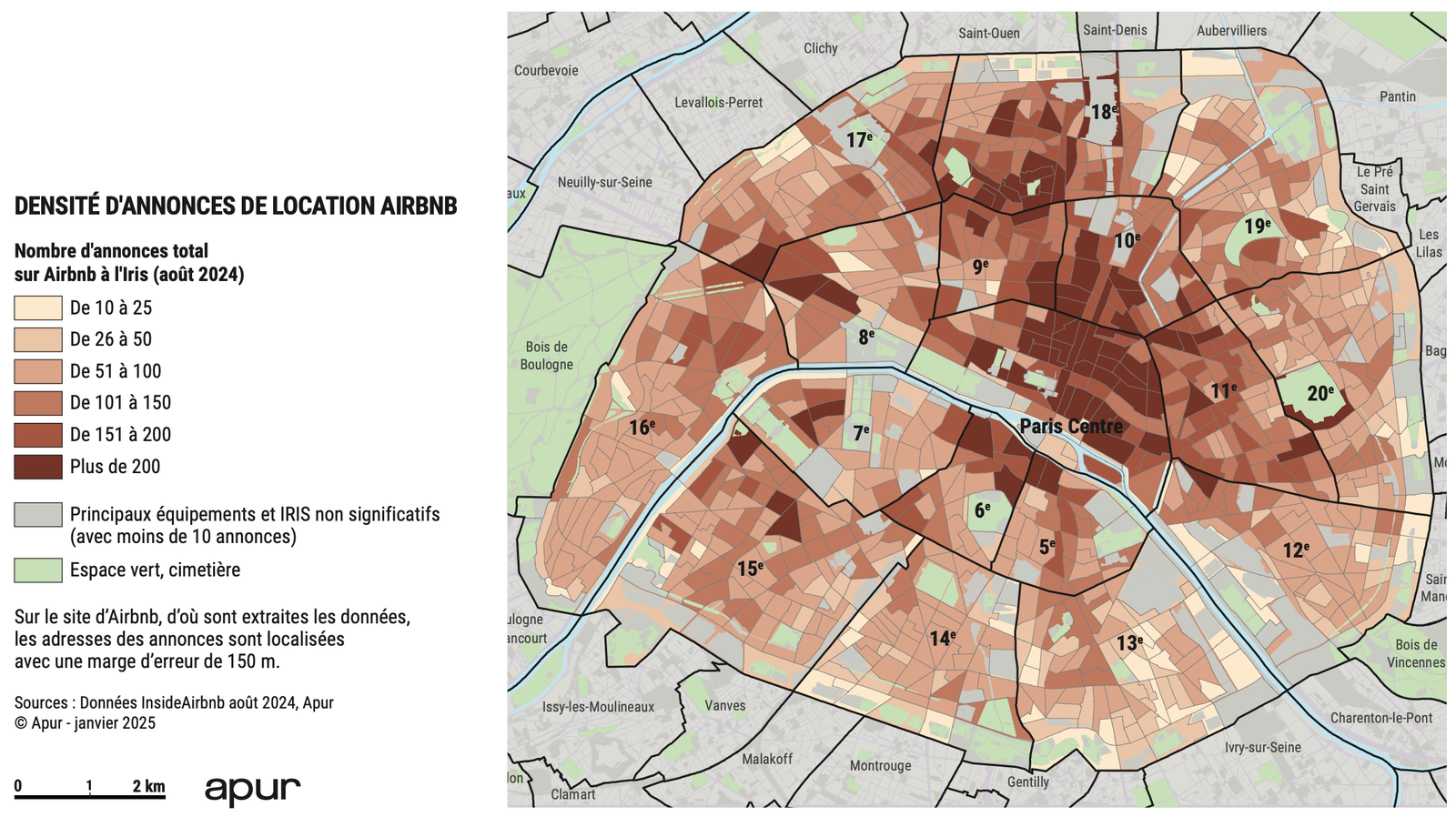
    But let’s put these figures into context. Here’s a map showing the density of Airbnb listings:

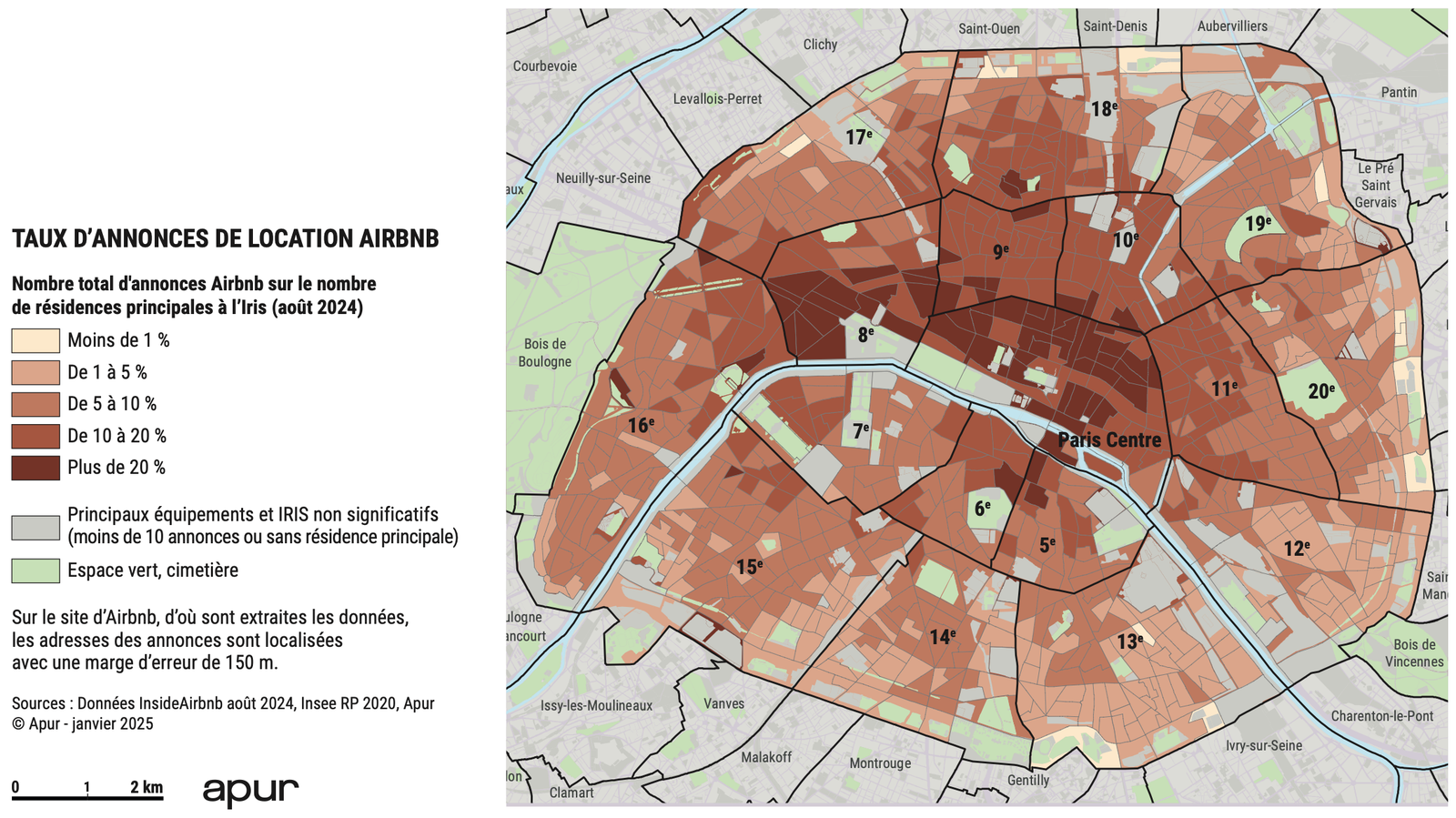
    Here’s a map showing the number of Airbnb listings compared to the number of principal residences:

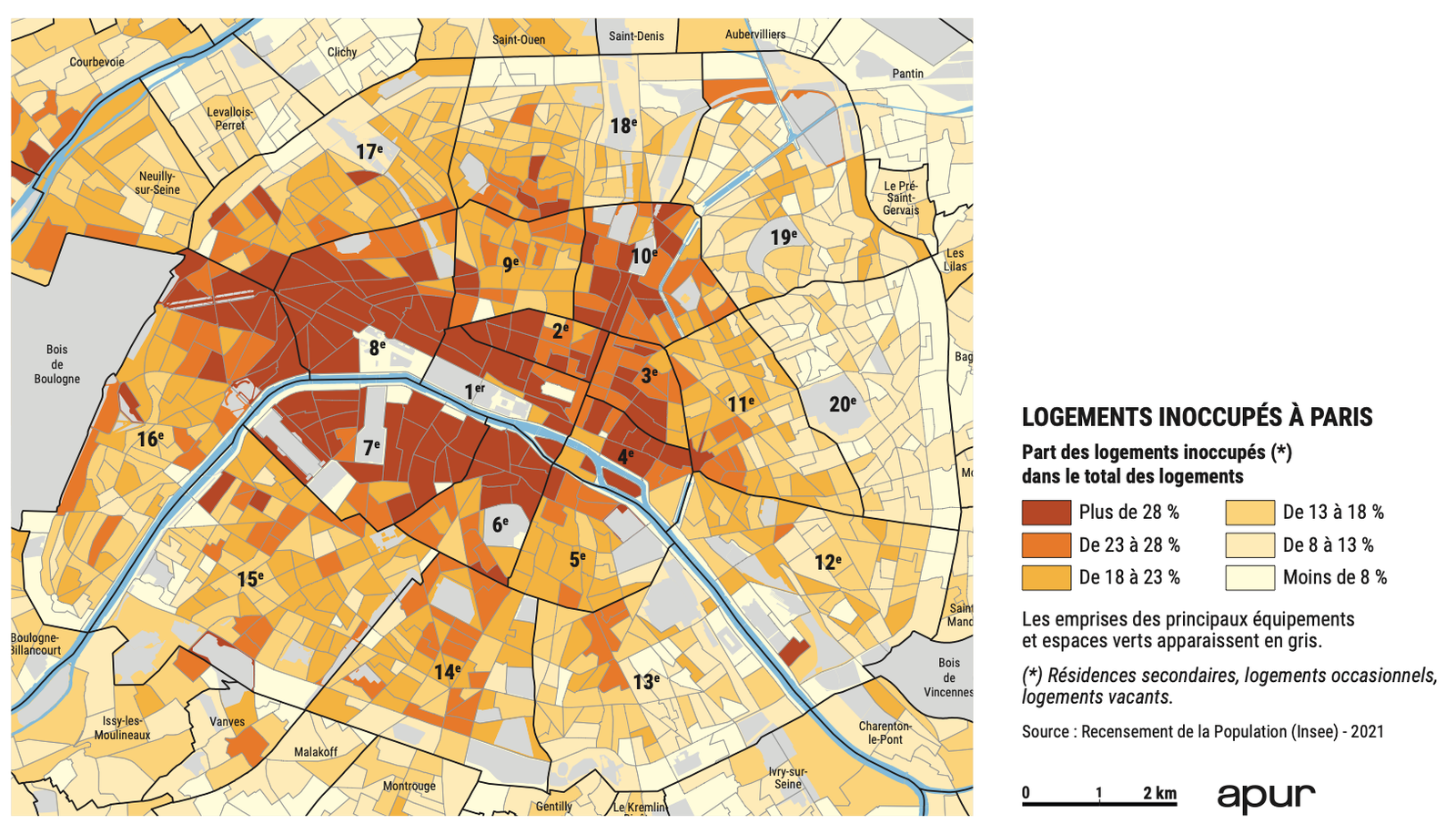
    And here’s a map showing the percentage of unoccupied homes in the city, which totalled 268,500 as of 2021:

    The report defines an “unoccupied home” to be any home that is not used as a household’s primary residence. So in addition to flat out empty homes, it includes homes that are used sporadically throughout the year for pleasure and/or for work. And as you can see, there are large sections of the center of the city where “unoccupied” and second homes make up over 28% of the total housing stock.

    These areas also closely mirror the areas where tourist rentals are most popular, and where Airbnb listings make up over 20% of the housing stock. (See the second chart above.) And as far as I can tell, these are mutually exclusive classifications, meaning there are sections of the city where a large percentage of the housing stock (perhaps up to half?) is either a short-term rental or a second home.

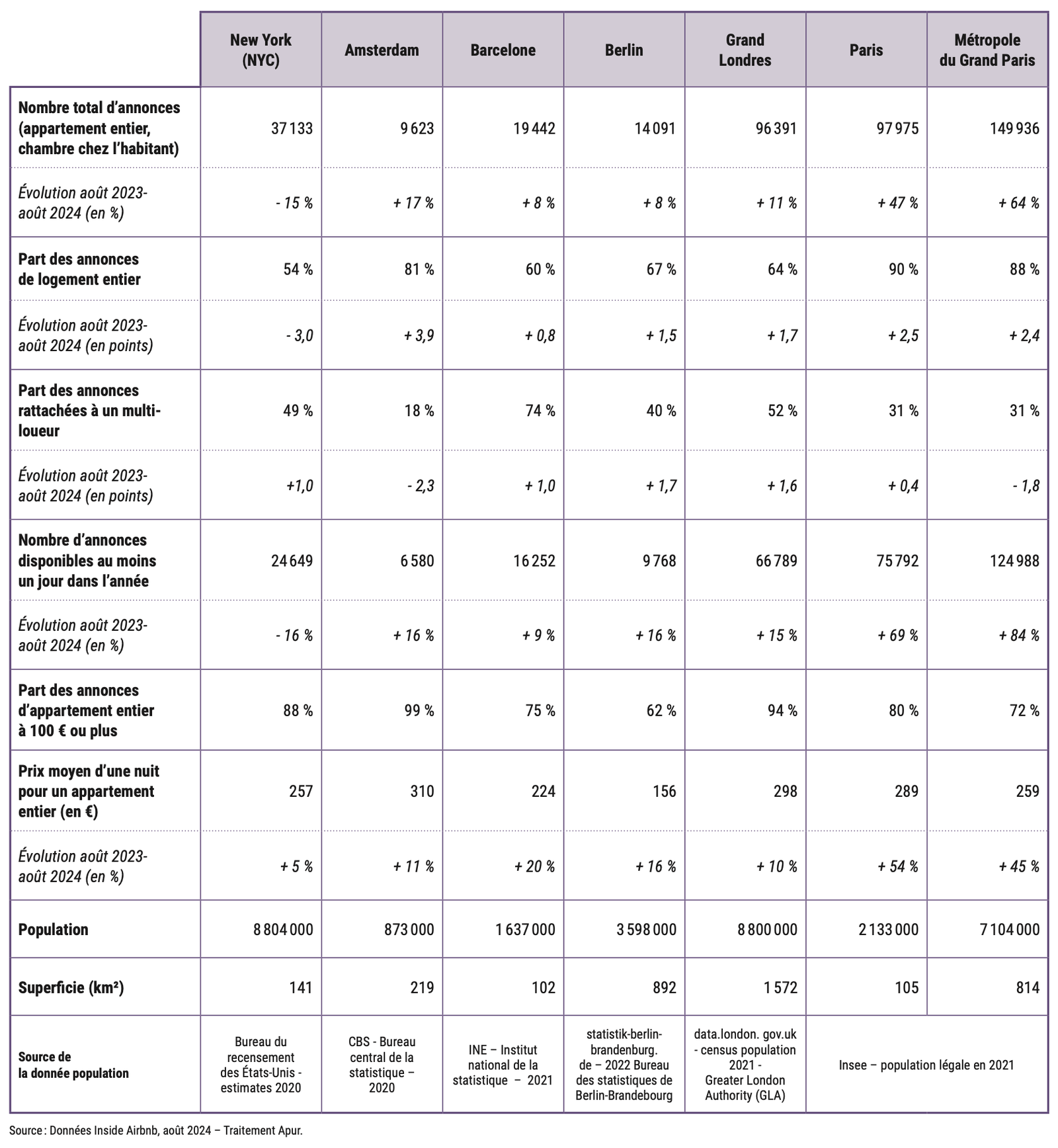
    This tells you a lot about the housing market in Paris, especially when you compare it to other global cities:

    NYC, for example, is shown here as having 8.8 million people, compared to 7.1 million people in Greater Paris. And yet Greater Paris has about 4x the total number of short-term rental listings. The number of available listings (where the property was available for at least one day of the year) also increased by 84% from August 2023 to August 2024 in Greater Paris; whereas it dropped by 16% in NYC, likely because the city basically banned short-term rentals.

    The two reports can be found here and here (note they’re in French). And they’re rich in data if you’d like to learn more about some of the dynamics impacting Paris’ housing market.

    Cover photo by Kris Atomic on Unsplash

  • New website for Parkview Mountain House

    March 16, 2025 · View original


    We just did a complete overhaul of the landing page for Parkview Mountain House.

    If you’re a new reader, PMH is Globizen’s “creative retreat” in Park City, Utah. We completed it and opened it up for reservations at the end of last year.

    If any of you have feedback on the new page, I’d love to hear it. It was a lot of fun rummaging through all of the photos that I have taken there over the years during development and construction.

    And as much as I love snowboarding, I also really enjoy visiting during the summer months. It’s a close second. This year my plan is to get down there for some road biking.

  • How “viager” transactions work in France

    March 12, 2025 · View original


    In the 9th century, France enacted into law a way to buy and sell property through something known as une vente en viager. My understanding is that there are other European countries that also allow this, but that it’s most popular in France, even if it still forms a relatively small portion of the market.

    Here’s how it typically works. You’re an older person (or older couple) and you want to use your home to generate some cash, but you also want to stay living in your home until the very end. So you offer it up for sale en viager occupé. (This is the most popular option, but there’s also le viager libre, where the seller moves out immediately.)

    Whoever buys it will usually pay you, the seller, in two ways. They will pay you an upfront lump sum (called le bouquet) and a recurring payment (called la rente viagère) up until the day you die (or both of you die). Once this happens, the buyer then gets full enjoyment of the property. The transaction is complete.

    So why would either party want to sell and buy in this way?

    Well, if you’re the seller, the obvious benefits are that (1) you get to continue living in your home and (2) you get some money now and for the rest of your life. This can be useful if you, say, run out of cash during retirement. It’s a means to financial independence.

    For buyers, it’s the opportunity to maybe acquire a property below its current market price. Because if you don’t have access to the home until some undetermined date in the future, well then a discount will obviously need to be applied. The initial lump sum payment is often around 30% of the current value. The other attractive feature is that it’s a form of financing for buyers who may not have all the money they need today.

    In the end, this is a bet on life expectancy. Because if the seller ends up living for a really long time, then they get the benefit of more annuity payments. However, if they end up living fewer years than expected, then the buyer benefits from having to pay less in annuity payments. They got to buy below market.

    It’s a fascinating pricing and time-value-of-money exercise, but it’s also a potentially morbid way to buy real estate. On the one hand, you could be helping someone live a dignified retirement. On the other hand, you stand to benefit if they die sooner than expected.

    Cover photo by Zach Dyson on Unsplash

  • The biggest developer in Paris today is the mayor

    March 9, 2025 · View original


    The other night, I went down a Parisian real estate rabbit hole on Twitter. And one of the things that kept coming up was this half joke: The biggest developer in Paris today is the mayor. The reason for this is that the city is targeting 40% of all homes to be public housing by 2035 (of which 30% will be social housing and 10% will be moderately affordable).

    Supposedly this is to stem the steady outflow of people from the capital as a result of housing being too expensive. But it means that a lot of new public housing will need to be created. As of January 1, 2021, the official estimate was 260,563 “logements sociaux” in the capital, which translates into 22.4% of all principal residences.

    To hit this 40% goal, the city is going to need to create somewhere around 140,000 new public housing dwellings between now and 2035. So how does it plan to do this? By being a developer, of course. A big part of the strategy seems to be to convert existing buildings (d’adapter l’existant). And to execute on this, the city is leveraging something known as “le droit de préemption.”

    The way it works is like a right of first refusal clause (ROFR), except that it’s not something that was contractually negotiated between market participants, it’s just the law. What it means is that if a property owner goes to sell their building and they receive an offer, the city has an automatic ROFR and can choose to buy the building at whatever that third party was willing to pay.

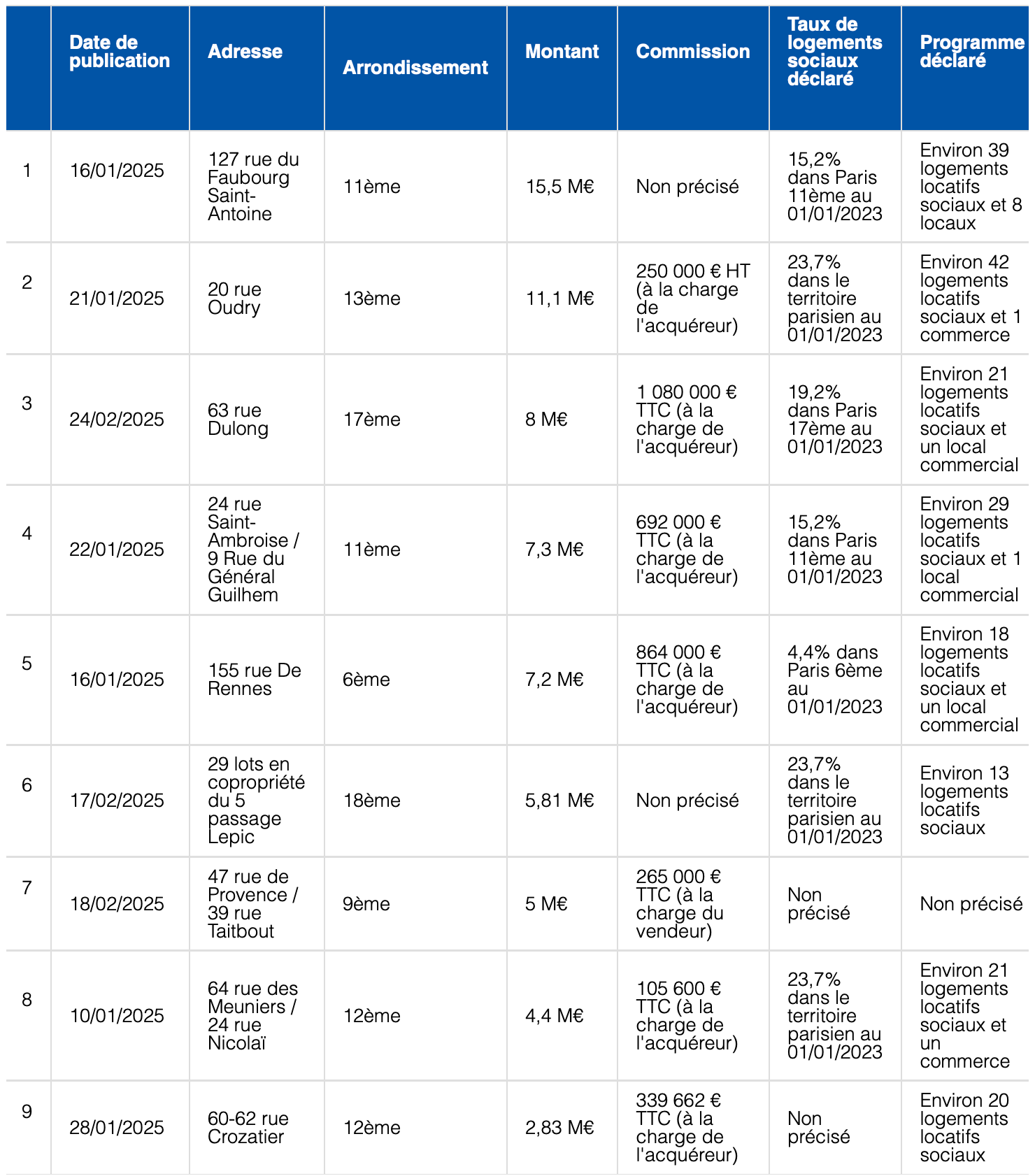
    Over the last two years, the city has elected to do this 84 times and has spent over €1.1 billion, according to Business Immo. And since the beginning of this year, they’ve done it 9 times, spending about €67 million on the following properties:

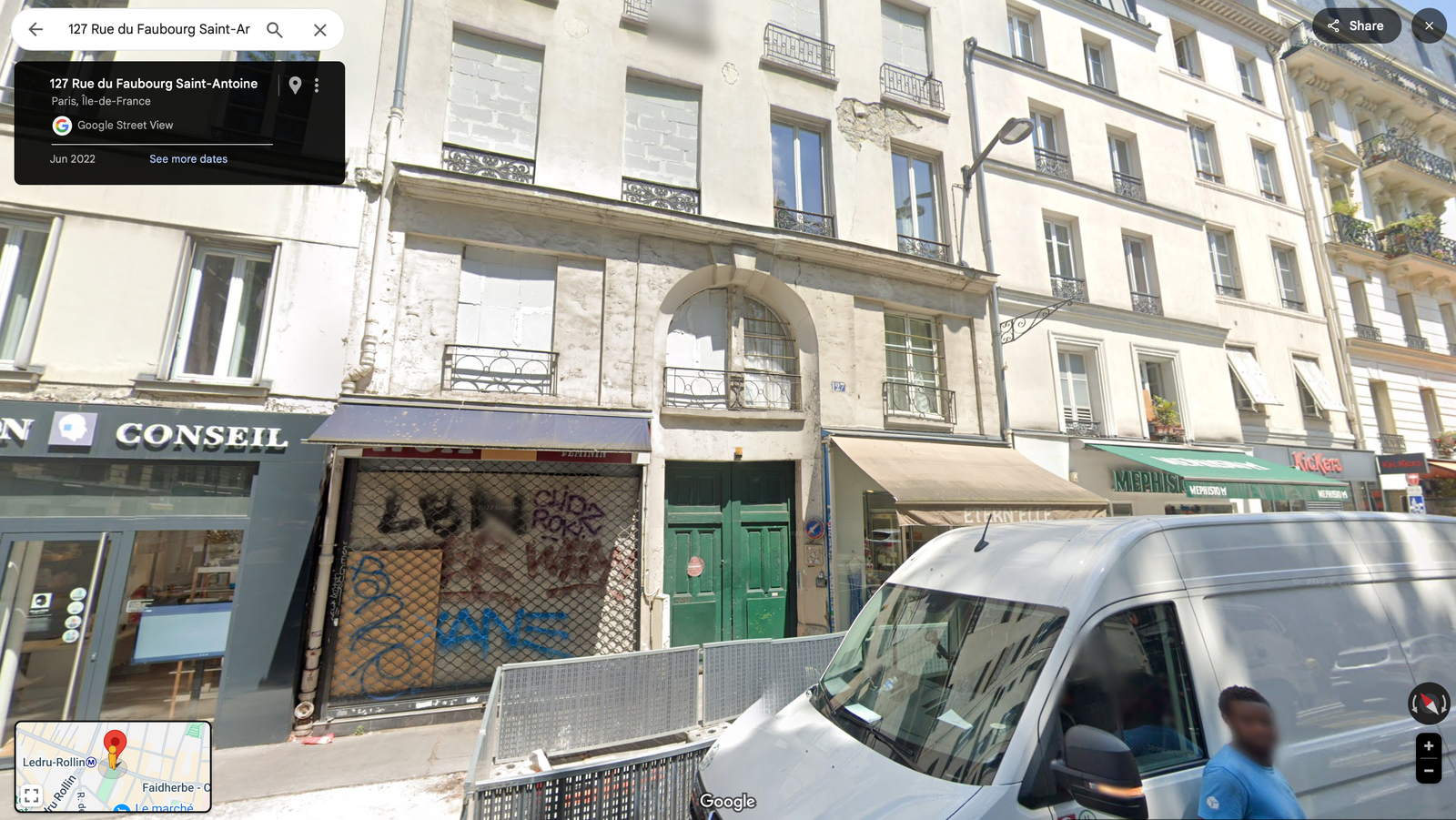
    For those of you who are visual learners like me, here’s the first property on the list:

    It’s certainly ambitious.

    But, for the most part, it does not create a lot of net new housing, even though the city is also aiming to buy office buildings, parking garages, and other non-residential buildings. APUR previously estimated that for every 1 unit of new public housing, 0.6 existing units are being demolished. So the most accurate way to think about this initiative is that it represents the socialization of Paris’ housing stock into public hands.

    This runs in contrast to what we’ve been talking about recently with cities like Minneapolis and Austin, who have instead added a lot of new market-rate housing in order to temper rents and increase affordability. Paris is reducing its stock of market-rate housing.

    At the same time, the city also enacted new policy prohibiting homes that consume more than 450 kWh/m2 from being rented. This is intended to force landlords to renovate, but it will certainly have a further impact on supply, at least in the short term.

    It’s also worth noting that all of this is happening at a time when Paris’ housing market is in broad decline (less transactions, higher days on market, lower prices, and so on). Like Toronto, it started around the middle of 2022. And it’s something that Paris hadn’t seen since the 2008 financial crisis.

    Chart by CoStar via Business Immo; cover photo by Salomé Watel on Unsplash

  • The 10 largest urban areas in the world

    February 18, 2025 · View original


    I have a new not-so-serious goal. I say not-so-serious because I’m busy with lots of other things and who knows if/when I’ll actually get around to this. So let’s just say that this goal is based on a strong interest. I would like to visit the 10 largest urban areas in the world.

    I was careful to say urban areas, because largest cities can be misleading. City proper boundaries are an arbitrary measure. What matters more are the built up areas.

    I have already been to a handful of them, namely the ones centered around Tokyo, Dhaka, and Mexico City. But there are more on the list that I haven’t been to.

    There are, however, two immediate challenges with setting a not-so-serious goal like this one. The first is that it’s not easy to come up with a definitive list of the largest urban areas. It’s nuanced and, for some cities, population estimates are very much rough estimates.

    The second is that population figures are constantly changing. So by the time I get around to this, many of the largest cities might be in Africa (current forecast for this century) and I may be checking off the wrong list.

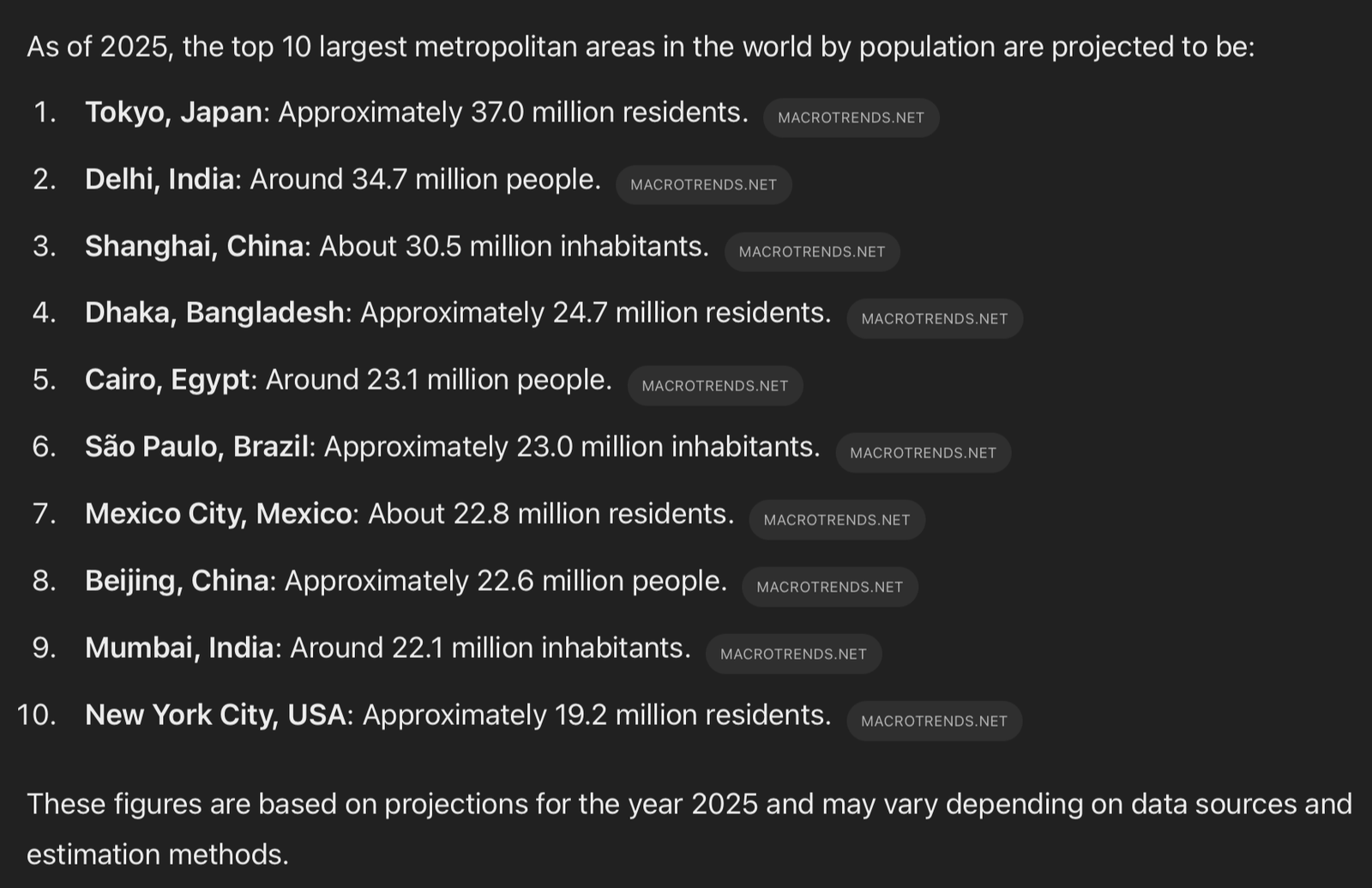
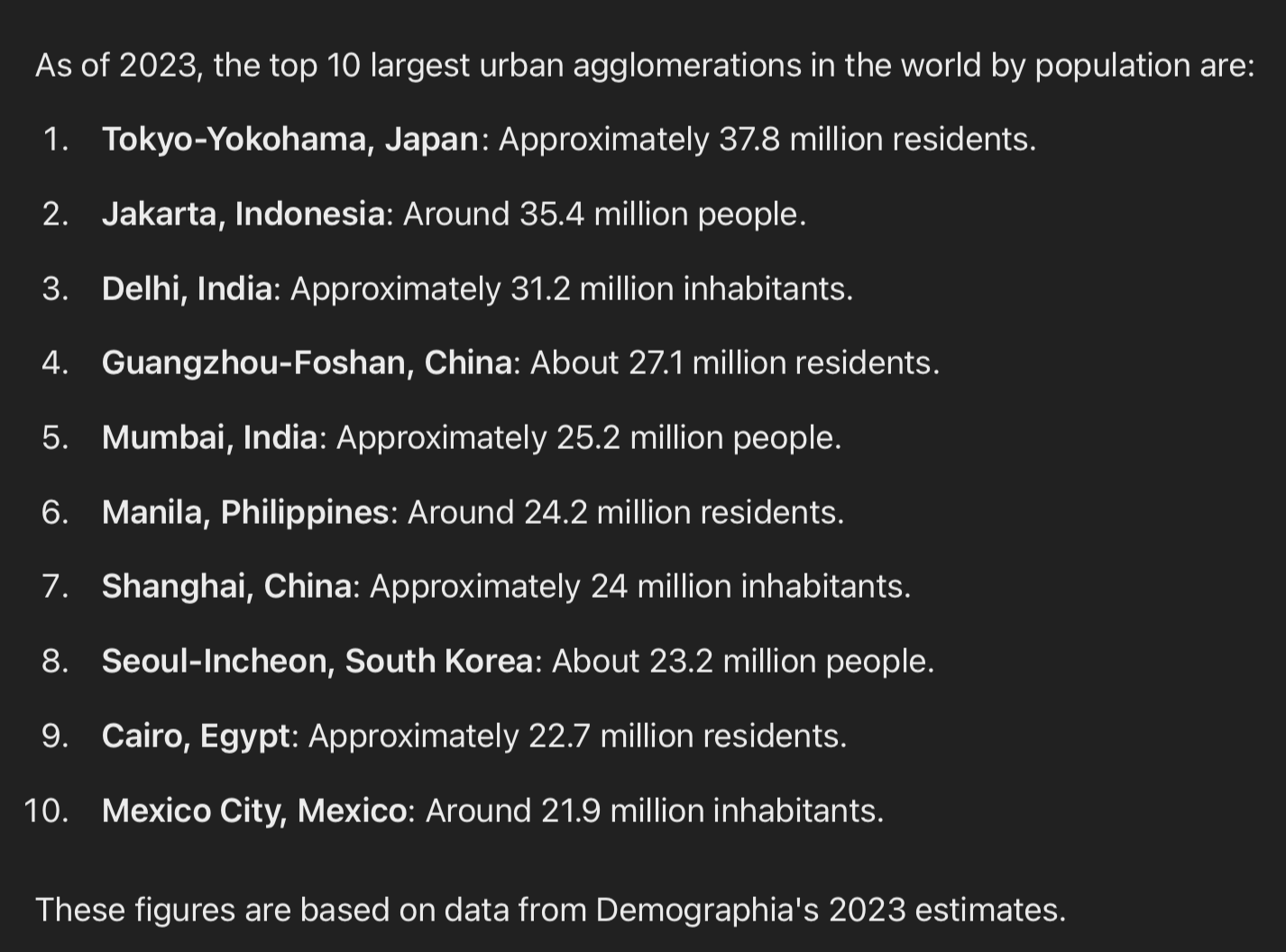
    But let’s not let perfect be the enemy of good. Here’s what I came up with. And by “what I came up with,” I mean that I asked ChatGPT its opinion. This is the list I got:

    Then I asked the question in a slightly different way and got this list:

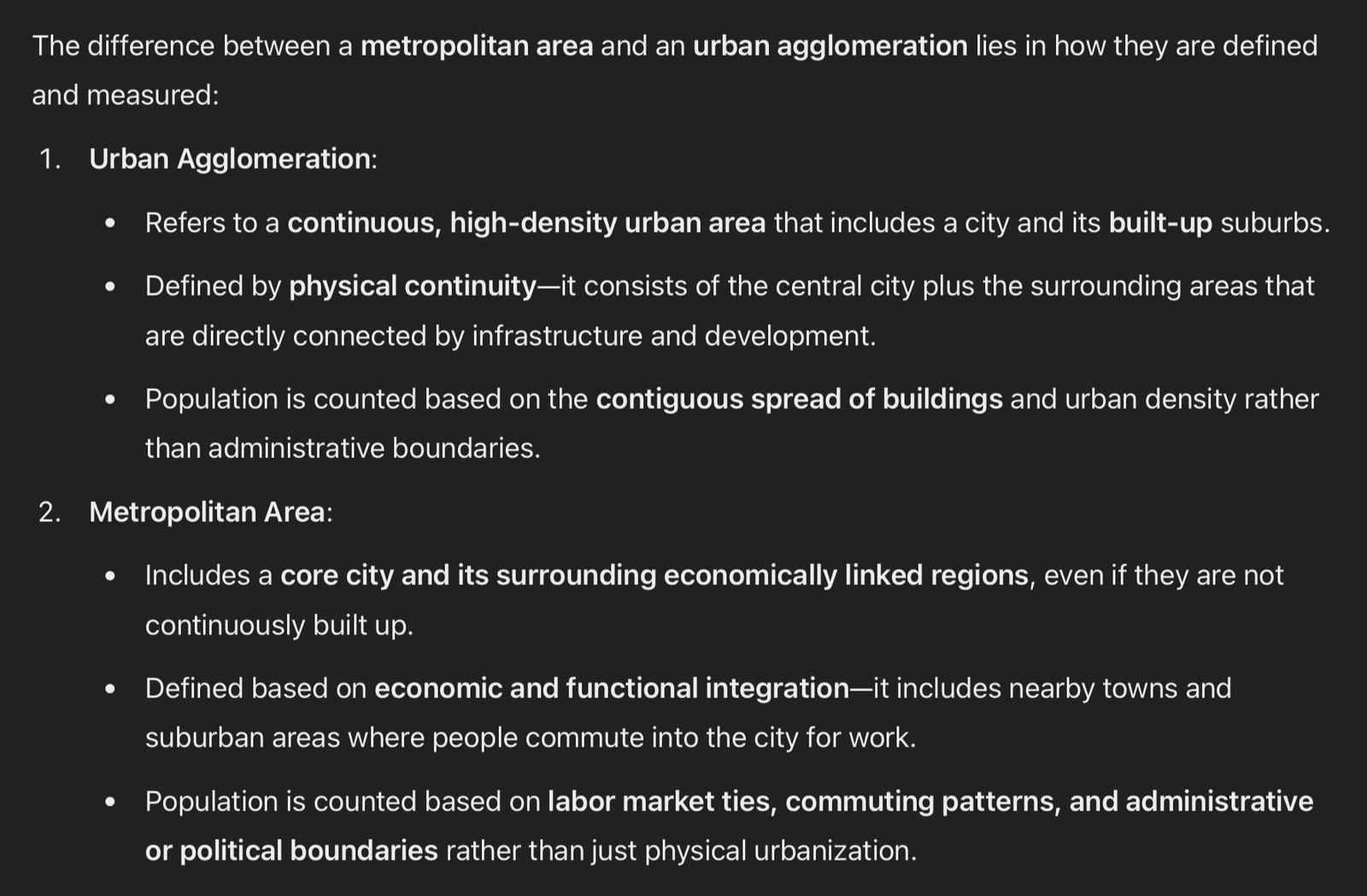
    Then I asked it to tell me its definition of metropolitan area vs. urban agglomeration:

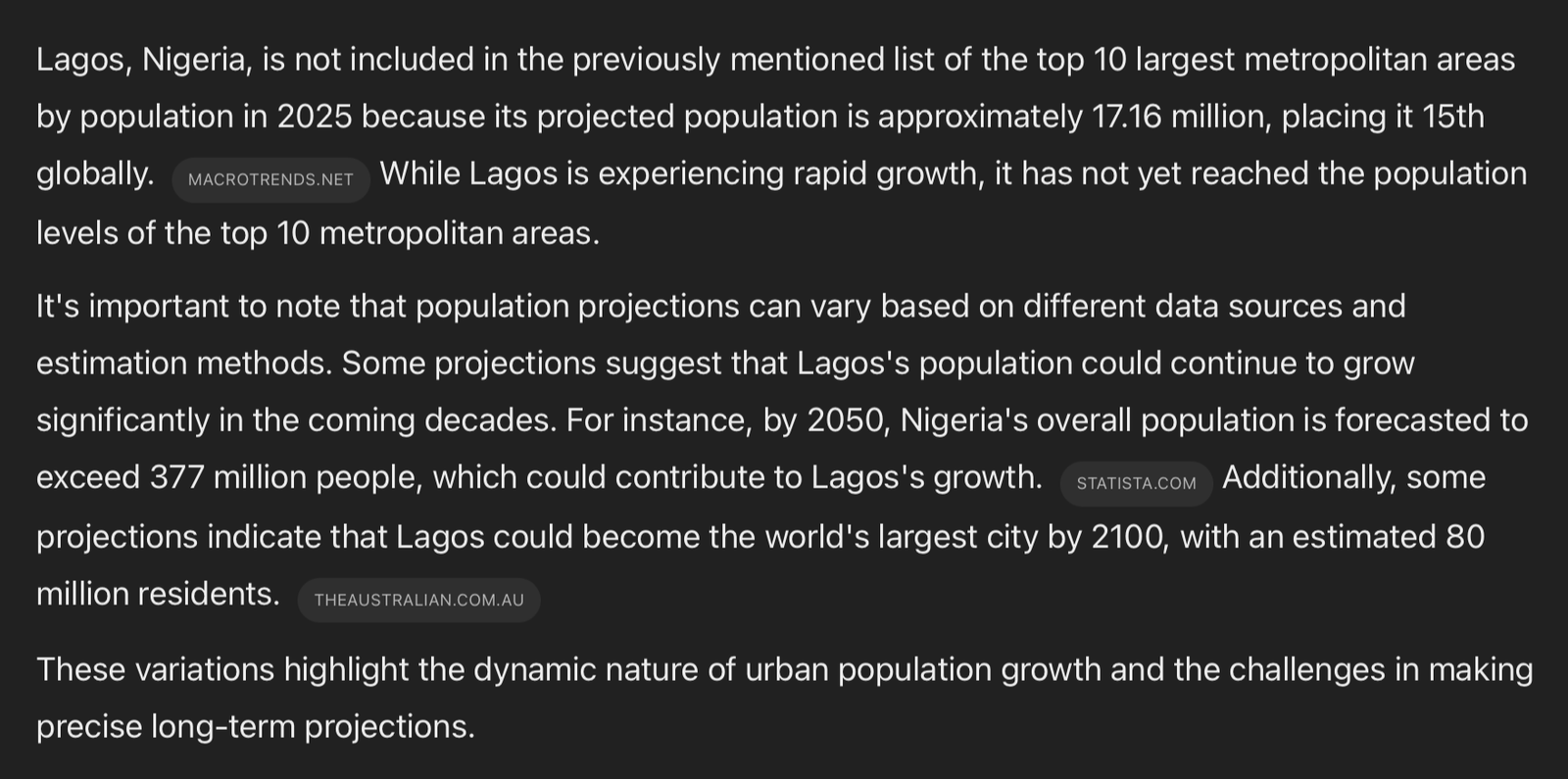
    Finally, I asked it why Lagos, Nigeria was not on the list. Current estimates place this urban region at more than 20 million people (which would place it ahead of New York in the first list), but I don’t think anyone really knows for sure. Whatever the current number, it is widely understood to be one of the fastest growing city regions in the world. This is how ChatGPT responded:

    I’m a little torn because high on my list of cities to visit are São Paulo and Seoul. And they don’t seem to be finding themselves on the same list. I’m also very curious to see Lagos, and I have a suspicion that it’s much larger than official estimates. Regardless, there are some clearly big cities to check off. India and China would be good places to start. So I better get to work. Or not. Since this is a not-so-serious goal.