
Daily insights for city builders. Published since 2013 by Toronto-based real estate developer Brandon Donnelly.

Subscribe to Brandon Donnelly
>4.2K subscribers
>4.2K subscribers

Canada must become a global superpower
The silver lining to the US starting a trade war with Canada and regularly threatening annexation is that it has forced this country out of complacency. Indeed, I'm hard pressed to remember a time, at least in my lifetime, when patriotism and nationalism has united so much of Canada. According to a recent survey by Angus Reid, the percentage of Canadians expressing a "deep emotional attachment" to the country jumped from 49% in December 2024 to 59% in February 2025. And as further evidence of...

The bank robbery capital of the world
Between 1985 and 1995, Los Angeles' retail bank branches were robbed some 17,106 times. In 1992, which was the the city's worst year for robberies, the number was 2,641. This roughly translated into about one bank robbery every 45 minutes of each banking day. All of this, according to this CrimeReads piece by Peter Houlahan, gave Los Angeles the dubious title of "The Bank Robbery Capital of the World" during this time period. So what caused this? Well according to Peter it was facil...
The story behind those pixelated video game mosaics in Paris
If you've ever been to Paris, you've probably noticed the small pixelated art pieces that are scattered all around the city on buildings and various other hard surfaces. Or maybe you haven't seen or noticed them in Paris, but you've seen similarly pixelated mosaics in one of the other 79 cities around the world where they can be found. Or maybe you have no idea what I'm talking about right now. Huh? Here's an example from Bolivia (click here if you can't see...

Canada must become a global superpower
The silver lining to the US starting a trade war with Canada and regularly threatening annexation is that it has forced this country out of complacency. Indeed, I'm hard pressed to remember a time, at least in my lifetime, when patriotism and nationalism has united so much of Canada. According to a recent survey by Angus Reid, the percentage of Canadians expressing a "deep emotional attachment" to the country jumped from 49% in December 2024 to 59% in February 2025. And as further evidence of...

The bank robbery capital of the world
Between 1985 and 1995, Los Angeles' retail bank branches were robbed some 17,106 times. In 1992, which was the the city's worst year for robberies, the number was 2,641. This roughly translated into about one bank robbery every 45 minutes of each banking day. All of this, according to this CrimeReads piece by Peter Houlahan, gave Los Angeles the dubious title of "The Bank Robbery Capital of the World" during this time period. So what caused this? Well according to Peter it was facil...
The story behind those pixelated video game mosaics in Paris
If you've ever been to Paris, you've probably noticed the small pixelated art pieces that are scattered all around the city on buildings and various other hard surfaces. Or maybe you haven't seen or noticed them in Paris, but you've seen similarly pixelated mosaics in one of the other 79 cities around the world where they can be found. Or maybe you have no idea what I'm talking about right now. Huh? Here's an example from Bolivia (click here if you can't see...

One of the fundamental principles that we espouse on this blog is that land use and transportation planning are integral to one another. This matters if you're trying to build a big, bad global city because there are limits to what you can accomplish with car-oriented planning. Eventually traffic congestion becomes unbearable and the model starts to breakdown (consider Toronto and Atlanta right now).
This means that, if you'd like to continue scaling, eventually you'll need to start getting serious about transit-oriented development and other forms of mobility. Japan is one of the best examples of this. But the key prerequisite for this is urban density. This is the unlock that makes transit practical and convenient for people.
That's why this week's planning announcement is a big one for Toronto. On August 15, the Government of Ontario (through the Ministry of Municipal Affairs and Housing) approved, with some modifications, 120 Major Transit Station Areas and Protected Major Transit Station Areas in the City of Toronto. Here's a summary of the MMAH's decision via the City's website, and below is a map of the transit station areas. (Note that some station areas are missing from this map and are still under review.)
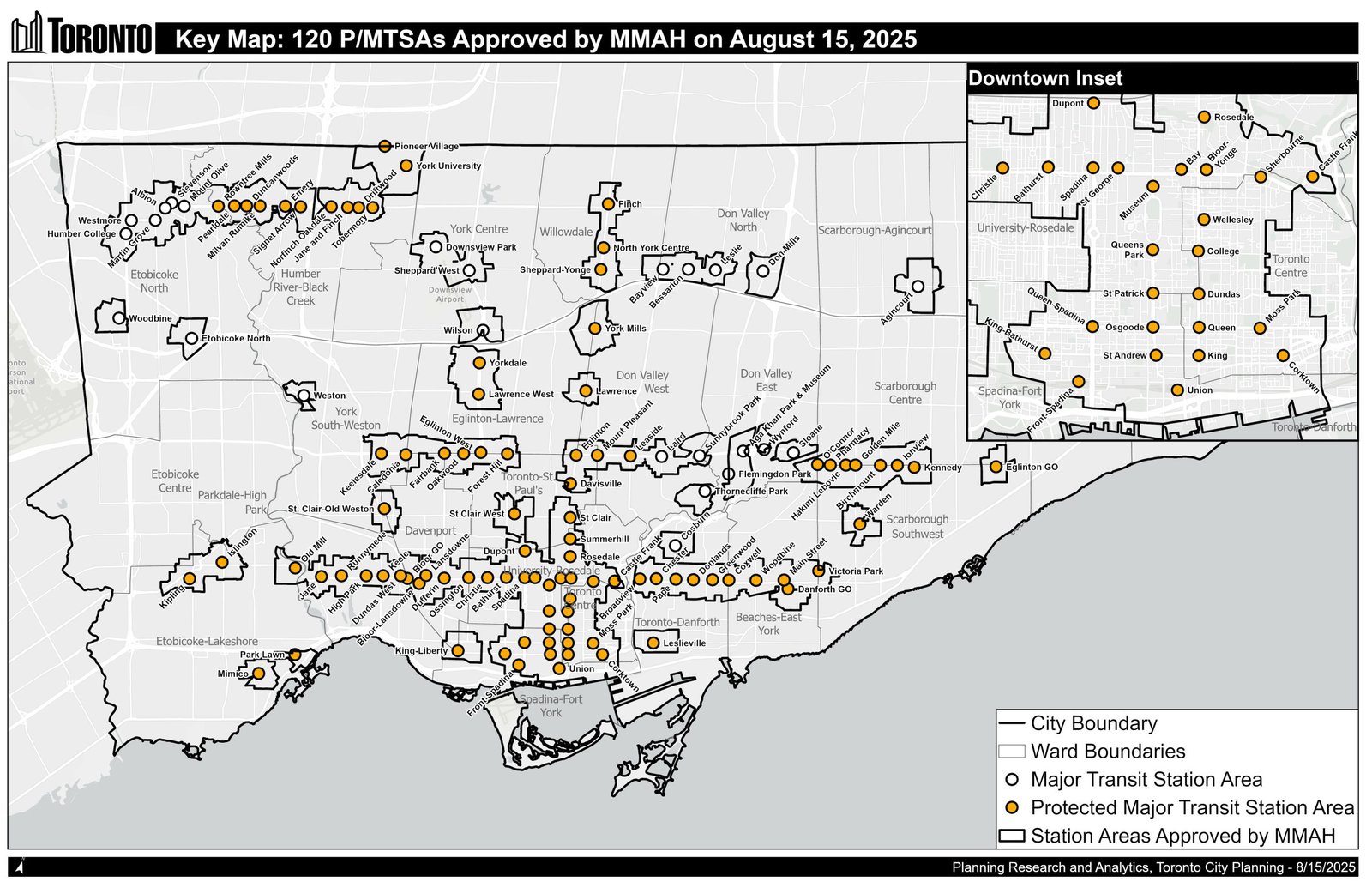
At a high level, these are areas that fall within an approximately 500-800 meter radius of transit stations, and would therefore be less than a 10-minute walk for most people. It's land that is best suited to transit-oriented development and that would strengthen any new/existing transit investments. For example, if you have an existing station that is underperforming from a ridership standpoint, the best solution is more density within its immediate catchment area.
Because of this, Ontario's Provincial Planning Statement prescribes the following minimum density targets for MTSAs:
200 residents and jobs per hectare for subways
160 residents and jobs per hectare for light rail or bus rapid transit
150 residents and jobs per hectare for commuter or regional rail
And to satisfy these requirements, cities need to demonstrate how they have planned for these minimum targets.
PMTSAs are a subset of MTSAs and come with some additional features, such as minimum unit counts and/or floor space indexes (floor area ratios). These are also the only transit areas where cities have the option of enabling Inclusionary Zoning, which is something they may do when the market rents in an area are high enough that the subsidies required to build affordable housing can be shifted onto the tenants paying market rents. (My views on inclusionary zoning can be found, here.)
Over the coming weeks, everyone in the industry is going to be analyzing the implications of this new approval. Overland (which is a legal firm that we work with) just posted on their blog that their review is underway and that they'll be posting something shortly. But in the meantime, I'd like to say that this is meaningful progress (and one that has been a longtime coming).
It acknowledges the important link between land use planning and mobility, and it better aligns our policies to support a post-car city. Of course, in many ways, this is an obvious thing to do. I started this post by calling it a fundamental principle of city building. But city planning happens slowly and incrementally. If you're following along, you'll see that Toronto is in fact growing up as a big, bad global city.
Cover photo by Andrii Khrystian on Unsplash

One of the fundamental principles that we espouse on this blog is that land use and transportation planning are integral to one another. This matters if you're trying to build a big, bad global city because there are limits to what you can accomplish with car-oriented planning. Eventually traffic congestion becomes unbearable and the model starts to breakdown (consider Toronto and Atlanta right now).
This means that, if you'd like to continue scaling, eventually you'll need to start getting serious about transit-oriented development and other forms of mobility. Japan is one of the best examples of this. But the key prerequisite for this is urban density. This is the unlock that makes transit practical and convenient for people.
That's why this week's planning announcement is a big one for Toronto. On August 15, the Government of Ontario (through the Ministry of Municipal Affairs and Housing) approved, with some modifications, 120 Major Transit Station Areas and Protected Major Transit Station Areas in the City of Toronto. Here's a summary of the MMAH's decision via the City's website, and below is a map of the transit station areas. (Note that some station areas are missing from this map and are still under review.)

At a high level, these are areas that fall within an approximately 500-800 meter radius of transit stations, and would therefore be less than a 10-minute walk for most people. It's land that is best suited to transit-oriented development and that would strengthen any new/existing transit investments. For example, if you have an existing station that is underperforming from a ridership standpoint, the best solution is more density within its immediate catchment area.
Because of this, Ontario's Provincial Planning Statement prescribes the following minimum density targets for MTSAs:
200 residents and jobs per hectare for subways
160 residents and jobs per hectare for light rail or bus rapid transit
150 residents and jobs per hectare for commuter or regional rail
And to satisfy these requirements, cities need to demonstrate how they have planned for these minimum targets.
PMTSAs are a subset of MTSAs and come with some additional features, such as minimum unit counts and/or floor space indexes (floor area ratios). These are also the only transit areas where cities have the option of enabling Inclusionary Zoning, which is something they may do when the market rents in an area are high enough that the subsidies required to build affordable housing can be shifted onto the tenants paying market rents. (My views on inclusionary zoning can be found, here.)
Over the coming weeks, everyone in the industry is going to be analyzing the implications of this new approval. Overland (which is a legal firm that we work with) just posted on their blog that their review is underway and that they'll be posting something shortly. But in the meantime, I'd like to say that this is meaningful progress (and one that has been a longtime coming).
It acknowledges the important link between land use planning and mobility, and it better aligns our policies to support a post-car city. Of course, in many ways, this is an obvious thing to do. I started this post by calling it a fundamental principle of city building. But city planning happens slowly and incrementally. If you're following along, you'll see that Toronto is in fact growing up as a big, bad global city.
Cover photo by Andrii Khrystian on Unsplash
Share Dialog
Share Dialog
One of the fundamental principles that we espouse on this blog is that land use and transportation planning are integral to one another. This matters if you're trying to build a big, bad global city because there are limits to what you can accomplish with car-oriented planning. Eventually traffic congestion becomes unbearable and the model starts to breakdown (consider Toronto and Atlanta right now). https://brandondonnelly.com/toronto-is-planning-for-a-post-car-future
Interesting! 15 minutes cities from French-Colombian urban planner Carlos Moreno. I see buildings being built in the Randstad region of the Netherlands with little to no parking. This is simply to fill the city with buildings, instead of utilizing natural or agricultural land. However, tension is developing in city centers between the many (parked) bicycles and pedestrians. There are also many cargo bikes these days, which take up a lot of space. In short, the battle for public space won't stop when the car is replaced. Arttip
3 comments
One of the fundamental principles that we espouse on this blog is that land use and transportation planning are integral to one another. This matters if you're trying to build a big, bad global city because there are limits to what you can accomplish with car-oriented planning. Eventually traffic congestion becomes unbearable and the model starts to breakdown (consider Toronto and Atlanta right now). https://brandondonnelly.com/toronto-is-planning-for-a-post-car-future
Interesting! 15 minutes cities from French-Colombian urban planner Carlos Moreno. I see buildings being built in the Randstad region of the Netherlands with little to no parking. This is simply to fill the city with buildings, instead of utilizing natural or agricultural land. However, tension is developing in city centers between the many (parked) bicycles and pedestrians. There are also many cargo bikes these days, which take up a lot of space. In short, the battle for public space won't stop when the car is replaced. Arttip
https://media.tenor.com/Q-iPP1ty6pkAAAAC/sickos-sicko