
Canada must become a global superpower
The silver lining to the US starting a trade war with Canada and regularly threatening annexation is that it has forced this country out of complacency. Indeed, I'm hard pressed to remember a time, at least in my lifetime, when patriotism and nationalism has united so much of Canada. According to a recent survey by Angus Reid, the percentage of Canadians expressing a "deep emotional attachment" to the country jumped from 49% in December 2024 to 59% in February 2025. And as further evidence of...

The bank robbery capital of the world
Between 1985 and 1995, Los Angeles' retail bank branches were robbed some 17,106 times. In 1992, which was the the city's worst year for robberies, the number was 2,641. This roughly translated into about one bank robbery every 45 minutes of each banking day. All of this, according to this CrimeReads piece by Peter Houlahan, gave Los Angeles the dubious title of "The Bank Robbery Capital of the World" during this time period. So what caused this? Well according to Peter it was facil...
The story behind those pixelated video game mosaics in Paris
If you've ever been to Paris, you've probably noticed the small pixelated art pieces that are scattered all around the city on buildings and various other hard surfaces. Or maybe you haven't seen or noticed them in Paris, but you've seen similarly pixelated mosaics in one of the other 79 cities around the world where they can be found. Or maybe you have no idea what I'm talking about right now. Huh? Here's an example from Bolivia (click here if you can't see...


Canada must become a global superpower
The silver lining to the US starting a trade war with Canada and regularly threatening annexation is that it has forced this country out of complacency. Indeed, I'm hard pressed to remember a time, at least in my lifetime, when patriotism and nationalism has united so much of Canada. According to a recent survey by Angus Reid, the percentage of Canadians expressing a "deep emotional attachment" to the country jumped from 49% in December 2024 to 59% in February 2025. And as further evidence of...

The bank robbery capital of the world
Between 1985 and 1995, Los Angeles' retail bank branches were robbed some 17,106 times. In 1992, which was the the city's worst year for robberies, the number was 2,641. This roughly translated into about one bank robbery every 45 minutes of each banking day. All of this, according to this CrimeReads piece by Peter Houlahan, gave Los Angeles the dubious title of "The Bank Robbery Capital of the World" during this time period. So what caused this? Well according to Peter it was facil...
The story behind those pixelated video game mosaics in Paris
If you've ever been to Paris, you've probably noticed the small pixelated art pieces that are scattered all around the city on buildings and various other hard surfaces. Or maybe you haven't seen or noticed them in Paris, but you've seen similarly pixelated mosaics in one of the other 79 cities around the world where they can be found. Or maybe you have no idea what I'm talking about right now. Huh? Here's an example from Bolivia (click here if you can't see...
Last month, we talked about how even "luxury" housing can improve overall housing affordability in a market. In that post, we spoke about a recent study that looked at the downstream effects of a new condominium tower in Honolulu. Today, let's look at Switzerland.
I stumbled upon this working paper on Twitter. The authors are Lukas Hauck and Frédéric Kluser, both from the University of Bern. In it, they look at the country-wide effects of new residential housing supply in Switzerland and, more specifically, the "moving chain" that new supply produces.
Moving chains work generally as follows:
A household moves into a newly constructed home
Their previous home becomes vacant
Another household moves into this vacant unit, leaving their previous home vacant
And the process continues, until someone breaks the chain (which can happen by way of a new household being formed or someone moving in from out of the market)
The authors found that these moving chains are relatively short in Switzerland. Approximately 75% of them terminate within three migration rounds. But this doesn't mean that these chains aren't critical for the market.
Importantly, they found that every new market-rate unit typically results in 0.75 moves for households with below-median incomes. So, that is 75 moves for every 100 new homes constructed.
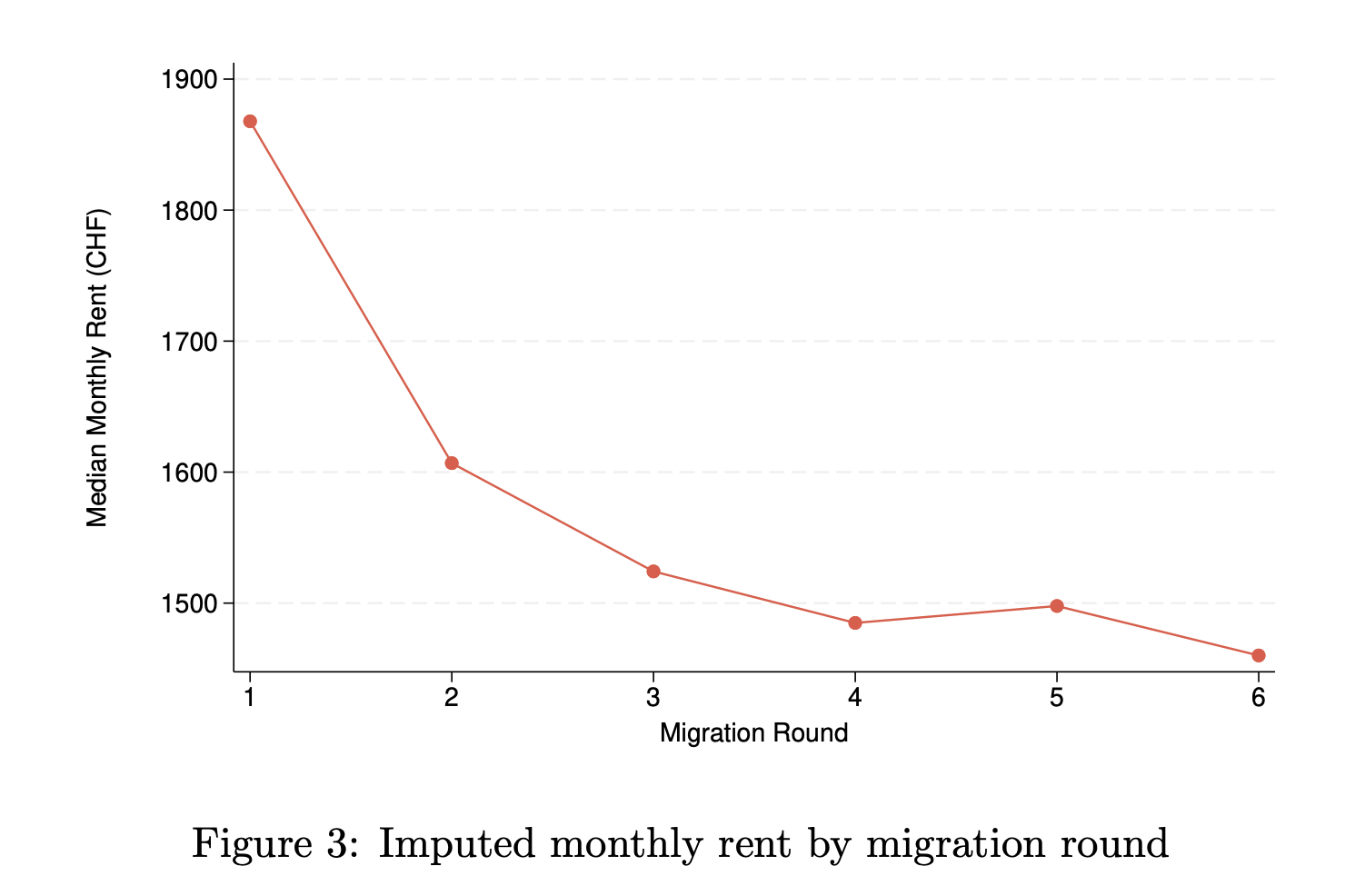
The reason why new supply ends up also benefiting lower-income households is because there's a clear income and rent gradient across the moving chain:
Last month, we talked about how even "luxury" housing can improve overall housing affordability in a market. In that post, we spoke about a recent study that looked at the downstream effects of a new condominium tower in Honolulu. Today, let's look at Switzerland.
I stumbled upon this working paper on Twitter. The authors are Lukas Hauck and Frédéric Kluser, both from the University of Bern. In it, they look at the country-wide effects of new residential housing supply in Switzerland and, more specifically, the "moving chain" that new supply produces.
Moving chains work generally as follows:
A household moves into a newly constructed home
Their previous home becomes vacant
Another household moves into this vacant unit, leaving their previous home vacant
And the process continues, until someone breaks the chain (which can happen by way of a new household being formed or someone moving in from out of the market)
The authors found that these moving chains are relatively short in Switzerland. Approximately 75% of them terminate within three migration rounds. But this doesn't mean that these chains aren't critical for the market.
Importantly, they found that every new market-rate unit typically results in 0.75 moves for households with below-median incomes. So, that is 75 moves for every 100 new homes constructed.
The reason why new supply ends up also benefiting lower-income households is because there's a clear income and rent gradient across the moving chain:

New housing (migration round 1) is typically priced at the highest end of the market. This makes sense because we know that development happens on the margin. But by migration rounds 2 and 3, median rents fall off noticeably, creating housing opportunities for other people.
New market-rate housing is sometimes criticized for only serving one segment of the market. But once again, we see evidence that it helps to ease overall housing pressures. There are other indirect benefits that shouldn't be ignored.
Cover photo by Henrique Ferreira on Unsplash

New housing (migration round 1) is typically priced at the highest end of the market. This makes sense because we know that development happens on the margin. But by migration rounds 2 and 3, median rents fall off noticeably, creating housing opportunities for other people.
New market-rate housing is sometimes criticized for only serving one segment of the market. But once again, we see evidence that it helps to ease overall housing pressures. There are other indirect benefits that shouldn't be ignored.
Cover photo by Henrique Ferreira on Unsplash
Share Dialog
Share Dialog
No comments yet