Daily insights for city builders, delivered every morning at 6 AM ET. I’m Brandon Donnelly — a Toronto-based real estate developer and founder of Globizen. I’ve been writing here since 2013.
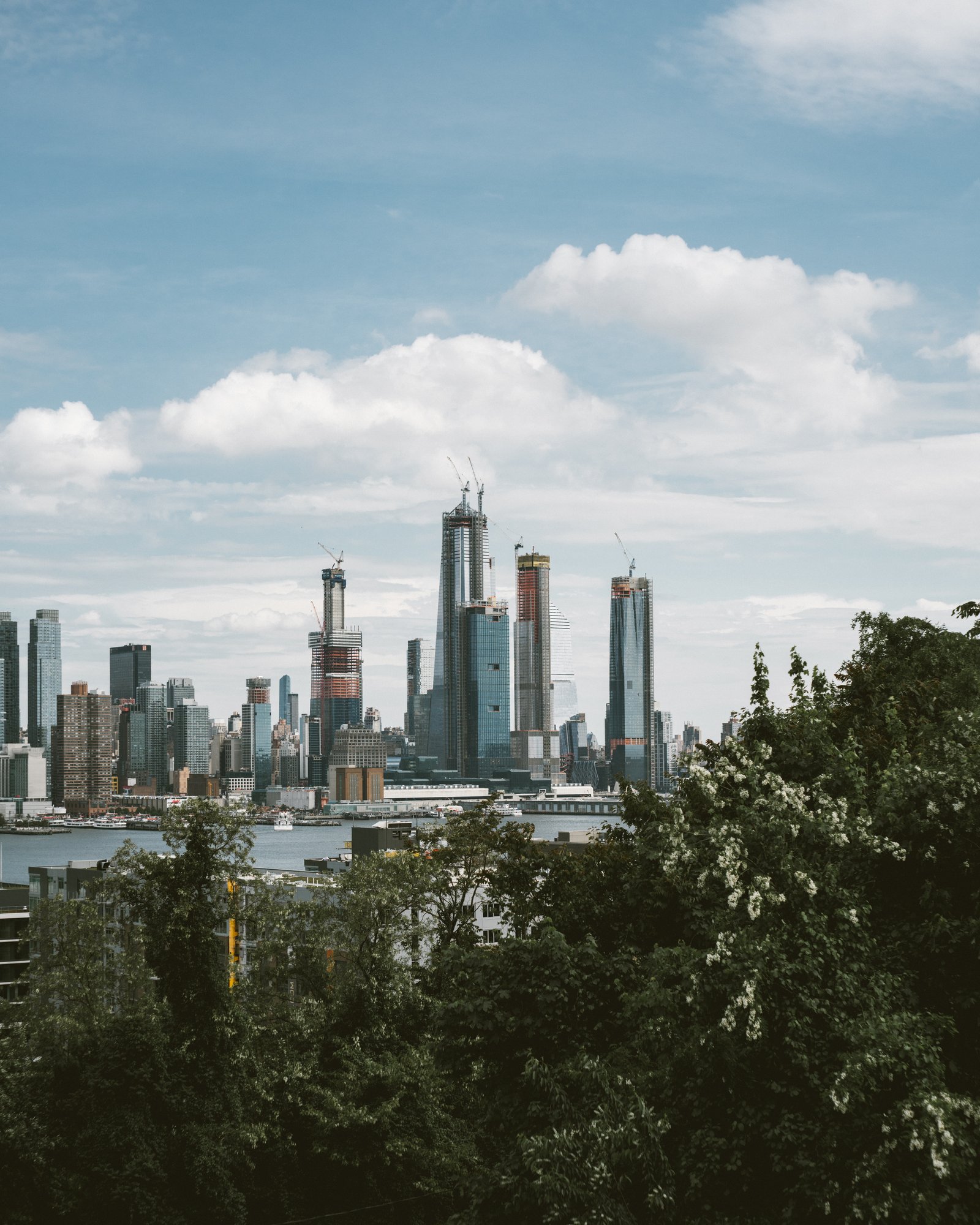
Debating the merits — or shortcomings, depending on which camp you’re in — of all-glass buildings isn’t new. But there seems to be a bit of a resurgence happening right now because of the recent opening of Hudson Yards in New York.
There’s an important environmental consideration here: Glass is, as a rule, a poor insulator. But often the other concern with all-glass buildings is their sameness. Witold Rybczynski recently wrote about this on his blog in a post called The Transparency Trap:
Le Corbusier described (modernist) architecture as “the masterly, correct and magnificent play of volumes brought together in light.” Corbusier used glass but he never designed all-glass buildings. Neither did Mies; he added superfluous I-beams to his facades (which also had substantial spandrels). The problem with transparent glass is that it doesn’t hold a shadow, and without a shadow there can be no “play of volumes.” Since minimalist modernist architecture doesn’t offer decoration or ornament, that doesn’t leave much to look at.
Witold isn’t usually appreciative of that which is new and I often find myself disagreeing with this critiques. But I like his metaphor of “holding a shadow.” Light and shadow are, of course, fundamental to architecture.
About a year ago I wrote about how NYC is considering a congestion charge on vehicles entering Manhattan below 60th street. Well it looks like that plan could be adopted as early as April 1 (however the fees won’t start until 2021).
Here’s a map of the proposed congestion pricing zone from the NY Times:
I have written extensively on road pricing over the years and so I won’t repeat myself here today. Suffice to say that I think creating a sustainable funding source for transit and other mobility options is a positive step forward.
Hudson Yards officially opened today on the west side of Manhattan. More specifically, the eastern half of Hudson Yards opened. There’s a second phase to come on the western yards. And the highly anticipated observation deck at 30 Hudson Yards — the highest outdoor observation deck in the Western Hemisphere — is also not quite ready. It is expected to open in early 2020.
Considered the largest mixed-use private real estate project in American history by square footage, Hudson Yards has been in the works for many decades and was previously part of New York’s (failed) bid for the 2012 Olympic Games. Dan Doctoroff, who is now the CEO of Sidewalk Labs, led the bid under the Bloomberg administration.
So today is a bit of a big deal.
To commemorate the opening, the architecture critic for the New York Times, Michael Kimmelman, published this searing, but highly visual, piece about the project. I think it is fairly safe to assume that he isn’t a huge fan (he doesn’t seem to love developers either).
Purportedly inspired by ancient Indian stepwells (it’s about as much like them as Skull Mountain at Six Flags Great Adventure is like Chichen Itza) the object — I hesitate to call this a sculpture — is a 150-foot-high, $200 million, latticed, waste-basket-shaped stairway to nowhere, sheathed in a gaudy, copper-cladded steel.
It preens along the critical axis between the High Line and the newish No. 7 subway station at Hudson Yards, hoping to drum up Instagram views and foot traffic for the mall, casting egregious shadows over what passes for public open space, ruinously manspreading beside the Shed, the most novel work of architecture on site, and the only building the private developers didn’t build.
If any of you have formulated your own opinions about Hudson Yards, I would love to hear from you in the comments below. I’m looking forward to exploring the neighborhood in person sometime soon. If you’re interested in learning more about the project, Curbed also just published, The ultimate guide to Hudson Yards.
New York is close to implementing new “pied-à-terre tax.” If the bill passes, which the New York Times believes is likely, cities of a million or more people will be able to levy an additional property tax on non-primary residence homes worth $5 million or more. The additional tax would be based on the following sliding scale:
So let’s say for argument sake that you own a pied-à-terre in New York City worth approximately $238 million. Based on the above, your additional tax would be $370,000 + [4% x ($238 million – ~$25 million)]. That’s almost $8.9 million. Most of the revenue from this tax is expected to come from this upper (and open-ended) valuation bracket.
New York City estimates that the tax could bring in about $650 million annually. The state in turn believes it could then raise $9 billion in bonds. And the intent is that these additional funds could be used to fund things like transit and housing. I am curious how elastic the demand is for trophy real estate in New York.
Another thing I noticed while reading up on this bill is that the New York State Senate has made it pretty easy to voice your opinion on proposed legislation. On the sidebar of every bill making its way through the system is a box that looks like this:
This is probably the clearest engagement tool I have ever seen on a government website. Do you think something like this could work for new housing?
Three years ago I wrote about how I was one step closer to not only going cashless — I had pretty much already done that — but also going walletless. (That’s one of the things about writing a daily blog — there’s a public record.) I still carry a wallet in most cases, but I couldn’t tell you the last time I paid for something using cash here in Toronto. It was probably at a Vietnamese restaurant.
I did, however, notice on my trip last month that Germany and Austria are still quite reliant on cash. Many places only accepted cash and many places wouldn’t accept credit cards under a certain minimum spend. Fewer opportunities to just tap as well. I had forgotten how annoying it was to carry around lots of coins. You really need a change purse.
Still, a paradigm shift has taken place. And because of this shift, there’s a growing movement in cities toward banning cash-free businesses. Philadelphia, Chicago, San Francisco, New York City, and Washington, DC are all working on policy. The concern is that not accepting cash discriminates against lower-income patrons.
An additional 24.2 million US households (additional 18.7% of all households) are estimated to be “underbanked”, meaning they have at least one account at an insured institution, but they also rely on outside financial products — such as payday loans.
When surveyed, somewhere around half tend to cite “not having enough money” as one of the reasons for being “unbanked.” But the good news is that the percentage of people without a bank account seems to be declining (see above chart).
This is important because we all know where things are headed. And banning cashless businesses isn’t going to stop that march. There are deeper issues that need to be addressed. Here is an excerpt from a recent CityLab article on the topic:
“I certainly don’t think [this bill] is the right long-term solution,” said Rogoff. “The future does not lie in this direction. The future lies in giving people free debit cards and financial inclusion.” He cited the case of India. The country launched a program to decrease the number of unbanked and saw the percentage decrease from 47 percent of adults in 2014 to 20 percent unbanked in 2017 according to the World Bank Global Findex Report. “If India can manage to give people free debit cards, so can the U.S.” Rogoff said.
Kenneth Rogoff is a professor of public policy at Harvard University, the former chief economist of the IMF, and author of The Curse of Cash. If you’re interested in this topic, his book may be a good one to check out.
Today the Partnership for New York City took out a full-page ad in the New York Times with an open letter to Amazon chief executive Jeff Bezos, asking him to reconsider the decision to pull out of NYC. The letter was signed by a long list of prominent leaders in the city. Here is a copy (a PDF version can also be found, here):
At the beginning of this year, the City of New York filed this lawsuit in an attempt to shut down an Airbnb business that has supposedly generated around $20 million in revenue since 2012. It is currently illegal to rent out an apartment in most buildings in the city for less than 30 days unless the owner/permanent tenant is present. And that’s not how this business was being operated.
Here are the locations of the rentals named in the lawsuit (map from the New York Times):
The defendants include a real estate brokerage, the three partners behind the business (more on them here), as well as others. NYC has been trying to pass legislation that would force Airbnb to disclose more information to the Mayor’s Office of Special Enforcement. Information such as the full name(s) and address(es) of every host and whether the short-term rental is an entire dwelling or a room. That presumably would have helped here.
For more on the lawsuit and the backstory, click here.
You may also find it interesting to go back to the five-point plan that Airbnb put forward back in 2016. It was intended to serve as a framework for new short-term rental legislation. The points make a lot of sense.
As I am sure you have all heard, there’s a lot of debate in New York right now (city and state) about whether they should reject Amazon’s decision to open up a new headquarters in Queens.
Urbanist Richard Florida has been arguing that one of the richest companies in the world shouldn’t be receiving taxpayer subsidies and that Amazon should do the right thing here. They should open up in New York but without any inducements.
As a counter argument, Kenneth Jackson, professor of history at Columbia University, recently opined that this is actually business as usual. American cities have a long history of competing for companies because the benefits outweigh the costs over the longer term.
Here is an excerpt from his op-ed in the New York Times:
They are right about one thing. It is absurd that any city would agree to such a deal. But this is how the game is played. Paying companies to relocate has been the American way since 1936, when Mississippi established the nation’s first state-sponsored economic development plan. Under that plan, since followed by many other jurisdictions, cities and states agreed to pay companies to relocate by promising them new factories and low or nonexistent taxes. With those inducements, numerous businesses relocated in the decades after World War II, usually from the union-dominated Northeast and Midwest to the business-friendly South.
The Mayor’s Office of Media and Entertainment in New York City recently commissioned this report on the city’s nightlife economy. The study was completed by Econsult Solutions, the North Highland Company, and Urbane Development. (Full disclosure: I was a teaching assistant for the President of Econsult while at Penn.)
Here’s what they found:
The total economic impact of this industry is the sum of its direct, indirect, and induced economic impacts, as well as the ancillary spending impacts that are adjacent to nightlife activity. In 2016 (the most recent year where standardized datasets were available), the nightlife industry supported 299,000 jobs with $13.1 billion in employee compensation and $35.1 billion in economic output. This economic impact also yielded $697 million in tax revenue for New York City.
They also found that, between 2011 and 2016, the nightlife industry has outpaced the city’s overall economy. Nightlife establishments grew by a 2% annual growth rate. Jobs in the nightlife industry grew by a 5% annual growth rate. And nightlife wages have been rising by 8% annually – about double the average for the city.
I am a firm believer in the value of the nighttime economy. So I’m happy to see more people paying attention to it as of late. For the full report, click here.
Since then, Harry and his firm have been in Time Magazine, have had a solo show at Design Miami, and have been named to the Architectural Digest 100, among many other things.
There has obviously been a lot of talk over the last few years about the impact that Instagram is having on physical spaces and design #IRL (in real life).
Some, or perhaps many, worry that it is having a “homogenizing effect on design.” Everyone is following a kind of global minimalism that looks good on social, but is maybe getting a bit monotonous.
There’s no question that online is having an impact on how we design offline. But I am far less fussed about it than most.
Architecture, design, and art have always reflected the cultural milieu at the time, and it just so happens that we are living through a period where the internet is transforming so much of what we know.
It is always important to question what is going on. But I think Crosby Studios is doing some really great work.