
Daily insights for city builders, delivered every morning at 6 AM ET. I’m Brandon Donnelly — a Toronto-based real estate developer and founder of Globizen. I’ve been writing here since 2013.

Tag: new york city

  • New York state law restricts condo conversions

    The State of New York just enacted a new law (on June 14, 2019) requiring that 51% of existing tenants agree to buy their apartments before a building can be converted into a condominium or a cooperative. There was previously no requirement for anyone to buy in order for a conversion to take place. Tenants who chose not to buy, could simply remain in the building as a renter.

    Supposedly, the real estate industry believes this new requirement will be a largely impossible threshold to meet, meaning that condo/co-op conversions could now be dead in NYC. There’s also an argument that conversions have historically helped many middle class New Yorkers buy a home since they sometimes (usually?) had the chance to buy their apartment below market at the time of a conversion.

    I’m not familiar enough with this space to be able to opine on the merits of these arguments, so I won’t. Perhaps some of you will in the comment section below. Instead, I will leave you all with a chart showing the median condo sale price in Manhattan over the last ~30 years (taken from the same WSJ article). I like seeing long(er) term charts. Maybe you do too.

  • Aman New York’s $180 million penthouse

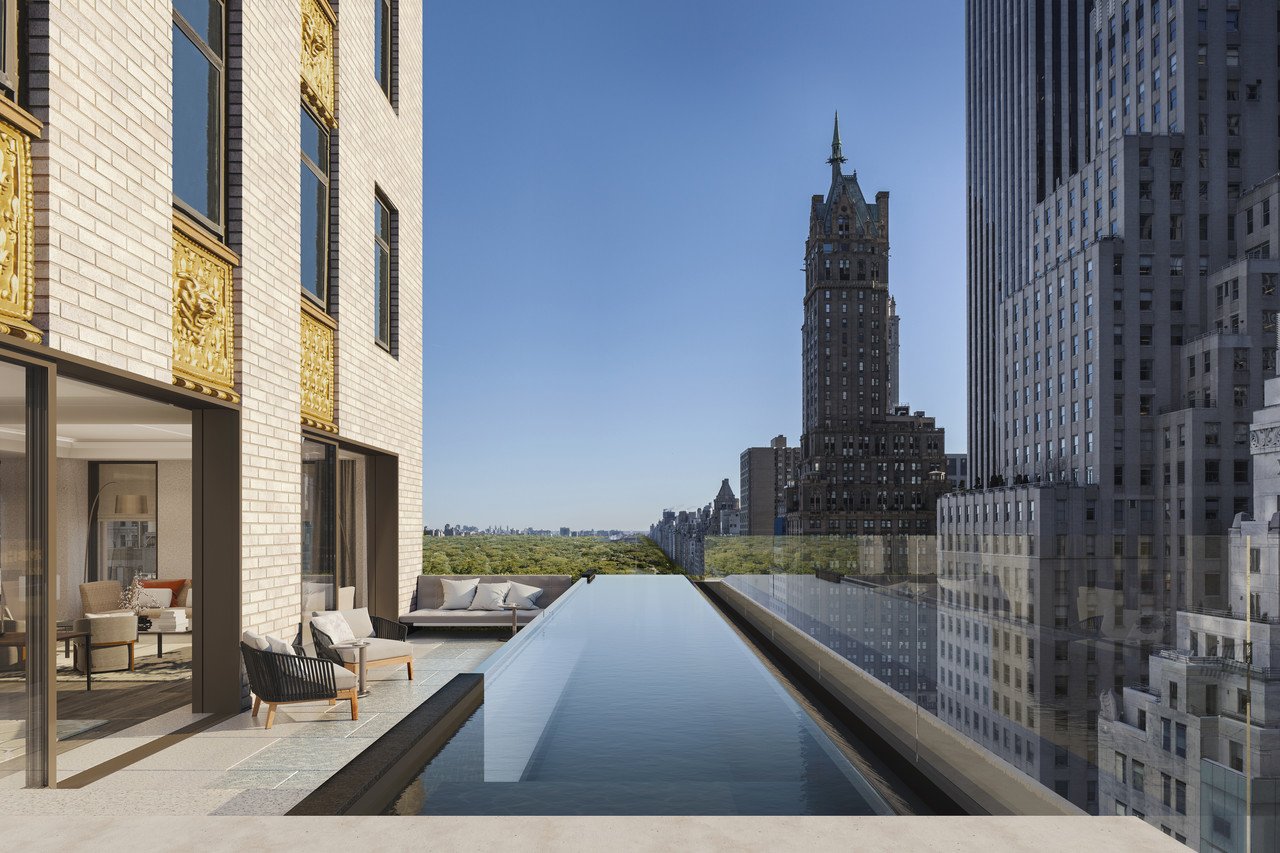
    This morning I was reading about Aman’s new condo and hotel project in New York, which is planned for the 100-year-old Crown Building at 730 Fifth Avenue. It will have 83 hotel rooms and just 22 homes, and be the first urban condominium for the resort company.

    Owned by OKO Group, the hospitality company is mostly known for their “sleek, minimalist hotels in secluded, far-flung destinations,” according to the WSJ. Rooms go for upwards of USD 2,500 per night and they, supposedly, have a rabid customer base known as “Amanjunkies.”

    What’s interesting about this project is that (among other things) it’s a bet the Aman brand will translate to an urban context and drive above-market pricing. And it will do it at a time when the ultra high-net-worth segment of the market in NYC has been cooling because of a new “mansion tax” and probably other factors.

    The five-storey penthouse, which will be built into the building’s “crown,” is asking USD 180 million. If/when it sells, it will break the record for the most expensive home ever sold in the city on a square foot basis at $14,358 psf.

    If you subscribe to the WSJ, you can read the full story here. I find it valuable to see how projects position themselves.

    Rendering: Aman

  • OMA’s first ground-up project in Manhattan finishes construction

    121 East 22nd — which is OMA’s first ground-up project in Manhattan — recently finished up construction at the corner of E 23rd St and Lexington Ave (the site continues through to E 22nd St, where there is basically a 2nd building). I wrote about the project over two years ago, here.

    Below is a photo by Laurian Ghinitoiu, via Dezeen, of it completed:

    The defining feature is its “prismatic corner”, which, I understand from this interview with David Von Spreckelsen (President of Toll Brothers City Living), was largely an outcome of the site’s restrictive zoning. There was a requirement to have constant street walls. That minimized what could be done architecturally on the project’s main elevations.

    The solution is two contextual street walls — the punched windows are designed to match the rhythm of their adjoining buildings — coming together and creating dramatic visual interest only at the point where they intersect. Below is a rolled out elevation from OMA. Note the gradient created by the windows as they converge toward the corner (center in the drawing below).

    The other interesting thing about this project is that it reminded me just how different the built form of Manhattan can be compared to Toronto. In the case of 121 East 22nd, the streetwalls rise 150 feet without any stepbacks. There is then a 10 foot stepback before the building rises another 60 feet — similarly without any additional breaks.

    I love the grandeur.

  • The taxi medallion bubble

    In 1937, New York created taxi medallions as a way of dealing with the sheer volume of unlicensed cabs in the city. About 12,000 were initially sold. They cost $10. And you needed one, fastened to your car, in order to operate a taxi service.

    In 2002, the price of a medallion had risen to about $200,000, though its value had been fairly stable since about 1995. Below is a graph from a recent NY Times investigation on taxi medallions. At their peak, in and around 2014, they were worth over $1 million.

    The common narrative is that ride sharing services simply killed the value of medallions. They disrupted the taxi business. While it is certainly true that mobile apps have forever changed the way we navigate our cities, the above investigation by the NY Times has revealed something potentially more impactful:

    The medallion bubble burst in late 2014. Uber and Lyft may have hastened the crisis, but virtually all of the hundreds of industry veterans interviewed for this article, including many lenders, said inflated prices and risky lending practices would have caused a collapse even if ride-hailing had never been invented.

    At the market’s height, medallion buyers were typically earning about $5,000 a month and paying about $4,500 to their loans, according to an analysis by The Times of city data and loan documents. Many owners could make their payments only by refinancing when medallion values increased, which was unsustainable, some loan officers said.

    So at the same time that Uber was being vilified in the media for destroying the taxi business, the industry itself was working to manipulate medallion prices and shill unaffordable debt onto new immigrants. An interesting read from the NY Times.

  • Architect I.M. Pei dies at 102

    Architect I.M. Pei died this week in New York City. He was 102. Being a centenarian is noteworthy enough. He was born in Hong Kong in 1917. I would love to join that club. Imagine how much change he experienced throughout his life. But, of course, Pei was also a celebrated Pritzker Prize winning architect.

    For those of you in Toronto, you can look to Commerce Court West to see an example of his work (Page & Steele was the local architect). Completed in 1972, it was the tallest building in Canada until 1976. But perhaps his most well known project is the Louvre Pyramid in Paris (pictured above).

    In reading some of his obituaries, I was intrigued — but in no way surprised — to learn that the Louvre Pyramid was deeply hated by Parisians at the time it was being proposed and built. Supposedly, for the first few years after completion, Pei couldn’t walk the streets of Paris without people berating him.

    However, if you surveyed Parisians today, I would bet you that the approval rating of the Pyramid would be extremely high. And I would also argue that it has since become one of Paris’ most globally recognizable symbols. (Parisians, please weigh in below in the comments.)

    All of this, once again, suggests to me that we’re often not very good at evaluating the merits of things that are new to us. Pei’s Pyramid, beyond being a new circulation strategy for the broader complex, was a radically different style of architecture.

    Appreciating that sometimes requires a bit of time.

    Photo by Uriel Soberanes on Unsplash

  • Uber Movement introduces new Speeds product

    Since we’re on the topic of large-scale data collection, I thought some of you may be interested in Uber Movement‘s new “Speeds” product.

    First launched in 2017, Uber Movement aggregates anonymized data from their ride-sharing business to create data sets and tools that can help cities make better transportation decisions.

    Below is a (hex cluster) map of Toronto showing average travel times from downtown. I dropped the pin at Toronto City Hall. What is shown is the average for all days of the week during the month of January 2018.

    Uber Movement’s new Speeds product looks at how specific streets are performing relative to their “free-flow speed.” Uber defines this as “the average speed of traffic in the absence of congestion or other adverse conditions.” (The 85th percentile of all speed values.)

    As of right now, Speeds is only available in 5 cities: New York City, Seattle, Cincinnati, Nairobi, and London. Here is a snapshot of London during the same time period as above, January 2018:

    In comparison to what we were talking about yesterday, I have few concerns with the fact that my Uber rides around town have likely contributed to these mappings. With these use cases, the value really only emerges once you aggregate the data.

  • Architect Jeanne Gang named to the TIME 100 list

    Architect Jeanne Gang (of Studio Gang) has just been named to the TIME 100, which is Time magazine’s annual list of the world’s most influential people. Jeanne is the only architect to be included in the 2019 list.

    Jeanne was named to the “Titans” category, which typically honors those who are at the top of their respective field. She sits alongside Mark Zuckerberg, Tiger Woods, and LeBron James in this year’s TIME 100.

    Past honorees within the architecture profession include Elizabeth Diller, David Adjaye, and Bjarke Ingels. All, stars.

    The list is in its 16th year. But it’ll be the first year where there will also be a day-long conference. (Lynne and Marc Benioff, of Salesforce, acquired the magazine in 2018 for $190 million in cash and are making some changes.)

    Congratulations Jeanne.

    Full disclosure: Studio Gang is the design architect for our One Delisle project in midtown Toronto.

  • Scooter trips surpassed bike share last year

    According to the National Association of City Transportation Officials (NACTO), scooter trips in the US surpassed station-based bike share trips for the first time in 2018. Here is a chart taken from Streetsblog:

    Dockless electric scooters have created a public nuisance in many of our cities, but what is clear is that the demand is there. Which perhaps isn’t all that surprising given that they require less effort than traditional cycling.

    The other interesting takeaway from NACTO’s analysis, which is likely also not that surprising, is that bike share trips are heavily concentrated in a select few cities.

    In 2018, there were about 36.5 million bike share trips across the US. And about 84% of them took place in just 6 cities: New York, Boston, Chicago, DC, Honolulu, and San Francisco.

    Almost half of the 36.5 million trips were on NYC’s Citi Bike network.

  • What’s in a roof?

    Over the weekend I stumbled upon this illustrated Medium post by Alfred Twu comparing sloped and flat roofs. The argument is that these two roof types are coded. In this part of the world, at least, sloped roofs signal low-rise “house” and flat roofs signal big city “high-rise.”

    I’m not yet convinced of this association with height, or of all the claims made in the article. Did New York City really make the flat roof commonplace in our cities? But the idea that a roofline can trigger certain associations — or even become divisive — is a fascinating one.

    Take, for example, Am Fischtal in Berlin. On one side of the street you have, still to this day, homes with flat roofs. And on the other side you have homes with sloped roofs. This clean divide is the result of a supposed “roof war” that took place during the Weimar Republic.

    At this moment in time in the suburbs of Berlin, the kind of roof you chose to live under was a proclamation of your political orientation. I’m not sure roofs have as much gravitas as they did in the 1920’s on Am Fischtal, but they still do say something.

    Image: Alfred Twu

  • IPOs and home prices

    Fred Wilson made an interesting remark in his recent post about the current “IPO bonanza” that is taking place in the tech space. He is, of course, talking about the recent IPO of Lyft, the recent S-1 filings from Pinterest and others, and the expected filings from Uber, Airbnb, and so on.

    After listing the benefits of going public, he went on to say that this bonanza will surely also mean that it is going to become even more unaffordable in the Bay Area. Part of this is perhaps self-serving, since he operates a VC firm out of NYC. (Take your money and move to NYC.)

    But the data suggests that there is truth to this.

    When Twitter when public in 2013, it was estimated that it created some 1,600 millionaires. This is great for the local startup ecosystem as many of these beneficiaries could go on to found their own companies and create a whole new batch of jobs. The money gets recycled.

    But what does it do to the local housing market — especially a supply-constrained one like that of the Bay Area where it is difficult to build?

    In 2018, Barney Hartman-Glaser, Mark Thibodeau, and Jiro Yoshida penned a paper called, Cash to Spend: IPO Wealth and House Prices. In it, they looked at the impact of IPOs on local home prices in California from 1993 through to 2017.

    What they found, among other things, was a “positive and significant association between local house price changes and firms going public.” The price increases were also found to be the greatest the closer you get to the headquarters of the firm that just went public.

    If you’d like to download a copy of the paper, you can do that here.