Daily insights for city builders, delivered every morning at 6 AM ET. I’m Brandon Donnelly — a Toronto-based real estate developer and founder of Globizen. I’ve been writing here since 2013.
This is one of my Christmas gifts. And it is, of course, exactly the sort of thing that gets me excited. Thank you Bianca. You clearly know me.
I am endlessly fascinated by cities. I keep a running list of places I want to explore (everywhere from São Paulo to Shanghai). And frankly, I consider it to be an important part of my job to think about how to make our cities better.
As I was flipping through the book this morning, I was reminded of something that I have been saying for years on this blog. Toronto could use a floating public pool like the Badeschiff (“bathing ship”) in Berlin:
Constructed from the hull of an old cargo vessel, the Badeschiff opened in 2004. The Spree itself is too polluted to swim in (or at least that was the case back in 2004), and so this has become an important swimming outlet for the city.
The real benefit of a floating pool is that you’re mostly in a big body of water, but now you can also heat it. In the winter, the Badeschiff is covered and turned into a spa/sauna. This would be particularly useful in a place like Toronto.
It’s easy to bring people to water in the summer. Apparently Summer-Badeschiff even has a bar and regular DJ sets (presumably all techno given this is Berlin).
The real challenge is in the winter. And if you’ve ever read an RFP involving a public space in Canada, you’ll know that this question invariably comes up: So, how do we, like, get people to come here when it’s 10 below?
Hot water, nice views, and a little food & drink. I promise that’s all you need.
Canada's Sugar Beach is celebrating double digits next week! After 10 years of enjoying sun and sand right downtown, it's hard to imagine the shoreline without those pink umbrellas. Swipe to see what this Toronto favourite looked like before we built it. pic.twitter.com/1BH5acNpXa
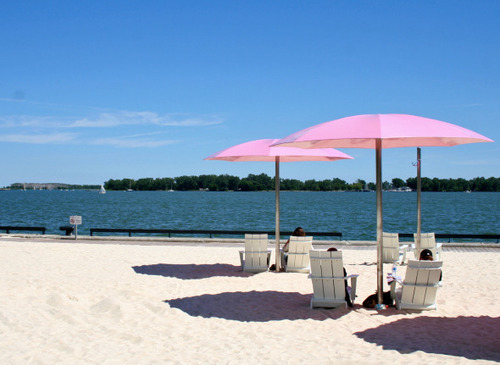
One of my favorite public spaces in the city is easily Sugar Beach at the foot of Jarvis Street. So I couldn’t resist sharing this before and after tweet by Waterfront Toronto. Sugar Beach turns 10 years old next week. It’s nearly a teenager.
For those of you who were around and paying attention a decade ago, there was a bit of controversy over the cost of this park — specifically its pink umbrellas. The budget for the park was $14 million and each umbrella cost $11,000.
It’s one of those things that’s easy to single out and make a big deal out of — if that’s what you’re trying to do. “How much? $11,000 for a candy pink beach umbrella? Come on.”
But as Waterfront Toronto explained in this blog post from 2014, each umbrella was fabricated out of a solid piece of fiberglass and was designed to withstand hurricane winds, as well as a good old fashioned Toronto winter. They also serve as lighting for the beach at night.
Part of this is coming from lessons they learned on previous waterfront parks, where the umbrellas weren’t as expensive and haven’t been as resilient to the elements. So there is a whole life cycle cost analysis to be considered here.
Now I don’t profess to be an expert on candy pink beach umbrellas, but I will say this: Sugar Beach wouldn’t be Sugar beach without them. And ten years later, it’s easy to argue for this being one of the most successful public spaces in the city.
P.S. If I could make one small request for Toronto’s waterfront, it’s that we need to better engage the lake. We need proper places to swim. Think of the Strandbad Tiefenbrunnen or the Seebad Enge in Zurich. We may need to tidy things up a little, but it’ll be worth it.
A colleague in the office recently introduced me to a Swiss invention called the Wickelfisch (or baby fish). Below is a video showing you how they work. They’re so neat. So Swiss. And I obviously just ordered one. They’re available via this US company for $12-20, depending on the size.
The video is of people swimming in the Rhein. Because swimming downstream in rivers — and ending up in a different location — is so popular in Switzerland, the Whickelfisch was invented as a way to keep your clothes and belongings dry. It also acts as a flotation device.
I’m not planning on floating down the Don River anytime soon, but a Wickelfisch looks like the perfect bag to bring to the beach. Especially if you don’t want to leave your stuff unattended to while you go for a swim.
Of course, the other neat thing about this video is that it shows you how awesome it is to have clean and swimmable water running through the middle of a city. Most people I know are afraid to swim in Lake Ontario out of fear they might grow a 6th toe.
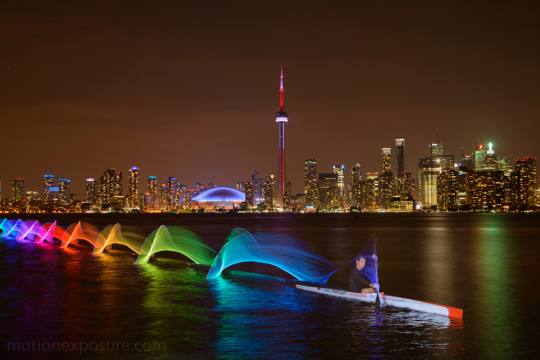
Photographer Stephen Orlando is obsessed with capturing “motion through time and space.” What he does is use long single exposures and LED lights (attached to people and objects) in order to reveal paths of movement. The results are stunning.
He has done this with various sports, including cross-country skiing, soccer, hockey, karate, and kayaking. His work is art + technology + sport. Check out his gallery here.
Recently Stephen collaborated with Olympic kayaker Adam Van Koeverden and shot photos of him cruising along Lake Ontario with the Toronto skyline in the background. See above photo. The LED lights were attached to his paddle. The rest of those photos can be found here.
What I like about these photos is that they’re created by visualizing – in a more permanent way – movement that is already latent within these sports. These are geometries that currently exist, we just can’t see them without Stephen’s help.
Lately I’ve been feeling that we’ve been having some pretty serious conversations here on Architect This City. Everything from condominium reserve funds to housing/tax policy. So today I thought we could change it up and talk about something a bit more fun: farmhouses.
Last weekend when I was in Prince Edward County, one of the places that I visited was the Drake Devonshire Inn. It’s been on my list for awhile, so I’m glad I finally got to experience it. It’s an outpost of the Toronto-based Drake Hotel (no relationship to Hotline Bling Drake) and they refer to it as their “contemporary farmhouse.”
It was stunning.
As soon as I walked on the grounds, I couldn’t stop looking around, taking pictures, and examining all the art that they have sprinkled around the inn. Those are the sorts of things I do when I get excited by a building or place. I’m like a kid in a candy store.
I was so impressed that after I left I had to message my friend – who worked on the project and who I went to architecture school with – to tell her that she did an amazing job. Want to see for yourself? Click here for photos of the farmhouse. And click here for information on the design firm behind the farmhouse (+tongtong).
But beyond just a great space, the Drake Devonshire is also symbolic of something greater than seems to be taking place. Almost everybody I met in PEC seemed to be a Toronto transplant. They were done with life in the city and decided take off for the country. But along with them is coming pieces of the city. (The Hayloft Dancehall is another example.)
I used to think that this kind of city-to-country colonization was bound to happen in Niagara-on-the-Lake, which is only about an hour west of the city. But it turns out I was wrong. It seems to be happening to the east of the city in Prince Edward County.
Given what the other speakers had to say and given some of what I heard at the event, this is definitely not a universal position. In fact, one person commended me on taking a “courageous stance.”
At the same time, quite a few of the people I spoke to seemed unsure of any position and instead came to the walk simply to learn more about the options. Hopefully by the end of it they were closer to one.
If I have one piece of constructive feedback on the walk it’s that it wasn’t interactive enough. It’s fine to standup and talk for 5 minutes, but it would have been great to also have a discussion and debate. At the very least, I would have liked to see where most people stand. Hopefully you will all share that in the comment section of this post.
I continue to believe that removing the Gardiner East is the right city building decision. But I also respect anyone who is willing to take a firm stance. Toronto City Council has already punted this decision before. It’s now time to make a decision and own it.
“Make no little plans. They have no magic to stir men’s blood and probably themselves will not be realized. Make big plans; aim high in hope and work, remembering that a noble, logical diagram once recorded will never die, but long after we are gone will be a living thing, asserting itself with ever-growing insistency. Remember that our sons and grandsons are going to do things that would stagger us. Let your watchword be order and your beacon beauty. Think big.”
-Daniel Burnham, Chicago architect. (1846-1912)
I’m a big fan of Chicago. Having now visited the city, I can say that everyone was right when they told me that I was going to love it. It has great art and architecture, great food (with some of the largest portions I’ve ever seen), great nightlife, and great people.
But I don’t want to talk about any of these things today. Instead, I want to talk about something much more specific that stood out to me last weekend: Chicago’s relationship to both the water and the street.
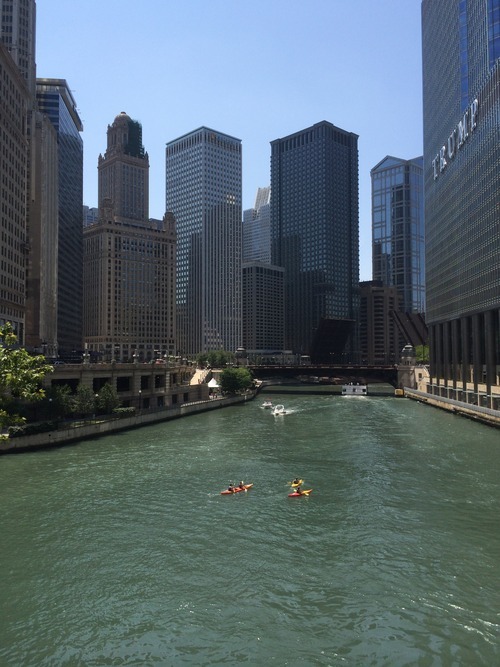
While Chicago and my hometown of Toronto share many similarities– including being situated on a Great Lake and having rivers flow through the middle of them–the relationship to these bodies of water is remarkably different. Here is a photo of people kayaking in the Chicago River on a Friday afternoon:
What impressed me about Chicago is how intimate and urban the relationship is with the lake and its rivers. If you look at the photo above, you’ll see that many of the buildings are built right up against the river, but that there’s space allocated for riverwalks, patios, and so on. It’s all about engaging and connecting with the water.
Toronto on the other hand, is only recently starting to reacquaint itself with its bodies of water. We spent much of the second half of the 20th century with our back turned to the lake and without a strong urban connection to the Don River. And if I had to guess why it’s because we built highways along them.
We built the Gardiner Expressway adjacent to Lake Ontario and we built the Don Valley Parkway adjacent to the Don River. This fundamentally changed our orientation and largely precluded us, I think, from creating the same kind of waterside urbanity offered in Chicago.
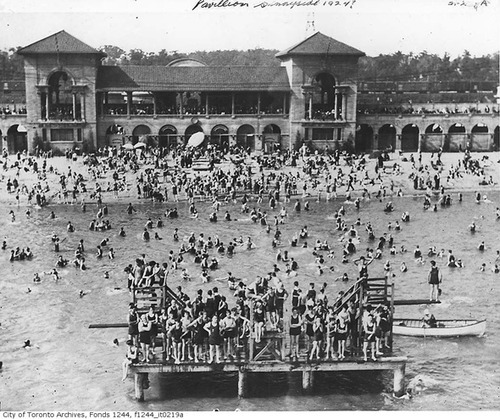
As an example, consider that in the first half of the 20th century, Toronto’s Parkdale neighborhood – which today still has a questionable reputation – was actually an affluent and desirable waterfront community filled with beautiful Victorian mansions. It was well connected to the waterfront, and so the area flourished. Here’s what Sunnyside Pavilion used to look like:
But then in the 1950s we built the Gardiner Expressway, disconnecting Parkdale from the lakefront and destroying many of its amenities, such as the Sunnyside Amusement Park. In turn, the rich people left and their large Victorian mansions got chopped up into rooming houses and other rental housing stock. And in my view, Parkdale still hasn’t fully recovered from this.
Highways are divisive. There’s no question.
So unless you can afford to bury them, it comes down to trade offs: Do you want to make it easier for people to drive in from the suburbs or do you want a truly spectacular water or riverfront? In the 1950s we chose the former. But even still today, the thought of tearing down–even a portion of the Gardiner Expressway–is fraught with opposition. I guess not much has changed.
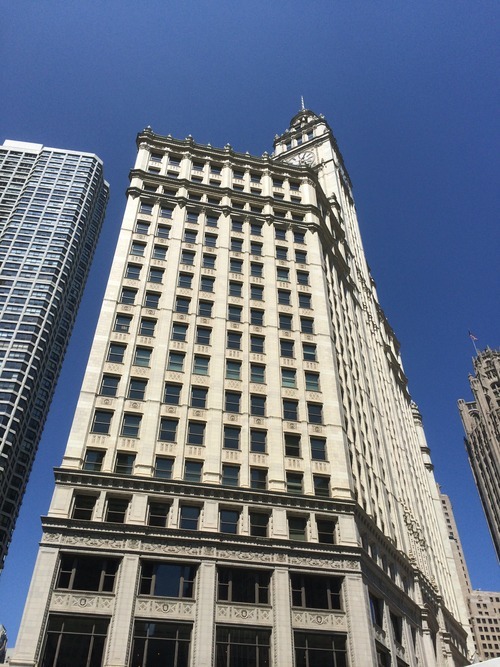
The second way that Chicago impressed me is through the relationship that many of its buildings hold to the street. They come down to ground level with authority and with great retail presence, and often make no amends about their mass and impressiveness. This frames the street and creates a level of urbanity that isn’t always found in Toronto – particularly outside of the downtown core.
In Toronto, the trend today is towards street level podiums, significant setbacks, and delicate point towers that minimize the impact of their height and allow for natural light to reach street level. It’s well-intentioned and perfectly appropriate in many urban settings. But sometimes you need a little urban assertiveness. Sometimes you want to impress and impose. And Chicago does that.
What I’m getting at is that Chicago architect Daniel Burnham was on to something. He famously advocated for man (that was the era) to think big. Make no little plans, he said. And it’s admirable advice. Toronto is going through a tremendous transformation right now. We’re North America’s boomtown, which is a title that Chicago would have held at one point.
But as we build for the future, let’s remember that, long after we’re gone, we’re going to be judged based on the plans we are making today. So why not make them big ones.
Before visiting Chicago for the first time, everybody told me that I was going to love the city. They would tell me that it’s similar to Toronto, except that it has better architecture and a better waterfront. Having now visited the city, I not surprisingly have a lot to say on this matter. But I need another day or so to formulate my thoughts.
In the interim, I thought it would be fun to host a little competition. Given that both Chicago and Toronto are Great Lake cities of comparable size (and formally sister cities), I’d like to know: Which city, do you think, has the better skyline? Please respond in the comment section below and make sure to include your location (so we all know if you might have a hometown bias).
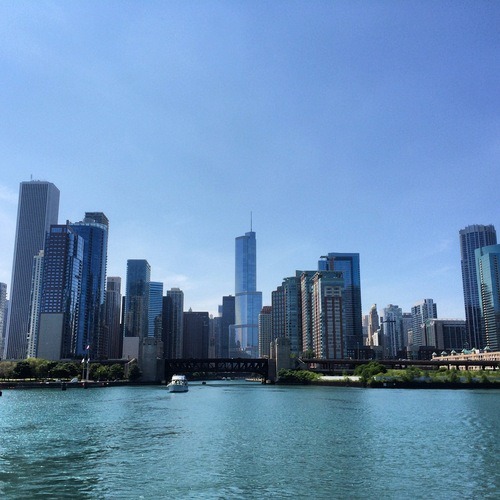
To help you make your assessment, here are a few photos. Below is one that I took of the Chicago skyline from the architecture boat cruise we went on yesterday afternoon. The building directly in the center is the Trump Chicago.
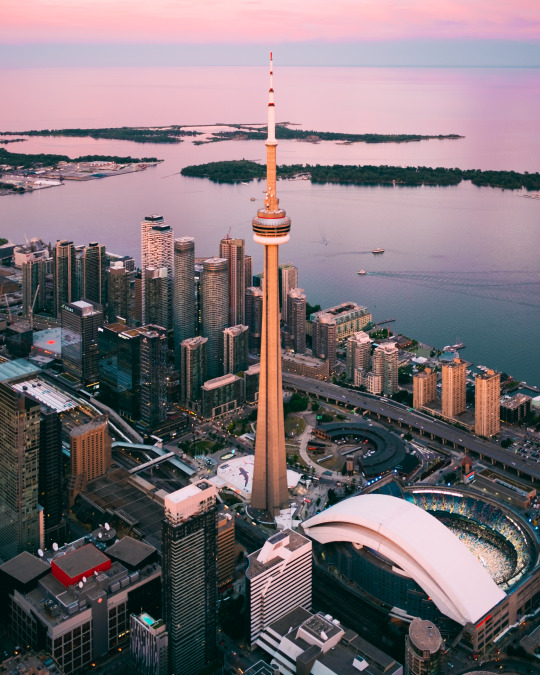
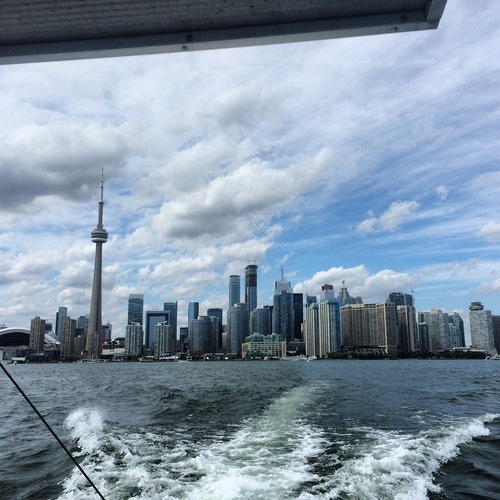
And here’s a photo of the Toronto skyline that I took from a water taxi earlier this summer.
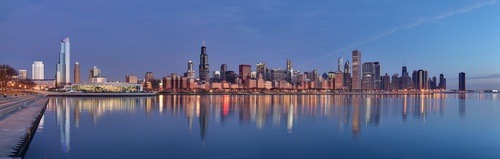
But since these photos only represent one particular vantage point (me on a boat), here’s a set panoramic photos that I found online (Chicago & Toronto). I want to be as fair as possible.
I think this one could go either way. But I personally like the variety that the lit up CN Tower and Sky Dome (Rogers Centre) bring to Toronto’s skyline. Overall, it feels a lot more modern and exciting to me. So I pick Toronto. What about you?
Sometimes I like to start my mornings off by grabbing a coffee and walking down Jarvis Street to Sugar Beach and the lake.
I’ll find a Muskoka chair (Adirondack chair for you Americans) and position it underneath one of the iconic pink umbrellas. I mostly like to look out at the lake, but I also like the shade so that I can see the screen on my phone in case my Type A tendencies kick in and I want to check emails or mess around on Twitter.
Oftentimes when I’m there–even early in the morning–there will already be other people at the beach. One time I came at 730am and a lady was there tanning in a bikini. I admired her dedication.
Sometimes I need these moments. I like that sobering feeling you get when you take a time out from the everyday to just sit and think. It helps put things into perspective. And you could argue that great cities provide those kinds of spaces.