Daily insights for city builders, delivered every morning at 6 AM ET. I’m Brandon Donnelly — a Toronto-based real estate developer and founder of Globizen. I’ve been writing here since 2013.

Tag: home buying

  • The Zillow postmortem

    The postmortems surrounding Zillow’s exit from the algorithmic home-flipping business are starting to surface. Here’s an article from the WSJ and here’s Matt Levine’s take on it. The latter piece is very Levine-like and is called, “Zillow tried to make less money.”

    The obvious story is that Zillow’s algorithms were not valuing homes correctly. But the story is more nuanced than this. In Q1 of this year, Zillow’s home flipping business was actually more profitable than it had initially expected. And that’s because its algorithms were consistently undervaluing homes. So when it did transact, it was doing so at favorable / low cost bases.

    The problem was that the company was not transacting enough and there was a fear of losing ground to competitors like Opendoor. Apparently only about 10% of people who requested an offer from Zillow actually ended up accepting it. Margins were good, but volumes were too low.

    So what Zillow did was tweak its algorithm to be more aggressive (see above chart from the WSJ). But this created the opposite problem: low/negative margins, higher volumes.

    Once again, it shows you some of the challenges with bringing real estate online. The supply of homes is largely heterogenous and there are a lot of qualitative factors that play into what someone is willing to pay.

  • Opendoor launches cash-backed offers

    Opendoor is best known for allowing homeowners to instantly sell their homes online. Enter your address. Get a cash offer. And then choose a closing date. (The commissions are around 5%.)

    Today, Opendoor announced something new called cash-backed offers. What it does is help to reduce the friction on the buy side and how it works is that Opendoor literally backs your offer with cash.

    If for whatever reason you can’t come up with suitable financing, Opendoor will buy the home themselves and you’ll have 240 days to figure out your affairs and buy it back from them for the same price and at the same terms.

    The idea is that it helps to improve the attractiveness of your offer, which is particularly useful in competitive low interest rate environments, such as the one we’re living through right now. (Already about 36% of the market in the US is compromised of all-cash homes sales.)

    Opendoor started by dramatically reducing the barriers to selling a home (supply). And now they’re trying to make things easier on the demand side of the marketplace. At the same time, the process is going digital. I think this is great for consumers.

    For more on the trends shaping home buying in the US, check out this report that was published by Opendoor last month.

    Full disclosure: I am long $OPEN.

  • Algorithmic home buying expands to Los Angeles

    Algorithmic home buying companies (or iBuyers) have now started to expand into Los Angeles. If you recall, most of these companies started in smaller markets where the homes are more homogenous, relatively inexpensive, and generally less liquid. Places like Phoenix.

    By tackling the second largest housing market in the US (after New York City), the algorithms of Opendoor, Redfin, and Zillow will now need to content with an older housing stock, greater variability, and higher values.

    All of these companies have increased their maximum offer price. The sweet spot for algorithmic home buying has typically been in the $150,000 to $300,000 range. Last year, two-thirds of all homes bought by iBuyers were in this range. I can’t imagine that gets you very much in LA.

    I keep expecting these companies to scale into something more beyond just iBuying and flipping. Perhaps we will see that happen once they establish themselves in country’s biggest markets.

    Photo by Josh Rose on Unsplash

  • People are camping out in Opendoor’s homes

    Inc. Magazine just did a profile on Opendoor, which is a company that we have, of course, talked a lot about on this blog and that I continue to follow closely.

    It’s interesting to read about some of the challenges that they’ve been having as a result of their frictionless open houses. Since all you need is a smartphone, the company has been having the ongoing problem of people camping out in their listed homes. Sometimes for weeks. They’ve been working to address this by restricting the hours (6AM to 9PM) and by installing motion detectors. I am sure they will figure it out.

    The company is also having to be careful in terms of how it positions itself alongside realtors. There are many livelihoods at stake here. Here’s an excerpt from the article:

    During interviews, Wu has chosen his words carefully when discussing Opendoor’s potential to replace Realtors. “The reality with Realtors today,” he said on stage at the Startup Grind Global Conference in Silicon Valley in February, “is their role is shifting from project management–especially in our ecosystem, where we’re automating a lot of the processes–to advisement.”

    Fred Wilson (venture capitalist) has argued many times before on his blog that business model innovation is far more disruptive than technical innovation. I think it’s valuable to keep that in mind in the context of this discussion.

    Opendoor continues to charge a commission fee (sometimes a higher one than is typical), but it also makes money on the flipping of homes and it has plans to vertically integrate other aspects of the real estate business.

    Will that do it?

  • Redfin is rolling out an online purchase option for homes

    There’s a lot of money at work right now trying to reinvent the way that homes are bought and sold. Perhaps the most popular trend is “instant buying” or algorithmic home buying. I have been writing about this for years, mostly because of Opendoor. But now there are lots of companies competing in this space. With this model, home sellers get the benefit of an almost immediate sale, though usually it’s at a slightly lower price.

    Redfin, on the other hand, is returning to something that it first tried out back in 2006: a buy now button on its online listings. It failed back then. But maybe it was simply too early. The feature allows unrepresented buyers — that is, buyers without an agent — to make online offers. Naturally, it’s far from a single click process. But when accepted, the seller ends up paying about half the amount of commission.

    According to the New York Times, the company started testing the feature in late March in the Boston area. Of the 120 homes listed on Redfin with a “start an offer” button, 5 ended up being purchased via an online bid. That’s more than I would have expected. But Redfin positions these offers as being the stronger option because they save sellers money. There’s also an option to tour the home on your own.

    Given this initial response, the company is now working to roll out this feature nationally, market by market. Is this the future of home buying?

  • Why Millennial homeownership is so low

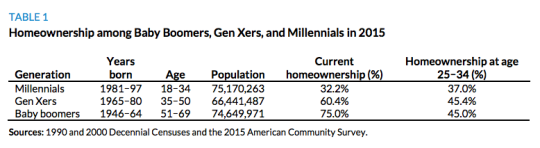
    The Urban Institute has a new study out that looks to explain why Millennial homeownership rates are lower than that of previous generations. The typical refrain is that Millennials have a lot more student debt and that the cost of housing in urban centers has risen faster than income levels. But this report tries to put some math behind those explanations. All data is for the US.

    Not surprisingly, marriage and kids are significant drivers, and Millennials appear to be delaying both. According to the study, being married increases the probability of owning a home by 18%. If marriage rates in 2015 were the same as they were in 1990 (this is the time period for the study), the Millennial homeownership rate would be 5% higher. Having a kid increases the probability by about 6.2%.

    There’s also a widening spread between the homeownership rates for more educated and less educated Millennials. Presumably the distinction is a 4 year university degree. Between 1990 and 2015, the spread between the two groups increased from 3.3% to 9.7%. This was identified as an area of “great concern” because of the possible long term implications.

    Combine this phenomenon with the stats that white households have a higher homeownership rate compared to all other racial groups and that having parents who are homeowners increases the likelihood of also owning a home (let’s ignore, for a second, the other intergenerational transfers of wealth), and you have a recipe for rising wealth disparities.

    Of course, some of you will undoubtedly argue that in this part of the world we are overly fixated on homeownership as a mechanism for wealth creation. I mean, there are many examples of very wealthy countries with homeownership rates that are far less than what they are here in Canada and the US. But that’s a discussion for a different blog post.

    If you’d like to go through the full Millennial Homeownership report, you can do that here.

  • A money back guarantee on your next home

    image

    I’ve written about Opendoor.com a few times. As far as I can tell, they are the furthest ahead in terms of disrupting the residential real estate market. So I like to follow them quite closely.

    They’ve recently launched some new features, so I figured it would be a good time to check-in on what they’re up to. But first – for those of you might not be familiar with Opendoor – here’s what they do.

    Opendoor offers instant liquidity to homeowners by buying homes site unseen. The fee they charge seems to amount to less than 10% of the value of the home. 

    They also say that they typically offer prices that are about 1-3% less than the market value of the home 3 months into the future. (Apparently 3 months is the average time-on-market for the cities in which they operate.)

    Once they’ve bought the home, they then make improvements and put it back on the market. As of today, they are buying about 10 homes a day in the two markets in which they operate (Phoenix and Dallas). They are spending about $75 million a month buying homes.

    To mitigate their risk, they won’t buy a home built before 1960, a home that was pre-fabricated, a home with a solar lease, and so on. They also stick to values that are between $100,000 to $600,000. But apparently this covers off about 90% of homes in the United States. (You can read their full FAQ here.)

    To accomplish all of this, they have raised about $110 million in venture capital.

    What’s fascinating about all of this is that they are starting to create a seamless marketplace. As they continue to buy more homes (and aggregate supply), more buyers are starting to come to their marketplace. They also allow people to easily find local contractors.

    Over time as they gain scale and as their algorithms improve, one could imagine their pricing becoming more competitive, them taking more of the market, and them bearing much less market risk as homes quickly trade. 

    They liken their model to car trade-ins. Apparently 60% of people who buy a new car are trading in an old one. That’s an interesting comparison that I hadn’t thought about before.

    So what’s new?

    Two things

    First, they are offering a 30 day full refund on new home purchases. In other words, if you buy a home through their platform and, for whatever reason, you end up not liking it, they’ll buy it back (minus some transaction costs and so on).

    Second, they are providing a 180-point inspection report to buyers and if anything breaks in the first two years of ownership (presumably it is something that contravenes the inspection), they’ll come and fix it.

    These additions are helpful because it starts to target buyers, which will help them fill out the other side of their marketplace. It also promotes greater transparency because now they’re partially on the hook for the home’s performance.

    I like what they are doing and, again, I can’t think of any other company making such big bets in this space.

  • The Business Blockchain Series

    I just backed this project on Kickstarter.

    https://www.kickstarter.com/projects/wmougayar/the-business-blockchain-books/widget/card.html?v=2

    I haven’t backed a lot of projects on Kickstarter, but I definitely enjoy the process of discovering a project that I’m interested in and then providing a small, seemingly insignificant, sum of money to help make it a reality.

    In this case, it’s a collection of two books by William Mougayar about Bitcoin, blockchains, cryptocurrency, and decentralization.

    These are all topics that I’ve touched on before on this blog, albeit with much less rigor than what I’m sure William will be applying to his books. I wrote this post about 2 years ago, when I first started wrapping my head around Bitcoin. And more recently, I wrote posts about how the blockchain could transform home buying and how Honduras is building a decentralized land registry system using the blockchain technology.

    So while at first glance it may seem like these books having nothing at all to do with city building and real estate, I am betting that they will over the long term, which is why I am doing my homework today.

    Here’s a snippet from William’s Kickstarter page:

    “The fundamental characteristics of blockchains are puzzling to consumers, corporations, governments, policy makers and regulators, because their implementation challenges centrally orchestrated trust, and enables a new kind of trust: one that is distributed, decentralized, from peer to peer, and not centrally managed by any single entity. Take any service, and add “without previous center-based authority”, and replace by “peer to peer, trust-based network”, and you will start to imagine the possibilities.”

    If all of this isn’t enough to pique your interest, then you should also know that William is from Toronto. Great things come out of this city 🙂

  • Name your laneway

    Photograph Urban Explorer by Andrew B. on 500px

    Urban Explorer by Andrew B. on 500px

    Laneway housing is becoming an incredibly popular topic here in Toronto. Lots of people seem to be interested in building, or least living in a compact ground-related laneway dwelling. 

    A big part of this, I think, has to do with affordability (or the perception of affordability). A lot of people want to live in a central urban neighborhood, but it has simply gotten both expensive and difficult to secure low-rise housing. Here’s an example of a young couple in Toronto who went door-to-door in their desperation to find a house.

    I believe that laneway housing has the potential to be a more affordable low-rise housing solution in this city, as well as in many other cities around the world who have a similar urban condition. But today, at least here, it’s not that way.

    Since the City of Toronto does not officially support laneway housing, it would be an uphill to get one approved and you need to be willing to put a significant amount of money at-risk in order to try. It’s unfortunate, but that’s the reality today.

    I’m certain that will change. But it will take a bit more pioneering. The Laneway Project, which I advise, is working to change the way Toronto thinks about its laneways and I know that there are many other small entrepreneurs working on doing the same.

    One of the first things that will need to happen is that we’re going to need to name our laneways. Some of them are already named, but many of them are not. And while this may not seem like a big deal, it is. For laneway housing to become a reality, they will need to have addresses and we will need to think of our laneways as legitimate streets.

    Recently The Laneway Project published a how-to guide called: How to Name Your Laneway. So if you’re interested in laneways and laneway housing here in Toronto, I would encourage you to give it a read and then try and get your local laneway named.

  • How Bitcoin could transform home buying

    Earlier today a friend of mine sent me this Fast Company article talking about bitcoin and the future of home buying. I’m really glad he did. Both because I wasn’t yet sure what I was going to write about today and because this is a topic that I’m deeply interested in.

    I recently heard Brad Burnham (venture capitalist at Union Square Ventures) say in a talk that if you’re thinking about Bitcoin just as a currency, then you’re thinking about it in the wrong way. If you take nothing else away from today’s post, I think you should remember that. Bitcoin, and the underlying block chain architecture, have the potential to be very transformative.

    The Fast Company article was written by Matt Weiss of IDEO (the powerhouse design and innovation firm). Here’s an introductory snippet:

    Insert block chains: a relatively new and promising technology that could transform the way we digitally exchange value, similarly to how Internet protocols, like TCP/IP, transformed the way we exchanged information. For example, to transfer ownership of a home today, there are countless check of authenticity and intermediaries involved to insure the transfer is legitimate. By using a distributed database (a.k.a. “a block chain,” the same technology behind Bitcoin) to prove authenticity, we could legitimately transfer ownership immediately without the need of a middleman. In fact, when we think about block-chain technology and the industries it could disrupt, real estate tops the list. While Trulia, Redfin, Angie’s List and others have brought some transparency to the opaque world of home buying and home ownership, most of our experiences in this industry are fraught with incomplete, inaccurate, and asymmetric information.

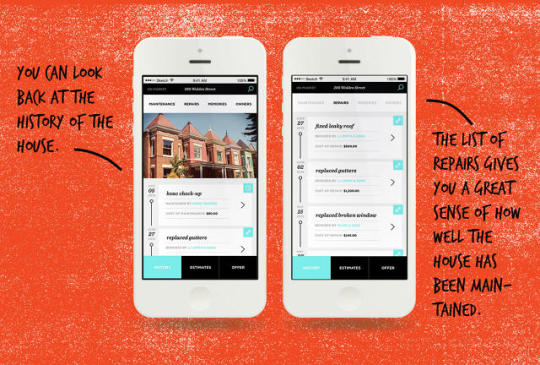
    Following this, he goes on to talk about what it might be like – each step of the way – to buy a house using the block chain technology. There are even mockups of what the app could look like. I highly recommend you give it a read if you’re interested or involved in this space.

    The real estate industry hasn’t seen a lot of innovation. It remains an opaque market with lots of information asymmetries. I have no doubt that will one day change; it’s just a question of when. Perhaps it’ll be the block chain that makes that happen.

    Image: IDEO via Fast Company