Daily insights for city builders, delivered every morning at 6 AM ET. I’m Brandon Donnelly — a Toronto-based real estate developer and founder of Globizen. I’ve been writing here since 2013.

Tag: gardiner expressway

  • The Bentway Islands

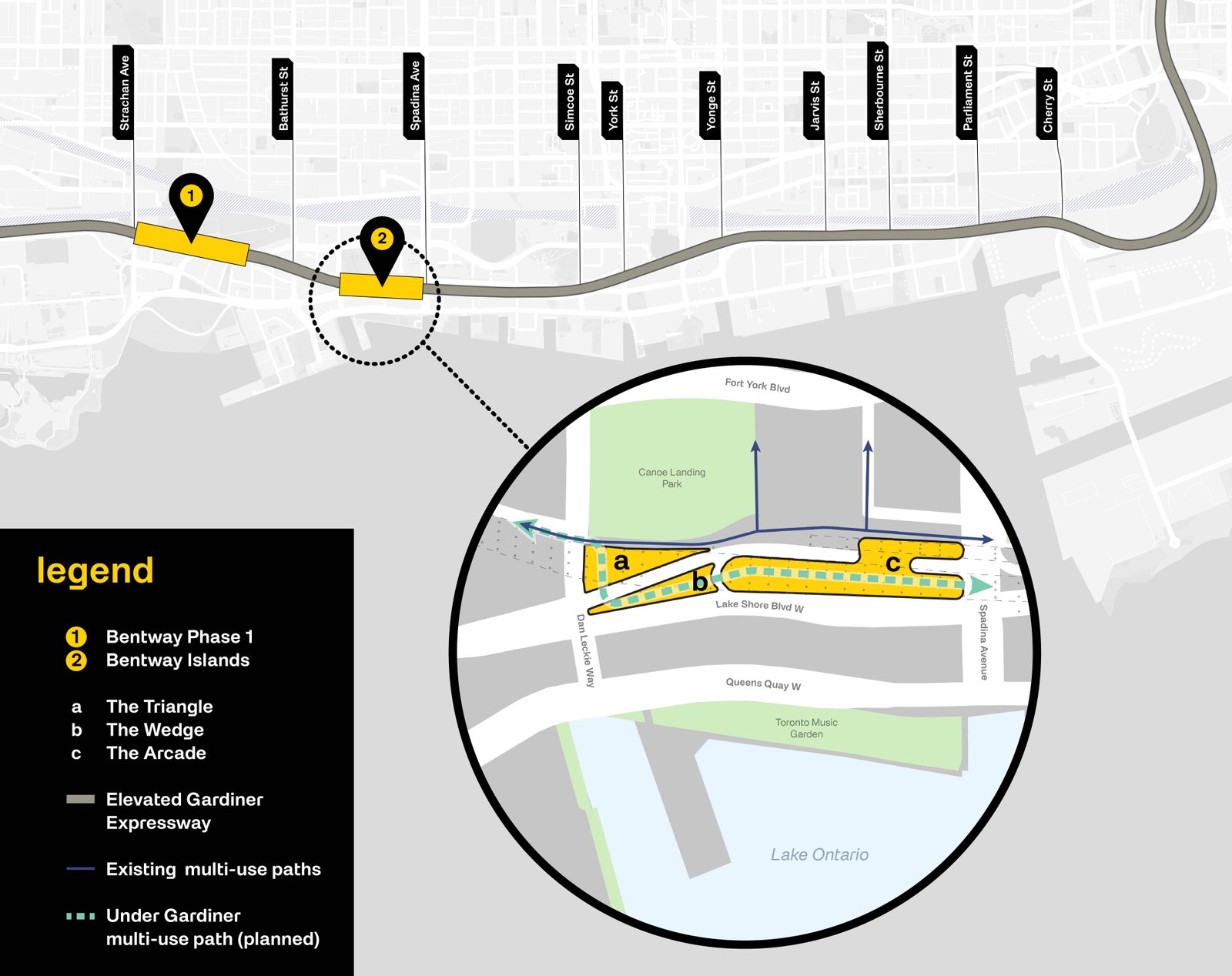
    As many of you know, Toronto has a highly successful public space underneath the Gardiner Expressway called The Bentway. I have ice skated in this space during the winter and I have listened to hard techno in this space during the summer. It has become a public space anchor in the city. Ilana Altman and the team are doing great work. And this week, they just announced that Field Operations (New York) and Brook McIlroy (Toronto) have been hired to design a major expansion. Called The Bentway Islands, this next phase consists of three “islands,” totalling 11,500 m2 (~125,000 ft2).

    Here’s a map:
    And here’s what the spaces look like today:
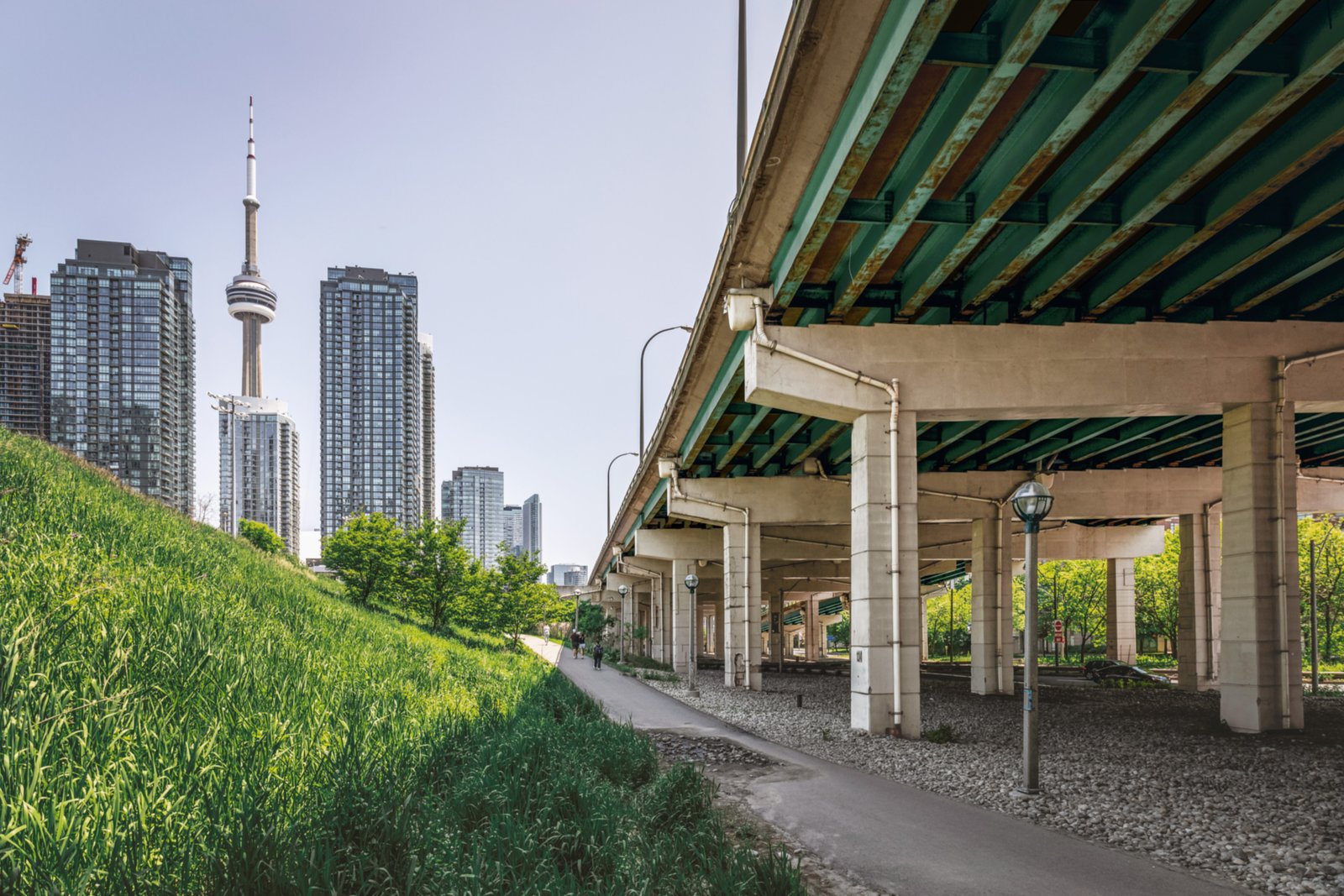
    Both of these firms do fantastic work, and so I’m excited to see what they come up with. (Field Operations is the firm behind New York’s High Line.) But if I can offer two unsolicited (yet related) suggestions, they would be: 1) Let’s incorporate more commercial uses and 2) let’s aim for these three parcels to not actually feel like urban islands. Generally speaking, the spaces underneath highways aren’t the most desirable. They also tend to be surrounded by inhospitable urban environments. Stitching them in and creating continuity in the fabric of the city (existing example, here) is the best way to make the highway above more or less disappear.

  • Gardens that filter highway runoff

    Toronto’s elevated Gardiner Expressway is a topic that pops up periodically on this blog. We have talked about taking down a portion, realigning a portion, adding a congestion charge, lighting it like they have done in Shanghai, and of course we have talked about the good work that The Bentway team is doing.

    Their most recent project is something called Standing Grounds. It’s a collaboration with New York-based Tei Carpenter (Agency–Agency, NYC) and Toronto-based architect Reza Nik (SHEEEP, Toronto), and I think it’s really clever.

    If you look closely at the underside of the Gardiner Expressway, you’ll see that there are existing downspouts in place that take rainwater, snowmelt, and whatever else from the highway above, down to the ground. What Standing Grounds is going to do (by next month) is take this existing infrastructure and add natural filtration chambers that can remediate this excess water.

    I learned today that plants like milkweed, agastache, and yarrow are actually able to absorb road salts and heavy metals like lead, cadmium, and hydrocarbons. So instead of this dirty water flowing from the highway and into the ground, it will soon be filtered by a seemingly simple garden system that looks like this:

    This is an obviously positive thing for the city and I love that it is leveraging infrastructure that already exists. As I said: really clever.

    Renderings: SHEEEP

  • How to spend city money

    This is an intriguing idea:

    Many cities around the world practice some form of participatory budgeting, but even among those that do, Cascais [Portugal] is an outlier. It spends prodigiously through the system: in Paris, five per cent of the city’s annual investment budget has been allocated to participatory projects in recent years, but in Cascais, more than fifteen per cent of the budget flows through the program, and the percentage can float higher if voter turnout rises. Cascais is surprising in another way: its mayor, Carlos Carreiras, is both a champion of participatory budgeting and a member of a center-right political party. Participatory budgeting is often considered a tool of the left, but its role in Cascais suggests that it could have a broader appeal; part of the theory behind it is that citizens can be better than officials at knowing how money should be spent.

    Of course, it won’t solve all of our problems:

    Even in the best of circumstances, participatory budgeting faces some structural limitations. Citizens can’t use it to raise the minimum wage, for instance, or to reconfigure affordable-housing policy, or to ban single-use plastics. As it stands, the approach “will never change the destiny of a poor neighborhood,” Giovanni Allegretti, a senior researcher at the Centre for Social Studies at the University of Coimbra, told me. Allegretti noted that participatory budgeting is mainly a competitive process involving limited resources with no long-term strategy; it doesn’t eliminate the need for other policy interventions. But when it functions effectively, participatory budgeting can give direct political power to those who might otherwise have very little of it.

    There is something very compelling about empowering people to come up with new ideas, compete with others for the best ones, and then participate in public decisions. It also strikes me as a possibly efficient way to force: “We only have this much money to spend. What should we spend it on? Spending on this means not spending on that. Time to make a decision.”

    And now it has me wondering: If we asked Toronto whether it wanted to spend over $1 billion to rebuild the Gardiner Expressway east or spend it on other things, what do you think it would say?

    For the rest of the above article, click here.

  • It’s not too late for the Gardiner Expressway East

    Boy, time sure does melt away when you’re writing a daily blog and trying to build buildings. It’s hard to believe that it has already been 7-8 years since I was writing incessantly about the merits of Toronto removing the eastern portion of its elevated Gardiner Expressway.

    For those of you who may not be familiar, Toronto has an elevated highway that runs along the waterfront. It is old. Pieces sometimes fall off. Lots of water will drip on you. And so remediation works are underway. Several years ago, there was also a great debate that took place in the city about what should happen with its eastern leg. I even spoke at a Jane’s Walk where I was, for the most part, not very popular.

    The two options under consideration ended up being: 1) remove it and replace it with a grand surface boulevard or 2) remove it and rebuild it with a slightly different alignment. This second option was dubbed the “hybrid” option, but that was mostly political speak so that it sounded like some sort of generous compromise. You can think of it as the more expensive rebuild option.

    City Council voted on these two options as one would expect. Councillors in the core of the city did not want an elevated highway running through their neighorhoods, and the Councillors and people in the inner suburbs — who might use it for commuting — were by and large more accommodating. Apparently there are somewhere around 15,000 commuters who use it each rush hour.

    But here’s the thing.

    This vote took place in June 2015 and the thing still hasn’t yet been rebuilt. So maybe it’s not too late! Maybe there’s an opportunity to save a few hundred million dollars between us friends. Also, if anyone is interested, I’m still available for controversial Jane’s Walk presentations. One new idea I have is an elevated highway that runs through the inner suburbs and connects the best weekend brunch spots.

  • Toronto should light the underside of the elevated Gardiner Expressway

    Back when Toronto was debating the future of the eastern portion of the elevated Gardiner Expressway, I was an annoying and vocal supporter of tearing it down and replacing it with an at-grade boulevard. I was blogging about it ad nauseam. I participated in Jane’s Walks where I spoke about the merits of removal. And I even created a petition that went to City Council the day the decision was being made.

    But throughout all of this, I felt like I was in the minority. Most people said I was crazy (though former mayor John Sewell agreed with me). How will people and services get to downtown Toronto? This is critical infrastructure, they said. And indeed, Toronto voted not to remove it.

    Whatever you feel was the right decision at the time, that ship has sailed. We tore down a leg of the Gardiner east of the Don River, at that was positive; but the rest of it is either staying intact or being relocated. In both cases, it will be elevated.

    But I believe in looking forward, not backwards. And so with that, I think we should be doing everything we can urbanistically to make the Gardiner as nice as it can be. It is for this reason that I think The Bentway is an extraordinarily important project. And it is for this reason that I wish we would light the underside of the Gardiner so that when you’re driving on Lake Shore it makes you feel happy.

    A good example of this in action is the Yan’an Elevated Highway in Shanghai (greenery, of course, also helps):

    https://www.instagram.com/p/BzvTmo3nN2J/?utm_source=ig_web_copy_link

    Relevant scene from Skyfall (James Bond):

    But let me be clear before my inbox lights on fire: I am not suggesting that this is an approach to urbanism that is in any way desirable or worth emulating. I am not advocating for elevated highways running through the middle of dense downtowns and walkable city centers. All I am saying is that if we are stuck with something as dreary and as utilitarian as the Gardiner Expressway, the least we can do is make it kind of cool. And lighting can be a relatively cost effective way of doing that.

  • Waterfront ReConnect Design Competition announces six shortlisted teams

    This past summer, the Bentway (in collaboration with the City of Toronto, the Waterfront BIA, and the Toronto Downtown West BIA) issued a call for expressions of interest to re-imagine two key intersections under downtown Toronto’s elevated Gardiner Expressway. The York Street intersection and the Simcoe Street intersection.

    That process has run its course and the following six teams have now been shortlisted:

    York Street

    • Sans Façon + Zeidler (Calgary/Toronto)
    • LeuWebb Projects + DIALOG + Mulvey & Banani Lighting (Toronto)
    • 5468796 Architecture Inc. (Winnipeg)

    Simcoe Street

    • O2 Planning & Design Inc. + Mulvey & Banani Lighting + ENTUITIVE (Calgary/Toronto)
    • Daily Tous Les Jours + SvN Architects + Planners + Latéral (Montreal/Toronto)
    • SOCA + Tiffany Shaw-Collinge + SHEEEP (Toronto/Edmonton)

    The next step in this process is a nine-week design exercise where the above teams will go away and prepare their design concepts. We work with a number of the companies on this shortlist and I am sure that there will be some fantastic ideas that are put forward. After selecting the two winners, the plan is to then start construction in 2022.

    The Bentway is doing some fantastic work in reimagining the underside of our downtown highway. This is yet another example of that. For more information about the competition, click here.

    Photo by Brian Jones on Unsplash

  • Building under the Gardiner Expressway

    For a very long time, there was a great debate in Toronto about whether or not the elevated Gardiner Expressway should be removed from downtown and replaced with something else. As recently as five years ago, that debate was centered around removing the eastern portion of the expressway and replacing it with a large surface boulevard.

    But that ship has sailed. A controversial decision was made not to remove the “Gardiner East,” but instead reroute it (that wasn’t my first choice). At the same time, wonderful new city building initiatives, such as The Bentway, have started to reclaim the long overlooked spaces that sit underneath it.

    Another good example of this is the “West Block,” which was recently unveiled at the northeast corner of Bathurst St and Lake Shore Blvd W. New retail uses (such as the above LCBO) and new public spaces (note the above stair/seating combo) have been tucked underneath the expressway’s structure, creating a beautiful contrast between old and new.

    It reminds me of some of the urban spaces that you might find in other dense urban centers such as Tokyo, because this may be the first fully fledged retail space located underneath the Gardiner. I think it is. But here’s what’s counterintuitive: the more we embrace the Gardiner in these ways, the more it will recede into the background.

    At some point in the near future, these spaces will be filled with people. People eating outside at restaurants. People sitting on the above steps enjoying an illegal drink (because of our antiquated liquor laws). And when that happens, I’m sure most won’t even consider what’s above their head.

  • Tridel unveils smart condominium in South Core

    A few weeks ago, Canadian developer Tridel unveiled its first “smart condominium” at Ten York – a recently completed 69 storey building in the South Core neighborhood of Toronto. Above is an archive photo of the building under construction. I chose this one because its siting between the Gardiner Expressway (left) and Harbour Street (right) is also noteworthy.

    Smart anything is one of those tech buzzwords that is, I know, starting to feel vapid. But Tridel has done some interesting things here with their Tridel Connect platform (a collaboration with SmartONE Solutions). And if you happen to also be in the business of designing and constructing multi-family buildings, I think you’ll find it to be a useful case study.

    At Ten York, you can now use your phone as a key fob. People buzzing up are shown to you on your wall pad so you can confirm identity. The suite entry doors use digital locks, which means you use an access code instead of a key. Additional codes can be created for family and friends or for service providers like dog walkers and cleaners. You’re also given a log of who has come and gone. And of course there’s an automated parcel delivery system.

    If you’d like to see all of the features in the live, I suggest you take a look at the “b-roll video” that was included as part of their press release. Tridel is excellent at implementing new technologies and I know that they frequently reserve test suites in their projects to try some of them out. This is a great thing for the industry and for consumers.

    Image: Tridel

  • How did we miss this?

    I promise that this post won’t be all about laneways.

    This afternoon Erin Davis of Torontoist published a post called: Are Laneway Suites a Solution to Toronto’s Housing Crisis?

    There’s a quote in it from yours truly:

    Brandon Donnelly, a 34-year-old real estate developer, has submitted plans to the City to build a laneway home behind the house he owns in the St. Clair Avenue and Dufferin Street area. “Look, nobody is claiming that laneway housing is going to solve all of our affordable housing woes. But it will do two important things. One, it will unlock new ground-related housing, which is precisely the kind of housing that we’re no longer able to build at scale. And two, it will create additional rental housing,” says Donnelly.

    But I particularly like this one from Christopher Hume – urban affairs columnist at the Toronto Star:

    “But the City has all kinds of rules against it—‘You can’t do it for this reason, you can’t do it for that reason; oh no, we can’t have that!’ Why? Says who and for what reason?

    This morning my friend Alex Bozikovic also published a piece on Toronto’s new 1.75km of public space under the Gardiner Expressway called The Bentway. It’s currently under construction and will open this winter.

    The timing of his article is actually quite serendipitous because I was in the area last night and as I walked past the construction site I couldn’t help but think to myself: “This is going to be absolutely brilliant once it’s done. Complete game changer for the area.”

    My point with these two examples is that in both cases we are rethinking – or at least trying to rethink – neglected urban spaces. It’s about finding value where no additional value was thought to be found. And I love that.

    Conventional wisdom has told us that our laneways and the spaces under our elevated Gardiner Expressway are not spaces to be celebrated. They are utilitarian at best and they are to be completely ignored at worst.

    But when The Bentway opens this winter I have no doubt in my mind that it will prove conventional wisdom entirely wrong. Who wants to hang out under an elevated highway? Watch the entire city. 

    One day I believe that we will also look back on our laneways just as we look back at the The Bentway before it became The Bentway. We will ask ourselves: How did we overlook this for so long?

    Image: PUBLIC WORK via the Globe and Mail

  • Toronto mayor proposes road tolls, finally

    When I wrote yesterday’s post about road tolls, it hadn’t been announced that Toronto Mayor John Tory was going to call for road tolls on both of the highways coming into downtown. That didn’t leak until late in the evening. So I was just writing another post on a topic that I care about.

    Today, however, that announcement was made and the proposal is a flat $2 toll on both the Gardiner Expressway and the Don Valley Parkway. It is expected that this could bring in close to $200 million a year in new revenue for the city – all of which would be dedicated towards transit and roads. Good.

    First, I want to applaud the mayor for coming out in support of road pricing. I didn’t agree with him on the Gardiner East, but I agree with him on this – mostly. It is a bold move.

    The reason I say mostly is because I hope that we don’t simply default to a fixed and blunt road toll. There are more sophisticated options out there, such as variable pricing models that change based on demand/congestion levels.

    Here’s a post that explains how that works and why I think it’s a good model.

    With this approach, it becomes more of a congestion charge rather than a toll. It also gives commuters the option of driving during off-peak times to save money. And if we implemented something like this, I am sure that we would see employers and office hours adapt. More on this in the above post.

    Still, I absolutely believe that it’s a step in the right direction for this great city. So thank you Mayor Tory.