
Daily insights for city builders, delivered every morning at 6 AM ET. I’m Brandon Donnelly — a Toronto-based real estate developer and founder of Globizen. I’ve been writing here since 2013.

Search results for: “road pricing”

  • Waymo is more expensive than Uber and Lyft — huh?

    June 17, 2025 · View original


    The autonomous vehicle narrative has historically gone something like this: remove the labor component of rides (i.e. drivers) and rides will become significantly cheaper. Then, people won’t need or want to own a car anymore. They’ll just Uber or Waymo or whatever around.

    But as Waymo provides in and around 250,000 paid trips per week in the 4 cities in which it operates, the opposite has proven to be true — at least so far. A recent report by Obi (an app that aggregates real-time ride pricing) has just revealed the following for San Francisco during the period of March 25 to April 25, 2025:
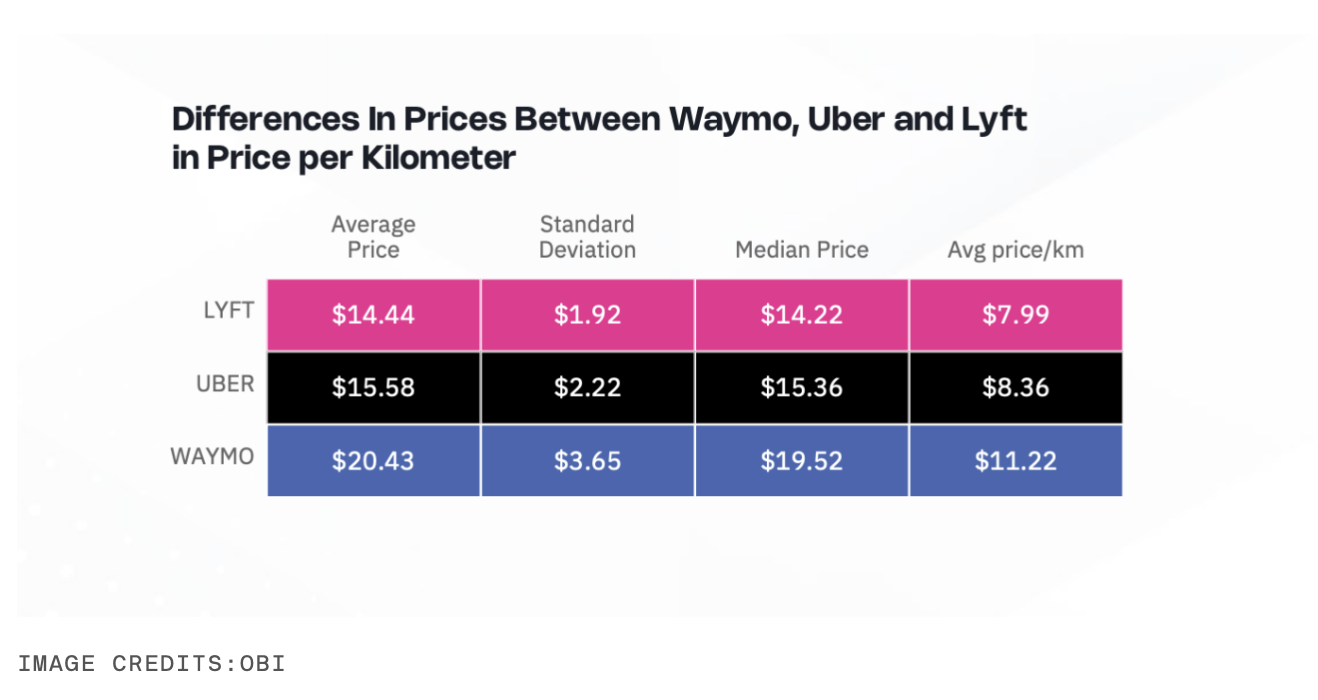
    In other words, Waymo is more expensive than Uber and Lyft, especially for shorter distances. Is this right? Well, Waymo may not have to pay drivers, but they do own and operate their own cars. Uber and Lyft do not. This represents a very different cost structure.

    They also have a more inelastic supply base, meaning they have cars whether demand is high or not. Whereas in the case of Uber and Lyft, supply can be variable. That’s the idea behind “surge pricing” — to induce more drivers onto the road when it’s needed the most.

    Fewer Waymos also means that wait times are going to be longer and that their cars are probably spending more time driving around without paying passengers. That’s a cost.

    Whatever the reasons, lots of people seem to be willing to pay the premium. Part of this almost certainly has to do with the novelty of riding in an autonomous vehicle. I’d pay more if they were in Toronto today. But another reason seems to be that people really appreciate being in the car alone. I guess it’s akin to driving your own car.

    It, of course, remains to be seen how Waymo’s cost structure and pricing model will evolve over time, but I have no doubt that privacy will remain a feature people are willing to pay something for. In the modern world, we are all going to have at least two places of solitude: bathrooms and Waymos.

    Cover photo by gibblesmash asdf on Unsplash
  • Early wins are good for city building

    May 11, 2025 · View original


    Here’s a new opinion piece from the Globe and Mail talking about the importance of “early wins” when it comes to building better cities. And whoever wrote it is right.

    One of the examples that is given is New York’s congestion pricing program. We’ve talked a lot about this initiative since the beginning of the year, and one of its important features is that it pretty much started working immediately.

    Travel times, in some cases, dropped by as much as 48% and, in the first two months of its operation, it brought in over $100 million of new revenue for the city. Less congestion and more money. That’s what congestion pricing does.

    Because of this, support for the program has risen. In December 2024, which is before the pricing went into effect, some polls suggested that around 51% of New Yorkers were opposed to the charge.

    But by March 2025, more New York City residents seemed to support the program than oppose it. And again, this is almost certainly because its positive effects were felt right away.

    City building doesn’t always work this quickly. Many or most things take too long. But finding ways to post early wins is good practice. It also provides a quick feedback loop just in case things need to be changed.

    Cover photo by Murat Onder on Unsplash

  • Zurich’s clever (but underrated) solution to traffic congestion

    April 25, 2025 · View original


    > Tweet: Traffic is horrible in Toronto and it will only get better once we fully embrace a post-car future. Everyone driving around most of the time just isn’t going to work for a city region of our scale.

    We talk a lot about mobility and traffic congestion on this blog — particularly in the context of Toronto — and that’s because it remains a problem and we continue to avoid any sort of big and meaningful moves. Instead, we like to politicize the problem and find scapegoats, such as bike lanes. So I think it’s important to have regular reminders that we do actually know how to address this problem. It’s a choice we and other cities can make.

    Here are three examples and possible solutions:

    Copenhagen: Over 60% of residents use a bicycle to commute to work or school. It is one of the most bike-friendly cities in the world. You’ve probably heard this before and are prepared to say, “yeah, well, we’re not Copenhagen.” But it’s important to point out that neither was Copenhagen. In the early-to-mid 70s, the modal split for bikes was somewhere between ~10-15%. – Singapore: This is one of my favorite examples. Singapore is home to the world’s first congestion charge zone (1975). And it operates on a dynamic pricing model, meaning that traffic congestion is continually monitored and road prices are adjusted to ensure that traffic always flows at certain minimum speed. It’s a highly effective tool and there’s no shortage of global case studies. Here’s Miami. – Zurich: Despite being one of the wealthiest cities in Europe, car ownership is relatively low (~40-45% of the population, compared to ~60-65% in Toronto). This is due to a great public transit system (Swiss trains and stuff) and because of strict parking policies, among other things.

    Zurich has a hard cap on the number of parking spaces in the central part of the city. It is set at 1990 levels, which works out to about 7,600 total parking spaces.). What this means is that if somebody, like a big bad developer, wants to build off-street parking, they need to simultaneously reduce the parking supply somewhere else. You can’t exceed the cap.

    This obviously discourages car usage and moderates the demand for city streets, but it also serves as a clever way to slowly replace on-street parking with better uses, such as an enhanced public realm. This policy has been in place since 1989 and it has had a dramatic effect on car usage. Between 2000 and 2021, the share of car trips in the city decreased from 40% to 29%.

    I know that many of you will scoff at these solutions and think “yeah, there’s no way.” But this is how you make traffic better. You reduce demand and use our finite amount of road capacity more efficiently. So we can either make bold moves or we can continue to complain about traffic.

    Cover photo by Claudio Schwarz on Unsplash

  • The price of construction depends

    February 14, 2025 · View original


    The typical way to buy or procure construction is create a set of drawings, put them out for tender to people who can build what is shown, select the lowest/best bidder, and then proceed with construction. This is commonly referred to as “design-bid-build.” There are, of course, others ways to procure construction, but this is the traditional method. And in an idealized world, it would always work out very well for owners and developers. But in reality, it’s a lot more complicated.

    The important prerequisite for this method is a great set of drawings (more broadly, great contract documents). Because that is effectively the thing you are buying. Unfortunately, great drawing sets don’t always happen and there are generally a few reasons for this. One possible scenario might be that you just don’t have enough time to produce them. Maybe the market is hot and you want to start construction yesterday, or maybe you have some deadline to meet. Whatever the case, you’re in a rush.

    But the most likely scenario is that the drawings aren’t great simply because the people doing them aren’t good or because, hey, we are all only human. Things were missed, there are mistakes, and the drawings weren’t fully coordinated across the various disciplines. There’s no such thing as 100% perfect drawings. And that results in construction risk, because you’ve now bought things that are wrong and that will need to be corrected later.

    Changes are costly. Later is also a suboptimal time for the simple fact that the price of construction depends on the current situation you happen to be in. Early on before a contract is awarded, buyers of construction have the most, or least some, leverage. The bid process is designed to be competitive and so bidders generally need to sharpen their pencils if they want to win the work. But once a job has been awarded and construction starts, that leverage flips.

    Scope gaps and change orders become that much more expensive because, well, they can be. Switching costs are prohibitively high at this point. And it doesn’t just work with scope additions. You will also be penalized for going in the opposite direction and removing scope items (i.e. credits). In these situations, you should expect to receive cents on the dollar back. This is one of the great asymmetries of construction pricing.

    My point with this post is simply that the price of construction depends — it depends on how and when you are buying it. It’s a very opaque market and it’s important to keep that in mind.

  • There’s growing support for NYC’s congestion relief zone — particularly from the people who actually use it

    February 10, 2025 · View original


    It has now been over 4 weeks since New York City started charging motorists to enter Manhattan so that they pay for a portion of the impact they have on roadways in the city. And the data overwhelmingly supports that travel times have fallen as a result. Transit ridership also appears to be increasing, despite what some critics will tell you, and trains and buses appear to be moving more efficiently as well (via Fast Company):

    > More commuters are opting for buses to cross Manhattan, and those buses are now traveling more quickly, too. Weekday bus ridership has grown 6%, while weekend ridership is up 21%, compared to January 2024. (Subway ridership has also grown by 7.3% on weekdays and 12% on weekends, part of a larger trend in ridership growth happening since the fall, per the MTA. Anecdotally, some subway riders have said they’ve seen more packed trains on their morning commutes.) Buses entering Manhattan from Queens, Staten Island, and the Bronx are saving up to 10 minutes on their route times, which also makes their arrivals more reliable.

    Also noteworthy is that polls suggest that the majority of Manhattan commuters (~66%) now support the congestion relief zone. They are experiencing the benefits and probably doing the mental math that the time they are personally saving is worth at least $9. However, one figure that hasn’t changed all that much is that about half of voters across New York State still oppose the congestion charge (though it has dropped by a few percentage points compared to earlier polls).

    Paul Krugman speculates (in this recent post) that this negative view is, therefore, coming from people living in upstate NY, which is interesting, because how many of these voters will actually end up paying this charge and/or experiencing its benefits? That’s the thing about being asked to spend money that you didn’t have to spend before; if you can’t clearly see the value in doing so, then you’re not going to like the idea.

    At the same time, it can be hard to win political battles with facts, figures, and rational arguments alone. Krugman also argues that there are other reasons for why this congestion relief zone is being opposed by many people and why Trump, in particular, wants to kill it:

    > …maybe the biggest reason for Trump’s desire to kill the congestion charge is a phenomenon I identified the last time I wrote about this: the rage some Americans obviously feel at any suggestion that people should change their behavior for the common good. What we’re seeing with regard to the congestion charge is that some Americans feel that rage even when they themselves aren’t being asked to make changes.

    As I have said before, this is an important policy to follow because its success, or failure, will naturally set a precedent for the rest of North America. If transit-rich NYC can’t make a congestion relief zone work, then who can? However, my optimistic view continues to be that it will ultimately stick. And already we are seeing positive sentiment from the people who it directly affects/benefits.

  • Spain proposes 100% tax on property purchases by non-EU buyers

    January 15, 2025 · View original


    Spain is a beautiful country and lots of people want to visit and/or buy property there. But here’s what Prime Minister Pedro Sánchez recently had to say about this:

    > Just to give an idea, in 2023 alone non-European Union residents bought around 27,000 houses and flats in Spain. And they didn’t do it to live in them, they didn’t do it for their families to have a place to live, they did it to speculate, to make money from them, which we – in the context of shortage that we are in – obviously cannot allow.

    And by cannot allow, he means that Spain is preparing to implement a 100% tax on property purchases made by buyers of non-EU countries, such as the UK. It’s not quite a foreign buyer ban, but it’s certainly a punitive tax that should, in theory, dissuade the majority of buyers.

    I am, however, unclear as to how this will interact with Spain’s golden visa program. For over 10 years, Spain has been encouraging foreigners to buy real estate in the country (minimum value of €500,000) in exchange for permanent residency.

    Will this program remain, and will these foreign buyers now be taxed at 100%? Or will permanent residency also exempt you? I don’t know.

    Whatever the case, it is yet another example of government trying to appear as if they’re doing something meaningful about housing affordability. You might also remember that, last year, Barcelona came out with a complete ban of short-term rentals starting in November 2028.

    But once again, I think it’s important to remember that economics is the study of choice and that there are always tradeoffs. A decision in one place, will create second-order consequences somewhere else.

  • When will the pre-construction condo market return?

    November 27, 2024 · View original


    In years past, it was relatively simple for Toronto condominium developers to underwrite pre-construction sales (which, as most of you know, is a requirement for construction financing). Notwithstanding the temporary blips, like at the start of the pandemic, it was easy to feel generally confident that the sales would be there when you needed them. It was just a question of 1) pricing and 2) how quickly could you get there (i.e. get through the zoning and entitlement process).

    This is not the case today. And it’s happening in many (most?) markets, not just Toronto.

    Today, the market clearing price for new condominiums is below the cost of actually building them. So no developer knows what the pricing should be, because no developer can price there and still have a feasible project. In addition, the question of timing is no longer dependent on approval timelines (though please don’t take this to mean that approval timelines don’t impact projects). At this point in the cycle, there are lots of zoned sites available. The question is now: When will the pre-construction condo market return?

    It is impossible to know the answer to this. If you have a truly differentiated product catering to a specific buyer pool, then it is possible the answer could still be today. But if you look at the number of condominium suites under construction in the region (more than 85k) and the number of suites expected to finish construction this year (around 27k the last time I checked), most people are broadly assuming the answer is, at the very least, a few years from now.

    Not surprisingly, this is having a meaningful impact on high-density land values. If you don’t know when and for how much you can sell for at the back end, then it’s pretty challenging to run a residual land value model today. Because it’s a lot harder to have conviction in your assumptions. What this also means is that, if your assumption is the market will take years to return, then you need to add in this additional cost of time into your model.

    To provide an indicative example, let’s say that you’re buying land today for $75 per buildable square foot, but that you don’t anticipate being able to launch condominium sales for a few years. The result could be that once you add in interest charges and other carry on the land, your effective land basis could end up being somewhere closer to $125 pbsf. (Again, these are just indicative numbers.) The end result is that you have to pay that much less today.

    In today’s market, you need to have the flexibility of patience. So this is one of the ways that developers are thinking about new acquisitions, assuming they’re still active. And it represents a significant discount on land (>50% in many cases) compared to where we were a few years ago.

    Photo by Nadine E on Unsplash

  • Toronto’s highway 407 is doing what it is supposed to do

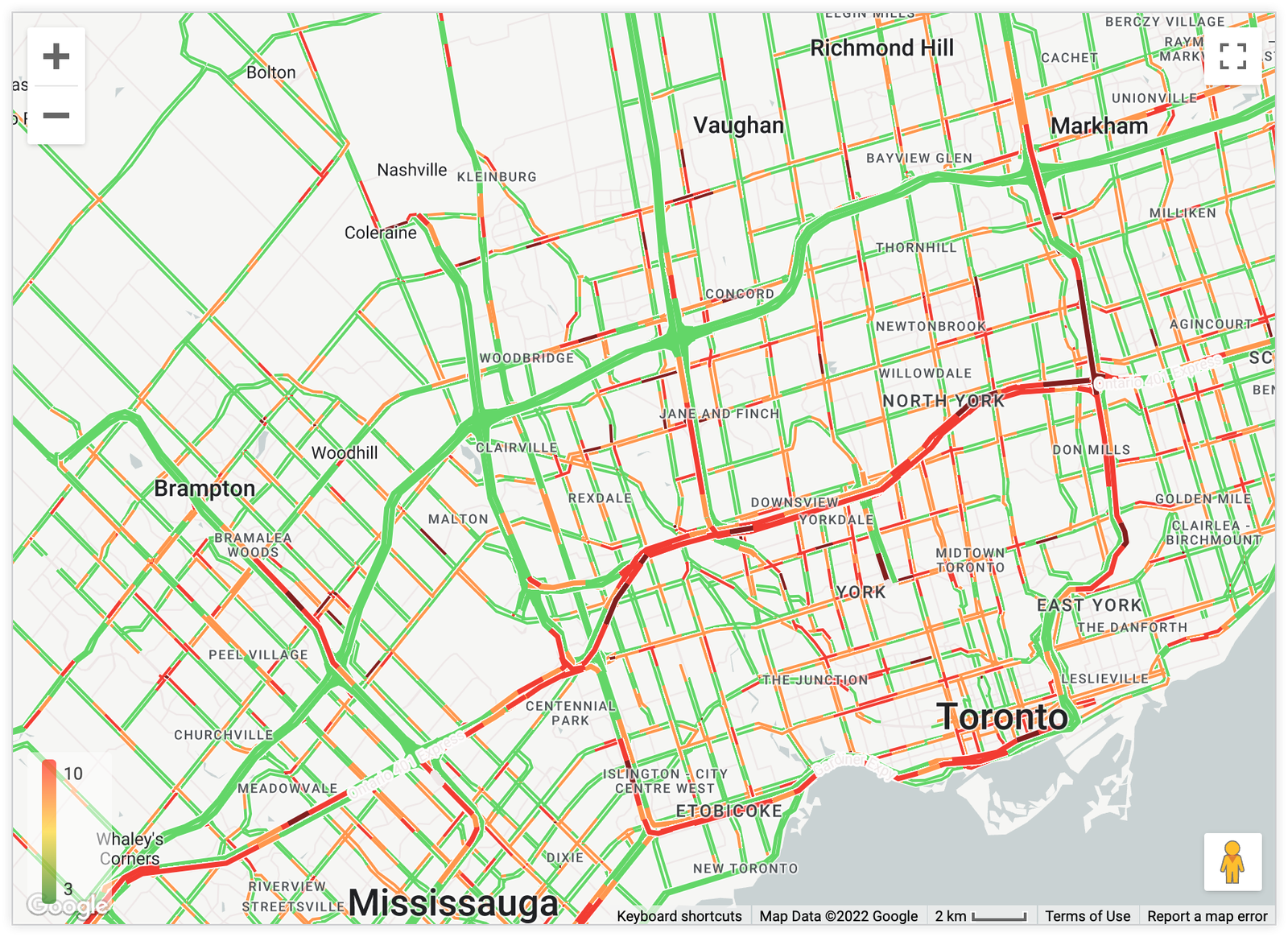
    In Google’s guide to its maps, there is a section on live traffic congestion, and in it, this image is used:

    It is a map of the Toronto region, and not surprisingly, it is showing traffic congestion on the 401 highway. But what’s interesting about this image is that there’s no traffic at all on the 407 express toll route. (This is the green highway running generally parallel and north of the 401, for those of you who aren’t familiar with Toronto.)

    This is, of course, accurate. A 2019 study by the Canadian Centre for Economic Analysis called the Economic Impacts of Highway 407 found that, at the time, an average of 413,000 drivers were using the 407 highway each weekday. And of these trips, more than 85% of vehicles were travelling at or above 100 km/h. This translates into a traffic congestion index of almost zero.

    During this same time, the highway 401 through Toronto showed that about 85% of vehicles were travelling below 50 km/h. Meaning, lots of congestion. This also had a significant impact on collision and fatality rates. On the 407, both were about half of what they were on the 401. (I couldn’t find any more decent data, but if you have it, please share it in the comments.)

    The reason for these differences is simple: the 407 charges for congestion. Here are the current per kilometer weekday rates for light vehicles travelling westbound:

    Naturally, there are people who think the 407 is too expensive and that it shouldn’t have been privatized. But the reality is that it works; really well in fact. And this is the only method that has been proven to reliably combat congestion. We can go ahead and spend a gazillion dollars building a new tunnel under the 401, and double the number of lanes (it’s already 18 lanes at its widest point), but we already know that it won’t solve our congestion problem.

    Either we price roads and congestion, or we don’t. But if we don’t, then we need to be brutally honest with ourselves about the economic trade off that we are making: free/underpriced roads = traffic congestion, and accurately priced roads and congestion = less traffic. The choice is ours. But know, there’s no such thing as a free lunch.

  • What happened in 2023

    As per tradition around here, I like to bookend the new year with two posts: a post that revisits my random predictions for the year and a post that talks about what might happen in the year to follow. Today’s post is the former. So let’s see how I did:

    • I thought the interest rate hikes would come to an end in Q1-2023. But that didn’t happen until the summer. I also thought this would lead to a mild recession in Canada. Technically, we are not actually in one, but according to some, we kind of are.
    • I thought the real estate sector would start seeing some distress in the first half of the year, and that a new equilibrium would be found in the second half. This proved to be overly optimistic in terms of timing. A lot ended up being on pause for the entire year, and I now think that my forecast was at least a year too early. The sea change is still underway.
    • Given the overall slowdown in real estate, I felt that construction costs had to see some softening. This did, in fact, happen with some of the “earlier trades”, such as shoring and excavation, and we did see some specific trade pricing, such as concrete formwork, come down by as much as 30%. The smart cost consultants we work with now expect to see overall hard costs come down by a further 5-6% next year in Toronto. This makes sense given construction starts are way down.
    • With me expecting the interest rate increases to stop in Q1, I thought that pre-construction condominium sales would return in a meaningful way by the spring. While we did see some buoyancy around that time, it was short lived. Sales remained nearly shutoff for the entire year, but for maybe a handful of projects. The more successful projects tended to be outside of the Toronto core and at lower price points.
    • With respect to home prices in more tertiary/fringe markets, my sense then, as it is now, was that these prices would remain below the peaks for many years. In addition to the upward momentum created by low rates, my view was/is that some of this pricing was the result of a bet on urban decentralization. I don’t think that has played out as many expected it to, so that’s why I think it will be many years before the pricing we saw in early 2022 returns.
    • The momentum around “expanding housing options” in our low-rise neighborhoods is many years in the making. And a lot of progress was made in 2023. Here in Toronto, we adopted new multiplex policies that now allow fourplexes plus an accessory dwelling (so 5 homes in total) on an as-of-right basis. I continue to believe that this momentum is only going to grow. I also think we will see the arrival of more mixed-use opportunities.
    • I believed that, broadly speaking, urban transit ridership would remain below pre-pandemic levels for all of 2023. This proved to be the case for most US and Canadian cities. But things are improving. For Canada as a whole, it looks like we’ll see full recovery sometime in 2024 based on this trend line.
    • I thought 2023 was going to be the year I took my inaugural ride in an autonomous vehicle. Sadly, this didn’t happen. The sector as a whole also saw some setbacks. Hopefully I’ll get a chance next year.
    • I assumed that Apple would finally release its augmented reality device. And though they didn’t technically release Vision Pro, they did announce it. So I guess that counts for something. I also thought that 2023 would be a big year for “phygital” goods. Maybe it was. Or maybe it was more of a building year. A lot of people are curious to see how Vision Pro does in 2024. It’s not set up for the mass market, just yet, but I think it will do exactly what it is supposed to once it’s out in the wild.
    • Finally, crypto. I know that a lot of you like to skip over these posts, but it is something that I feel strongly about. A year ago, though, I was pretty bearish on Solana. Boy was I wrong. Solana ended the year as the best performing major crypto asset — up 933% at the time of writing this. Oops! However, Ether is also +91%, and I continued to dollar-cost average in all throughout the year.

    Next up: What will, or more accurately, what might happen in 2024.

  • New York City is piloting about a dozen motion sensor cameras

    This won’t come as a surprise to many of you. But I recently attended a community meeting where someone was advocating for adding new lanes to a particular road. Their argument was that traffic congestion is forcing too many cars to sit needlessly idle and that that is bad for the environment. The proposed solution of adding new lanes would get traffic moving, reduce idling pollution, and therefore be overall better for the environment.

    I disagree entirely.

    But transportation planning seems to be one of those things that many people feel is intuitive. It’s one of those things where people feel confident saying, “I know how to fix this. We just need to do this.” But the reality is that cities are incredibly complex organisms and it’s not always obvious what should be done. So I think that a big part of making our cities better comes down to having much better data. And that’s why I’m very intrigued by the work that startup Viva, and others, are doing.

    Viva uses small street-light mounted cameras and machine learning to track urban mobility (see image above). Currently they track 9 different modes: pedestrian, bicycle, e-scooter, motorcycle, car, van, light truck, semi-truck, and bus. And after they collect this data, the relevant information is extracted and then everything else is deleted for privacy reasons. There are also plans to make this data openly available to the public so that people can use it and/or build on top of it.

    Obviously this is still going to raise privacy concerns and that is something that will need to be carefully addressed. But I do think that the data from a platform like this is going to be invaluable for cities. Among many other things, it will help us to better allocate space among the various modes and design much safer streets. Hopefully it can also help to take some of the politics out of these sorts of decisions: “Here’s the data. Take a look.”

    Viva currently has 1,000 sensors already installed in London (where they are being used to evaluate the impacts of congestion pricing), and about half a dozen in New York. So it’ll be interesting to see what this leads to. And who knows, maybe it will actually turn us all into amateur transportation planners. We’ll certainly have access to a lot more data.

    For more information on Viva, here’s their website.

    Image: Viva