Daily insights for city builders, delivered every morning at 6 AM ET. I’m Brandon Donnelly — a Toronto-based real estate developer and founder of Globizen. I’ve been writing here since 2013.
One way to define “brand” is that it is “the sum of how a product or business is perceived by those who experience it.” And it’s a pretty awesome construct when you stop to think about it. Because if I perceive one brand to be superior to another — which might just mean that it better matches my sense of self — then there’s a good chance I’d be willing to pay more for that brand.
And if I happen to own a brand that people perceive to be valuable, then I can also monetize this brand by lending it out to other people for money.
It is for this reason that in the world of real estate development there is something known as branded residences. Broadly speaking, it involves a pretty simple trade. Person 1 has a brand that lots of people perceive to be desirable. Person 2 has real estate that it is looking to sell, but it doesn’t have a brand with the same kind of cachet as person 1.
So what happens is that person 1 offers the following trade to person 2: pay me $X (upfront and/or over time) and then I will let you use my highly coveted brand to sell your real estate. And hopefully you won’t screw it up by doing weird things with it. (But other than this, person 1 isn’t really taking on much risk with this trade.)
Because person 2 believes that they’ll be able to sell their real estate for more money and/or faster than without the brand, it gladly accepts the trade. And as long as the benefit it gains is, in fact, greater than the cost of using the brand, it should be a good trade and both person 1 and person 2 should be happy with the outcome.
Now here’s an actual example. Earlier this month, the proposed Baccarat Hotel and Residences in Dubai set a new pre-construction pricing record when it sold a ~14,507 square foot apartment for 203.1 million dirhams (or US$55.3 million). For those of you who are wondering, this works out to be about US$3,812 psf.
Supposedly this is the most that anyone has ever paid for a new place in Dubai, and there’s a strong argument to be made that the developer got this pricing because it was a branded residence.
Let’s assume that you’re Mayor of your city and that, for whatever reason, you have no need to pander to voters. You’re a benevolent dictator. You can do whatever you think is best overall for the city and it will just happen. What would you do? This is more or less the question I asked on Twitter this morning, and I think it’s only fair that I answer my own question. So here is a non-exhaustive list of items that came to mind while thinking of Toronto:
Substantially increase the pay of public sector workers throughout the city and bonus them based on measurable outcomes. Forget things like time limits on development applications; instead align incentives. For example, if we’re trying to get more shovels in the ground on affordable housing, incentivize people based on building permits issued. I’ll never forget what Roger Martin told me while I was at Rotman. When he became Dean of the school, Rotman was a whatever business school that wasn’t faring all that competitively in the rankings. One of the problems he discovered was that the school’s professors were getting paid far less than those at Wharton, Harvard, Stanford, and so on. So if you were a star, why would you ever want to teach at Rotman? He immediately matched the salaries of those top-tier schools and then, not surprisingly, the top-tier talent arrived. You get what you pay for.
Immediately price roads and congestion, and direct, to the fullest extent possible, the funds toward transit and cycling infrastructure. At the same time, the planning and building of transit would be depoliticized. There would be a reccurring funding stream and a plan that we’re continually building out. Minimize protracted debates. Never stop building. There’s a lot of talk this mayor election about solving traffic congestion. I have yet to see a plan that will actually work. Accurately pricing congestion likely won’t be popular, but I can guarantee you that it will be highly effective.
Ensure that property taxes are sustainably covering the costs of operating the city and then, at a minimum, peg all future increases to CPI.
Make any new housing development less than 12 storeys as-of-right. That would mean, no rezoning process and no site plan approval; just straight to building permit.
Empower the private sector to build affordable housing through incentives and subsidies. Affordable housing isn’t feasible to build on its own, which is why nobody is doing it. Inclusionary zoning also won’t get us there. Make developers want to build it and they’ll do it.
Liberalize licensing and cut red tape to empower small entrepreneurs across the city in various industries. A perfect example in my mind is street food. Toronto is the most diverse city in the world with some of the best restaurants, and yet the only thing you can buy on the street is a stupid hot dog. If we empowered small entrepreneurs to setup shop on our streets, we would easily have the best street food scene in the world. And I am positive that there are countless other latent opportunities in this city that are being held back by dumb and archaic rules.
Focus on art, design, culture, and innovation as central pillars of Toronto’s brand. Miami is a good example of what this approach — along with favourable taxes and nice weather — can do for a city. I’ve said this before, but here’s just one example: Toronto is in many ways the birthplace of the cryptocurrency Ethereum. Why is nobody talking about this? Why are we not celebrating and leveraging this? It’s a missed opportunity. Broadly speaking though, I think just having and doing three things can be effective in promoting new ideas for these pillars: have reasonably affordable housing, be a city that young people want to live in, and remain open and tolerant to immigrants.
Stop thinking of the night-time economy as a nuisance and instead think of it as a powerful economic development tool. I recently responded to this “night economy survey” that the City of Toronto released and the obvious bias is that nighttime things are seen as a terrible nuisance. In other words, “tell us how do we make all of this less annoying for grouchy voters.” My response was to extend last call to 4am and to start thinking of it as an opportunity to draw in young people, tourists, and whoever else. This complements my previous point.
This is, again, a completely non-exhaustive list. But if I had to summarize the overall ambition, it would be to make Toronto a truly exceptional and remarkable city. We should never be happy with mediocrity.
We have been speaking about Nabr and the productization of housing for the last year (and, more broadly, about prefabricated housing for probably as long as this blog has existed). And now it is possible to go on to Nabr’s website and reserve a new home in their San Jose project. Here’s what that looks like:
What is immediately clear is that this is an obvious improvement over the way that new homes are typically purchased. The pricing is transparent. You can easily see the floor plan and features of each home. And if you’d like to reserve one, you can go ahead and do that right away for $1,000:
You can also specify whether or not you’re interested in Nabr’s lease-to-purchase program (known as LEAP). More information on that can be found, over here.
But the exciting question remains whether thinking about and executing on this new housing as a product, rather than as an individual project, will ultimately bring greater cost efficiencies and savings. In other words: can it make housing more affordable?
Today, the base pricing for SoFA One looks something like this:
Home 1002: $1,415,000, ~1080 sf (excluding exterior space), $1,310 psf
Home 1003: $2,144,000, ~1547 sf (excluding exterior space), $1,386 psf
Home 1108: $938,000, ~795 sf (excluding exterior space), $1,180 psf
These are just the first 3 homes that showed up for me when I opened the website. And while I’m not intimately familiar with the San Jose housing market, Realtor tells me that the median sold price is $1.2 million and that the median list price per square foot is about $766.
Though not really an apples-to-apples comparison, this suggests to me that the above pricing may not be as affordable as some people were hoping for. However, it is more or less where I figured pricing would need to be in order to make a high-rise project like this pencil.
Does this change over time with more product scale? I think it could.
The central bank tightening and interest rate hikes that we saw last year will come to an end in the first quarter of 2023 as inflation gets under control. This will ultimately lead to a recession but my sense is that it will be more mild than severe. For this reason, I don’t think anyone should expect ultra-low rates to return in the short-term.
Much of the real estate sector went on pause in the second half of 2022. But ultimately this reset to a more balanced market is going to be necessarily painful for some. And I think we will see that pain play out in the first half of the year. This will obviously be bad for some, but it will create opportunities for others.
Construction costs tempered in the second half of 2022 and started to show some evidence of price softening. I think we will see more of this in 2023, which will be healthy for the market. Cost management over the last few years has been a meat grinder for the development industry.
Pre-construction condominium sales for well-located projects will return in a more fulsome way by the spring. This will be driven by buyers now having clarity around where interest rates will be hanging out in the short-term and, in the case of Canada’s largest cities, by record-high immigration levels.
For the tertiary/fringe housing markets that saw big run ups in pricing during the pandemic, I unfortunately think it will take many years for prices to fully rebound. The price increases we saw in these submarkets were of course a result of low rates, but it was also driven by a view on urban decentralization that in my view did not actually materialize.
The desire to add more housing to single-family neighborhoods will continue to pick up steam across North America. How exactly this plays out will be market specific, but in Toronto I expect to see new planning policies put in place, as well as supportive building code changes.
Public transit ridership will remain below pre-pandemic levels throughout 2023. This will continue to exacerbate public finances.
Autonomous taxis will grow rapidly this year. Companies, such as Cruise, will expand into a number of new US markets and, at some point during the year, I will take my very first ride in an autonomous vehicle.
2023 will be a big year for augmented reality and “phygital” goods. Last year I thought Apple would release a new product in this space. That didn’t happen, but it will this year. At the same time, we will see more companies releasing products that blur the lines between our online and offline worlds (hence “phygital”). This will include NFTs and other crypto-related things that will start to operate more seamlessly in the background of consumer-facing products/services.
I continue to be bullish on Ethereum and I think it will overtake Bitcoin in terms of market cap in the next 2-3 years. But I was very wrong about Solana last year. And now I am struggling with its value proposition. Today, layer 2 chains such as Polygon feel more likely to win out. Broadly speaking, I suspect 2023 will be a positive year for crypto, but not a record-setting one.
In summary, I think we are going to see more pain at the beginning of 2023, but that on the other side of it will be healthier and more balanced markets. This means that we can look forward to the end of the year feeling much better than it does right now. All of this said, please keep in mind that I’m often wrong and that nothing in this post should be construed as actual advice.
In the wake of Bill 23, there has been a lot of discussion and concern around development charges and parkland dedication revenues. At a high level, the concern is that the proposed changes will reduce the amount of money that cities are able to collect from developers, and that this will exacerbate any existing funding shortfalls and possibly force municipalities to do things like raise property taxes. In the case of Toronto, the estimated figure is about $230 million of lost revenue per year.
For all intents and purposes, this is objectively true. Bill 23 includes changes that will reduce the amount of revenue that cities are able to collect when new stuff is being built. Here is one such example:
New sections 4.1, 4.2 and 4.3 provide, respectively, for exemptions from development charges for the creation of affordable residential units and attainable residential units, for non-profit housing developments and for inclusionary zoning residential units.
This makes for great headline fodder: “Bill 23 is bad, it is going to reduce city revenues by $X million, your property taxes may need to go up, so you should be deeply upset about this.” Hmm. We should talk about this. I’m not going to suggest that Bill 23 is entirely perfect. But I do think it is important to consider two important facts when it comes to things like development charges.
Firstly, the above exemption (to use just one example) is specifically related to affordable and attainable housing. It is not a reduction in DCs for the sake of reducing DCs. It is an attempt to recognize that we need more affordable/attainable housing and so maybe we should do things that make it easier and less costly to build it. And this brings me back to a point that I frequently make on this blog, which is that we can talk all we want about the need for more affordable housing, but at the end of the day it comes back to this: Who is going to pay for it? There is no such thing as a free lunch.
The common rebuttal to exemptions like this is that developers will always profit maximize and price their housing at the most the market will bear. In other words, there is no evidence that developers will pass on any cost savings to the end consumer. But this is not entirely true. For developers, pricing a project is typically a cost-plus exercise: how much is this going to cost to build and what do I need in revenue in order to hit my required returns?
When costs go down, it reduces what you need to make a project feasible. This in turn reduces developer risk, because there is always a very real question of absorption. The more you push pricing, the more you slow market absorption. So you might actually be better off selling for less, more quickly. An example of this line of thinking is when condominium developers choose to sell 100% of their inventory upfront as opposed to holding some back with the expectation that prices will increase in the future. Doing this means that you value certainty over profit maximization.
Development charges are fees collected from developers at the time a building permit to help pay for the cost of infrastructure required to provide municipal services to new development, such as roads, transit, water and sewer infrastructure, community centres and fire and police facilities.
Put differently, development charges are based on the idea that growth should pay for growth. When you build something new you create additional servicing demands, and so developers should pay for whatever incremental needs their projects are creating. This is, of course, fair. However, it is not the intent that growth pays for existing services. i.e. Ones that would be required regardless of whether there was the presence of development.
So in theory, if new development were to shut off entirely and if development charge revenue were to go to $0, there shouldn’t be any issues funding the existing services. And in theory, nobody should be complaining about this lost revenue, because there is actually no need for this additional revenue. There is no growth to fund and all existing services are being adequately funded by the residents who are already there and using them.
Of course, not all city services are self sustaining. Public transit, for instance, typically requires subsidies. Ridership fares aren’t enough to pay for operations, and this shortfall got understandably a lot worse during the pandemic. But is this a growth-related problem or is it an existing-resident problem? I mean, technically the problem is notenough riders. So isn’t that kind of the opposite of growth related? More people would be a benefit right now.
In any event, the point I am raising today is that there is a right way and a wrong way to complain about lost development charge revenue. The wrong way is thinking, “ah, this lost revenue is going to impact my quality of life and the existing city services that I enjoy. I may have to pay higher property taxes.” The relevant points for this particular discussion should not be that there’s an operating budget shortfall or that existing taxpayers maybe can’t afford to pay.
The more valid way to complain would be to say, “hey, these reduced development charges are going to make it difficult to fund the growth-related upgrades needed to support new and more housing in my community. And we need more housing!” Because if the concern is not actually this second one, then the headlines are a great big red herring. We have a larger financial problem on our hands that we are not speaking about.
Yesterday I made a comment on Twitter about most people not understanding to what extent government bureaucracy inhibits the delivery of new housing in this city. It received a number of responses, including remarks about how development charges have also recently doubled and how this statement applies to pretty much every city out there. But there was also a comment about developers not being transparent and not properly explaining the impact to the public. In other words: please demystify the development pro forma. I thought that was a fair remark, and so this post is going to be a response to that comment.
Before I begin, it’s important to keep in mind that most developers have investors. These investors put up most of the money required for a project and in turn they take most of the profits. However, there is typically a “promote” in place, which is just an incentive structure that pays the developer more of the profits (disproportionate to the cash they invested in the project) if they perform and hit certain return benchmarks. All of this is to say that developers aren’t usually the ones holding all of the cash (which is what a lot of the public seems to think) and they are accountable to their investors to do what they said they would do.
Now let’s run through the costs that make up a “typical” development pro forma. For this example, I am going to assume that we’re talking about a 100,000 square foot mid-rise building; the kind that you might build and find along any one of Toronto’s Avenues. If we were doing this in real life, we would get more precise with the areas and consider gross construction area, gross floor area (city definition), and the net saleable/rentable areas. But to keep the math simple, we will ignore these differences. That’s the approach I’m going to take overall in the post. What you need to know, though, is that you have to pay to build the entire building, but you only get to collect revenue on a portion of it. That’s why the “efficiency” of a building matters.
Land
The value of development land is a function of what you can build and the revenue you can ultimately collect. So location matters a great deal. Based on the latest high-density land report from Bullpen and Batory, the average price of an unzoned mid-rise site in the City of Toronto is about $231 psf. So let’s assume a land cost for our project of $23.1 million. Assuming we can get land financing at 60% of the value of the land (loan-to-value), that would mean we’re putting up $9.24 million of cash (plus a loan guarantee!) and borrowing $13.86 million to start our project. At 5.25% per annum (interest-only loan), our annual interest charges would be about $727,650. From now on forward, we’re going to pay ~$60k in additional interest charges for every month that our project is delayed. Buckle up.
You should now begin to see why time is so valuable and why government bureaucracy can be so frustrating. As a developer, you’re heavily incentivized to move things forward, whereas it can often feel like everyone around you is trying to deliberately erect roadblocks in order to slow you down and make your project more expensive to build. Oftentimes, it is because it is less risky for them to punt things down the road and not make a decision. That is not the case for us and our project.
Hard Costs
Onto construction (or hard) costs. As many of you know, these have risen dramatically over the last 4 to 5 years. On some of our projects, we have added over $100 psf in hard costs alone. Part of this has to do with a busy construction market and part of this has to do with new building requirements: watertight undergrounds, new Green Standards, and so on. For our project, which is on the small side, let’s assume $360 psf for a total of $36 million. This would include our direct construction costs and our construction manager’s overhead (general conditions). We should also prepare for some of the trades to decline to bid on our project because it is too small and not worth their time.
Soft Costs
Soft costs include everything from consultant costs and interest charges to government levies and management fees. Like everything in your pro forma, these absolutely need to be broken out line by line. Don’t be lazy here. But for the purposes of this simplistic example, we’re going to use 75% of hard costs, which works out to be $27 million (or $270 psf). When I first started out in the development business, the rule of thumb was closer to 25% of hard costs. But times have changed. Government fees, alone, can make up about 1/4 of the price of a new condo in Toronto.
Adding up all of these costs, we’re at $861 psf or $86.1 million in costs. It’s now time to consider the revenue side. $1,000 psf seems like a nice round number, so let’s start there and assume we’re going to sell our condos for that. Typically in Toronto, the price you pay is inclusive of HST, so that liability will need to be deducted from our revenue line. It’s not a straight 13% because of the new home rebate, but the rebate also hasn’t been properly indexed since it was introduced and so the liability could still be upwards of 10%. (This is worthy of a separate blog post.) The result is $900 psf in revenue and a margin on costs that is less than 5%. No sensible developer would want to do this project. One misstep (or development charge increase) and you’re dead.
So let’s increase our condo prices to $1,100 psf. Maybe that will work. In doing that, we get to a margin on costs that is nearly 15%. Okay, now we’re in the range. But let’s say we just got delayed by 6 months (boom, interest charges) and our hard costs turned out to be off by $15. They’re actually working out to be $375 psf because of some new tariff and because the formworkers in the city are all tied up on bigger projects and couldn’t give a shit about our cute little infill project. Now we’re offside again in terms of our margin on costs. No problem, let’s try and push condo prices a bit more. Is $1,150 achievable? Perhaps. But ideally, given the above, we would want to be at $1,200 psf just to be safe.
This is an overly simplistic example of the math that goes into a development pro forma. But hopefully it begins to show you (1) just how many moving parts there are in a development project and (2) the kind of pricing that is required in today’s cost environment. Developers are reacting to the costs that they are being thrown and it is creating upward pressure on home prices. (See related post: Cost-plus pricing.) So far there has been enough elasticity in the market to absorb these price increases, but that may not always be the case. If you have questions about this post or disagree with any of my assumptions, feel free to leave a searing comment below.
This past Monday, Tesla held an event for its investors called “Autonomy Day.” It was livestreamed, but if you missed it, here’s the video. It’s almost 4 hours long, though the first hour is just footage of Tesla vehicles driving around. I’m assuming it was background content.
I’ll be honest in that I haven’t watched it all. But there’s a lot here if you want to get into the inner workings of how their self-driving cars work. Musk also promises, at the event, that Tesla will have level 5 autonomy ready by the middle of next year (2020). At that level, you will no longer need to pay attention to the road as a driver.
Along with this autonomy, the company plans to start rolling out “robotaxis” and a ride-hailing app that will allow owners to rent out their cars. Musk is predicting that this could generate upwards of $30,000 in profit per year for owners. Of course, at this point, nobody really believes any of these promises. Musk is notorious for overselling.
But let’s imagine that robotaxis are the future. Maybe it won’t happen by the middle of 2020. But it will happen at some point.
If taxis are automated machines that drive people around all day and then go and park somewhere during off-peak times, where do they want to go and park? Does autonomy all of a sudden disconnect the locations of owners and parking, because your car will simply come to you when you need it?
And what do these feature mean for parking supply? Presumably (and we have talked about this before on this blog), you need less parking and it wants to be in locations where the real estate values are less. But because of this, I bet that we’re going to need to start — and get really good at — pricing road usage.
I am reading up on a few different things this morning.
Southwest Florida, which is where I am right now, is in the midst of a “red tide” that began last November. These happen fairly regularly along the Gulf Coast, but this one is high up on the severity scale. There doesn’t appear to be a clear explanation for what causes them, but sustained warmer temperatures and fertilizer and other pollutant runoff are thought to stoke it. Whatever the cause, they are devastating to the environment. We are switching coasts tomorrow morning.
Portland now has electric scooters. (Why don’t we have these in Toronto?) But to combat possible concerns around urban clutter, the company, Bird, has committed to collecting all of its scooters each night and has agreed to remit $1 per scooter per day to the city. These scooters are pissing off some cities (or maybe it’s just San Francisco), but I still believe the problem will eventually get resolved. City Observatory also has this interesting piece where it compares the above scooter pricing to car pricing. Are we underpricing cars?
Finally, here is a short film on civic security in Paris. In an effort to mitigate terrorism, the city has, of course, been implementing and erecting fencing, barricades and other reactive security measures. But sadly, now that this has become a new reality, the capital is spending more time considering how these measures could be more thoughtfully designed. The video showcases some of them. Certainly a more deliberate approach, but are they just as reactive?
Maybe one of these topics will be of interest to you too.
Stockholm has a congestion charge that is used to reduce traffic volumes in the center of the city. Toronto does not. We looked at it, actually fairly recently, but then we lost our nerve.
Stockholm’s congestion charge was first implemented on a trial basis starting in January 2006. Trials and pilots have become a common way to actually create positive change. Otherwise the status quo bias may simply be too strong.
When Stockholm started the trial back in 2006, public support was very low. Maybe 30%. But as soon as it was implemented, car trips dropped overnight by 20%. Once people saw the benefits, support grew – hitting around 70% by 2011.
Here is a brief Street Films video with Stockholm’s Director of Transport, Jonas Eliasson, talking about their experience with congestion pricing. If you can’t see the video below, click here.
Ontario is looking to pass legislation that would allow municipalities in the province to implement something known as inclusionary zoning. If passed and should municipalities decide to use this tool (Toronto almost certainly would), developers would then be required and/or incentivized to include some percentage of affordable housing in their new market rate developments.
Politically, inclusionary zoning tends to be popular. It’s believed to be a way for governments to create new affordable housing using relatively small public subsidies. Not surprisingly though, the development industry generally hates IZ. It’s another cost that needs to be added to the development pro forma – though some municipalities rightly offset these additional costs with additional density, breaks on levies, and so on.
What I always think about when this topic comes up is the broader economic impact of the land use policy. Because I’m suspect that it’s as simple as: mandate affordable housing; get more affordable housing for free. Generally there are always trade-offs.
So here’s some reading material for you all this morning.
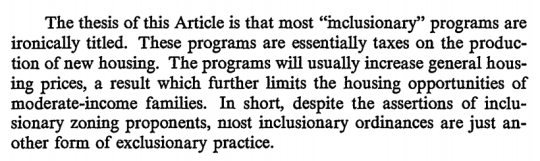
In a classic paper (1981) by Yale Professor Robert C. Ellickson – called The Irony of Inclusionary Zoning – he argues that these practices can actually increase general house prices:
As a counterargument Owen Pickford over at The Urbanist argues that IZ simply reduces land prices as a result of the new tax. Land, after all, is the residual claimant. Therefore, he believes it’s an effective affordable housing policy. (I’m not so sure I believe that land prices would decrease in practice.)
There’s also debate about the effectiveness of inclusionary zoning to actually deliver affordable housing at a meaningful scale. City Observatory wrote a post that looked at the total number of units produced (through IZ) across a number of American cities and the results were spotty. It should, however, be noted that not all inclusionary zoning policies are mandatory.
Finally, the Furman Center for Real Estate & Urban Policy at New York University published a housing policy brief back in 2008 that looked at this exact topic. While they admit that the data is scarce, they come to the conclusion that IZ had no meaningful impact on the prices and production of single-family housing in San Francisco, but that IZ seems to have slightly decreased production and slightly increased pricing in the suburbs of Boston.
What this last point suggests is that inclusionary zoning policies are not all created equal. So like all difficult questions, the answer to this one is likely: it depends. If anyone can point me to better data on inclusionary zoning, I would love to see it.